
Views: 295 Author: Eyunhome Vacuum Publish Time: 2026-10-27 Origin: Site


Content Menu
● 2200mAh vs 2500mAh vs 3000mAh Vacuum Batteries: Quick Comparison
● What Does mAh Mean for a Cordless Vacuum Battery?
>> Cell Capacity vs Complete Battery Pack Capacity
● How Much Longer Will Each Vacuum Battery Last?
>> Illustrative Runtime at the Same Power Consumption
● Does a 3000mAh Battery Provide Stronger Suction?
>> Why Discharge Capability Matters
● Which Battery Capacity Fits Your Vacuum Product?
>> 2200mAh Vacuum Batteries: Task-Focused Product Positioning
>> 2500mAh Vacuum Batteries: A Middle-Capacity Option
>> 3000mAh Vacuum Batteries: Longer-Runtime Positioning
● Charging Time, Battery Aging, and Replacement Compatibility
>> Will a 3000mAh Battery Take Longer to Charge?
>> Does Higher Capacity Mean Longer Battery Life?
>> Can Customers Upgrade from 2200mAh to 3000mAh?
● A Practical OEM/ODM Battery Validation Protocol
>> 1. Define the Cleaning Task
>> 2. Control the Test Conditions
>> 3. Measure Runtime and Cleaning Performance Together
>> 4. Repeat Across Multiple Samples
>> 5. Recheck Performance After Aging
● A Better Commercial Metric: Cost per Usable Cleaning Minute
● What to Specify in Your Vacuum Battery RFQ
● Choosing a Battery with Ningbo Eyunhome
>> Is 3000mAh Better Than 2200mAh for a Vacuum?
>> How Much More Runtime Does 2500mAh Offer Than 2200mAh?
>> Can a 2500mAh Battery Outperform a 3000mAh Battery?
>> Does More mAh Increase Vacuum Suction?
>> Should Buyers Compare mAh or Wh?
>> Are These Battery Capacities Relevant to Corded Vacuums?
Comparing 2200mAh vs 2500mAh vs 3000mAh vacuum batteries starts with a simple question: how much cleaning time does your customer actually need? A larger capacity can extend runtime, but it does not automatically deliver stronger suction, faster charging, or a better cordless vacuum.
For distributors, retailers, and appliance brands, the right battery must balance usable energy, discharge capability, weight, cost, and replacement support. At Ningbo Eyunhome Electric Technology Co., Ltd., our OEM/ODM vacuum solutions serve different product requirements. Battery selection should therefore begin with the intended cleaning task—not simply the largest number on the packaging.
This guide compares all three capacities, explains their practical limitations, and provides a purchasing framework for cordless upright and handheld vacuum projects.

The following comparison assumes identical nominal voltage, comparable cell quality, the same vacuum, and equivalent operating conditions. Application suggestions are positioning recommendations, not guarantees of performance.
| Comparison point | 2200mAh battery | 2500mAh battery | 3000mAh battery |
|---|---|---|---|
| Rated charge capacity | 2.2Ah | 2.5Ah | 3.0Ah |
| Capacity relative to 2200mAh | Baseline | Approximately 13.6% higher | Approximately 36.4% higher |
| Illustrative energy at 21.6V | 47.52Wh | 54Wh | 64.8Wh |
| Potential positioning | Entry-level cordless cleaning | Balanced everyday cleaning | Longer-runtime positioning |
| Main purchasing question | Does it complete the target task? | Is the runtime gain worth the quotation difference? | Does usable runtime justify the premium? |
| Important limitation | Less energy at equal voltage | Moderate rather than dramatic capacity increase | Capacity alone does not establish power capability |
The central principle is usable energy: compare the energy a complete battery pack can safely deliver under the vacuum's actual load.
Milliamp-hours, abbreviated as mAh, describe electrical charge capacity. A 3000mAh battery has a nominal capacity of 3Ah.
However, mAh does not describe energy unless voltage is also known.
For a more meaningful comparison, use:
Nominal energy (Wh)=Nominal voltage (V)×Capacity (Ah)
A 21.6V, 2200mAh pack contains 47.52Wh of nominal energy. An 18V, 2500mAh pack contains 45Wh. Despite its higher mAh rating, the second pack has less nominal energy.
Pack configuration also matters.
Six 3.6V, 2500mAh cells connected in series produce a nominal 21.6V, 2500mAh pack—not a 15,000mAh pack. Series connections increase voltage; parallel connections increase capacity.
Ask suppliers to identify:
- Cell manufacturer and model.
- Series and parallel configuration.
- Nominal pack voltage and watt-hours.
- Minimum versus typical capacity.
- Capacity measurement conditions.
Without these details, apparently comparable battery specifications may describe substantially different products.
Under equivalent conditions, the nominal capacity differences are:
- 2500mAh vs 2200mAh: approximately 13.6% more capacity.
- 3000mAh vs 2500mAh: 20% more capacity.
- 3000mAh vs 2200mAh: approximately 36.4% more capacity.
These percentages indicate potential runtime differences, not guaranteed cleaning times.
The table below assumes a 21.6V pack and a constant 120W electrical load.
| Battery capacity | Nominal energy | Ideal calculated runtime |
|---|---|---|
| 2200mAh | 47.52Wh | 23.8 minutes |
| 2500mAh | 54Wh | 27.0 minutes |
| 3000mAh | 64.8Wh | 32.4 minutes |
Calculated runtime equals nominal watt-hours divided by watts, multiplied by 60.
These are mathematical examples, not Eyunhome product test results. Actual runtime can be shorter because nominal energy is not always fully accessible under operating load.
Voltage sag, battery protection thresholds, temperature, motor control, and accessory consumption all affect the result. Different cleaning modes can change it substantially.
For purchasing decisions, request measured runtime on the actual vacuum and attachment combination you intend to sell.
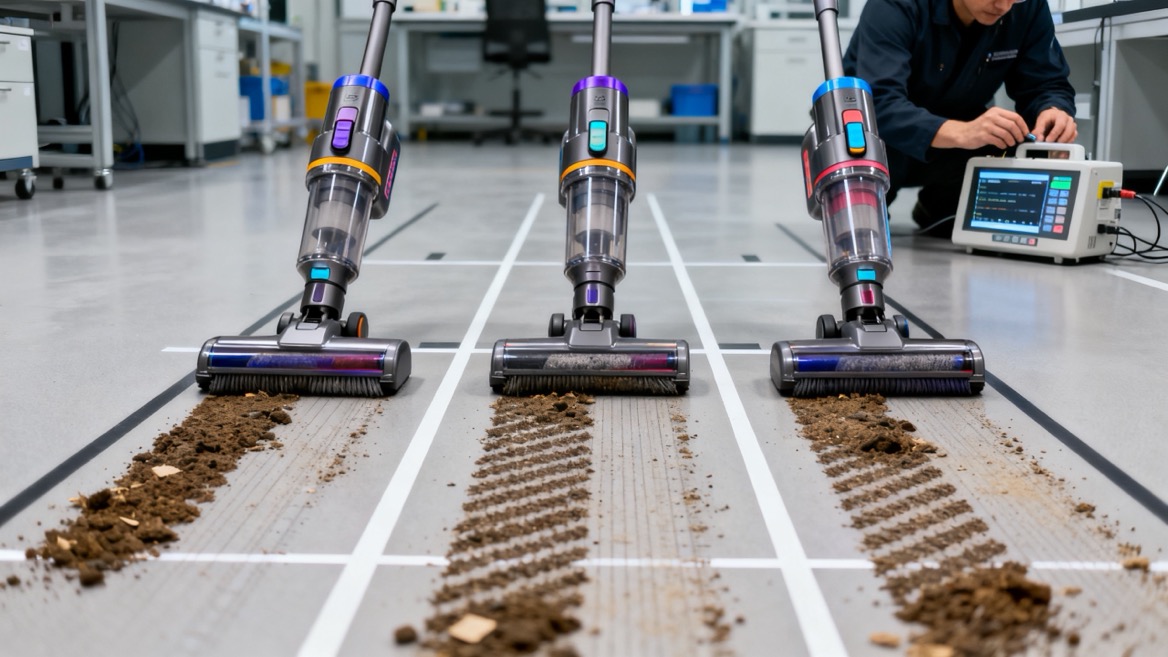
Not automatically.
Suction performance depends on the complete system: motor, fan, airflow path, seals, filters, brush head, and electrical controls. Battery capacity mainly describes stored charge.
A higher-capacity battery may sustain operation longer, but stronger suction requires sufficient electrical power and an efficient cleaning system.
High-power appliances need cells that can supply the required current safely.
For example, Samsung's INR18650-25R specification lists 2500mAh nominal capacity and a maximum continuous discharge of 20A under its stated conditions. Molicel lists its 3000mAh INR-18650-P30B cell with a 36A discharge rating.
These examples demonstrate that capacity and power capability must be evaluated separately. They do not establish that either cell is installed in an Eyunhome product, nor do cell-level ratings become complete-pack ratings automatically.
A battery pack must also account for its protection electronics, connections, wiring, enclosure, and thermal conditions.
A 2200mAh pack can be appropriate when the target task is short and clearly defined.
Potential applications include:
- Handheld spot cleaning.
- Car-interior maintenance.
- Small-area cleaning.
- Entry-level cordless product ranges.
The commercial question is whether the product completes the intended task at an acceptable price.
Do not assume a 2200mAh pack is necessarily smaller, lighter, or cheaper. Those outcomes depend on the selected cells, pack design, and supplier quotation.
A 2500mAh pack offers a moderate capacity increase over 2200mAh without moving directly to 3000mAh.
It is worth evaluating for everyday cordless vacuum ranges where buyers want additional runtime but remain sensitive to the complete product price.
However, a 13.6% capacity increase may not produce a noticeable improvement for every customer. Validate the difference in minutes under relevant cleaning conditions before turning it into a selling point.
A 3000mAh pack provides the most nominal charge capacity of these three options.
It can support longer-runtime positioning when its discharge capability, thermal behavior, and pack integration match the appliance.
The trade-off should be assessed through actual quotations and tests. Higher capacity does not inherently guarantee longer service life, faster charging, or better ergonomics.
With equivalent charging conditions and the same charging current, a larger-capacity battery generally requires longer to recharge.
However, lithium-ion charging includes a constant-current phase followed by a constant-voltage phase, during which current tapers. Dividing capacity by charger current does not give a reliable full-charge time by itself.
Compare charging times using the approved charger, the same starting charge level, and the same temperature conditions.
Never select a charger solely because its connector fits.
No. Runtime per charge and service life are different measurements.
Battery aging depends on factors including temperature, charging voltage, discharge intensity, storage conditions, and cell design.
For procurement, request cycle-life results that identify:
- Test temperature.
- Charge and discharge rates.
- End-of-discharge voltage.
- Capacity-retention threshold.
- Whether testing covered individual cells or complete packs.
"Long-lasting battery" is not a useful purchasing specification without these conditions.
Only when the replacement pack is explicitly approved for the specific vacuum.
Compatibility involves voltage, charging requirements, connector arrangement, protection functions, physical fit, and sometimes communication with the appliance.
Matching capacity—or matching the external shape—is insufficient. Replacement guidance should identify approved pack models rather than encourage customers to modify packs or replace individual cells.
A strong comparison tests complete products under controlled conditions. The following protocol is a proposed procurement framework, not a claim about completed Eyunhome testing.
Specify floor type, debris, cleaning mode, accessory, and expected task duration.
A handheld vacuum used intermittently in a vehicle should not be evaluated using the same customer scenario as an upright vacuum cleaning multiple rooms.
Use comparable charge states, ambient temperatures, filters, dust bins, and attachments.
Record differences rather than assuming samples are identical.
Log operating time, pack voltage, temperature, and electrical consumption.
Also measure cleaning performance. A long runtime is less valuable if useful pickup declines substantially during the test.
One sample can reveal a problem, but it cannot establish production consistency.
Agree on sample quantity, acceptance limits, and reporting format before approval.
Compare fresh and cycled packs under the same procedure. This helps distinguish attractive initial specifications from performance that remains useful over time.
Capacity alone does not reveal procurement value.
A practical internal metric is:
Cost per cleaning minute=Battery pack purchase price/Measured runtime
For illustration, suppose one pack costs 10 purchasing units and provides 20 minutes of measured runtime. Its cost is 0.50 units per minute.
A second pack costing 12 units and delivering 27 minutes costs approximately 0.44 units per minute.
The more expensive pack provides better value by this narrow metric.
This is a hypothetical calculation, not a market quotation. It excludes warranty costs, replacement availability, charging time, shipping, and product margins.
For a fuller decision, combine runtime value with expected warranty exposure and service support. A lower purchase price can become less attractive when replacement packs are difficult to source.
A detailed request for quotation helps prevent misleading comparisons.
| RFQ item | Information to request |
|---|---|
| Electrical specification | Nominal voltage, Ah, Wh, cell model, pack configuration |
| Power capability | Continuous and peak current limits with conditions |
| Runtime | Mode, attachment, surface, temperature, and cutoff definition |
| Charging | Approved charger, charge time, operating limits |
| Protection | Overcharge, overdischarge, overcurrent, and temperature safeguards |
| Durability | Cycle-test method and capacity-retention criteria |
| Service | Warranty terms, replacement-pack identification, supply arrangements |
| Verification | Applicable safety documentation and transport test records |
For market-specific requirements, confirm the applicable documentation with qualified compliance specialists. A cell datasheet alone does not establish compliance of the finished vacuum.
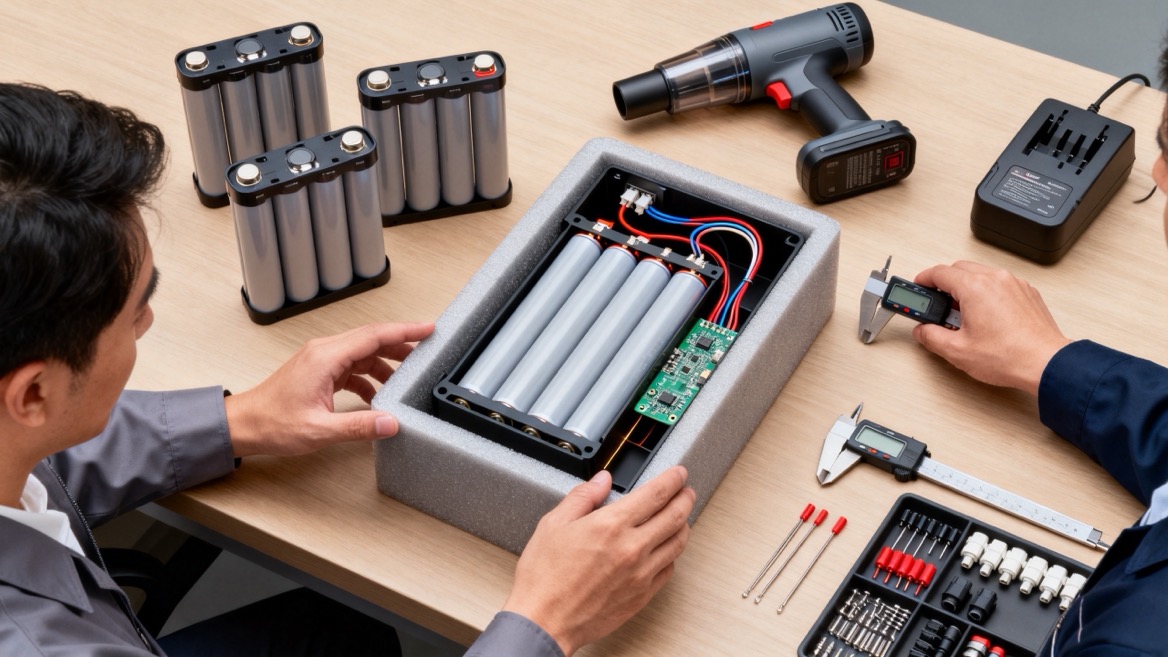
At Ningbo Eyunhome Electric Technology Co., Ltd., we offer upright, handheld, corded, and cordless vacuum solutions with OEM/ODM services, production support, and after-sales assistance.
For cordless projects, the useful starting point is a clear product brief: target market, cleaning task, runtime objective, suction requirements, price positioning, and replacement strategy.
Send our team your requirements and request a model-specific comparison of available 2200mAh, 2500mAh, and 3000mAh configurations. Ask for confirmed specifications, sample-testing conditions, charger details, and after-sales arrangements before approving a configuration.
The right choice is the battery that meets your customer's cleaning needs consistently—not simply the one with the highest printed capacity.
At equal voltage, 3000mAh provides approximately 36.4% more nominal charge capacity. It can extend runtime, but suitability still depends on discharge capability, compatibility, and complete-product testing.
The nominal capacity difference is approximately 13.6%. Actual runtime improvement depends on usable energy, load, temperature, and protection thresholds.
Yes, under some conditions. A suitable high-power 2500mAh pack may maintain operation better than a 3000mAh pack that cannot meet the appliance's current demand.
Not directly. Suction depends on motor power, airflow, sealing, filtration, and electrical control. Higher capacity primarily increases the available charge.
Compare watt-hours when pack voltages differ. Also review discharge capability and measured runtime, because nominal energy alone does not establish real cleaning performance.
Not for the main power supply of a conventional mains-powered vacuum. This comparison primarily concerns cordless products that use rechargeable battery packs.
1. Samsung SDI. *INR18650-25R: Lithium-ion Rechargeable Cell Product Specification.* Manufacturer specification hosted by Battery Junction; covers capacity, discharge current, voltage limits, and test conditions. [files.batteryjunction]
2. Molicel. *INR-18650-P30B (Low Impedance).* Manufacturer product information covering nominal voltage, typical capacity, and discharge rating. [molicel]
3. Battery University. *BU-501a: Discharge Characteristics of Li-ion.* Explains differences between energy-oriented and power-oriented cells and their behavior under load. [batteryuniversity]
4. Battery University. *BU-409: Charging Lithium-ion.* Explains constant-current/constant-voltage charging, charge termination, and charging-time considerations. [batteryuniversity]
5. Battery University. *BU-808: How to Prolong Lithium-based Batteries.* Discusses temperature, charge level, cycling conditions, and capacity degradation. [batteryuniversity]


