
Views: 263 Author: Eyunhome Vacuum Publish Time: 2026-09-27 Origin: Site


Content Menu
● Choose the Right Vacuum Format First
● Match the Floor Head to Your Floors
>> Hard Floors: Check Large-Debris Pickup
>> Carpets: Look Beyond Motor Claims
>> Pet Hair: Test Pickup and Maintenance
● Read Battery Claims in Context
>> Battery Replacement Affects Ownership
● Evaluate Filtration as a Complete System
● Check Ergonomics Before Buying
● Look Past Peak Suction Numbers
>> Request a Model-Specific Evidence Pack
>> Turn User Feedback Into a Product Brief
● Discuss Your Next Vacuum Program
>> Is a cordless vacuum good enough as my only vacuum?
>> Which cordless vacuum head is best for hard floors?
>> How much cordless vacuum runtime do I need?
>> Does a HEPA filter mean the whole vacuum is sealed?
>> What should pet owners prioritize?
>> What should importers ask a manufacturer before ordering?
>> Are replacement batteries always available?
A cordless vacuum cleaner should make daily cleaning easier, not leave you with a tangled brush, a dusty exhaust, or a battery that runs out halfway through a room. This cordless vacuum buying guide explains how to compare floor heads, real-world runtime, filtration, handling, and long-term ownership. It also gives retailers and importers a practical way to evaluate a cordless vacuum cleaner manufacturer before committing to an OEM or ODM program.
The key is to judge a complete cleaning system, not a single headline specification. A powerful motor cannot compensate for a floor head that pushes cereal across tile. A high-efficiency filter cannot contain dust if air escapes through gaps around the bin. And a long advertised runtime says little about performance with a powered brush on carpet.

Cordless stick vacuums suit quick floor cleaning, stairs, and homes with limited storage. A detachable handheld unit can extend their usefulness to upholstery, shelves, and car interiors. But convenience has limits: compact bins need frequent emptying, and high-power operation shortens battery life.
A corded upright may be a better primary machine for a large, heavily carpeted home or frequent, uninterrupted cleaning. A small handheld vacuum may be more practical for crumbs and car seats than a full-size stick. Before comparing prices, decide which job the product must do most often.
| Main cleaning need | Format worth considering | Priority feature | Trade-off to check |
|---|---|---|---|
| Hard floors and quick daily pickup | Cordless stick | Effective hard-floor head | Roller cleaning and storage |
| Mixed floors | Cordless stick with a versatile head | Debris pickup and carpet agitation | Head changes or added weight |
| Deep carpet cleaning | Corded upright or proven cordless model | Verified carpet performance | Size, noise, or runtime |
| Cars, stairs, and furniture | Handheld or detachable stick | Comfortable grip and useful tools | Smaller bin and shorter sessions |
A low front edge can create a strong seal, but it may push larger crumbs forward rather than let them enter. A soft roller often handles fine dust and larger debris well on sealed hard floors. Check whether you can remove and clean it easily, especially if hair or grit collects around its ends.
If your home has rugs, confirm that the head works on them. Do not assume a hard-floor-only roller will agitate carpet effectively. When a vacuum comes with two heads, ask whether changing them during a normal clean is realistic.
On carpet, brush agitation, airflow at the cleaning head, and head-to-floor contact all matter. A design that performs well on tile may struggle with embedded grit. Look for a repeatable carpet test, not just a demonstration of surface crumbs disappearing.
In one independent reviewer's test series covering more than 100 cordless machines, the average carpet deep-cleaning result was 93%, versus about 98% for corded machines under that reviewer's assessment. These are results from one test program, not universal ratings. The useful question is whether the specific model can clean your carpet—not whether it advertises strong suction.
Picking up visible pet hair is only half the job. Long strands can wrap around the brush, collect near bearings, or block the air path. For a pet-focused model, inspect the brush after repeated passes with both short fur and long hair. Test the mini motorized tool on upholstery as well as the main floor head.
A larger bin may reduce interruptions, but it will not fix awkward emptying. Look for a release mechanism that lets users dispose of debris without pulling hair out by hand.
Advertised maximum runtime commonly reflects the lowest power setting. What matters more is how long the vacuum cleans on the setting and with the floor head you will actually use. Ask for results with the powered head attached, on both hard floor and carpet where relevant. Compare low, normal, and boost modes under stated conditions.
Vacuum Wars reports an approximately 44-minute average on low power among the cordless machines it evaluated. As a rough guide, it suggests that a machine claiming 60 minutes on low may deliver around 30 minutes on medium and 10 minutes on maximum power. Those are observations, not promises for any individual model. An efficient normal setting may be more useful than an impressive peak-power figure.
Check whether the battery can be replaced, whether compatible spares are actually sold, and how customers obtain them. Replacement access matters when battery capacity declines. If a bundle includes two batteries, also confirm charging time and charger compatibility.
For products intended for the EU, review battery design early. EU rules generally require portable batteries incorporated into products to be removable and replaceable by end users from February 2027, subject to applicable exceptions and implementation details. Verify the requirements for the final product before making a compliance claim.
A filter's efficiency describes what happens to particles that pass through the filter. It does not prove that all exhaust air passes through it. If fine dust matters to you, ask for evidence of whole-machine sealing, including possible leakage around the bin, filter housing, joints, and exhaust.
A true HEPA filter is commonly described as capturing at least 99.97% of 0.3-micron particles under the relevant filter definition. That figure is not an automatic whole-vacuum capture rate. If a supplier advertises HEPA filtration, request the filter specification and the assembled machine's test method separately.
Consider emptying, too. A bagged or well-contained disposal design may make a meaningful difference in daily use. Do not present any household vacuum as a medical treatment for allergies or asthma.
Total weight is useful, but it does not tell you how a vacuum feels when lifted to clean shelves. Battery placement, handle shape, and balance all affect handling. Try an above-floor task with the intended attachment—not just a short pass across an open floor.
Check how the vacuum turns around chair legs and whether the head reaches under furniture. A pivoting wand may help in low spaces, although extra joints also deserve a durability check. Stable storage matters when you need to put the machine down midway through cleaning.
Choose attachments by task. A crevice tool helps along baseboards and car seats; a soft brush helps on delicate surfaces; a motorized mini brush can help with upholstery hair. More accessories offer little value if they are difficult to store or replace.
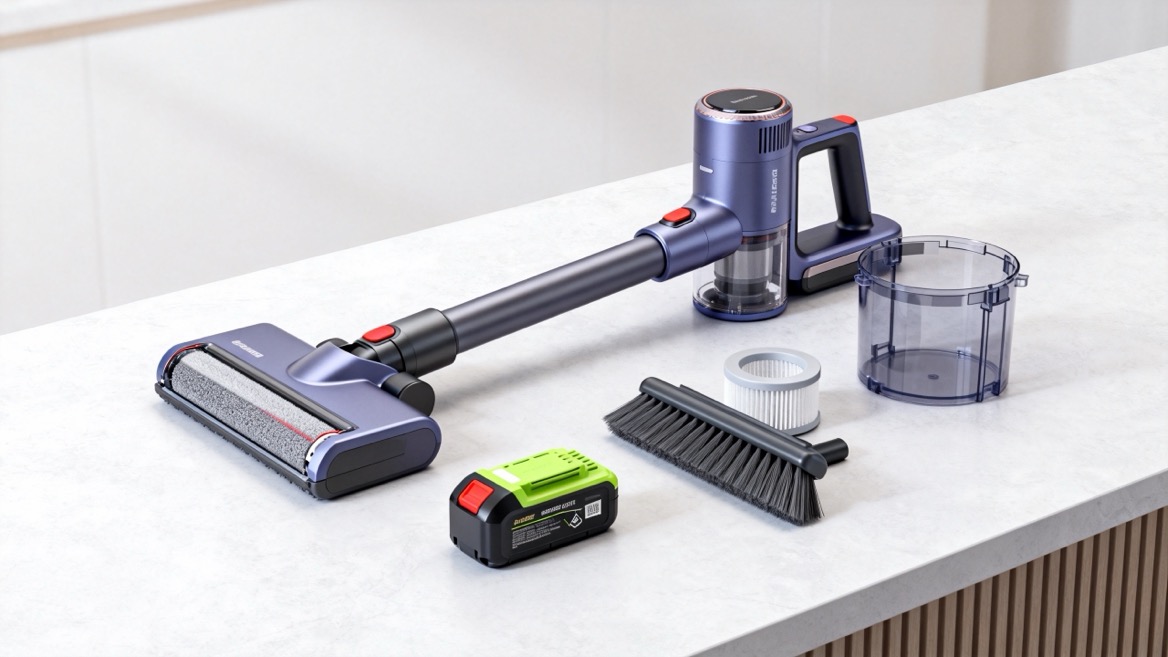
Suction can be measured at different points and under different conditions. Two figures without a shared method are not a sound comparison. Ask what was measured, where, with which attachment, and at what battery state.
A credible performance sheet should cover practical outcomes: fine- and large-debris pickup, carpet dust removal, usable runtime, filtration, noise, hair tangling, and handling. IEC 62885-4 sets out methods for measuring cordless dry-vacuum performance. A report should identify the method and configuration used, rather than merely display a laboratory logo.
When reading customer feedback, distinguish recurring ownership issues from first-day impressions. Reports of declining runtime, difficult bin emptying, brush jams, unavailable filters, or broken clips can reveal problems a brief demonstration will miss. Verify the product model and context before treating an anonymous comment as evidence about a supplier.
You can compare two or three shortlisted machines using the same simple checklist. This is a purchasing aid, not a substitute for laboratory testing.
1. Map your surfaces. Note the mix of hard floor, carpet, rugs, and stairs.
2. Start in normal mode. Time a routine clean with the supplied powered head.
3. Challenge the head. Try fine dust and larger dry debris on hard floor, then hair and dirt on a suitable rug or carpet.
4. Inspect missed areas. Check edges, corners, brush ends, and the space behind the roller.
5. Empty and reassemble it. Note dust exposure, contact with debris, and whether the parts refit securely.
6. Repeat after maintenance. Ease of cleaning affects whether users will maintain performance over time.
Record specific observations. "Picked up fine dust but pushed cereal on tile" helps you make a decision; "excellent suction" tells you much less. If you cannot test before purchase, seek reviews that show comparable tasks and explain their methods.
For a retailer, distributor, or private-label brand, the household buying checklist is only the beginning. A promising sample can still create warranty costs if replacement parts, production controls, or documentation are weak.
Ningbo Eyunhome Electric Technology Co., Ltd. offers upright, handheld, corded, and cordless vacuum solutions, alongside OEM/ODM services and after-sales support. For a sourcing decision, treat those capabilities as the start of a model-specific discussion. Ask what can be demonstrated for the exact configuration you intend to sell.
- Performance: Test conditions and results for runtime, pickup, filtration, noise, and brush durability.
- Battery and electrical safety: Battery-pack information, charger compatibility, protection design, and applicable reports.
- Commercial configuration: Final accessories, packaging, branding options, and permitted component substitutions.
- Production consistency: Inspection checkpoints, batch traceability, defect handling, and sample-approval process.
- After-sales support: Written warranty scope, spare-part availability, replacement lead times, and an escalation contact.
Request evidence for the exact SKU, not a visually similar machine. If a battery pack, floor head, or filter seal changes during development, repeat the relevant checks. A familiar product name does not guarantee an unchanged cleaning experience.
Connect each recurring complaint to a testable requirement:
- If users report dust escaping during emptying, specify an emptying demonstration and a leakage assessment.
- If hair wraps around the roller, define the hair type, test duration, and acceptable cleanup time.
- If customers say the battery "doesn't last," define runtime with the powered head attached in normal mode.
This approach helps avoid raising a headline specification while leaving the original problem unsolved. It also gives engineering, quality, and sales teams shared acceptance criteria. Request a revised sample when materials or components change; do not assume the first sample represents every production batch.
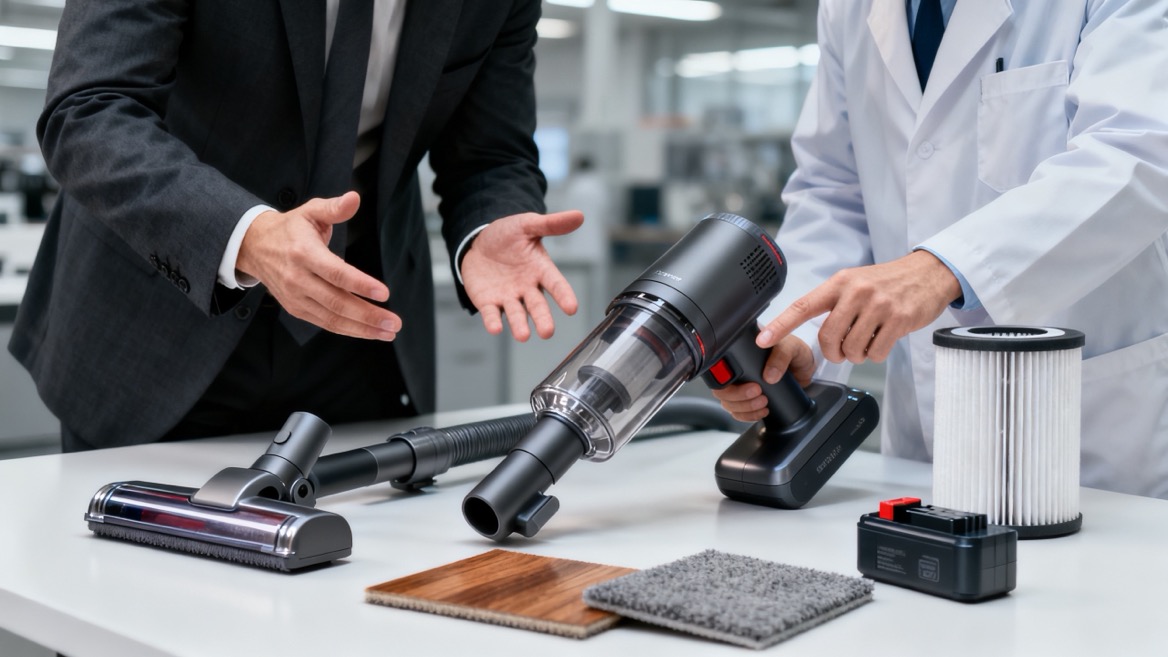
Purchase price is only one cost. Filters, batteries, brush rolls, shipping, downtime, and warranty handling can matter throughout ownership. Ask whether common wear parts can be removed without damage and whether maintenance instructions are clear.
Basic care includes emptying the bin before it overfills, clearing hair and blockages, and cleaning or replacing filters according to the model's instructions. Do not wash a part unless the manufacturer identifies it as washable. Allow washable filters to dry fully as instructed before reinstalling them.
The right cordless vacuum starts with a clear cleaning job and ends with evidence that the final product can do it consistently. If you are sourcing upright, handheld, corded, or cordless vacuums, contact Ningbo Eyunhome Electric Technology Co., Ltd. with your target floor types, sales region, desired features, order requirements, and branding brief. Request a matching sample, model-specific test documentation, an OEM/ODM proposal, and written after-sales terms before placing a production order.
It can be, particularly in a smaller home with lighter cleaning needs. A large carpeted home may call for a corded upright or a cordless model with demonstrated carpet performance and enough normal-mode runtime.
A soft roller is often a strong option for fine dust and larger debris on sealed hard floors. Also check rug compatibility, access for roller cleaning, and whether a suitable carpet head is included.
Time a normal cleaning session and allow a margin. Compare normal-mode runtime with the powered head attached, rather than relying only on the maximum low-power claim.
No. Filter efficiency and whole-machine leakage are separate questions. Ask whether the assembled vacuum has been evaluated for air bypass around the filter and bin.
Look for effective hair pickup, limited brush wrap, easy roller access, a practical bin, and an upholstery tool. Consider the cleanup required after repeated use, not just the first pass.
Request model-specific test results, the final bill of materials, applicable target-market documentation, a quality-control plan, spare-parts terms, warranty terms, and an approved production sample.
No. Confirm the part number, purchasing channel, expected availability, and safe replacement instructions before promising customers a replaceable-battery benefit.
- Vacuum Wars. [*The Cordless Vacuum Buyer's Guide: What to Know Before You Buy*]. Independent observations on floor heads, runtime, carpet cleaning, handling, and maintenance; updated July 18, 2025.
- American Lung Association. [*Not All Vacuums Are Created Equal: Pick the Best One for Your Health*]. Guidance on sealed systems, filtration, and dust exposure; updated October 15, 2025.
- U.S. Environmental Protection Agency. [*What is a HEPA filter?*]. HEPA definition and filter-level particle-capture figure.
- International Electrotechnical Commission. [*IEC 62885-4:2020/AMD1:2023*]. Methods for measuring cordless dry-vacuum performance.
- European Commission. [*Commission adds exemptions to portable battery removal rules*]. Overview of battery removability requirements and exceptions; July 14, 2026.
- HKTDC Sourcing. [*Ningbo Eyunhome Electric Technology Co., Ltd. supplier profile*]. Public listing of manufacturer identity and location; updated March 31, 2025.


