
Views: 210 Author: Eyunhome Vacuum Publish Time: 2026-09-29 Origin: Site


Content Menu
● Cordless Vacuum vs Canister Vacuum: At a Glance
● Which Cleans Urban Floors Better?
>> Hard Floors, Edges, and Low Furniture
>> Rugs, Carpets, and Pet Hair
● How Do They Fit Apartment Life?
>> Storage, Stairs, and Everyday Reach
>> Battery Runtime Versus Plug-In Cleaning
>> Filtration and Dust Disposal
● A Five-Minute Apartment Fit Test
● What Should Buyers and Brands Verify?
>> Look Beyond Headline Specifications
>> Build an Urban-Home Product Range
>> Can a Cordless Vacuum Replace a Canister in a Small Apartment?
>> Is a Canister Vacuum Always Stronger?
>> Which Type Is Easier to Store?
>> Which Is Better for Someone Sensitive to Dust?
>> Do Cordless Vacuums Work on Area Rugs?
>> What Should Importers Verify Before Ordering?
Choosing between a cordless vacuum and a canister vacuum for an urban home is less about finding the "strongest" machine and more about matching a cleaner to your floor plan. A compact cordless stick can make daily crumbs and hallway dust easy to tackle. A corded canister may serve you better when rugs, long cleaning sessions, or dust-sensitive residents call for more capacity and uninterrupted cleaning.
For a small, mostly hard-floor apartment, start with a cordless stick. For a larger flat with substantial rugs or longer cleaning sessions, start with a canister. The best choice still depends on the particular model, floorhead, filtration system, and space you have to store it. Consumer Reports likewise distinguishes the convenience of sticks from the sustained cleaning strengths of full-size vacuums.

Here, "cordless vacuum" means a rechargeable stick vacuum, while "canister vacuum" means a conventional corded floor canister. Power source and body shape are separate features: cordless canisters and corded sticks also exist.
| Urban-home consideration | Cordless stick vacuum | Corded canister vacuum |
|---|---|---|
| Daily crumbs and entryway dust | Quick to retrieve; no outlet needed while cleaning | Effective, but generally takes more setup |
| Hard floors and area rugs | Convenient if the head suits both surfaces | Versatile with the appropriate floorhead |
| Extended carpet cleaning | Depends on the model, head, and available runtime | Allows uninterrupted operation; carpet-head design still matters |
| Furniture and edges | Slim wand can help in tight spaces | Separate hose and wand offer flexible reach |
| Storage | Narrow body, but the dock needs a location | Body, hose, wand, and tools all need space |
| Dust disposal | Often a smaller bin that needs frequent emptying | Bagged versions can be less messy to empty |
| Ongoing costs | Battery and filter replacement may matter | Bags, filters, and other replacement parts may matter |
These are category-level tendencies, not a ranking of every machine. A well-designed cordless stick can outperform a poorly matched canister on a particular floor, while a canister without a suitable carpet head may struggle on thick rugs. Independent buying guidance recommends judging vacuums by the surfaces and jobs they will actually face.
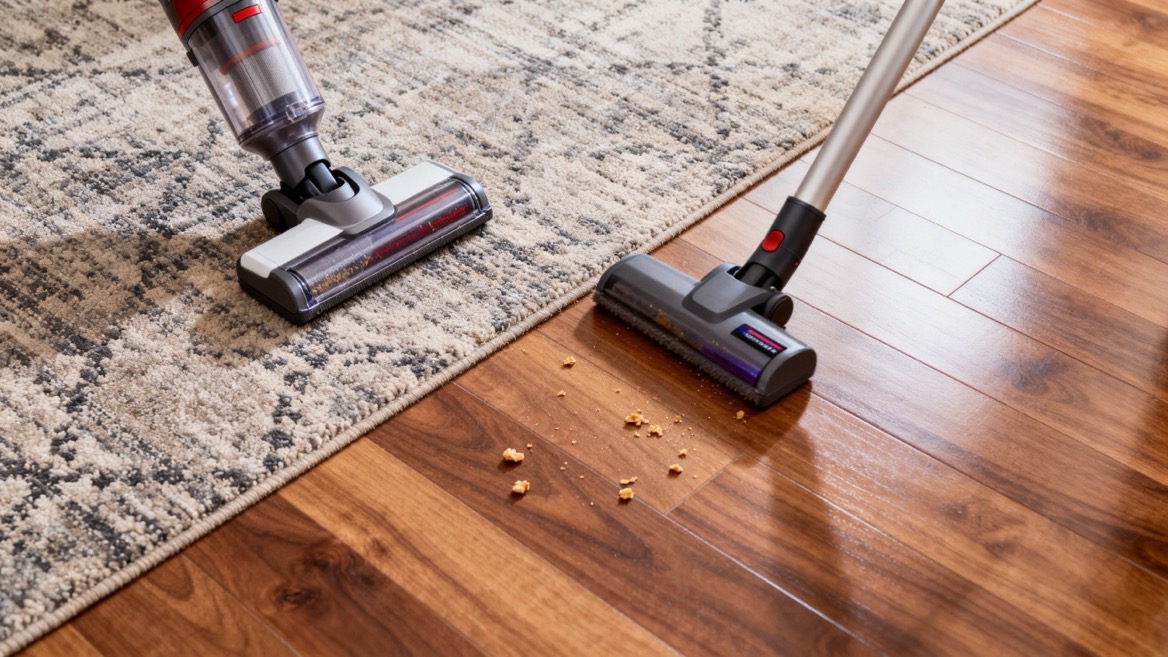
Many city apartments combine tile or wood-look flooring with a few area rugs. On hard floors, the useful question is whether a vacuum picks up fine dust and larger crumbs without scattering them. The floorhead matters: a suitable hard-floor tool or a brush-roll switch can make transitions between bare floors and rugs easier. Independent vacuum tests assess bare-floor pickup, carpet pickup, and handling separately for this reason.
A cordless stick is convenient beneath dining chairs after a meal. A canister's hose and wand can help along baseboards, behind furniture, and beneath a sofa without requiring you to move the entire machine into each gap. Before buying either type, measure the clearance beneath your lowest furniture and compare it with the nozzle's actual height.
Carpet changes the decision. Removing embedded grit depends on more than a headline suction figure: the brush, nozzle, airflow during use, and cleaning passes all contribute. Full-size vacuums generally offer an advantage for sustained carpet cleaning, while a capable cordless stick may be sufficient for one small rug and frequent surface cleaning. Consumer Reports tests carpet pickup and pet-hair removal as distinct measures rather than assuming one predicts the other.
If you have mostly tile and a single low-pile rug, a cordless model could be your only vacuum. If several rooms are carpeted, prioritize measured carpet pickup and a head suited to the carpet. For a delicate rug, check its care instructions and whether the vacuum lets you adjust suction or brush action.
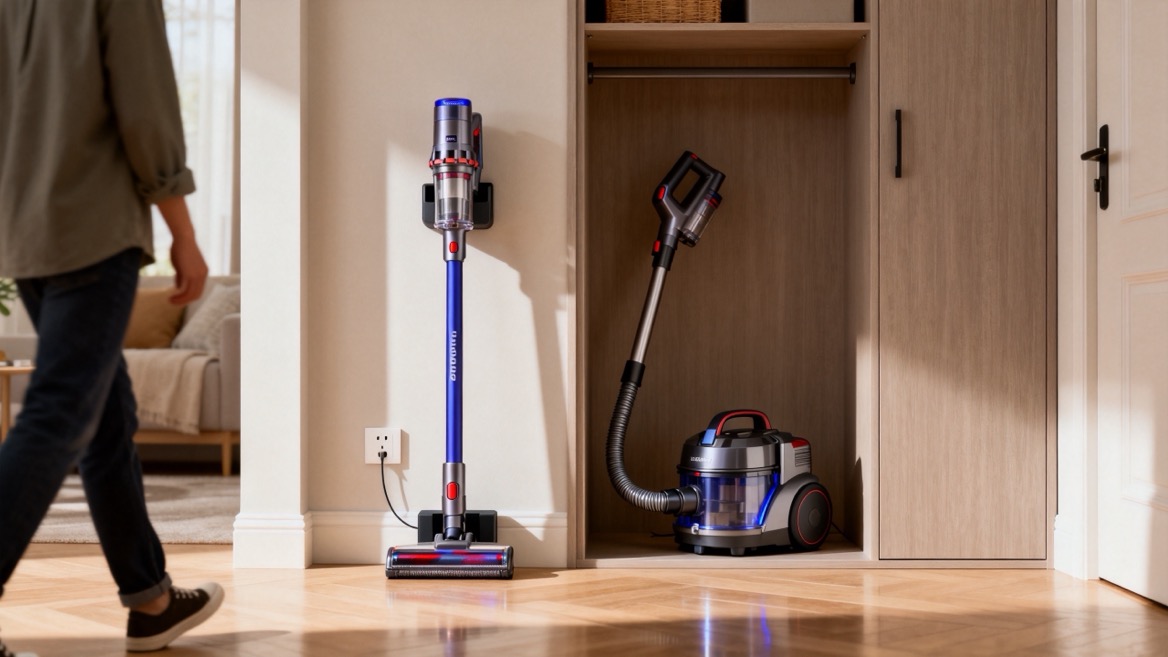
A vacuum that is awkward to retrieve can make a two-minute cleanup feel like a chore. A cordless stick generally has a smaller stored footprint, but its charging dock still needs an accessible spot near an outlet. Some models do not stand on their own. A canister may have a parking position for its wand, yet its hose and attachments still require storage space. Published dimensions should cover the complete stored setup, not just the main body. Consumer Reports identifies storage and handling as meaningful differences between stick and canister designs.
For stairs, consider what you actually lift. With a stick, you carry the motor and battery in the unit. With a canister, you can handle the wand separately while positioning the body securely. Neither design is automatically easier for everyone. Check grip comfort, the weight you must carry, and whether the hose reaches without pulling the canister toward a stair edge.
Noise also matters in a shared building. Do not assume that cordless means quiet. Compare noise measurements taken under stated operating conditions, and consider how the machine sounds in the mode you will use most. Standardized methods exist for measuring vacuum noise on both carpet and hard floors.
An "up to" runtime is not necessarily the time you will get while cleaning rugs with a motorized head. Power setting, attachments, and battery condition all affect the session you can complete. Consumer Reports tests cordless runtime on different settings and notes that batteries can diminish over time; it also suggests considering whether a compatible extra battery is available.
A corded canister avoids a charging pause, but it depends on well-placed outlets. In a flat with few sockets, repeated unplugging can interrupt an otherwise straightforward route. Compare the practical working radius of the cord, hose, and wand rather than cord length alone.
Here is a useful check: time one normal whole-home clean. Include moving chairs, changing floorheads or modes, cleaning the sofa, and emptying the bin. Then ask whether the cordless model has enough runtime *in that configuration*—or whether a canister can reach the rooms conveniently from available outlets. This makes your decision more reliable than comparing maximum-runtime claims.
A filter labeled "HEPA" does not, by itself, prove that the entire vacuum contains dust effectively. Air can escape through gaps that bypass a filter. The U.S. Environmental Protection Agency's guidance on HEPA vacuums emphasizes that the machine must be designed so air passes through the final filter without leaking around it; that guidance concerns renovation-dust cleanup, not a certification claim for ordinary household vacuums.
For a household sensitive to dust, ask about whole-machine emissions as well as filter specifications. Consider what happens when you empty the vacuum, too. A bagless bin can release a dust plume, whereas replacing a well-fitting bag may expose you to less loose debris. Neither format guarantees low emissions: sealing, maintenance, and model-specific test results matter. Consumer Reports measures dust released during operation and notes the disposal trade-off between bagged and bagless designs.
Before comparing product listings, gather five pieces of information from the home itself:
1. Map the floors. Note how much is hard flooring, low-pile rug, thick rug, or fitted carpet.
2. Measure storage. Check closet dimensions, dock space, nearby outlets, and clearance beneath furniture.
3. Time your route. Clean as you normally would, including upholstery and awkward corners.
4. Identify difficult tasks. List pet hair, stairs, entryway grit, sofa crevices, and other recurring jobs.
5. Check ownership needs. Confirm the availability of compatible filters, bags, batteries, warranty service, and instructions.
For example, a studio with tile, one washable runner, and little closet space may favor a cordless stick. A larger flat with several rugs, a shedding pet, and a resident who dislikes emptying dusty bins may favor a bagged canister with a suitable floorhead. The point is not that either home *must* choose that type; it is that its cleaning routine gives you a clear way to assess candidates.
Motor wattage tells you about electrical input, not how much debris a machine removes from your particular floor. Likewise, a suction claim without a stated setup does not tell you how the vacuum handles a rug, a full bin, or a narrow floorhead. Ask for the test conditions behind performance figures: surface, debris, number of passes, operating mode, and attached tool.
The IEC 62885-2:2026 standard describes methods for measuring the performance of mains-operated and cordless household dry vacuums, including provisions intended to make cordless and mains-operated results comparable. Its publication description also notes that some comparisons are more reliable when appliances are tested in the same laboratory under the same conditions. For noise, ask which mode and surface were used.
Practical specifications matter just as much. Check stored dimensions, usable bin or bag capacity, weight where you hold the machine, replacement-part information, and regional electrical compatibility. These details help a household avoid a poor fit—and help a retailer avoid promising convenience that the product does not deliver.
For importers and retailers, "urban home" should describe a set of use cases, not one product in several colors. A small, mostly hard-floor flat may call for an easy-access cordless stick. A home with mixed flooring may need more floorhead options or spare-battery availability. Customers who clean for longer periods may also want to compare corded solutions.
Ningbo Eyunhome Electric Technology Co., Ltd. offers upright, handheld, corded, and cordless vacuum solutions, with OEM/ODM services and after-sales support. That makes a configuration-led sourcing discussion more useful than assuming every available model includes the same filtration, runtime, certification, or accessories. The company details in this paragraph are supplied by the commissioning company and should be verified against its current product and service documents before publication.
For each shortlisted model, request a brief covering floorhead options, runtime with the intended head attached, battery replacement arrangements, bin-emptying design, filtration architecture, dimensions, noise data, and spare-part supply. Ask for test reports that identify the exact quoted configuration. Settle warranty handling, packaging, instructions, and destination-market requirements before approving samples or making performance claims.
Choose a cordless stick when your apartment is compact, mostly hard-floored, and you value quick, frequent cleaning—provided it completes your normal route on one charge. Choose a canister when sessions are longer, substantial carpet or rugs need attention, or a larger bag and less exposed dust disposal better suit the household. If you have room for two, a canister for thorough cleaning and a cordless stick for everyday touch-ups can be a practical combination. Independent buying guidance supports assessing the primary cleaner first, then deciding whether a smaller second machine adds value.
Sourcing a vacuum range for urban homes? Contact Ningbo Eyunhome Electric Technology Co., Ltd. with your target market, typical floor mix, preferred power source, price positioning, and required documentation. Request suitable OEM/ODM configurations and model-specific samples before finalizing product claims.
Yes, it may be enough if the home is mostly hard-floored and the model completes your usual route without running out of charge or filling its bin. Where thick rugs or heavy pet hair are major tasks, compare model-specific pickup results before making the switch.
No. A vacuum's shape does not establish how well it cleans a particular surface. Full-size canisters are often suited to sustained work, but the floorhead and measured results matter more than a general claim about strength.
A cordless stick generally needs less floor space, though you still need to place its charger and tools. Measure the complete stored arrangement for each candidate; a canister body alone does not show the space its hose and wand will occupy.
Prioritize low measured emissions and disposal that limits exposure. A well-sealed, bagged canister may be less messy to empty, but an effectively sealed cordless model may also perform well. Check results for the whole machine, not only its filter label.
Many can handle routine rug cleaning, but performance depends on the rug, floorhead, and available runtime in the required mode. Check the rug maker's care instructions and seek test results for a comparable surface.
Request configuration-specific cleaning and noise data, battery and filter information, applicable destination-market documentation, spare-part availability, packaging specifications, and written after-sales terms. Test samples on the flooring mix your customers actually have. Standardized methods provide a useful basis for comparing performance claims.
- Consumer Reports, "[Choose the Right Vacuum for Your Home]," updated November 20, 2025. Buying guidance on vacuum types, floors, storage, batteries, and dust disposal. [consumerreports]
- Consumer Reports, "[How to Choose the Right Vacuum for the Job]," updated August 26, 2025. Guidance on canisters, sticks, carpet, hard floors, and complementary cleaners. [consumerreports]
- Consumer Reports, "[How Consumer Reports Tests Vacuums]." Describes tests for floor pickup, pet hair, handling, emissions, and noise. [consumerreports]
- Consumer Reports, "[Best Vacuums of 2026 for Allergy Sufferers]," updated May 19, 2026. Discusses filtration effectiveness and exposure when emptying bagless bins. [consumerreports]
- Consumer Reports, "[8 Best Stick Vacuums of 2026, Lab-Tested and Reviewed]." Explains cordless runtime testing across power settings. [consumerreports]
- U.S. Environmental Protection Agency, "[What Should I Look for When Purchasing a HEPA Vacuum?]." Explains HEPA filtration and the importance of a sealed air path in the renovation-cleanup context. [epa]
- International Electrotechnical Commission, "[IEC 62885-2:2026]." Standard covering household dry-vacuum performance measurement methods. [webstore.iec]
- International Electrotechnical Commission, "[IEC 60704-2-1:2026]." Standard covering vacuum-cleaner airborne-noise measurement. [webstore.iec]


