
Views: 230 Author: Eyunhome Vacuum Publish Time: 2026-09-03 Origin: Site


Content Menu
● Quick Answer: Cordless or Robot Vacuum for Pet Hair?
● Cordless Vacuum vs Robot Vacuum Comparison Table
● Why Pet Hair Requires a Different Cleaning Strategy
● Cordless Vacuum for Pet Hair Removal
>> Strengths of Cordless Vacuums
>> Limitations of Cordless Vacuums
● Robot Vacuum for Pet Hair Removal
>> Limitations of Robot Vacuums
● Cleaning Performance by Surface
● The Hidden Issue: Hair Wrap and Brush Roll Design
● Expert Cleaning Routine for Multi-Pet Homes
>> A Practical Two-Tool Routine
● What Brands Should Prioritize in Pet Vacuum Development
● Cordless Vacuum vs Robot Vacuum: Final Verdict
● FAQ
>> 1. Is a cordless vacuum better than a robot vacuum for pet hair?
>> 2. Can a robot vacuum remove pet hair from carpet?
>> 3. Do robot vacuums get clogged with pet hair?
>> 4. What vacuum features are most important for pet hair?
>> 5. Are cordless vacuums powerful enough for dog hair?
>> 6. How often should pet owners vacuum?
>> 7. Is HEPA filtration useful for pet owners?
Pet hair is not a single cleaning problem. It collects in carpet fibers, clings to upholstery, gathers below furniture, floats along baseboards, and often wraps around brush rolls. That is why the choice between a cordless vacuum vs robot vacuum for pet hair removal should not be based on convenience alone.
For pet-owning households, the better solution depends on the type of fur, flooring, furniture, shedding level, cleaning frequency, and whether the home needs fast spot cleaning or automated daily maintenance. A cordless vacuum gives the user direct control and access to difficult areas. A robot vacuum creates a repeatable cleaning routine that can reduce the visible buildup of fur between deeper cleaning sessions.
For distributors, retailers, and private-label buyers, this comparison is also important because pet-focused vacuum demand requires more than attractive product specifications. A successful product needs a practical brush design, stable suction performance, appropriate filtration, user-friendly maintenance, and reliable manufacturing support.
At Ningbo Eyunhome Electric Technology Co., Ltd., we develop upright, handheld, corded, and cordless vacuum cleaner solutions for international markets. Through flexible OEM and ODM services, we help brands create products that address real cleaning needs, including demanding pet hair removal applications.

A cordless vacuum is usually the better primary choice for deep, targeted pet hair removal. It can clean upholstery, stairs, corners, carpets, pet beds, and sudden messes with stronger user control.
A robot vacuum is often the better supporting choice for daily fur maintenance on open hard floors and low-pile carpets. It reduces the amount of hair that accumulates between manual cleaning sessions.
For many multi-pet households, the most effective solution is not choosing one category over the other. It is combining a robot vacuum for routine floor cleaning with a cordless vacuum for detailed cleaning and high-shed zones.
Independent product-testing publications commonly evaluate robot vacuums based on pickup ability, navigation, obstacle avoidance, battery performance, and setup quality. They also test how robots handle pet fur, litter, furniture edges, and floor transitions. In these evaluations, a robot's cleaning results can vary significantly depending on carpet depth, obstacle layout, hair length, and navigation performance.
| Comparison Factor | Cordless Vacuum | Robot Vacuum |
|---|---|---|
| Best use | Deep cleaning and targeted pet hair pickup | Daily maintenance cleaning |
| User involvement | High; the user operates the vacuum | Low; runs automatically on a schedule |
| Upholstery cleaning | Excellent with dedicated attachments | Limited or unavailable |
| Stairs and car interiors | Excellent | Cannot clean stairs; limited for cars |
| Under-furniture cleaning | Depends on floor head and wand profile | Often strong if clearance is sufficient |
| Thick carpet performance | Usually stronger with motorized floor heads | Can be inconsistent depending on suction and brush design |
| Daily fur control | Requires manual use | Excellent when scheduled consistently |
| Spot cleaning | Fast and direct | May require app activation and travel time |
| Pet hair tangling | Depends on anti-tangle brush design | Depends heavily on roller design and self-cleaning features |
| Noise timing | User selects when to clean | Can be scheduled for low-disruption periods |
| Maintenance | Empty bin, clean filter, remove hair from roller | Empty bin, clean roller, maintain sensors, wash or replace parts |
| Main advantage | Control, versatility, deep cleaning access | Automation and frequency |
| Main limitation | Requires time and effort | May miss elevated surfaces, stairs, corners, and complex pet messes |
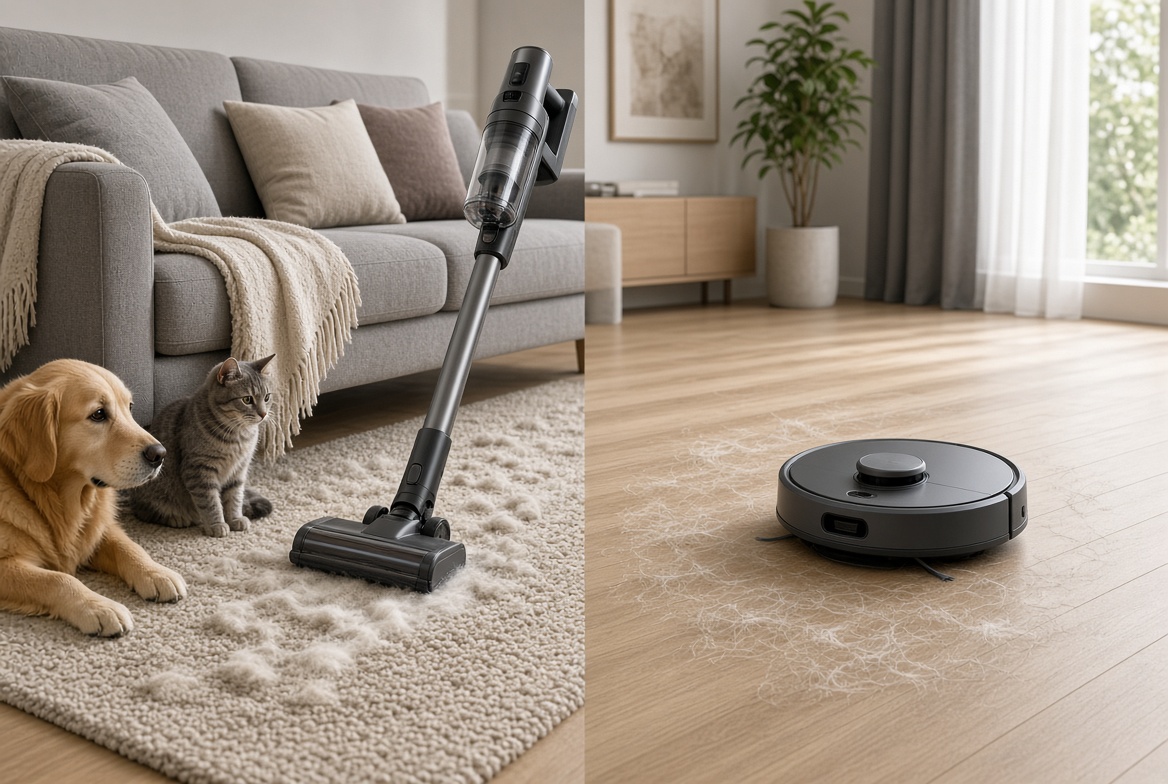
Pet hair behaves differently from ordinary household dust. Fine dander can remain airborne or settle into soft surfaces. Short stiff hairs may become embedded in carpet. Long hair can twist around brush rolls. Lightweight fur can also move away from a vacuum nozzle before it is collected if airflow and floor-head design are not properly balanced.
A vacuum designed for pet households should therefore consider more than headline suction figures. Product developers and buyers should evaluate the full cleaning system:
- Motorized brush roll performance for lifting embedded hair from rugs and carpet.
- Anti-tangle brush structure for reducing hair wrap and cleaning downtime.
- Sealed filtration performance for containing fine dust and pet dander.
- Dedicated accessories for sofas, cushions, pet beds, stairs, curtains, and vehicle interiors.
- Dustbin capacity that matches the expected shedding level.
- Easy maintenance access for filters, rollers, and dust containers.
- Reliable runtime or power delivery for realistic cleaning sessions.
Filtration matters particularly in homes where people are sensitive to allergens. Product testing sources often distinguish between pet hair pickup and fine-particle filtration because a vacuum can collect visible fur yet still perform poorly at containing smaller particles. In one testing framework, a filtration score of 8.0 or higher is treated as a strong benchmark for allergen control, while a pet-hair pickup score of 7.5 or higher indicates good single-pass removal performance.
A cordless vacuum is a flexible tool for households that need immediate control. If a dog sheds heavily on the sofa, a cat leaves litter near the tray, or fur gathers on stairs, the user can pick up the vacuum and clean the area directly.
Direct cleaning control is the biggest advantage. Users can slow down over heavy fur areas, change cleaning direction, use a higher power mode, and apply a mini motorized tool to furniture.
Cordless vacuums can clean surfaces that robot vacuums cannot reach effectively:
- Sofas and upholstered chairs
- Pet beds and blankets
- Stairs
- Car seats and footwells
- Curtains and fabric-covered headboards
- Baseboards and ceiling corners
- Crevices beside appliances
- Raised platforms and cat furniture
A cordless model with a motorized floor head is especially useful on carpets, where pet hair can be trapped below the visible surface. The user can make deliberate, overlapping passes instead of relying on a robot's programmed route.
The main limitation is that cleaning still depends on the user. A cordless vacuum can deliver excellent results, but it will not run unless someone uses it.
Battery runtime is also a purchasing factor. High-power modes can shorten operating time, especially when a motorized brush head is active. For this reason, product selection should focus on usable runtime under realistic cleaning conditions rather than only maximum runtime claims.
For larger homes, buyers may prefer:
- A removable battery system
- A second battery option
- Wall-mounted charging storage
- A larger dustbin
- Multiple suction modes
- A powered mini brush for furniture
- A soft roller for hard floors
- A dedicated anti-tangle floor head
Many full-size cordless models in current consumer guidance offer around 40 minutes or more of claimed runtime, while handheld models may offer shorter operating periods. However, actual runtime changes according to power mode, floor head, battery condition, and debris load.
A robot vacuum changes the cleaning model from occasional manual cleaning to scheduled maintenance. Instead of waiting until fur becomes visible, a household can run the robot every day or several times per week.
This frequency can be highly valuable in homes with shedding dogs, multiple cats, or busy families. A robot can collect loose fur before it gathers under furniture, moves across hard floors, or gets carried into bedrooms.
The central value of a robot vacuum is consistency. A well-programmed unit can clean while the owner is working, sleeping, or away from home.
Robot vacuums work best in homes with:
- Mostly hard flooring
- Open-plan layouts
- Low-pile carpets or rugs
- Regularly cleared floors
- Predictable furniture placement
- Pets that shed daily
- Owners who value scheduled cleaning
Modern robot vacuums may include room mapping, no-go zones, carpet recognition, auto-recharge functions, self-emptying docks, and obstacle-avoidance systems. These features can improve daily usability, but their effectiveness depends on sensor quality, software performance, lighting conditions, cable clutter, pet toys, and floor layout.
For larger homes, some testing guidance recommends looking for at least 90 minutes of battery capacity so a robot has a stronger chance of covering the home before returning to charge.
A robot vacuum is not a complete substitute for manual pet hair cleaning.
It cannot properly vacuum stairs. It generally cannot clean sofas, cushions, curtains, shelves, pet beds, or car interiors. It may struggle with thick rugs, dense carpet, long fibers, tight corners, and hair trapped in upholstery.
Obstacle avoidance is another practical issue. Pet toys, food bowls, cables, blankets, and unexpected pet accidents can interrupt a cleaning cycle. Some advanced robots offer better object recognition, but no buyer should assume that an automated machine can handle every unpredictable household condition.
Robot vacuum testing frequently examines whether units can cross floor thresholds, avoid obstacles, and complete cleaning cycles without repeated errors. In one testing program, reviewers specifically assessed 0.75-inch thresholds, pet fur, litter, hay, and baseboard debris.
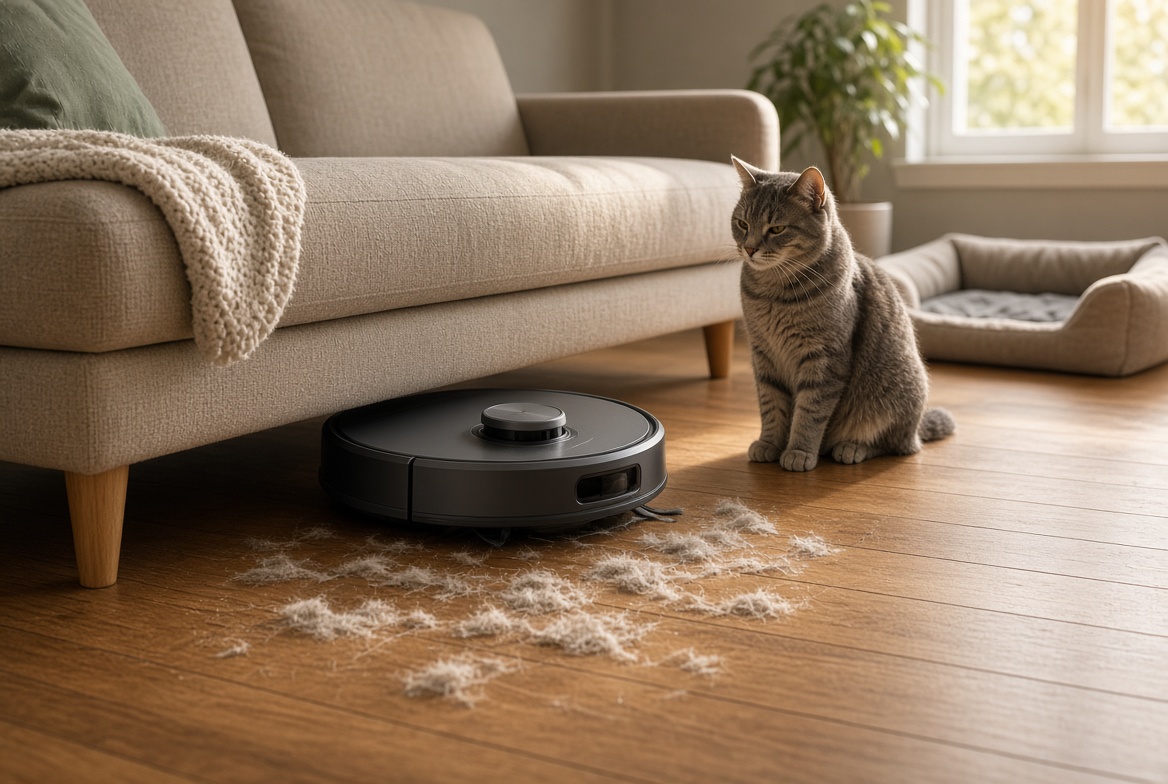
The best vacuum choice becomes clearer when evaluating specific surfaces rather than treating the home as one uniform space.
| Surface or Cleaning Zone | Better Option | Why |
|---|---|---|
| Hard floors | Robot vacuum for daily use; cordless for deep cleaning | Robots can repeatedly collect loose fur, while cordless models handle corners and stubborn debris |
| Low-pile carpet | Cordless vacuum | A motorized brush and controlled passes usually remove embedded hair more thoroughly |
| Thick carpet | Cordless vacuum | Stronger manual control and deeper agitation are important |
| Upholstery | Cordless vacuum | A mini motorized brush can pull hair from fabric surfaces |
| Pet bed | Cordless vacuum | Requires direct access and concentrated airflow |
| Stairs | Cordless vacuum | Robot vacuums cannot clean stair surfaces |
| Under low furniture | Robot vacuum | A slim robot can clean frequently beneath beds and sofas |
| Corners and baseboards | Cordless vacuum | A crevice tool offers more precise cleaning |
| Open living room | Robot vacuum | Ideal for automated repeat cleaning |
| Car interior | Cordless vacuum or handheld vacuum | Portable and controlled cleaning is essential |
Pet hair removal performance is often limited by hair wrap, not suction alone. Long pet hair, human hair, threads, and fibers can wrap around a roller, reduce brush effectiveness, and force the user to stop for maintenance.
For cordless and robot vacuum product development, an anti-tangle system should be evaluated from several angles:
- Roller material and bristle layout
- Comb or scraper structure
- Hair channel design
- End-cap accessibility
- Roller removal method
- Cleaning-tool storage
- Resistance to long-hair wrapping
- Performance across carpet and hard-floor surfaces
A practical anti-tangle design can improve customer satisfaction because it reduces cleaning interruptions. It also supports stronger product positioning for homes with long-haired pets, multi-pet families, and consumers with long hair.
Recent robot-vacuum test reporting has highlighted models that achieved strong pet hair extraction and avoided hair tangling during controlled testing. The results reinforce an important sourcing lesson: anti-tangle claims should be supported by real roller and airflow design, not simply by a product label.
The most effective pet hair strategy is based on cleaning frequency, not just vacuum category.
1. Run the robot vacuum daily on hard floors, hallways, and open living spaces.
2. Use a cordless vacuum two to three times weekly on rugs, carpet, furniture, pet beds, and corners.
3. Use the mini motorized tool weekly on sofas, fabric chairs, mattress edges, and vehicle interiors.
4. Empty the dustbin before it reaches capacity to maintain airflow and pickup efficiency.
5. Clean the brush roll regularly, especially in homes with long-haired pets.
6. Wash or replace filters according to the product instructions to help maintain airflow and filtration performance.
7. Create no-go zones around feeding stations, water bowls, cables, and delicate pet areas when operating a robot vacuum.
This approach prevents the common mistake of using one product for every cleaning task. The robot handles the repetitive work. The cordless vacuum handles the detailed work.
For vacuum brands, importers, and wholesale buyers, pet hair cleaning is a strong application category because it connects directly to a daily consumer frustration. However, a successful product must deliver a visible improvement in real homes.
A high-value pet vacuum cleaner program should consider the following product features:
- Strong and stable suction, not only peak motor power
- Motorized floor brush suitable for hair pickup
- Anti-tangle brush roll
- Multi-stage or sealed filtration
- Washable filter options, where appropriate
- Large and easy-empty dustbin
- Pet-grooming or upholstery accessories
- Battery flexibility for cordless models
- Low-profile floor head for furniture clearance
- Durable charging and docking solution
- Clear maintenance instructions
- Packaging and accessory customization
- Market-specific compliance support
Ningbo Eyunhome Electric Technology Co., Ltd. can support brands seeking customized cordless, upright, handheld, corded, and pet-oriented vacuum cleaner solutions. Our OEM and ODM capabilities can help partners develop product configurations that fit their pricing strategy, target users, accessory requirements, branding needs, and regional market expectations.
For deep pet hair removal, a cordless vacuum is the stronger standalone choice. It reaches carpets, furniture, stairs, pet beds, corners, and vehicles. It gives users the control needed to remove embedded hair and deal with sudden shedding or messes.
For daily fur management, a robot vacuum provides meaningful convenience. It can reduce visible hair buildup on hard floors and open areas without demanding regular user effort.
The best recommendation for a pet-focused household is simple:
- Choose a cordless vacuum if you need one versatile machine for deep and detailed cleaning.
- Choose a robot vacuum if your priority is automated daily maintenance on accessible floors.
- Choose both if your home has multiple pets, mixed flooring, upholstery, or frequent shedding.
For brands looking to develop a competitive pet hair vacuum cleaner line, the priority should be practical performance: brush-roll design, filtration, accessory versatility, maintenance convenience, stable manufacturing quality, and a product experience that solves real pet-owner problems.
Looking for a reliable vacuum cleaner manufacturing partner? Contact Ningbo Eyunhome Electric Technology Co., Ltd. to discuss OEM/ODM cordless, upright, handheld, corded, and pet hair vacuum cleaner solutions for your market.
A cordless vacuum is generally better for deep pet hair removal because it can clean carpets, sofas, stairs, pet beds, and corners. A robot vacuum is better for automated daily collection of loose fur on accessible floors.
Yes, many robot vacuums can remove pet hair from low-pile carpet. However, performance may decrease on thick carpet or in areas where hair is deeply embedded. A cordless vacuum with a motorized brush is usually more effective for deep carpet cleaning.
They can. Long pet hair and human hair may wrap around the main roller, side brush, or wheel area. A robot with an anti-tangle brush design and regular maintenance can reduce this issue.
The most important features include a motorized brush roll, anti-tangle design, strong airflow, effective filtration, a mini motorized upholstery tool, sufficient dustbin capacity, and simple brush-roll maintenance.
Yes, a well-designed cordless vacuum can be highly effective for dog hair, especially when it includes a motorized floor head and a higher-power mode. Buyers should assess real cleaning performance on their target flooring rather than relying only on motor wattage.
Homes with heavily shedding pets may benefit from daily robot vacuum cleaning on open floors and manual cordless cleaning two to three times per week. Upholstery, pet beds, rugs, and high-traffic carpet areas may need more frequent attention.
High-efficiency filtration can help capture fine particles such as dust and pet dander during vacuuming. The U.S. Environmental Protection Agency notes that HEPA filters capture 99.95% to 99.99% of particles measuring 0.3 microns, although the overall vacuum system design also affects real-world filtration performance.
1. [PCMag — The Best Robot Vacuums We've Tested]
2. [The New York Times Wirecutter — The Best Robot Vacuums]
3. [RTINGS — The Best Vacuums for Pet Hair]
4. [NBC News Select — Best Vacuums for Pet Hair]
5. [CNET — Best Robot Vacuums Tested]
6. [Vacuum Wars — Best Robot Vacuums with Obstacle Avoidance]


