
Views: 268 Author: Eyunhome Vacuum Publish Time: 2026-09-04 Origin: Site


Content Menu
● Why Upright Vacuum Cleaners Remain a Practical Choice
● What Makes the Best Upright Vacuum Cleaner?
>> Powerful and Consistent Suction
>> Multi-Surface Cleaning Capability
>> Filtration That Supports Cleaner Indoor Air
>> Ergonomic Design and Daily Usability
>> Durability and Serviceability
● Corded vs. Cordless Upright Vacuum Cleaners
● A Practical Buying Checklist for Households
>> Step 1: Identify the Main Floor Type
>> Step 2: Consider Pet Hair and Long Hair
>> Step 3: Evaluate Weight, Reach, and Storage
>> Step 4: Check Filtration and Emptying Design
>> Step 5: Confirm After-Sales Support
● What Brands and Importers Should Evaluate
● Common Mistakes When Choosing an Upright Vacuum
● Partner With Ningbo Eyunhome
● FAQ
>> What is the best upright vacuum cleaner for carpet?
>> Are upright vacuum cleaners good for pet hair?
>> Is a HEPA filter enough for allergy-sensitive homes?
>> Should I choose a bagged or bagless upright vacuum?
>> How much should an upright vacuum cleaner weigh?
>> What should a retailer ask an OEM vacuum cleaner manufacturer?
>> How often should filters and brush rolls be cleaned?
Choosing the best upright vacuum cleaner is not about buying the model with the biggest motor number or the longest feature list. The right vacuum must match real cleaning conditions: carpet density, hard-floor protection, pet hair volume, household size, user strength, filtration requirements, and the level of maintenance a customer is willing to accept.
From a product-development and sourcing perspective, a strong upright vacuum cleaner is a balanced system. Its suction path, brush-roll design, filtration layout, bin structure, cord management, wheels, handle, and accessories must work together reliably. Ningbo Eyunhome Electric Technology Co., Ltd. develops upright, handheld, corded, and cordless vacuum cleaner solutions for brands and distributors that need dependable performance, flexible customization, stable production, and professional OEM/ODM support.
This guide explains what makes an upright vacuum cleaner genuinely effective, how buyers can compare models beyond marketing language, and what importers should evaluate when selecting a vacuum cleaner manufacturing partner.

Upright vacuum cleaners continue to be a popular option because they combine a motorized floor head, dust collection system, handle, and body into one familiar, easy-to-store format. For homes with wall-to-wall carpet, rugs, pet hair, or frequent high-volume cleaning needs, an upright can provide strong contact between the cleaning head and the floor surface.
Independent product testing commonly finds that uprights perform particularly well on carpet because the machine's weight sits over the power brush. This can help the brush roll agitate carpet fibers and lift embedded debris more effectively than lighter floor-cleaning formats.
For many households, an upright vacuum is especially useful when cleaning involves:
- Carpeted bedrooms, hallways, and living rooms
- Large rugs with trapped dust and hair
- Pet fur on low-pile or medium-pile carpet
- High-traffic entrances and family areas
- Fast, whole-room cleaning sessions
- Homes that need one primary vacuum rather than multiple devices
However, the best upright vacuum cleaner for one household may be a poor fit for another. A heavy corded unit may be excellent for deep carpet cleaning but inconvenient in a small apartment. A lightweight cordless upright may be easy to carry upstairs but have less runtime or a smaller dust cup.
The key is to identify the cleaning problem before selecting the product.
A quality upright vacuum cleaner should deliver more than visible dirt pickup. It should clean efficiently, move comfortably, maintain stable airflow, contain fine dust, and remain easy to service over its working life.
Suction is one of the first features customers ask about, but it should not be judged by a single number alone. Real cleaning performance depends on the entire airflow system, including motor power, air path design, nozzle sealing, brush-roll agitation, filters, cyclone structure, and dust-bin condition.
A well-designed upright vacuum should maintain useful pickup performance as the dust cup begins to fill. It should also avoid airflow restrictions that make cleaning slow or cause debris to scatter on hard floors.
When evaluating upright vacuum cleaners, look for:
- Stable pickup on carpet and hard floors
- A floor head designed to reduce air leakage
- An efficient air path with fewer blockage points
- A motorized brush roll for deep carpet agitation
- Easy access for clearing clogs
- Consistent performance after repeated use
For carpet, brush-roll action matters almost as much as airflow. The rotating brush helps loosen dust, hair, and particles from fibers so the vacuum can draw them into the collection system.
Modern homes often contain several floor types. A single cleaning session may involve carpet, wood flooring, laminate, tile, mats, stairs, sofa cushions, and tight edges near baseboards.
The best upright vacuum cleaner should adapt to these transitions without damaging delicate surfaces or forcing users to change machines.
Useful multi-surface features include:
| Feature | Why It Matters | Best Use Case |
|---|---|---|
| Adjustable brush-roll height | Helps the floor head maintain proper contact with different carpet piles | Low-pile, medium-pile, and thicker rugs |
| Brush-roll on/off control | Reduces the risk of scattering debris or scratching certain hard floors | Hardwood, laminate, tile |
| Suction adjustment | Helps users clean curtains, rugs, and lighter surfaces more safely | Mixed-surface homes |
| Swivel steering | Improves movement around furniture and corners | Busy homes and compact rooms |
| Edge-cleaning design | Improves pickup along walls and baseboards | Kitchens, corridors, room edges |
| Detachable hose or tools | Extends cleaning beyond the floor | Stairs, upholstery, car interiors |
For a brand owner, these functions should be planned early in the product definition stage. A basic model may focus on reliable carpet and hard-floor performance, while a premium model may add variable suction, LED illumination, detachable handheld functionality, and specialized pet tools.
Filtration is one of the most important but most misunderstood parts of a vacuum cleaner. A machine may use a high-efficiency filter, but that alone does not guarantee that fine dust stays inside the vacuum. The complete system also needs effective seals, a controlled exhaust path, and properly fitted filter components.
A true HEPA filter is generally defined as filtering at least 99.97% of particles measuring 0.3 microns under specified test conditions. However, practical vacuum performance also depends on whether air can bypass the filter through gaps in the product structure.
For homes with allergy concerns, pet dander, or frequent fine-dust cleaning, buyers should look beyond a label and examine the full filtration design.
A stronger filtration system may include:
- Multi-stage separation to capture larger debris first
- A fine-dust pre-filter
- A washable or replaceable high-efficiency filter
- A sealed air path that reduces leakage
- A well-fitted exhaust filter
- A dust-bin release system that limits dust clouds during emptying
Independent reviewers also emphasize that emptying a bagless dust cup can release fine particles, even when the cleaning system itself performs well. For allergy-sensitive users, bagged systems or carefully designed sealed bin systems can be more practical.
A vacuum cleaner can have strong cleaning performance and still fail in the market if it is uncomfortable to push, difficult to carry, or frustrating to store.
In product reviews, upright vacuums commonly fall within a roughly 12–17 lb range, with models under 12 lb generally feeling lighter for stairs and frequent lifting. Cord length also affects practical usability: a longer cord can reduce the number of outlet changes needed during a cleaning session.
For users, the most meaningful ergonomic details are often simple:
- Comfortable handle angle and grip
- Balanced center of gravity
- Smooth rear wheels
- Responsive swivel steering
- Low-effort recline mechanism
- A manageable total product weight
- Long power cord for corded models
- Compact storage footprint
- Quick-release hose and tools
- Easy dust-cup removal
A product team should test these points with real users rather than relying only on engineering assumptions. A handle that feels natural in a short demonstration may cause wrist discomfort after 20 minutes of cleaning. A dust bin that looks large may be difficult to remove with one hand. These are small details, but they strongly influence reviews and repeat purchases.
Durability is not just about using thicker plastic. It comes from selecting the right materials, designing dependable joints, controlling tolerances, protecting moving parts, and making wear items easy to replace.
A well-engineered upright vacuum should be designed around predictable long-term issues, including hair wrapping around the brush roll, clogged hoses, worn belts, blocked filters, cracked dust bins, loose wheels, and reduced airflow from neglected maintenance.
From a manufacturing viewpoint, important durability areas include:
- Motor life and thermal protection
- Brush-roll bearing reliability
- Belt durability or beltless drive design
- Dust-bin latch strength
- Hose flexibility and fatigue resistance
- Wheel and axle stability
- Cord strain relief for corded vacuums
- Filter housing accuracy
- Availability of replacement parts
The best product is not necessarily the one with the highest specification on paper. It is the one that provides dependable cleaning performance after repeated use and is straightforward to maintain when the customer needs help.
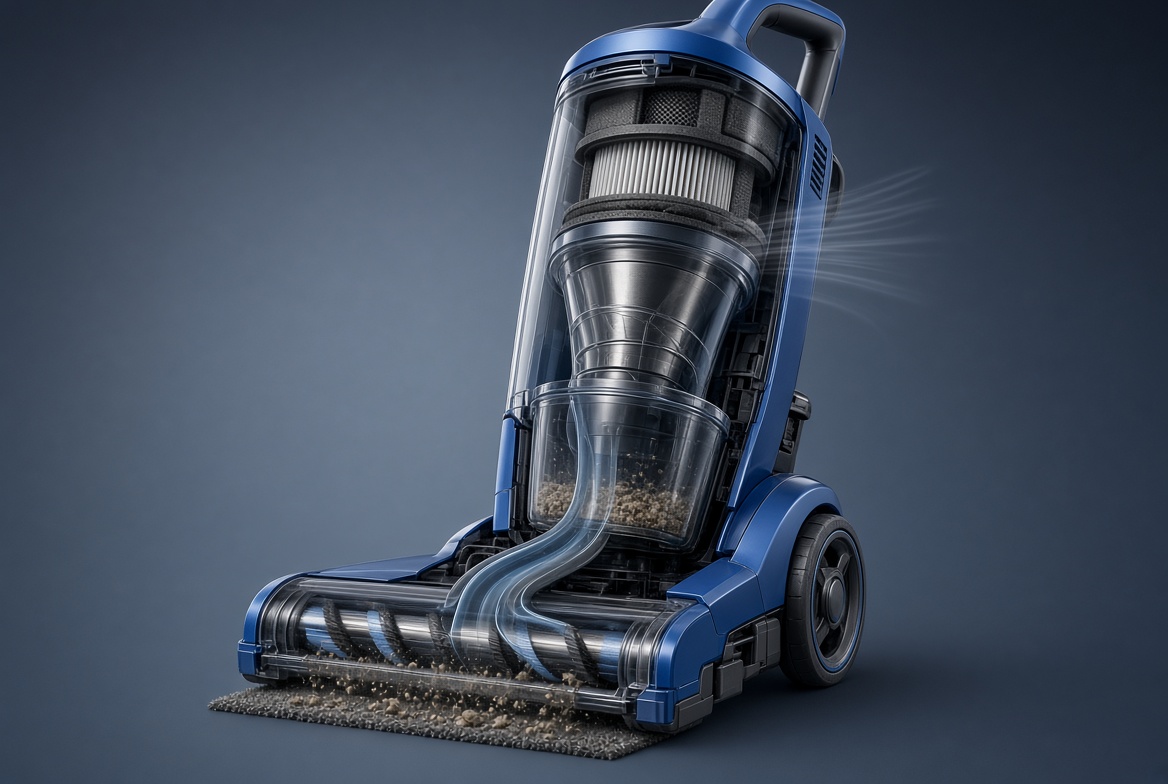
One of the most important decisions is whether the product should be corded or cordless. Both formats have clear advantages, and both can serve different market positions.
| Category | Corded Upright Vacuum | Cordless Upright Vacuum |
|---|---|---|
| Cleaning duration | Continuous operation while connected to power | Limited by battery runtime |
| Deep carpet cleaning | Often suited to sustained, high-demand cleaning | Depends on battery, motor, and floor-head design |
| Convenience | Requires cable handling and outlet access | Highly convenient for quick cleaning |
| Product weight | Can be heavier due to motor and construction | May feel lighter, but battery placement affects balance |
| Maintenance | May require belt, cord, and filter inspection | Requires battery-care planning plus filter maintenance |
| Best target users | Large homes, carpeted homes, value-focused buyers | Apartments, quick cleanups, convenience-focused users |
| Brand opportunity | Durable, cost-effective mainstream product lines | Premium features, modular batteries, modern styling |
For many brands, the strongest product portfolio includes both. A corded upright vacuum can serve buyers who prioritize continuous power and value. A cordless upright can address customers who want mobility, fast cleanup, and easy everyday access.
Ningbo Eyunhome Electric Technology Co., Ltd. can support product planning across these segments, including corded upright vacuum cleaners, cordless stick and upright-style solutions, handheld units, accessory options, and customized feature packages for different target markets.
Before purchasing an upright vacuum cleaner, buyers should answer a few practical questions. This process is more useful than simply comparing product images or headline motor claims.
If most of the home is carpeted, prioritize a motorized brush roll, reliable carpet pickup, and adjustable floor-head settings. If hard floors dominate, prioritize brush-roll control, smooth wheels, and a head that does not scatter larger debris.
Homes with pets or long-haired residents need a brush roll that resists tangles and is easy to clean. Some newer upright designs use comb-like structures or anti-tangle arrangements to reduce hair buildup.
Ask these questions:
- Does the brush roll need scissors or tools for cleaning?
- Can hair accumulate around the end caps?
- Is there a pet tool for upholstery and stairs?
- Does the bin handle hair clumps without frequent blockage?
- Is the filtration system suitable for pet dander?
A vacuum should fit the person who uses it most often. A powerful machine that is too heavy to carry upstairs will not be used as frequently as intended.
For larger homes, consider a longer cord, broader cleaning path, larger dust capacity, and flexible hose reach. For small homes, lighter weight and compact storage may matter more.
If indoor air quality is a priority, inspect the full dust-containment system. Look for a properly designed filter arrangement, sealed construction, and a dust cup that can be emptied with minimal direct contact with debris.
Before purchasing, check whether filters, brush rolls, belts, batteries, chargers, hoses, and dust cups can be replaced. A good vacuum cleaner should remain useful after normal wear items need service.
For retailers, private-label brands, distributors, and e-commerce sellers, the question is broader than "Which upright vacuum is best?" The real question is: Which product platform can deliver stable quality, differentiated features, compliant documentation, and long-term service support?
A dependable OEM/ODM vacuum cleaner partner should be able to support:
- Product concept development and market positioning
- Industrial design and functional customization
- Motor, battery, filtration, and accessory selection
- Packaging and brand identity customization
- Tooling coordination where applicable
- Quality-control procedures during production
- Product testing aligned with destination-market requirements
- Spare-parts planning and after-sales support
- Stable production capacity and delivery coordination
At Ningbo Eyunhome Electric Technology Co., Ltd., the goal is to help global partners create vacuum cleaner solutions that fit their market rather than forcing every customer into one standard model. A value retailer may need a durable corded upright with essential functions. A pet-care brand may need anti-tangle technology, a turbo tool, and enhanced filtration. A premium online seller may need a cordless platform with a modern display, interchangeable accessories, and branded packaging.
The most successful product launches begin with a precise brief: target market, retail price range, floor types, expected usage frequency, desired certifications, packaging requirements, color direction, and service-part strategy.
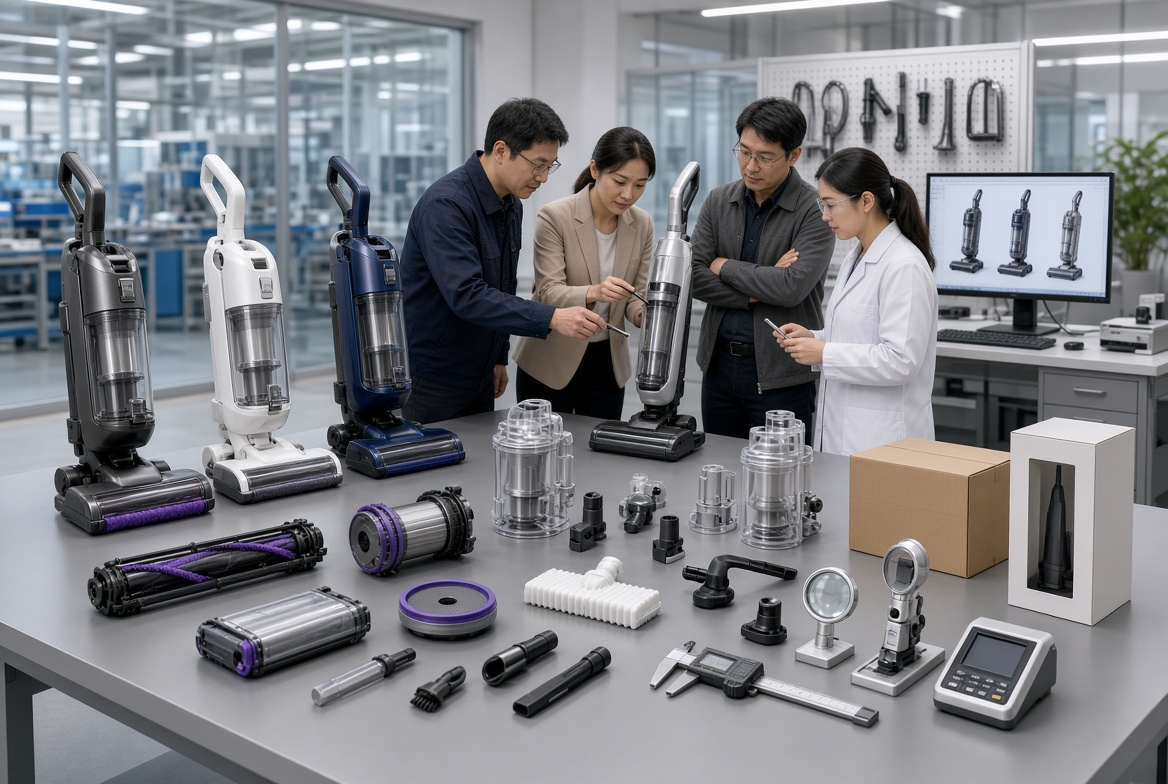
Many product disappointments come from a mismatch between expectations and real-world use.
Avoid these common mistakes:
- Choosing only by advertised wattage or motor claims
- Ignoring floor type and carpet thickness
- Treating a HEPA filter as proof of total-system dust containment
- Buying a heavy vacuum without considering stairs or storage
- Overlooking brush-roll maintenance in homes with pets or long hair
- Selecting a small dust cup for a large household
- Forgetting to assess replacement filters and spare parts
- Choosing a low-cost unit without evaluating build quality and support
A better approach is to compare performance, ergonomics, filtration, maintenance, and service as one complete ownership experience.
The best upright vacuum cleaner is the one that solves a specific cleaning challenge reliably, comfortably, and over the long term. For consumers, that means matching the vacuum to their floors, lifestyle, pets, and maintenance preferences. For brands and importers, it means working with a manufacturer that understands product performance, customization, production consistency, and after-sales requirements.
Ningbo Eyunhome Electric Technology Co., Ltd. provides professional OEM/ODM vacuum cleaner solutions for global businesses. Whether you need a corded upright vacuum for deep carpet cleaning, a lightweight cordless solution for modern households, a handheld vacuum for quick cleanup, or a customized product range for your brand, our team can support your project from concept to stable production.
Contact Ningbo Eyunhome today to discuss your upright vacuum cleaner requirements, customization goals, target market, and OEM/ODM project plan.
The best upright vacuum cleaner for carpet usually has a motorized brush roll, effective airflow, a floor head that contacts the carpet properly, and adjustable height or surface settings. Uprights are often well suited to carpet because their weight sits over the power brush, helping loosen embedded debris.
Yes. Upright vacuum cleaners can be highly effective for pet hair when they include a strong floor head, anti-tangle brush-roll design, pet upholstery tool, and fine-dust filtration. Buyers should also check how easily the brush roll and dust cup can be cleaned.
A HEPA filter is an important component, but it is not the only factor. The vacuum should also have a well-sealed air path so that air does not bypass the filter and release fine dust back into the room.
Bagless uprights avoid ongoing bag costs and allow users to see when the bin is full. Bagged models can be cleaner to empty because they reduce direct contact with collected dust. For users who are sensitive to allergens, the emptying process should be considered carefully.
There is no universal ideal weight, but lighter models are generally easier to carry and maneuver. Independent reviews describe models below 12 lb as relatively light, while many upright vacuums fall between 12 and 17 lb.
A retailer should ask about product customization, quality-control processes, production capacity, compliance support, sample procedures, tooling needs, spare parts, warranty support, packaging options, and delivery timelines. It is also important to define the target market and retail price level before product development begins.
The correct schedule depends on how often the vacuum is used, the amount of pet hair, and the household environment. In general, dust bins should be emptied regularly, filters should be cleaned or replaced according to the product manual, and brush rolls should be checked for wrapped hair or threads.
1. [Eureka — Which Upright Vacuum Cleaner Is the Best?]
2. [RTINGS — The 4 Best Upright Vacuums of 2026]
3. [Consumer Reports — How to Choose the Right Vacuum for the Job]
4. [Consumer Reports — Choose the Right Vacuum for Your Home]
5. [RTINGS — The 5 Best HEPA Vacuums of 2026]
6. [IBR Laboratories — Appliance Filters and Performance Testing]
7. [Safety, Compliance, and Regulatory Training — High-Efficiency vs. HEPA Vacuums]


