
Views: 231 Author: Eyunhome Vacuum Publish Time: 2026-10-30 Origin: Site


Content Menu
● What Makes a Robot Vacuum Worth Buying?
● Top Rated Robot Vacuums: What the Published Reviews Show
>> Roborock Qrevo Slim: A Candidate for Low Furniture
>> Roborock Saros 10R: Navigation With Practical Trade-Offs
>> MOVA P10 Ultra: Verify the Product Identity
● Three Robot Vacuums to Investigate Carefully
● How to Read Robot Vacuum Reviews Without Being Misled
>> Separate Dissatisfaction From Failure Rates
>> Look for Specific, Repeated Experiences
>> Match Reviews to the Right Version
● Why the Original Ranking Needs More Context
● A Practical Seven-Day Robot Vacuum Trial
>> Days 1–2: Mapping and Coverage
>> Days 3–4: Everyday Cleaning
>> Days 5–7: Maintenance and Repeatability
● Calculate Ownership Cost Before Comparing Prices
● Robot Vacuum vs. Upright, Handheld, and Cordless Models
● What Importers Should Request From a Vacuum Manufacturer
>> Request Comparable Performance Evidence
>> Clarify Production and After-Sales Commitments
● Develop Your Vacuum Range With Ningbo Eyunhome
>> What is the best robot vacuum for my home?
>> Does a low one-star percentage prove reliability?
>> Should I avoid all three negatively reviewed models?
>> Do self-emptying robot vacuums still require maintenance?
>> Can a robot vacuum replace a handheld or upright vacuum?
>> What should I send an OEM/ODM vacuum supplier?
Top rated robot vacuums should do more than impress on a specification sheet. They should navigate real homes, collect everyday debris, return to their docks, and remain manageable after months of use. For buyers comparing a robot vacuum and mop—or businesses developing their next floor-care range—customer feedback helps reveal where impressive features become practical benefits.
The most useful question is not simply, "Which model has the highest rating?" It is, "Which problems keep appearing, and will they matter in my home or product portfolio?"
This guide combines published independent testing, reported customer-review patterns, and a manufacturer-oriented buying framework. It also explains where upright, handheld, corded, and cordless vacuums fit alongside robotic cleaning.

A worthwhile robot vacuum balances cleaning performance, dependable navigation, manageable maintenance, and accessible support.
From a product-selection perspective, I would prioritize reliability over the longest feature list. A robot that completes routine cleaning consistently can be more useful than a technically advanced model that repeatedly needs rescuing.
Evaluate five fundamentals:
- Cleaning effectiveness on your actual flooring.
- Navigation around furniture, thresholds, and everyday clutter.
- Successful docking and charging.
- Maintenance requirements and replacement-part availability.
- Clear warranty terms and responsive support.
These priorities also help importers and retailers assess products beyond packaging claims. The experience after purchase matters as much as the demonstration before it.
Vacuum Wars' article, updated September 18, 2026, compares selected robot vacuums using its evaluations and reported Amazon customer ratings. Its review-based scoring considers one-star percentages when a product has more than 50 reviews.
The following figures reproduce that article's reported snapshot. They are not live marketplace ratings, independently verified failure rates, or predictions of future performance.
| Robot vacuum | Reported one-star share | Reported customer-feedback pattern | Main buying consideration |
|---|---|---|---|
| Roborock Qrevo Slim | 5% | Positive comments about mapping, floor cleaning, and dock convenience | Check furniture clearance and maintenance needs |
| Roborock Saros 10R | 6% | Praise for navigation and automated floor-care features | Assess onboard capacity and pet-hair workload |
| MOVA P10 Ultra | 6% | Strong overall satisfaction and perceived value | Confirm the exact model and regional specification |
| iRobot Roomba Combo 10 Max | 37% | Complaints about navigation, errors, and mop-station design | Investigate recent reports about these issues |
| Dyson 360 Vis Nav | 40% | Complaints about mapping, connectivity, and battery life | Check suitability for your layout |
| iRobot Roomba Combo j9+ | 41% | Complaints about docking, errors, battery life, and app usability | Examine repeat complaints before purchasing |
These results provide a starting point, not a universal shortlist. Floor layout, software changes, product revisions, and local support can influence ownership.
The source article describes positive customer feedback about hardwood cleaning, accurate mapping, and automated mop maintenance. Its low-profile design also makes furniture clearance an important selection factor.
Before buying, measure the space beneath sofas and cabinets. Compare the manufacturer's stated height with the narrowest entry point, not just the open space underneath.
Vacuum Wars reports strong obstacle-avoidance performance and positive customer comments about mapping and dock automation.
However, its discussion also flags a relatively small onboard dustbin as a consideration for heavy pet-hair workloads. Evaluate capacity alongside emptying frequency rather than assuming dock automation eliminates every blockage risk.
The source associates the MOVA P10 Ultra with strong customer satisfaction and value. However, its embedded shopping section names the P10 Pro Ultra.
That inconsistency matters. Buyers should confirm the full model name, model number, included accessories, and regional warranty before comparing offers.
A high concentration of negative reviews deserves attention, but it does not justify saying that every unit will fail.
The Roomba Combo 10 Max, Dyson 360 Vis Nav, and Roomba Combo j9+ attracted substantial negative feedback in the source's snapshot. The reported complaints focused heavily on navigation, docking, battery performance, connectivity, and maintenance.
The practical lesson is more useful than a blanket "never buy" label:
1. Identify the repeated complaint.
2. Check whether recent owners still report it.
3. Look for evidence of a relevant update or revision.
4. Confirm return terms before accepting the risk.
A discounted price does not resolve an ownership problem unless the underlying issue has actually changed.
A one-star percentage describes the distribution of submitted reviews. It does not measure the percentage of all sold units that failed.
Reviewers are a self-selected group. Some report delivery damage, retailer problems, setup confusion, or unmet expectations rather than mechanical faults.
Use negative-review concentration as a signal for investigation, not as a substitute for warranty or service data.
A detailed review explaining that a robot repeatedly misses the same room is more actionable than "terrible product."
Look for patterns involving:
- Missed rooms or incomplete cleaning runs.
- Repeated failure to return to the dock.
- Hair blockage and difficult brush cleaning.
- Persistent app or connection problems.
- Unavailable consumables or slow support.
Compare several sources. The Federal Trade Commission advises checking review recency and avoiding assumptions that apparently genuine feedback must be authentic.
Check whether comments concern the same model, accessory bundle, and market.
If a listing appears to combine variants, investigate whether the displayed rating meaningfully represents the product you intend to purchase. Record the review date and exact product identity when building a comparison.
The original article usefully connects customer dissatisfaction with independent evaluation. However, several limitations reduce its usefulness as a complete buying guide.
First, marketplace ratings and test scores measure different things. They should not be treated as interchangeable.
Second, some displayed product-card scores differ from narrative scores. Without a clearly synchronized reporting date, readers cannot safely interpret every number as part of one current ranking.
Third, the MOVA naming inconsistency makes exact product identification essential.
Finally, long-term ownership costs receive less attention than headline satisfaction. A stronger purchasing decision also considers consumables, maintenance time, replacement parts, and support arrangements.
These gaps explain why this guide emphasizes verification rather than reproducing a simple winner-and-loser list.
A structured home trial can reveal whether a shortlisted product suits your environment. This is a proposed evaluation routine, not a claim that every buyer needs laboratory equipment.
Follow the setup instructions and map the intended cleaning area.
Check whether the robot:
- Recognizes accessible rooms.
- Reaches the dock without intervention.
- Handles your normal thresholds.
- Respects configured no-go areas.
Record missed areas instead of relying on a general impression.
Run the robot under normal household conditions.
Check common debris locations, including dining areas, entrances, rug edges, and furniture legs. Assess pet-hair collection if relevant.
Avoid introducing hazardous objects or conditions contrary to the manufacturer's instructions.
Inspect brushes, wheels, filters, and the dock as directed.
Record:
- Completed runs without assistance.
- Minutes spent on routine maintenance.
- Unresolved alerts.
- Consumables used.
- Areas requiring manual follow-up.
This produces a practical measure of convenience: how much useful cleaning the robot delivers relative to the attention it requires.
The purchase price is only one component of value.
A useful planning model is:
Three-year ownership cost = purchase price + consumables + expected maintenance and repairs + owner-assigned maintenance time.
This is a budgeting framework, not a forecast of any specific model's expenses.
Request prices and availability for dust bags, filters, brushes, mop pads, and other model-specific parts. Check replacement instructions rather than assuming every component follows the same schedule.
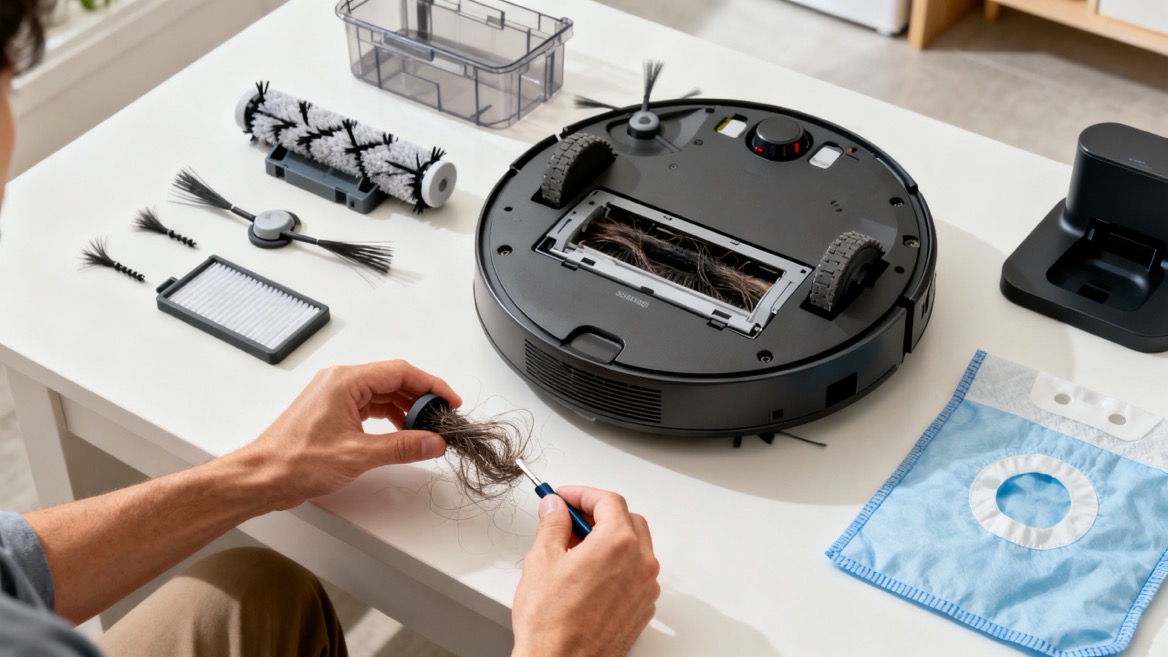
Independent maintenance guidance also shows why automation should not be confused with maintenance-free ownership. Brushes, wheels, and side brushes still require inspection and cleaning.
For commercial buyers, an inexpensive product with difficult-to-source parts may create support burdens that its initial margin does not reveal.
Robot vacuums address scheduled floor cleaning. Other formats address different tasks, making a complementary range worth considering.
| Vacuum format | Suitable purchasing scenario | Key checks |
|---|---|---|
| Robot vacuum | Automated routine floor cleaning | Coverage, docking, obstacle handling, upkeep |
| Upright vacuum | Manual floor cleaning across larger areas | Handling, brush access, floor compatibility |
| Handheld vacuum | Targeted cleaning of furniture or vehicles | Weight, attachments, emptying convenience |
| Corded vacuum | Buyers prioritizing continuous powered operation | Cable reach, storage, usable cleaning range |
| Cordless vacuum | Buyers prioritizing mobility and quick deployment | Runtime by mode, charging, battery arrangements |
Corded and cordless describe power arrangements, not mutually exclusive product shapes. For example, a handheld or upright design may use either configuration.
For retailers, this distinction supports clearer product positioning. Sell each format around the cleaning task it solves rather than presenting every vacuum as a direct substitute.
Customer complaints can become a practical product-development checklist.
A procurement team should ask suppliers to define measurable acceptance criteria before approving production.
Ask for the test method, configuration, accessories, and operating mode behind performance claims.
The 2026 edition of IEC 62885-2 covers methods for measuring performance characteristics of mains-operated and cordless dry vacuum cleaners. Request relevant reports for applicable products; the existence of the standard does not establish that a particular model has been tested or certified.
For robotic products, request evidence appropriate to their additional functions rather than assuming a conventional vacuum test addresses navigation or docking.
Discuss:
- Approved sample specifications and change control.
- Inspection criteria and defect handling.
- Packaging and transport requirements.
- Replacement-part availability.
- Warranty responsibilities and escalation procedures.
- Manuals, labeling, and market-specific documentation.
Treat certifications, production capacity, lead times, and customization scope as items to verify in writing.
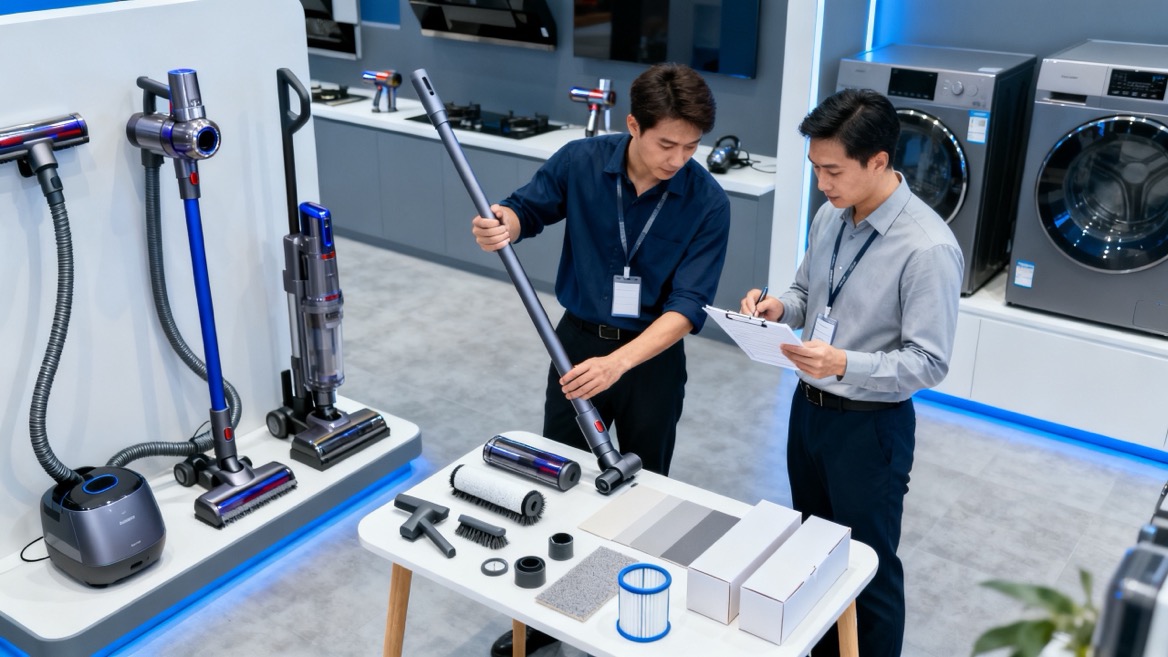
Ningbo Eyunhome Electric Technology Co., Ltd. presents its offering as upright, handheld, corded, and cordless vacuum solutions, supported by OEM/ODM services, stable production, and after-sales assistance.
For buyers building a complementary floor-care range, the discussion should begin with intended use, target market, retail positioning, and required documentation.
The company information supplied for this article does not establish robot-vacuum manufacturing capability, specific certifications, production volumes, or independently verified performance results.
Contact Ningbo Eyunhome with your target market, product format, expected order quantity, customization requirements, and desired launch timing. Request suitable samples, relevant test documentation, and a written support proposal before selecting your production partner.
The best choice depends on flooring, clutter, pets, thresholds, and maintenance preferences. Use independent testing and recent model-specific feedback to shortlist products, then verify suitability during the return period.
No. It indicates fewer strongly dissatisfied reviewers within the submitted reviews. It does not establish a product's failure rate, lifespan, or service performance.
Not automatically. Investigate the reported issues, current software or hardware revisions, local support, and return terms. Do not assume an older complaint has been resolved without evidence.
Yes. Brushes, wheels, filters, and docks require attention according to the manufacturer's instructions. Automated emptying reduces one task but does not eliminate every cleaning responsibility.
It depends on your tasks. Scheduled floor cleaning does not address every staircase, upholstery surface, vehicle interior, or targeted mess. Compare formats around actual cleaning needs.
Provide the target market, intended user, product format, price positioning, order estimate, customization needs, documentation requirements, and launch schedule. Request written confirmation of what the supplier can deliver.
1. [Vacuum Wars — "The Most Loved (or Hated) Robot Vacuums on Amazon – How We Now Score the 1-Star Reviews."] Updated September 18, 2026. Source for the reported review percentages, customer-feedback summaries, independent evaluation findings, and identified naming and scoring inconsistencies. Figures represent the article's snapshot, not live marketplace verification. [vacuumwars]
2. [Federal Trade Commission — "How To Evaluate Online Reviews."] Consumer guidance on comparing review sources, checking recency, and recognizing the limits of identifying deceptive feedback. [consumer.ftc]
3. [Federal Trade Commission — "Federal Trade Commission Announces Final Rule Banning Fake Reviews and Testimonials."] August 14, 2024. Background on deceptive review practices and sentiment-conditioned review incentives. [ftc]
4. [International Electrotechnical Commission — IEC 62885-2:2026, "Surface Cleaning Appliances — Part 2: Dry Vacuum Cleaners for Household or Similar Use — Methods for Measuring the Performance."] Published July 13, 2026. Authoritative description of the standard's scope, including mains-operated and cordless dry vacuum cleaners. [webstore.iec]
5. [RTINGS — "The 4 Best Robot Vacuums of 2026."] Independent buying and maintenance guidance, including brushroll, wheel, and side-brush inspection requirements. [rtings]


