
Views: 243 Author: Eyunhome Vacuum Publish Time: 2026-10-18 Origin: Site


Content Menu
● What Does Vacuum Cleaner Suction Power Actually Mean?
>> Sealed Suction: Maximum Pressure Difference
>> Airflow: Moving Dirt into the Collection System
>> Air Watts: Pressure and Airflow Working Together
● Which Vacuum Cleaners Have the Most Suction Power?
● Why High Suction Does Not Always Mean Better Cleaning
>> Carpet Cleaning Requires Effective Agitation
>> Hard Floors Need Suitable Debris Entry
>> Filtration Must Work Without Ignoring Resistance
● Powerful Upright, Handheld, Corded, and Cordless Vacuums Compared
>> Corded Models: Evaluate the Complete Working Session
>> Cordless Models: Measure Useful Runtime
● A Five-Step Test for Comparing High-Suction Vacuum Cleaners
>> 1. Define the Intended Cleaning Task
>> 2. Keep Test Conditions Consistent
>> 3. Measure Pickup Instead of Appearance Alone
>> 4. Compare Fresh and Partially Loaded Performance
>> 5. Include Handling and Maintenance
● What User Reviews Should Add to Performance Testing
● Turning Cleaning Performance into an OEM/ODM Specification
>> Define Acceptance Criteria Before Sample Approval
>> Connect the Approved Sample to Production Controls
>> Plan Service Support Before Launch
● How Eyunhome Can Support Your Vacuum Cleaner Project
>> 1. Which vacuum cleaner has the most suction power?
>> 2. Is a higher kPa rating always better?
>> 3. Are motor watts the same as suction power?
>> 4. Can cordless vacuum cleaners provide strong suction?
>> 5. What should brands request from a vacuum cleaner manufacturer?
>> 6. How should I start an OEM/ODM vacuum cleaner project?
Vacuum cleaners with the most suction power can make demanding cleaning tasks easier, but the biggest specification does not automatically identify the best machine. For households, retailers, and appliance brands, the real question is whether a vacuum converts its power into consistent dirt removal.
A strong motor matters. So do airflow, brush design, filtration resistance, floorhead geometry, and maintenance requirements.
From a product-selection perspective, I would start with the cleaning task rather than the largest advertised number. Embedded carpet dust, scattered cereal, and pet hair on upholstery require different combinations of pressure, airflow, and agitation.
This guide explains how to compare powerful upright, handheld, corded, and cordless vacuum cleaners—and how to turn those comparisons into a practical sourcing specification.
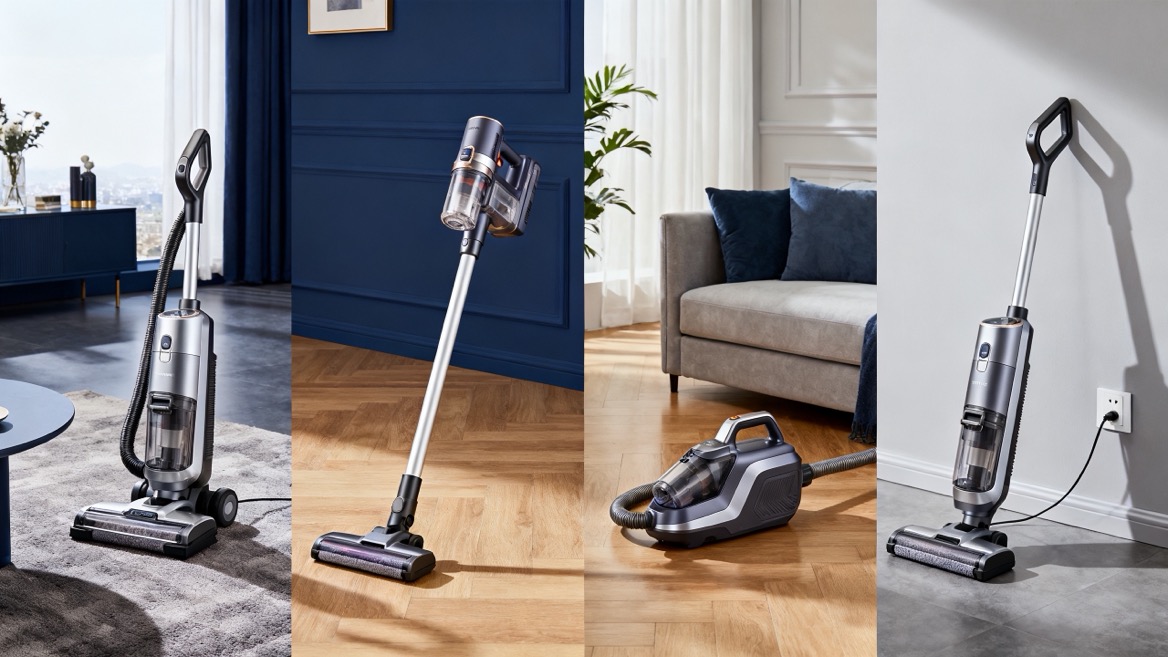
"Suction power" often describes several different measurements. Treating them as interchangeable makes product comparisons unreliable.
Sealed suction measures the pressure difference a vacuum can create when its inlet is blocked under a defined test condition.
Common units include:
- Pascals, or Pa.
- Kilopascals, or kPa.
- Inches of water lift.
This measurement helps describe pressure capability, but it does not show how much air moves during cleaning. At a completely blocked opening, airflow is effectively zero.
A high sealed-suction figure therefore cannot prove excellent carpet pickup or efficient hard-floor cleaning on its own.
Airflow measures the volume of air passing through the vacuum. Common units include cubic feet per minute, or CFM, and liters per second.
Air movement transports loosened debris through the floorhead, wand, and collection system. However, measurements taken at the motor inlet, hose, and floorhead describe different operating conditions.
For meaningful comparisons, request the measurement location, installed accessories, power setting, and filter condition.
Air watts describe pneumatic power by combining pressure difference and airflow at the same operating point.
They are not the same as electrical input watts. A higher-wattage motor does not automatically produce better cleaning.
Nor should buyers multiply a product's maximum sealed suction by its maximum unrestricted airflow. Those maxima occur under different conditions and do not represent a valid operating-point measurement.
Independent testing provides useful benchmarks, provided the results remain tied to the tested models and methods.
In its article updated September 12, 2025, Vacuum Wars reported the following leaders within its tested upright vacuum group.
| Performance category | Reported leading model | Reported result |
|---|---|---|
| Sealed suction | Dyson Ball Animal 3 | 114 inches of water lift |
| Floorhead airflow | Sanitaire Tradition | 155 CFM |
| Usable suction | Dyson Ball Animal 3 | 2.94 kPa |
| Combined Power Score | Dyson Ball Animal 3 | 58 points |
These figures answer different questions. They should not be treated as four interchangeable measures of cleaning ability.
The Combined Power Score is the publisher's own composite ranking, not a universal industry rating. Its article also concentrates on upright machines; it does not establish the strongest vacuum across every cordless, handheld, canister, and commercial category.
The most useful lesson is that different designs lead different measurements. Maximum pressure, maximum airflow, and overall suitability are not identical achievements.
A vacuum is a connected cleaning system. Improving one component while neglecting another can produce an impressive specification and disappointing results.
For embedded carpet dirt, a brush roll helps loosen material so moving air can carry it away.
Evaluate:
- Brush contact with the carpet.
- Pickup after controlled passes.
- Hair accumulation around the roller.
- Push resistance on different carpet constructions.
- Height or suction adjustment.
An excessively restrictive floorhead may feel powerful because it grips the carpet, yet become tiring to push.
A floorhead must admit debris before the vacuum can collect it.
A tightly sealed opening may collect fine dust effectively but push larger particles ahead of the nozzle. Brush behavior also matters: unsuitable agitation can scatter debris.
Test fine dust and larger particles separately. A single demonstration with lightweight crumbs cannot establish complete hard-floor performance.
Filters help retain collected particles, but they also form part of the airflow path.
A filter specification alone does not establish whole-machine dust containment. Housing seals, assembly quality, and the emptying process also deserve attention.
For product development, evaluate pickup and particle containment together rather than presenting filtration as an isolated feature.
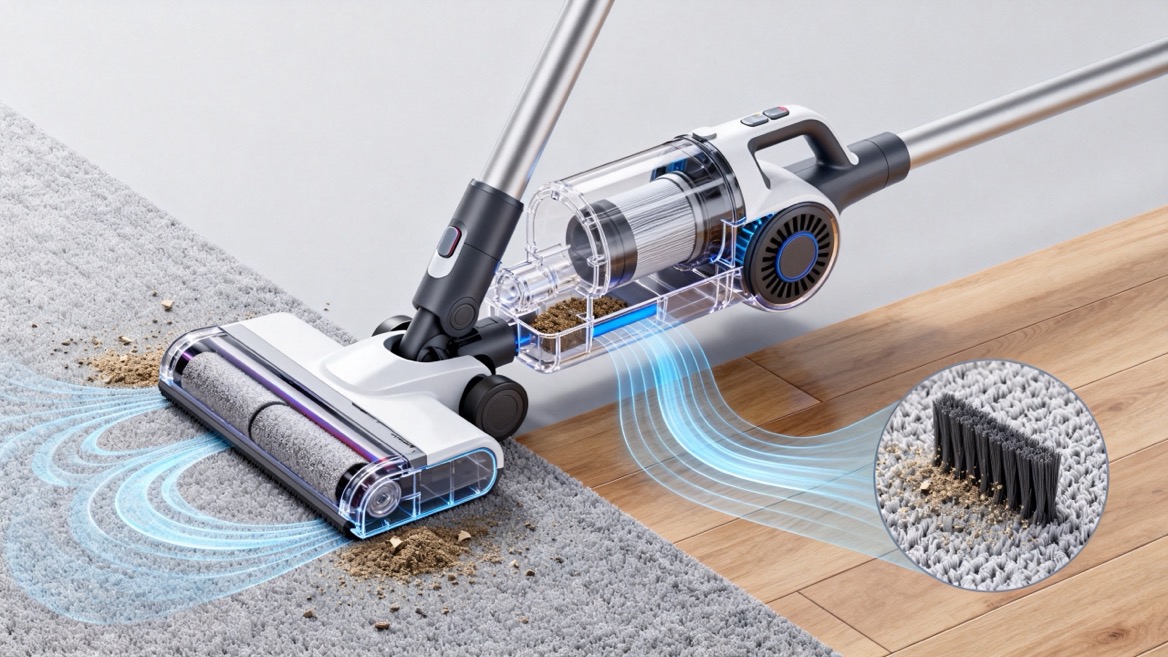
Product format and power source are separate decisions. An upright can be corded or cordless, while a handheld may prioritize portability over full-room coverage.
| Product type | Suitable application | Important evaluation points |
|---|---|---|
| Upright vacuum | Larger carpeted areas | Carpet pickup, floorhead adjustment, maneuverability |
| Handheld vacuum | Stairs, upholstery, vehicle interiors | Tool performance, grip comfort, collection capacity |
| Corded vacuum | Longer cleaning sessions | Reach, handling, sustained pickup |
| Cordless vacuum | Convenient room-to-room cleaning | Runtime with the working head, weight, charging |
Corded operation avoids a battery-runtime limit during use, but convenience still depends on cord reach, socket access, and storage.
For larger spaces, assess how often users must change outlets and whether the machine remains manageable around furniture.
An advertised maximum runtime needs context.
Ask whether the figure was measured:
- In the lowest power mode.
- With a motorized floorhead attached.
- On a specified surface.
- With a fully charged battery.
- Before a defined performance decline.
A more useful buying question is: How long can this vacuum maintain acceptable pickup in the configuration customers will actually use?
Brands and importers need a repeatable comparison process—not just a dramatic demonstration.
The following is a proposed screening workflow. It does not replace a complete laboratory standard.
Specify the main surfaces and debris before selecting samples.
For example, a pet-focused carpet product needs different validation from a lightweight vacuum intended mainly for sealed hard floors.
Document accessories, weight expectations, collection capacity, and maintenance priorities.
Use the same surface, debris quantity, cleaning area, pass count, and operating mode.
Record filter condition, container loading, and battery state where relevant. Repeat tests rather than relying on one favorable run.
Controlled conditions make differences easier to interpret.
Weigh the test debris and determine how much remains after cleaning.
A practical screening calculation is:
Pickup percentage = collected debris mass ÷ initial debris mass × 100.
Account for material scattered outside the test area. For comparable laboratory results, use an appropriate documented method rather than assuming this simplified calculation is sufficient.
An empty-bin demonstration describes only one condition.
Repeat selected tests after a documented loading sequence. Check whether pickup, airflow, handling, or emptying becomes less satisfactory.
This helps reveal products that perform convincingly when fresh but require frequent intervention during normal use.
Time routine tasks such as removing wrapped hair, emptying the container, and accessing filters.
Also assess edge cleaning, accessory changes, storage, and perceived operating comfort.
The strongest candidate should clean effectively without making ownership unnecessarily difficult.
Customer reviews can identify ownership problems that short demonstrations miss. However, comments need traceable context before they become useful evidence.
No verified customer-review dataset was supplied for this article, so no quotations or customer satisfaction claims are presented.
For a future review analysis, group feedback by observable issue:
| Review theme | Evidence worth investigating |
|---|---|
| "Suction became weaker" | Filter condition, blockages, loading, maintenance instructions |
| "Battery does not last" | Operating mode, floorhead, battery age, cleaning duration |
| "Poor pet-hair pickup" | Surface type, attachment used, hair wrapping |
| "Difficult to empty" | Container opening, trapped debris, dust release |
| "Hard to push" | Carpet construction, height setting, floorhead sealing |
These comments suggest investigation routes; they do not establish the cause by themselves.
Keep model names, review dates, and usage conditions attached to the findings. Repeated, specific complaints are more actionable than isolated praise such as "very powerful."
For commercial buyers, consistency matters as much as the best sample result.
A vacuum program should translate the desired customer experience into measurable requirements.
Agree on the conditions under which performance claims will be evaluated.
A useful specification can include:
- Pickup targets for defined surfaces and debris.
- Pressure and airflow measurement locations.
- Cordless runtime with specified accessories.
- Filter and seal inspection requirements.
- Brush-roll access and cleaning procedures.
- Packaging and accessory verification.
IEC 62885-2:2026 provides methods for measuring performance characteristics of household and similar dry vacuum cleaners, including mains-operated and cordless products.
Performance testing should not be confused with product safety approval. Confirm the separate requirements applicable to the destination market.
A successful sample is only the beginning.
Buyers should agree how production units will be checked against the approved configuration. Component substitutions, assembly variation, and accessory changes should follow a documented approval process.
Request clear inspection records and escalation procedures rather than relying only on a general promise of quality.
After-sales planning belongs in product development.
Discuss replacement filters, brush rolls, batteries where applicable, illustrated troubleshooting, and spare-parts arrangements before confirming the program.
A serviceable design can make customer problems easier to diagnose and resolve.
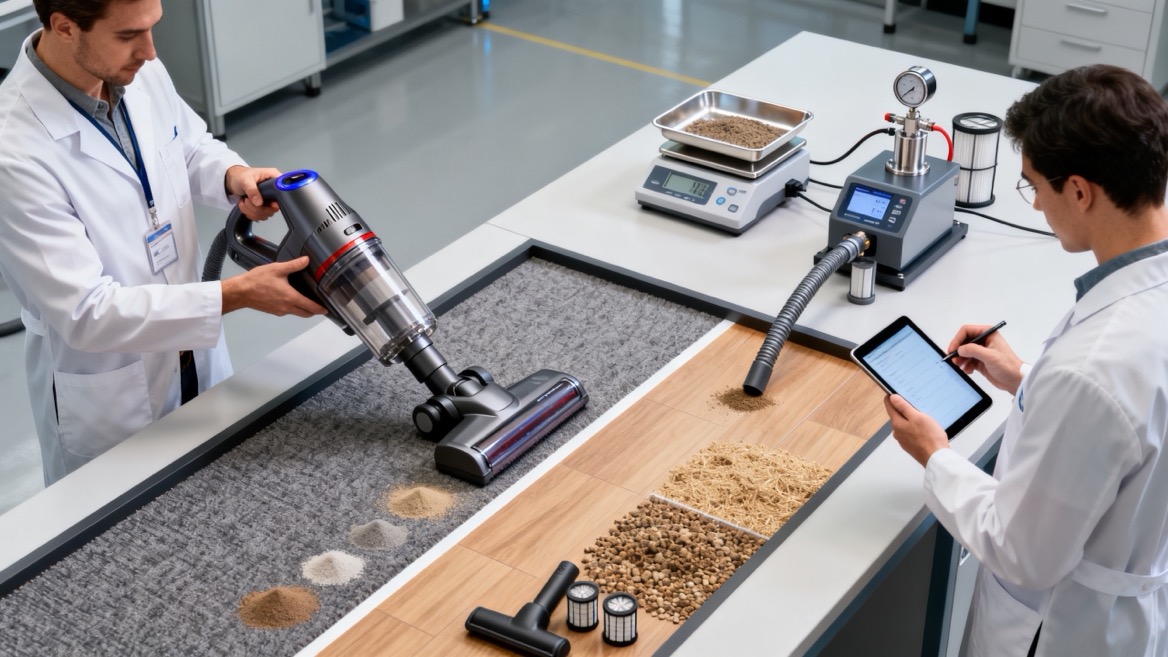
Ningbo Eyunhome Electric Technology Co., Ltd. is a China-based vacuum cleaner manufacturer offering upright, handheld, corded, and cordless solutions.
According to the company information supplied for this article, Eyunhome provides OEM/ODM services, stable production, and after-sales support for global market requirements.
For buyers, the next step is to turn those capabilities into a project-specific proposal.
Share your:
- Target market and intended retail positioning.
- Main floor surfaces and cleaning challenges.
- Preferred product format and power source.
- Performance and runtime expectations.
- Branding, packaging, and accessory requirements.
- Forecast order quantities and service expectations.
Ask Eyunhome to confirm the available configurations, customization scope, validation plan, production arrangements, and support terms for your project.
Choose a development partner around documented requirements and verified samples—not an unsupported suction claim.
Within the upright group covered by the referenced Vacuum Wars article, the Dyson Ball Animal 3 led sealed suction at 114 inches of water lift. That does not establish it as the strongest vacuum in every category or the best choice for every surface.
No. A kPa figure describes pressure under a particular condition. It does not independently establish airflow, brush effectiveness, floorhead pickup, filtration, or handling. Compare the measurement method before comparing the number.
No. Electrical watts describe input power. Cleaning depends on how the system converts that input into pressure, airflow, agitation, and debris collection. Higher electricity consumption alone is not proof of better pickup.
Yes, but peak pressure is only part of the assessment. Compare usable pickup and runtime with the intended floorhead and operating mode. Also evaluate weight, charging arrangements, and battery-service options.
Request a defined specification, representative samples, documented test conditions, production inspection arrangements, applicable market documentation, and after-sales terms. Confirm that every published performance claim matches the tested configuration.
Prepare a brief covering your market, cleaning tasks, product format, target price, expected quantities, and branding needs. Contact Eyunhome with that brief and request a configuration proposal, sample evaluation plan, and quotation.
1. Vacuum Wars. "Vacuum Cleaners with the Most Suction Power." Updated September 12, 2025. Source for the reported upright-vacuum benchmarks, distinctions among sealed suction, airflow, and usable suction, and the publisher's Combined Power Score. The inconsistent Kenmore Elite airflow figure was excluded. [vacuumwars]
2. International Electrotechnical Commission. "IEC 62885-2:2026: Surface Cleaning Appliances—Part 2: Dry Vacuum Cleaners for Household or Similar Use—Methods for Measuring the Performance." Source for the standard's purpose and coverage of mains-operated and cordless dry vacuum cleaners. [webstore.iec]
3. U.S. Environmental Protection Agency. "ENERGY STAR Market and Industry Scoping Report: Vacuum Cleaners." Historical technical background on electrical input power, suction power, airflow, and air watts; not used as evidence of current certification requirements. [nepis.epa]
4. Testfakta. "How We Test—Vacuum Cleaners." Source for practical evaluation categories, including debris pickup, battery capacity, filtration, maneuverability, and emptying. [testfakta]
5. RTINGS. "Samsung Jet 60 Vacuum Review." Model-specific example demonstrating why hose and floorhead measurements must be distinguished. Its results are not generalized to other products. [rtings]


