
Views: 237 Author: Eyunhome Vacuum Publish Time: 2026-10-21 Origin: Site


Content Menu
● What Is a HEPA Filter in a Vacuum Cleaner?
>> Does HEPA Capture Particles Smaller Than 0.3 Microns?
● Why a Sealed Vacuum System Matters
>> Where Should Buyers Check for Potential Leakage?
● HEPA Filter vs. Sealed HEPA Vacuum: What Is the Difference?
● What Whole-Vacuum Filtration Testing Can Tell You
>> Read Beyond the Headline Percentage
● Choosing Between Upright, Handheld, Corded, and Cordless Vacuums
● Are Sealed HEPA Vacuums Helpful for Allergy-Conscious Homes?
>> Consider the Entire Cleaning Routine
● Maintenance: Protecting Performance After Purchase
>> A Practical Maintenance Checklist
● How to Use Customer Reviews Without Turning Opinions into Evidence
>> Turn Verified Feedback into Development Questions
● A Supplier Checklist for HEPA Vacuum OEM/ODM Projects
● Develop Your Vacuum Cleaner Range with Ningbo Eyunhome
>> 1. Is a HEPA filter enough to make a vacuum a sealed HEPA vacuum?
>> 2. Can a cordless vacuum have a sealed filtration system?
>> 3. Does 99.97% filtration mean the room becomes 99.97% cleaner?
>> 4. How can buyers check a supplier's filtration claim?
>> 5. Can I wash a vacuum's HEPA filter?
>> 6. Are household HEPA vacuums suitable for hazardous dust?
Vacuums with HEPA filters and sealed systems address a simple concern: dust collected from the floor should stay inside the machine. For households, that means considering more than visible debris pickup. For retailers and private-label brands, it means choosing products whose filtration claims match their engineering and supporting evidence.
At Ningbo Eyunhome Electric Technology Co., Ltd., we offer upright, handheld, corded, and cordless vacuum cleaner solutions, supported by OEM/ODM services, stable production, and after-sales assistance.
Our approach to this buying decision starts with one principle: containment matters as much as collection. A high-efficiency filter is valuable, but buyers also need to understand airflow, sealing, maintenance, and the performance of the complete vacuum.

HEPA stands for high-efficiency particulate air. The U.S. Environmental Protection Agency describes a HEPA filter as capable of theoretically removing at least 99.97% of airborne particles measuring 0.3 microns.
That figure describes filtration performance under specified conditions. It does not automatically establish the performance of every vacuum containing that filter.
The 0.3-micron figure is not a minimum particle size that the filter can capture. It represents a particularly challenging size range for filtration. Larger and smaller particles can be captured more efficiently.
For buyers, the practical lesson is straightforward: compare the stated efficiency, particle size, and test method together. A percentage without those details provides an incomplete picture.
Also distinguish between a test of filter material, a finished filter cartridge, and an assembled vacuum cleaner.
A sealed vacuum system is designed to prevent collected particles from bypassing the intended filtration path.
Imagine a highly efficient filter installed in a housing with a poorly seated gasket. Air passing through the filter may be cleaned effectively, while air escaping around its edges avoids that protection.
This is why a HEPA filter and a sealed system should be evaluated together.
Important inspection points include:
- The filter frame and surrounding gasket.
- The dust container lid and release mechanism.
- Housing joints along the contaminated airflow path.
- Filter access covers and locking features.
- Connections disturbed during routine cleaning.
The significance of each location depends on the vacuum's airflow design. A visual inspection can identify fit problems, but it cannot establish a numerical filtration efficiency.
The EPA makes this distinction explicitly in its guidance for renovation cleanup: fitting a HEPA filter into a vacuum does not necessarily make the complete machine properly sealed. That guidance concerns a specialized application, but the underlying engineering distinction is useful for household product evaluation.
These terms describe different aspects of performance and should not be treated as interchangeable.
| Product description | What it tells you | What still needs verification |
|---|---|---|
| HEPA filter | The filter has a stated filtration capability | Test conditions and supporting documentation |
| Vacuum with a HEPA filter | A HEPA filter is included | Whether contaminated air can bypass it |
| Sealed filtration system | Airflow containment is part of the design | How sealing performance was evaluated |
| Whole-system filtration result | The assembled vacuum was evaluated | Particle sizes, operating conditions, and limitations |
| "HEPA-type" filter | A marketing description is being used | Actual efficiency and test basis |
From a product-development perspective, the strongest specification is not the longest feature list. It is a clear statement connecting a defined product configuration with an appropriate test result.
A filter certificate and a whole-vacuum test report answer different questions.
ASTM F1977 provides a method for determining the initial fractional filtration efficiency of a vacuum cleaner system. It covers several formats, including upright, stick, handheld, and canister machines.
The published method evaluates performance at multiple particle sizes with new filters and without preliminary dust loading.
When reviewing a report, ask:
1. Which model and filter configuration were tested?
2. Was the assembled vacuum tested, or only a component?
3. Which particle sizes were measured?
4. What operating mode and test connection were used?
5. Were motor emissions included or mathematically removed?
6. Does the report describe initial performance only?
That final question matters. An initial filtration result does not establish performance after months of use, repeated filter removal, or damaged seals.
For private-label projects, agree on the evidence needed before approving packaging claims. A report should support the wording actually used, rather than a broader interpretation.
Product format should follow the cleaning task. Filtration requirements should then be evaluated within that format.
Also remember that these categories overlap: an upright vacuum can be corded or cordless, and a cordless model may convert into a handheld unit.
| Format | Typical buying priority | Questions to include in evaluation |
|---|---|---|
| Upright | Routine floor cleaning | Is the machine manageable, and are filters accessible? |
| Handheld | Furniture, stairs, and localized cleanup | Is emptying controlled, and is the filter easy to reinstall? |
| Corded | Cleaning without battery-runtime limits | Does cable handling suit the intended environment? |
| Cordless | Mobility and convenient storage | What runtime is available in the required cleaning mode? |
Avoid assuming that a larger machine filters better, or that a compact machine cannot offer effective filtration. Compare evidence for the actual model.
For cordless products, specify the mode, attachment, and conditions behind runtime claims. A maximum runtime figure alone may not describe the customer's normal cleaning routine.
The Asthma and Allergy Foundation of America recommends weekly vacuuming with a HEPA-filter vacuum as part of dust mite management.
However, it also explains that vacuuming alone cannot remove all dust mites and their waste. Material embedded deep in upholstery, bedding, and carpeting can remain.
This sets an important boundary for product communication. A vacuum can support a cleaning routine; it should not be presented as a cure for allergies or a guarantee of symptom relief.
For an allergy-conscious household, useful evaluation questions include:
- Can the user empty the container without unnecessary handling of dust?
- Are replacement filters readily available?
- Are maintenance instructions clear?
- Can upholstery and difficult edges be cleaned with suitable tools?
- Does the product documentation explain its limitations?
These questions connect filtration specifications with the way a customer actually lives with the machine.
A vacuum's filtration system must remain correctly assembled throughout its service life. Instructions should make that easy, rather than relying on users to interpret unclear diagrams.
1. Switch off and disconnect the vacuum before maintenance.
2. Empty the container before exceeding the marked fill limit.
3. Inspect accessible seals for trapped debris or visible damage.
4. Reinstall filters in the correct position.
5. Wash only components specifically identified as washable.
6. Allow washed components to dry as instructed before refitting.
7. Replace damaged or worn components according to the manual.
Do not assume every HEPA filter is washable. The correct procedure depends on the filter construction and the product instructions.
There is also no single replacement interval suitable for every vacuum and household. Follow model-specific guidance and consider usage conditions.
For brands, maintenance instructions are part of product quality. Clear illustrations, identifiable replacement parts, and accessible support can make correct ownership easier.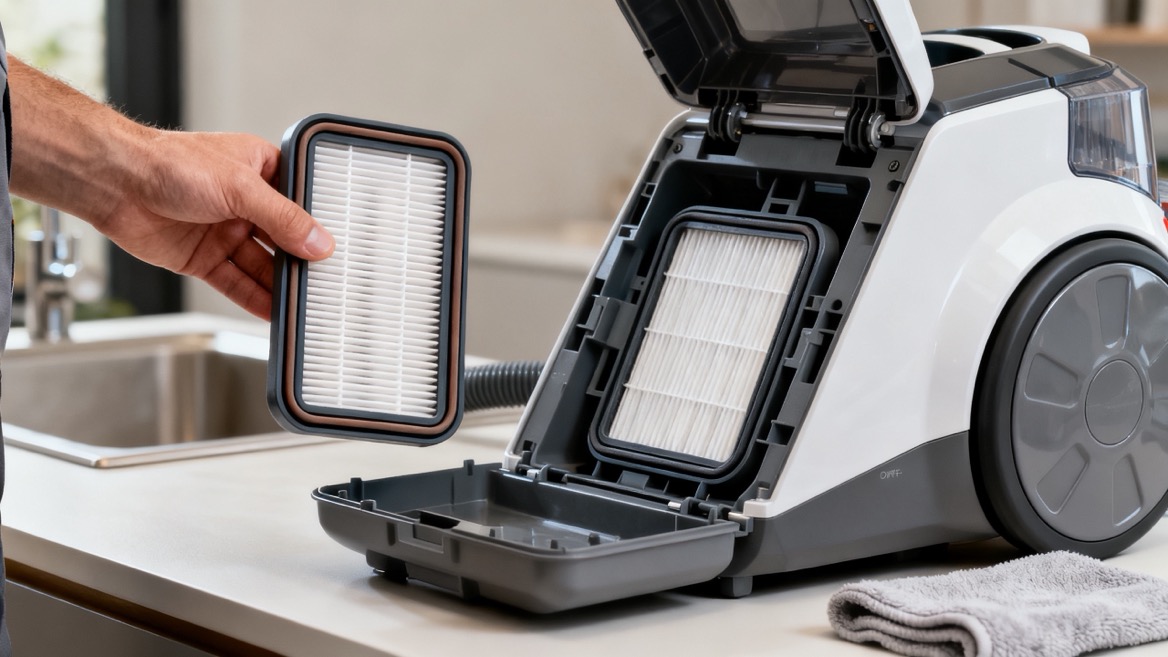
Reviews are useful for understanding usability. They are not a substitute for controlled particle-filtration testing.
A customer may describe excellent pickup, awkward emptying, or a filter that is difficult to fit. Those observations can help identify practical design priorities. They do not establish a verified capture percentage.
| Review topic to investigate | Follow-up question |
|---|---|
| Dust released during emptying | Can the container be opened and emptied more controllably? |
| Filter installation feels uncertain | Would guides, clearer markings, or a more positive lock help? |
| Performance changes during use | Were blockages, filter condition, and operating mode checked? |
| Replacement parts are difficult to find | Can part identification and ordering be simplified? |
| Maintenance instructions are confusing | Which steps need better illustrations? |
These are proposed review-analysis categories, not quotations from Eyunhome customers.
When publishing real testimonials, obtain permission where appropriate, preserve their meaning, and identify the relevant product. Keep personal impressions separate from laboratory findings.
A useful development brief defines what the product must do, how it will be evaluated, and how it will be supported after shipment.
Begin with the target customer and cleaning environment. Then translate those needs into measurable requirements.
Ask a prospective manufacturing partner to clarify:
- Available product platforms and customization options.
- Proposed filtration architecture.
- Evidence supporting any filtration claims.
- Sample configuration and evaluation procedures.
- Maintenance access and replacement-part identification.
- Production quality-control arrangements.
- After-sales responsibilities and communication channels.
Avoid leaving phrases such as "premium filtration" undefined. Agree on the required test scope and claim wording.
Confirm that the approved filter, gasket, housing, and assembly specifications are reflected in production documentation.
Also agree how material or component changes will be reviewed. A report for one configuration should not automatically be assumed to cover a changed design.
This approach makes sourcing discussions more productive: both parties can work toward defined acceptance criteria rather than different interpretations of quality.
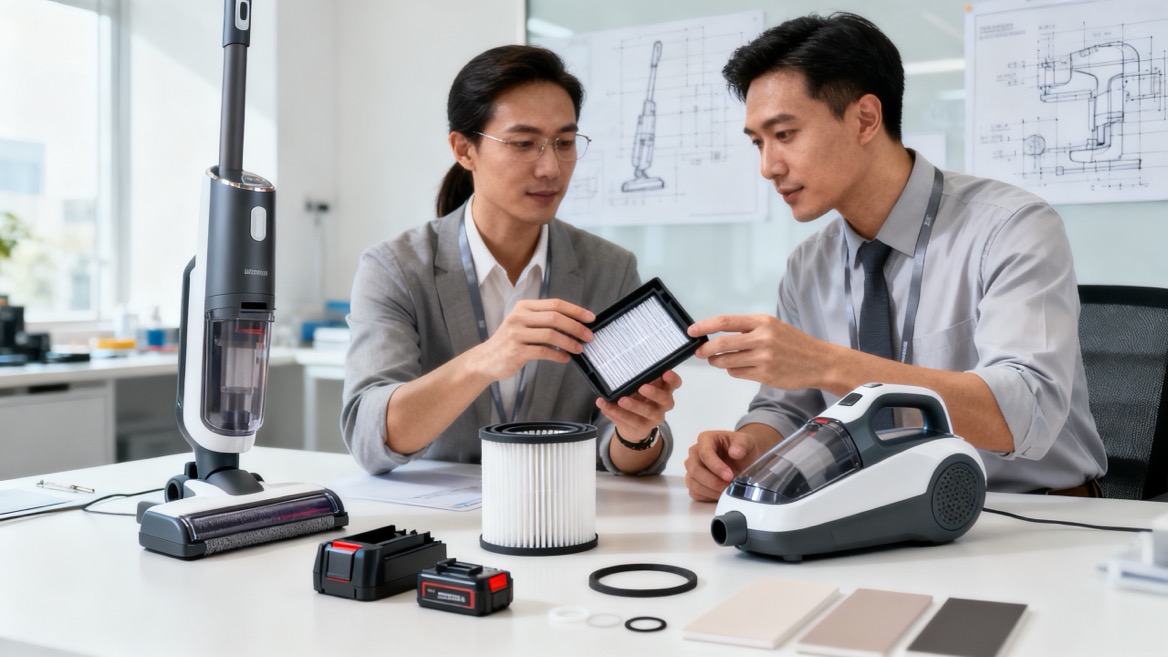
Ningbo Eyunhome Electric Technology Co., Ltd. supplies upright, handheld, corded, and cordless vacuum cleaner solutions for business customers.
We provide professional OEM/ODM services, stable production, and reliable after-sales support to help customers address international market requirements.
For a filtration-focused project, begin by sharing your target market, preferred format, expected cleaning tasks, and documentation requirements. Model-specific filtration performance and applicable approvals should be confirmed during product evaluation.
Contact Ningbo Eyunhome with your product brief to discuss available platforms, customization options, sample evaluation, and after-sales arrangements.
No. The filter and the surrounding airflow system must be considered together. A filter rating alone does not demonstrate that the assembled vacuum prevents unfiltered air from bypassing it.
Yes, cordless operation and sealed filtration are separate design considerations. Buyers should verify the actual model's construction and supporting evidence rather than judging filtration by its power source.
No. A filtration percentage describes performance under stated test conditions. It is not a measurement of the percentage of all dust removed from a room, nor a guarantee of health outcomes.
Request documentation identifying the tested model, filter configuration, method, particle sizes, and operating conditions. Confirm whether the result applies to filter material, a cartridge, or the complete machine.
Only if the manufacturer explicitly identifies it as washable. Follow the specified washing and drying instructions. Do not apply cleaning instructions for one filter type to another.
Do not assume so. Lead, asbestos, and other hazardous materials can require specialized equipment and procedures. Confirm suitability for the exact material and applicable requirements before selecting a machine.
1. Vacuum Wars. "Not All HEPA Filters Are Created Equal: A Deep Dive into Air Purifier HEPA Filter Issues." Background reading on filter claims and sealing; not used here as proof of Eyunhome product performance. [Read the source]. [vacuumwars]
2. U.S. Environmental Protection Agency. "What Is a HEPA Filter?" Source for the HEPA definition, 99.97% benchmark, and particle-size explanation. [Read the source]. [epa]
3. U.S. Environmental Protection Agency. "The RRP Rule Requires HEPA Vacuums to Be Used for Cleaning Up the Dust Created by Renovations. What Should I Look for When Purchasing a HEPA Vacuum?" Source for the distinction between adding a filter and designing a complete sealed vacuum. Its regulatory context is renovation cleanup. [Read the source]. [epa]
4. ASTM International. "ASTM F1977-22: Standard Test Method for Determining Initial, Fractional, Filtration Efficiency of a Vacuum Cleaner System." Source for whole-system testing scope, particle sizes, and initial-condition limitations. [Read the source]. [store.astm]
5. Asthma and Allergy Foundation of America. "Dust Mite Allergy." Source for HEPA vacuuming advice and the limitations of vacuuming alone. [Read the source]. [aafa]


