
Views: 268 Author: Eyunhome Vacuum Publish Time: 2026-11-08 Origin: Site


Content Menu
● HEPA H13 vs Standard HEPA Filters: Quick Comparison
>> Does H13 Mean "Medical Grade"?
● What Does "Standard HEPA" Actually Mean?
>> True HEPA vs HEPA-Type Filters
● Is H13 Better Than 99.97% HEPA?
>> Why the Percentage Alone Is Insufficient
● How HEPA Filters Capture Fine Particles
● Why Vacuum Sealing Can Matter More Than the Filter Label
>> An Illustrative Leakage Calculation
● H13 Filtration, Suction, and Cordless Runtime
>> Upright, Corded, and Handheld Vacuums
● Which Filter Is Better for Allergens, Pet Dust, and Odors?
>> Pet Hair and Fine Dander Require Different Solutions
>> HEPA Does Not Automatically Remove Odors
● A Practical OEM/ODM Filter Verification Workflow
>> Step 1: Define the Intended Claim
>> Step 2: Request Traceable Documentation
>> Step 3: Evaluate the Assembled Vacuum
>> Step 4: Control Production Changes
● Compare Ownership Cost, Not Just Filter Price
● Develop a Vacuum Cleaner Around Verified Performance
>> Is H13 Better Than True HEPA?
>> Can H13 Filters Capture Particles Smaller Than 0.3 Microns?
>> Can I Upgrade Any Vacuum to an H13 Filter?
>> Are H13 HEPA Filters Washable?
>> How Often Should a HEPA Vacuum Filter Be Replaced?
>> Does an H13 Filter Make a Vacuum Suitable for Hazardous Dust?
Comparing HEPA H13 vs standard HEPA filters is not simply a question of which label sounds more advanced. H13 identifies a specific filter class under the European EN 1822 standard. "Standard HEPA," however, is not one universally defined classification. In the United States, HEPA commonly refers to filtration efficiency of at least 99.97% at 0.3 microns.
For vacuum cleaner brands, importers, and distributors, that distinction matters. A filter's rating influences product specifications, but it does not independently establish how effectively a complete vacuum contains dust.
At Ningbo Eyunhome Electric Technology Co., Ltd., our approach to OEM/ODM product discussions starts with the intended application: what customers need to clean, how the vacuum will be maintained, and which performance claims require verification. Here is how to compare these filters without confusing laboratory efficiency with everyday cleaning performance.
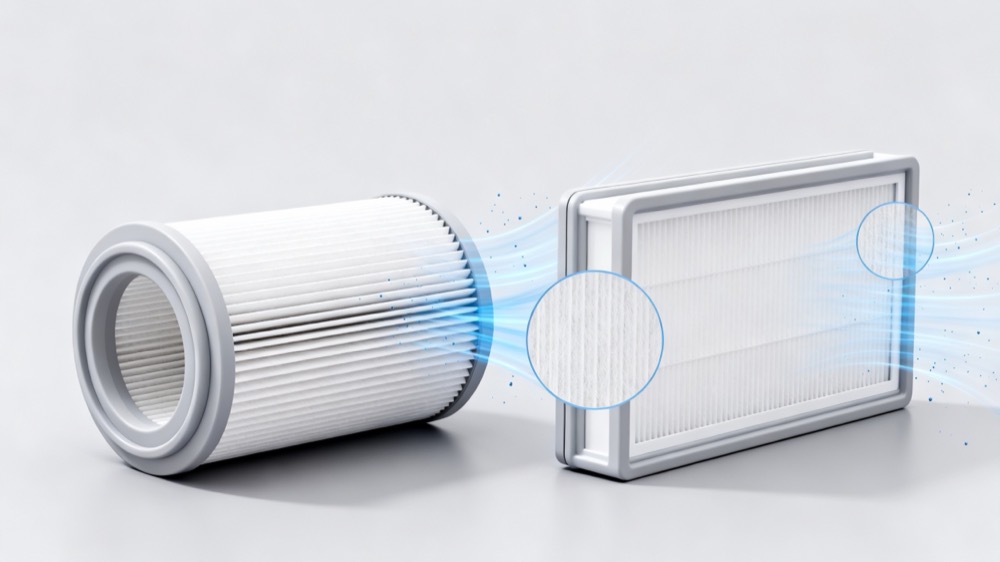
The most important distinction is test conditions, not the appearance of the filter or the wording on its packaging.
| Comparison point | H13 HEPA filter | Standard HEPA filter |
|---|---|---|
| Meaning | A defined class under EN 1822 | A general description requiring clarification |
| Common efficiency specification | At least 99.95% overall efficiency at MPPS | Common U.S. definition: at least 99.97% at 0.3 microns |
| Particle-size basis | The filter's most penetrating particle size | Usually a stated 0.3-micron reference |
| What buyers should verify | Classification, airflow, filter identity, and test documentation | Applicable definition, test method, particle size, and documentation |
| Whole-vacuum performance | Not established by the filter class alone | Not established by the HEPA label alone |
| Best purchasing approach | Evaluate the filter and assembled vacuum together | Request measurable specifications rather than relying on terminology |
Neither column automatically represents the better vacuum. The comparison becomes meaningful only when testing conditions and product construction are understood.
An H13 HEPA filter belongs to the high-efficiency particulate air filter classifications defined by EN 1822. Its minimum overall collection efficiency is 99.95% at the most penetrating particle size, usually abbreviated as MPPS.
MPPS describes the particle size that passes through a particular filter most readily under specified test conditions.
It is not a universal particle diameter. Filter media and operating conditions influence where this most challenging size occurs. Camfil describes a typical MPPS range of approximately 0.1–0.2 microns for its discussion of HEPA factory testing.
This explains why H13 should not simply be described as "99.95% at 0.3 microns." That wording replaces an MPPS-based classification with a different specification.
"Medical grade" is not the EN 1822 filter class itself. H13 identifies filtration performance, not approval of an entire vacuum for healthcare, infection control, or hazardous-material cleanup.
A household vacuum containing an H13 filter should therefore not be presented as a medical device or specialist dust extractor without separate, relevant evidence.
"Standard HEPA" needs a definition before it can support a useful product comparison.
The U.S. Environmental Protection Agency describes HEPA filters as capable of removing at least 99.97% of airborne particles measuring 0.3 microns. That definition provides a familiar reference point, but a supplier should still identify how its particular filter was tested.
Terms such as "true HEPA," "HEPA-type," and "HEPA-style" can appear in product descriptions. Their wording alone does not establish a verified efficiency.
For procurement, I would replace the question "Is it HEPA?" with four more useful questions:
- Which standard or test procedure supports the claim?
- What particle size was measured?
- At what airflow was the filter evaluated?
- Does the report cover the media, finished filter, or complete vacuum?
A clearly documented specification is more valuable than an impressive but unexplained label.
Not automatically. Although 99.97% is numerically higher than 99.95%, the figures commonly describe different test bases.
H13 is evaluated at MPPS. The familiar U.S. HEPA definition refers to 0.3-micron particles. Comparing those percentages without explaining the measurement conditions can mislead buyers.
Imagine two suppliers offering these descriptions:
- Supplier A: "H13, at least 99.95% at MPPS."
- Supplier B: "HEPA, at least 99.97% at 0.3 microns."
Those statements alone do not establish which filter performs better across all particle sizes or operating conditions. One filter may satisfy both specifications, but that must be demonstrated rather than assumed.
For a fair comparison, request results using matching particle sizes, airflow conditions, and test scope wherever possible.
HEPA filters do not work like kitchen sieves with a simple minimum hole size. Their fibrous structure captures particles through several mechanisms, including interception, impaction, and diffusion.
Larger particles are more likely to contact fibers through interception or impaction. Very small particles move irregularly and can collide with fibers through diffusion.
Consequently, particles smaller than 0.3 microns are not automatically too small to capture. The EPA explains that particles larger or smaller than the commonly cited 0.3-micron reference can be captured with greater efficiency.
However, particle capture does not mean sterilization. A HEPA filter can retain particles without proving that it kills microorganisms.
A high-efficiency filter only treats air that actually passes through it.
If dusty air escapes around a filter frame, dust-container connection, or housing joint, the filter's laboratory rating cannot describe the entire machine's emissions.
The EPA makes this distinction explicitly in its guidance for lead-renovation HEPA vacuums: the machine must direct its intake air through the final HEPA filtration stage without air leaking past it. That guidance concerns a specific regulated application, but the underlying engineering distinction is relevant to ordinary vacuum design.
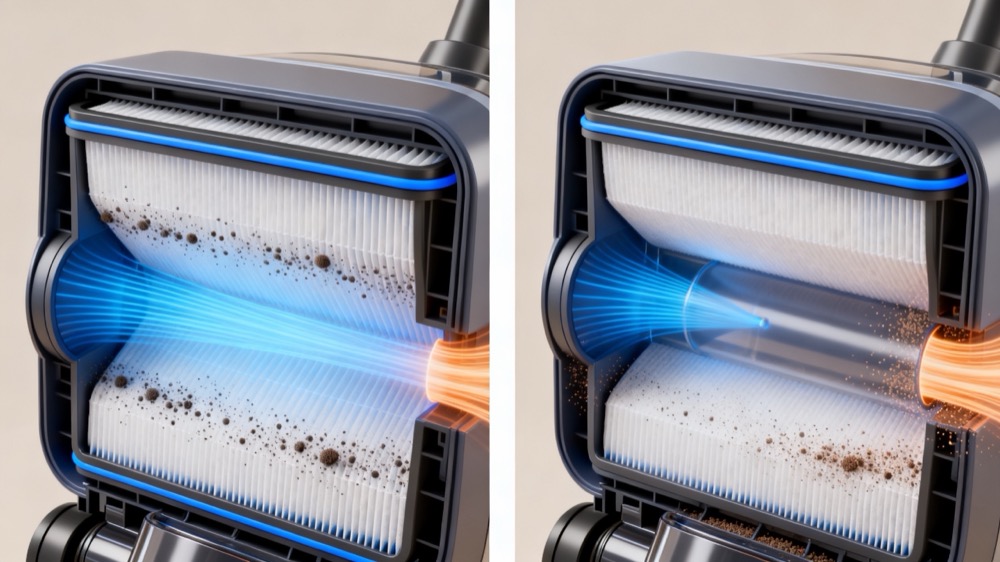
Suppose a filter captures 99.95% of the relevant test particles, but 1% of particle-bearing airflow bypasses it completely.
Assuming equal particle concentration in both airflow paths, the simplified overall capture becomes:
99% × 99.95% = approximately 98.95%.
This is an illustration, not a measured result for any Eyunhome product. It shows why even modest bypass can outweigh small differences between high filter-efficiency percentages.
For buyers, the practical lesson is to request whole-machine testing, not just a filter certificate.
Filtration efficiency is only one part of vacuum performance. Airflow resistance also matters.
A filter's pressure drop depends on its media, usable surface area, pleat arrangement, airflow, and dust loading. H13 classification alone does not specify how restrictive a finished filter will be.
For cordless designs, evaluate filtration alongside:
- Cleaning performance at each power setting.
- Runtime under a clearly defined operating mode.
- Airflow with clean and dust-loaded filters.
- Noise and operating temperature.
- Filter accessibility and replacement cost.
Do not assume that installing H13 media will produce a fixed runtime penalty. The outcome depends on the complete motor, battery, airflow, and filtration design.
Corded models still need an appropriate balance between airflow and resistance. Compact handheld models may face tighter packaging constraints.
The right specification is therefore application-specific. An effective filter must fit the available space while supporting the vacuum's intended cleaning performance.
Both properly specified H13 and conventional HEPA filters can capture fine particles associated with household dust, pollen, and animal dander.
For allergy-conscious households, the more useful comparison includes sealing, dust containment, maintenance, and emptying—not just the filter label.
Visible pet hair and fine airborne particles create different engineering challenges.
Brush design and pickup performance influence hair collection. Fine-particle filtration influences what remains in the exhaust airflow. A product intended for pet owners needs both.
HEPA filtration primarily targets particles. Odors and gaseous pollutants require a different treatment approach, often involving appropriately selected adsorbent media.
Likewise, a vacuum is not a substitute for ventilation or a suitably sized room air cleaner. Its primary purpose is surface cleaning.
Avoid promising allergy relief, odor elimination, or disease prevention solely because a vacuum contains an H13 filter.
For private-label development, a structured verification process makes specifications clearer and reduces avoidable misunderstandings.
Specify whether the claim concerns:
1. Filter media efficiency.
2. Finished-filter classification.
3. Complete-vacuum particle containment.
These are different claims and need corresponding evidence.
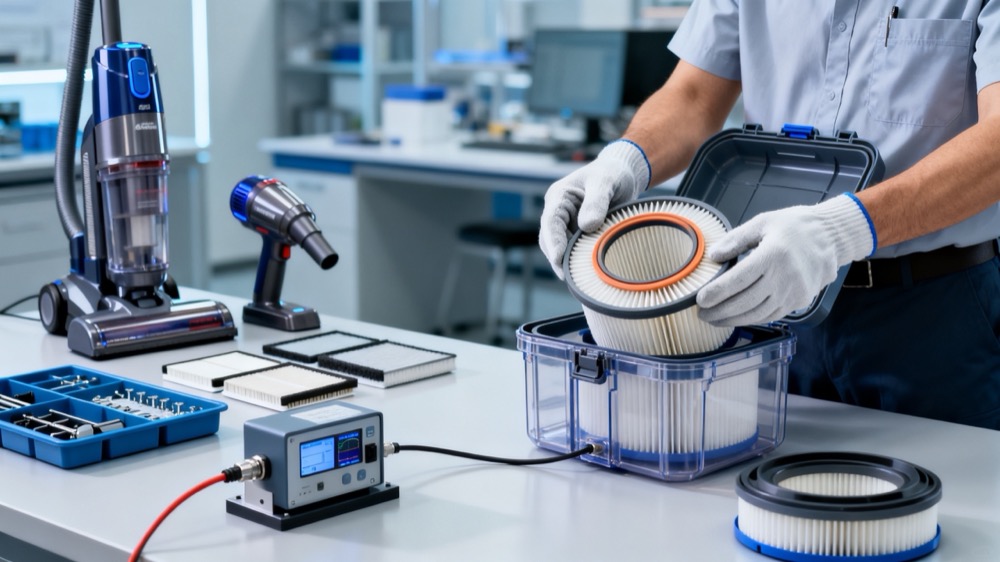
Ask for the filter model, applicable standard, tested airflow, particle-size basis, results, laboratory details, and test date.
Confirm that the report matches the proposed production component rather than a similar-looking sample.
Assess filtration together with pickup, airflow, sealing, noise, runtime where applicable, and dust-emptying behavior.
Where relevant, agree on testing after representative dust loading and maintenance cycles rather than evaluating only a new sample.
Record approved media, dimensions, sealing materials, and assembly requirements. Agree on when component substitutions require additional verification.
A documented development sample is useful only if production remains aligned with it.
A lower filter purchase price does not necessarily create a lower-cost product.
Compare expected replacement expenditure, availability, cleaning instructions, customer effort, and after-sales requirements. Use an agreed usage scenario rather than assuming every customer replaces filters at the same interval.
For example, ask suppliers to quote both the vacuum and replacement filters for the planned sales market. Confirm whether replacements will remain available throughout the intended support period.
This helps distributors avoid a familiar problem: selling an attractive vacuum that later becomes difficult to maintain.
The best answer to "HEPA H13 vs standard HEPA filters" is not a label-based winner. It is a documented match between filtration requirements, machine design, customer expectations, and maintenance.
Ningbo Eyunhome Electric Technology Co., Ltd. provides upright, handheld, corded, and cordless vacuum cleaner solutions with OEM/ODM services, production support, and after-sales assistance.
Contact our team with your target market, preferred vacuum format, filtration claim, and expected price range. Request a model-specific discussion covering filter options, available test documentation, replacement-filter supply, and sample evaluation before confirming your specification.
Not necessarily. H13 is a defined EN 1822 class, while "true HEPA" needs a stated test basis. Compare documented efficiency under equivalent conditions and check complete-vacuum containment.
Yes. HEPA filtration can capture particles below 0.3 microns. Smaller does not automatically mean harder to capture because diffusion contributes to collecting very small particles.
No. The replacement must match the vacuum's dimensions, seals, airflow requirements, and manufacturer instructions. A higher-rated filter does not automatically make the machine properly sealed.
H13 classification does not establish washability. Follow the instructions for the exact filter. Do not rinse, brush, or use compressed air unless the manufacturer permits that method.
There is no universal interval. Replacement depends on the filter design, dust exposure, usage, and maintenance instructions. Replace damaged filters and investigate persistent airflow loss according to the product manual.
No. Hazardous-dust applications can require dedicated equipment, containment features, and application-specific compliance. Do not select an ordinary household vacuum for such work based on H13 labeling alone.
1. U.S. Environmental Protection Agency. ["What Is a HEPA Filter?"] Explains the common 99.97% at 0.3-micron definition and particle-size capture behavior. [epa]
2. Camfil. ["EN 1822 and ISO 29463 HEPA Filter Factory Test."] Explains MPPS-based testing and HEPA filter verification. [camfil]
3. Camfil. ["Absolute™ VGHF."]/absolute-vghf) Documents H13 efficiency of 99.95% at MPPS and individual EN 1822 testing for the specified product range. [camfil]/absolute-vghf)
4. U.S. Environmental Protection Agency. ["The RRP Rule Requires HEPA Vacuums…"] Distinguishes HEPA filter installation from properly designed, sealed HEPA vacuum equipment in lead-renovation applications. [epa]
5. U.S. Environmental Protection Agency. ["Residential Air Cleaners: A Summary of Available Information."] Discusses mechanical particle filtration, gaseous-pollutant limitations, and airflow-resistance considerations. [19january2017snapshot.epa]
6. U.S. Environmental Protection Agency. ["Air Cleaners and Air Filters in the Home."] Explains the role and limitations of room and central-system air filtration. [epa]


