
Views: 228 Author: Eyunhome Vacuum Publish Time: 2026-11-09 Origin: Site


Content Menu
● Why Source Bagless Cordless Stick Vacuums from China?
>> What the Latest Industry Data Actually Shows
● How We Selected These Manufacturers
● Top 10 Bagless Cordless Stick Vacuum Manufacturers in China
>> 1. Ningbo Eyunhome Electric Technology Co.,Ltd.
>> 2. KingClean Electric Co., Ltd.
>> 3. Suzhou EUP Electric Co., Ltd.
>> 4. Suzhou Chunju Electric Co., Ltd.
>> 5. Suzhou Cleva Electric Appliance Co., Ltd.
>> 6. Suzhou Dibea Electrical Technology Co., Ltd.
>> 7. LIYYOU
>> 10. Guangdong Deerma Technology Co., Ltd.
● Manufacturer Comparison: Capacity, MOQ, and Compliance
● Technical Buyer's Guide: What to Specify Before Comparing Prices
>> Compare Cleaning Performance Under the Same Conditions
>> Specify Material Grades and Workmanship
>> Separate Factory Systems from Product Compliance
● Common Sourcing Problems and How to Avoid Them
>> Problem 1: The Production Unit Is Not the Approved Sample
>> Problem 2: Quoted Capacity Includes Unrelated Products
>> Problem 3: Compliance Documents Cover a Different Configuration
>> Problem 4: A Low Purchase Price Creates Expensive Service Obligations
>> An Overlooked Trap: Freezing the Product Without Freezing Its Firmware
● A Practical Sampling and Factory-Verification Process
>> Plan Battery Logistics Before Confirming Delivery Dates
● Conclusion: Choose a Reproducible Product and an Accountable Partner
● FAQs
>> 1. How Can I Check Whether a Supplier's ISO Certificate Has Expired or Been Suspended?
>> 3. How Should I Verify a "HEPA Filtration" Claim?
>> 4. What Should the Contract Say About Tooling and Product Exclusivity?
>> 5. How Can We Reduce the Risk of Discontinued Replacement Batteries?
Choosing a bagless cordless stick vacuum manufacturer in China requires more than comparing suction claims and unit prices. For procurement managers, the stronger long-term partner is the supplier that can reproduce an approved sample consistently, document compliance for the destination market, and support batteries, filters, and other replacement parts after shipment.
This guide compares ten Chinese manufacturers and manufacturer-led brands with relevant cordless cleaning products. Ningbo Eyunhome Electric Technology Co., Ltd. appears first as a practical starting point for buyers seeking customization and direct factory communication. Larger manufacturing groups and established consumer brands follow, with their different cooperation models clearly identified.
This is a research-based procurement shortlist, not a laboratory-tested performance ranking or an independently audited factory assessment. Company capabilities are attributed to public sources; unpublished minimum order quantities, model-specific production capacity, and current certificate validity are not assumed.
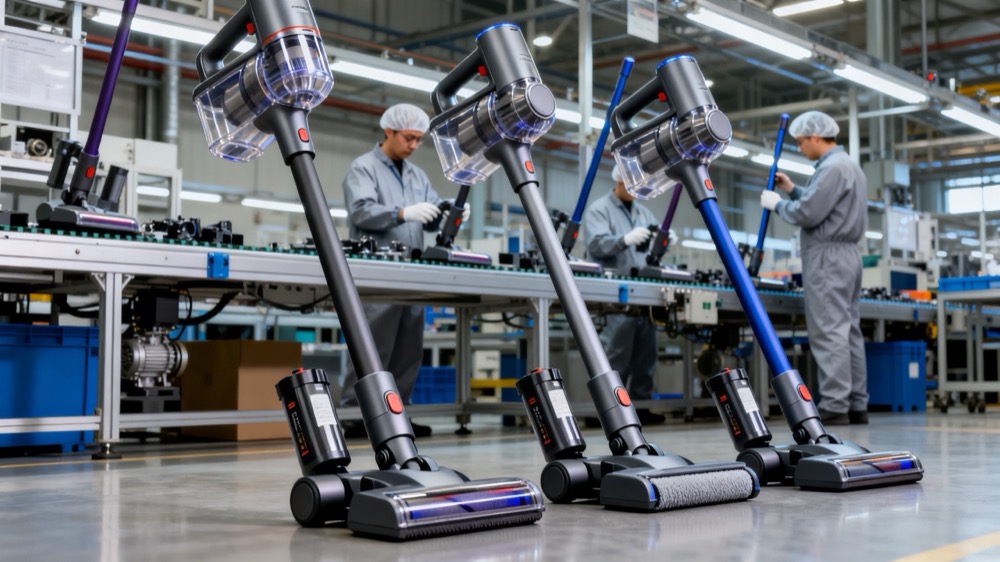
China offers an established cleaning-appliance supply base spanning product development, motors, plastic molding, electronics, battery packs, and final assembly. The companies in this guide illustrate three relevant sourcing locations: Suzhou in Jiangsu, Ningbo in Zhejiang, and Shunde in Foshan, Guangdong. Their published profiles show both vertically integrated manufacturing groups and more specialized cleaning-appliance businesses.
For international buyers, the commercial advantage is not simply a lower factory price. It is the opportunity to source an existing cordless vacuum platform, adapt its configuration, and coordinate branding, packaging, accessories, and production through one development relationship.
The China Household Electrical Appliances Association's April 2026 review reports that China's cleaning-appliance market reached 35.5 million units and RMB 47.1 billion in sales during 2025, increasing 17% and 11.3%, respectively. However, these figures cover the broader cleaning-appliance category, including floor washers and robotic vacuum cleaners. They should not be presented as the market size of bagless cordless stick vacuums alone.
For export context, China's General Administration of Customs publishes official major-export tables, including household-appliance totals. Those aggregate tables provide useful trade context, but they do not establish the export volume of cordless stick vacuums as a separate product segment. Buyers evaluating demand should distinguish customs categories from commercial product descriptions.
The practical implication is straightforward: China has a substantial cleaning-appliance ecosystem, but supplier selection still needs to happen at the factory, platform, and destination-market levels.
The shortlist uses six procurement dimensions rather than an unsupported "largest equals best" ranking.
| Selection dimension | Evidence buyers should request | Why it matters |
|---|---|---|
| Manufacturing identity | Business license, production address, factory audit, subcontractor disclosure | Establishes who actually makes the product |
| Development capability | Engineering team, existing platforms, tooling ownership, validation records | Separates meaningful customization from cosmetic relabeling |
| Quality control | Incoming inspection, in-process checks, final inspection, traceability | Helps prevent differences between samples and bulk orders |
| Compliance readiness | Current management-system certificates and model-specific technical files | Connects documentation to the actual product being purchased |
| Delivery reliability | Production schedule, component availability, historical on-time delivery | Tests whether quoted lead times are commercially realistic |
| Lifecycle support | Spare-parts plan, battery availability, warranty procedure, change control | Protects the buyer after the first shipment |
Public company information supports initial screening, not final approval. In particular, a company-wide production figure does not reveal how much capacity is available for your selected bagless cordless stick vacuum.
For a transparent purchasing process, separate three questions:
1. Can this supplier develop or supply the product?
2. Can it manufacture the approved configuration consistently?
3. Will it accept your order size, customization requirements, and service obligations?
- Established: 2011.
- Location: Ningbo, Zhejiang.
- Product focus: Battery-powered cleaning products and handheld vacuum cleaners.
- Market coverage: International customers; a country-by-country sales breakdown is not published on the reviewed company page.
- OEM/ODM discussion scope: Existing cleaning-product platforms, buyer-specific configurations, branding, and customized development requirements. The exact engineering scope should be confirmed for each project.
Eyunhome is a relevant first contact for smaller and developing brands that want to discuss product requirements directly rather than begin with a large corporate supplier structure. Its company introduction reports a 7,500-square-meter facility, an engineering focus, an ISO 9000-based quality system, and an emphasis on personalized solutions and responsive customer service.
For a private-label bagless cordless stick vacuum project, the useful conversation is therefore not just "What is your lowest price?" It is whether the team can translate a buyer's target market, retail price, floor types, and accessory requirements into a controlled specification.
Buyers can use Eyunhome's stated customization and service approach to evaluate communication efficiency: request one consolidated response covering the proposed platform, configuration options, tooling implications, documentation, sampling stages, and spare-parts support. Its suitability as a cost-effective partner should then be established through a like-for-like quotation, not assumed from promotional wording.
The company lists GS, CE, EMC, LVD, RoHS, REACH, CCC, CB, and other approvals or compliance references. These statements are useful screening information, but buyers should request current documents covering the exact vacuum, charger, battery, and manufacturing entity. Its reference to BSCI should be assessed as a social-compliance auditing matter, not treated as product-safety certification.
Procurement checkpoint: Confirm model-specific monthly capacity, MOQ by customization level, engineering responsibilities, and the availability period for replacement batteries and filters.
- Established: 1994.
- Location: Suzhou, Jiangsu.
- Core strength: High-speed digital motor technology and cleaning-appliance engineering.
- Market coverage: International manufacturing business and global consumer-brand activity.
- OEM/ODM discussion scope: Cleaning-appliance platform development and motor-led product engineering; commercial access and project acceptance require confirmation.
KingClean is a relevant candidate when a buyer's differentiation depends on the motor, airflow architecture, or broader engineering capability rather than packaging alone. Its corporate profile identifies ultra-high-speed digital motors as a core technology.
Buyers should also understand the relationship between the manufacturer and its brands. JIMMY is a KingClean brand, not an unrelated factory that should be counted separately in the same supplier ranking. JIMMY's corporate information reports more than 800 research and development engineers, although this is a company-level resource rather than a team allocation promised to any particular customer.
Procurement checkpoint: Establish whether your forecast volume and development budget fit its project requirements. Confirm intellectual-property ownership, platform exclusivity, and which technologies can be supplied under a customer-owned brand.
- Established: 1994.
- Location: Suzhou, Jiangsu.
- Core strength: Vertically integrated cleaning-appliance development and manufacturing.
- Market coverage: Approximately 70 countries and regions across the Americas, Europe, Asia, Oceania, and Africa, according to its corporate website.
- OEM/ODM discussion scope: Cordless vacuums and related cleaning appliances supported by tooling, molding, motors, battery packs, and assembly capabilities.
EUP's official website describes a manufacturing group with seven production bases, more than 5,000 employees, and annual capacity for 27.5 million small appliances. That capacity covers a broad product portfolio and must not be described as cordless stick vacuum capacity. Its manufacturing footprint also includes Vietnam, so buyers seeking Chinese origin should confirm the contracted production site.
Its integration is commercially relevant for purchasers planning several cleaning categories or multiple product generations. However, an extensive supplier footprint introduces another task: ensuring that the quoted factory, approved factory, and shipping factory are the same agreed entity or site.
Procurement checkpoint: Request a site-specific capacity plan, the proposed bill of materials, and a written process for approving motor, battery-cell, and component substitutions.
- Established: 1999.
- Location: Suzhou, Jiangsu.
- Core strength: Large-scale cleaning-appliance manufacturing with in-house production processes.
- Market coverage: Asia, Europe, Australia, New Zealand, and the Americas.
- OEM/ODM discussion scope: Vacuum cleaners and related appliances, including development and manufacturing cooperation for international customers.
Chunju's official website reports a 300,000-square-meter production site and 203 patents, including 29 invention patents. A China Chamber of Commerce for Import and Export of Machinery and Electronic Products company profile describes OEM-oriented operations and annual production capacity of 12 million products.
These are useful scale indicators, but they represent different company disclosures and should not be interpreted as independently verified, currently available cordless-vacuum capacity.
Chunju merits consideration when purchasing teams value industrial production depth and experience supporting overseas appliance programs.
Procurement checkpoint: Ask for the specific cordless stick platform, current line allocation, production-site certificates, and recent records demonstrating repeat-order consistency.
- Established: 2004, according to its European corporate history.
- Location: Suzhou, Jiangsu.
- Core strength: Vacuum-cleaner engineering and manufacturing for brands and retailers.
- Market coverage: International, with overseas brand operations and regional commercial presence.
- OEM/ODM discussion scope: Retailer and brand manufacturing programs; cordless stick products are included in its published product information.
Cleva states that it designs and manufactures products for major retailers and brands alongside its own Vacmaster and LawnMaster businesses. Its European company history reports more than 82 million vacuum cleaners and garden appliances manufactured and sold cumulatively. That figure is neither annual capacity nor cordless stick vacuum output.
For buyers, the relevant strength is experience connecting product engineering with retailer requirements. Nevertheless, a large wet-and-dry vacuum or garden-equipment business should not be used as a substitute for evaluating the proposed household cordless platform.
Procurement checkpoint: Confirm the dry cordless stick product configuration, current technical reports, warranty arrangements, and which engineering resources support the proposed project.
- Established: 2007.
- Location: Suzhou, Jiangsu.
- Core strength: Cordless stick vacuum specialization and private-label cooperation.
- Market coverage: More than 80 countries and regions, according to its website.
- OEM/ODM discussion scope: Cordless stick vacuum private labeling, product cooperation, and distribution arrangements.
Dibea is particularly relevant to this shortlist because its official website explicitly presents cordless stick vacuum OEM/ODM services. It also distinguishes importer, distributor, and manufacturing-partner opportunities.
That distinction matters. A distributor agreement for an existing Dibea product is commercially different from a private-label agreement, which is different again from an exclusive design-development contract.
Procurement checkpoint: Clarify whether the proposed cooperation provides only branding changes, a configurable shared platform, or genuinely exclusive tooling and design rights. Request the associated MOQ and development charges separately.
- Established: 2013, according to its current official company introduction.
- Location: Ningbo, Zhejiang.
- Core strength: Buyer-oriented cleaning-appliance supply programs.
- Market coverage: More than 35 countries, with Europe, Southeast Asia, and the Middle East specifically identified.
- OEM/ODM discussion scope: Branding, packaging, market-specific configurations, and SKD/CKD cooperation.
LIYYOU's current website presents an OEM-ready cordless stick vacuum platform and explicitly addresses brands, importers, distributors, and retailers. It also advertises semi-knocked-down and completely knocked-down supply options for factory customers.
This makes it worth screening for importers seeking finished private-label goods or buyers exploring local assembly. However, SKD/CKD supply introduces additional responsibilities, including assembly quality, local testing, and warranty ownership.
Procurement checkpoint: Verify the precise contracting entity, factory ownership, manufacturing address, and company history against its business license. The corporate brand, exporter, and actual producer should be documented rather than assumed to be interchangeable.
- Established: 2017 in its current corporate account; its high-speed motor development work began in 2015.
- Location: China-based cleaning-technology business with international operations.
- Core strength: High-speed motors and premium cleaning-product development.
- Market coverage: More than 120 countries and regions, including China, the United States, Germany, France, and South Korea.
- OEM/ODM discussion scope: Historical corporate material mentions ODM capability; present availability for third-party private-label projects requires direct confirmation.
Dreame is a useful premium-product benchmark because its portfolio includes cordless stick vacuums alongside robotic and wet-and-dry cleaning products. Its current corporate account connects the business to early high-speed motor research and subsequent expansion into several cleaning categories.
However, brand prominence does not establish open access to contract manufacturing. Buyers should not build a private-label sourcing plan around an assumed willingness to supply.
Procurement checkpoint: Confirm the cooperation model first. Establish whether the opportunity is branded distribution, a strategic development agreement, or an available third-party manufacturing program.
- Established: 1998 factory heritage; the company describes its transition from TEK branding to Tineco in 2018.
- Location: China-based cleaning-appliance manufacturing heritage with overseas operations.
- Core strength: Cordless cleaning products and intelligent product features.
- Market coverage: International, including a North American business presence.
- OEM/ODM discussion scope: Current third-party manufacturing availability is not established by the reviewed public material.
Tineco's published history states that it launched a cordless stick vacuum in 2013 and later expanded its branded international business. This makes it relevant as a manufacturer-led product benchmark, particularly for buyers studying feature integration and premium positioning.
It should not, however, be presented as an automatically accessible private-label factory. Procurement teams must distinguish a company's manufacturing background from its current commercial willingness to accept external projects.
Procurement checkpoint: Verify whether the company accepts your intended cooperation model before investing in technical comparisons or sample purchases.
- Established: July 2011.
- Location: Shunde, Foshan, Guangdong.
- Core strength: Integrated product design, development, manufacturing, and branded sales.
- Market coverage: China and overseas markets; the reviewed corporate introduction does not provide a detailed regional sales ranking.
- OEM/ODM discussion scope: Manufacturing capability is documented, but third-party private-label availability must be confirmed.
Deerma offers a useful view of the Shunde appliance ecosystem. Its corporate introduction describes an integrated operating model, while its product portfolio includes a cordless vacuum with a brushless motor and multi-cone cyclone design.
For buyers, it is relevant both as a potential commercial contact and as a benchmark for accessible consumer-product design. Those two roles should remain separate until the company confirms its external manufacturing offer.
Procurement checkpoint: Ask whether the proposed arrangement is distribution, co-development, or customer-brand manufacturing. Confirm territory rights and product-design ownership in writing.
The following table deliberately distinguishes published figures from missing information. "Not published" does not mean a supplier lacks capability; it means the figure must be obtained during the quotation process.
| Manufacturer | Published scale or capacity indicator | MOQ | Published compliance information and verification status |
|---|---|---|---|
| Eyunhome | 7,500 m² facility; unit capacity not published | Request by model and customization level | Lists ISO 9000 system operation and multiple product approvals; current model coverage requires verification |
| KingClean | Large engineering organization; current model-specific available capacity not established here | Project quotation required | Request site certificates and complete target-model reports |
| EUP | 27.5 million small appliances annually across its broader group | Project quotation required | Corporate site lists management-system and product-compliance credentials; scope and validity require verification |
| Chunju | CCCME profile states 12 million products annually; not cordless-only | Project quotation required | Request current factory and target-model documentation |
| Cleva | More than 82 million vacuum and garden appliances cumulatively; not annual capacity | Project quotation required | Request current system certificates and product-specific evidence |
| Dibea | International reach published; annual capacity not established here | Confirm branding, configuration, and tooling MOQs separately | Request target-market documentation for the selected platform |
| LIYYOU | International reach published; annual capacity not established here | Project quotation required | Website displays several system and market-compliance references; verify original documents |
| Dreame | Historical capacity statements are not a current allocation commitment | Confirm whether external projects are accepted | Obtain documentation through the approved commercial channel |
| Tineco / TEK | Factory area published; current available unit capacity not established here | Confirm whether external projects are accepted | Request documentation for the exact cooperation model and product |
| Deerma | Integrated manufacturing disclosed; cordless-only capacity not established here | Confirm whether external projects are accepted | Request target-product and destination-market documentation |
The table draws on the companies' published information and the chamber profile cited above. It is not a certificate-validation exercise or a confirmation of production availability.
For smaller private-label buyers, Eyunhome, Dibea, and LIYYOU provide relevant starting points because their public positioning addresses customized or buyer-brand cooperation. EUP and Chunju merit consideration for broader manufacturing programs. Dreame, Tineco, and Deerma should be approached with an initial commercial-model check rather than an assumption of open OEM access.
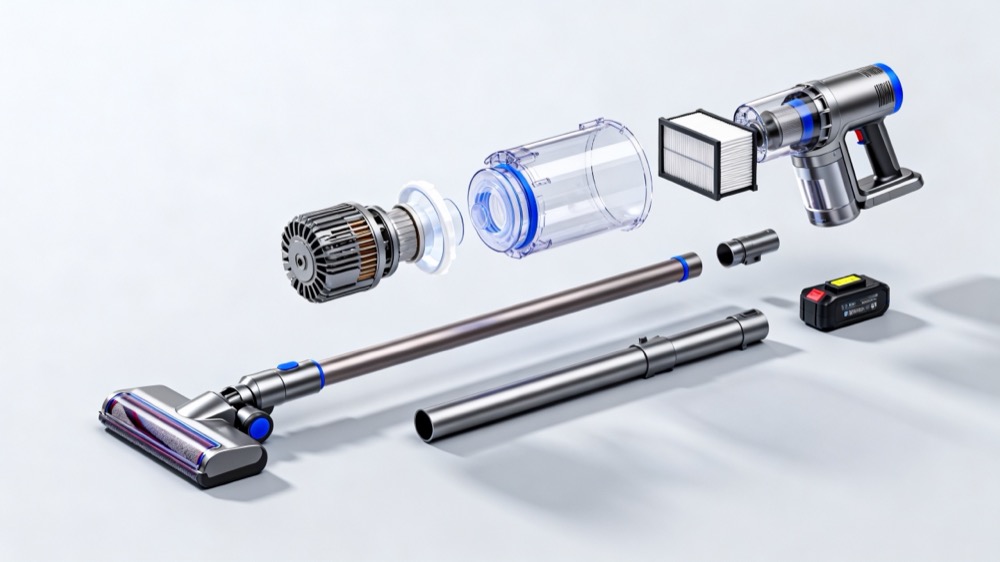
A procurement specification should define how performance is measured, not simply repeat a headline suction number.
IEC 62885-4 provides methods for measuring the performance of cordless dry household vacuum cleaners. It offers a relevant basis for agreeing comparable tests rather than accepting unrelated supplier demonstrations.
Ask competing suppliers to quote against the same test conditions, including:
- Operating mode and battery state.
- Motorized floor head attached.
- Hard-floor and carpet pickup.
- Runtime with the intended accessory.
- Performance before and after controlled dust loading.
- Noise measurement method and distance.
- Hair-wrap behavior and brush-cleaning procedure.
A maximum suction claim and a maximum runtime claim should not be treated as simultaneous performance unless the supplier demonstrates both under the same operating conditions.
Avoid purchasing specifications that say only "high-quality plastic" or "premium battery."
Instead, request an agreed bill of materials covering:
| Component | Suggested specification detail |
|---|---|
| Structural housing | Resin family, exact approved grade, supplier, and permitted recycled content |
| Dust cup | Approved material, impact requirements, transparency, and cleaning compatibility |
| Battery enclosure | Approved material and relevant safety-test requirements |
| Seals | Material, dimensions, fit, and leakage acceptance |
| Extension tube | Material, dimensions, coating, and connection-cycle requirements |
| Brush assembly | Bearings, roller construction, balance, and hair-removal access |
| Filter assembly | Media specification, seal design, replacement method, and test evidence |
These are proposed purchasing controls, not universal requirements for every design. Final material choices should follow the product's engineering and safety assessment.
CE marking is not a general factory-quality certificate. The European Commission explains that the manufacturer must identify applicable requirements, gather supporting technical documentation, and issue an EU declaration of conformity. There is no central EU authority that simply grants permission to use the mark.
Likewise, RoHS concerns restricted hazardous substances; it does not prove cleaning performance, durability, or filtration efficiency. EU guidance links applicable RoHS obligations to conformity documentation and CE marking.
For the selected product, ask a qualified compliance professional to map requirements for the vacuum, charger, battery, and any radio-connected functions. Do not assume a low-voltage battery appliance and its mains charger have identical regulatory obligations.
A visually identical vacuum may contain a different cell, motor, filter, or resin grade.
Recommended control: Approve a production bill of materials, identify critical components, and require written approval before substitutions. Keep sealed reference samples with both parties and arrange random production-unit checks.
A factory may report millions of appliances annually while offering limited availability on your chosen cordless line.
Recommended control: Ask for weekly output for the selected model, current order loading, bottleneck components, and the production slot reserved for your purchase order.
A report may refer to another charger, battery pack, model suffix, or production entity.
Recommended control: Build a document matrix connecting every report to the ordered model and its critical components. Check that the declaration and technical file remain aligned with product changes, as EU guidance requires.
A quotation is incomplete if it leaves battery replacement, filter supply, defect analysis, and warranty freight undefined.
Recommended control: Compare expected landed and service costs, not just the initial unit price. Agree who supplies replacement parts, who authorizes claims, and how recurring failures are investigated.
A less visible procurement risk is approving the exterior and component list while leaving motor-control or battery-management firmware uncontrolled.
As a purchasing safeguard, record firmware versions in the approved configuration. Require written review of changes that may affect runtime, protective shutdown behavior, charging, or performance claims. A hardware approval alone should not authorize unrestricted software changes.
This is a recommended change-control practice, not an allegation about any supplier in this list.
Use a staged process rather than moving directly from one attractive sample to a container order.
1. Screen the legal entity.
Match the quotation, business license, factory address, bank beneficiary, and intended contract party.
2. Review the proposed platform.
Confirm dimensions, weight, battery configuration, accessories, performance targets, and customization boundaries.
3. Test engineering samples.
Use one test protocol across suppliers. Where practical, conduct comparative testing in the same laboratory; the relevant European standard notes that consistent conditions improve the reliability of comparisons.
4. Approve a pre-production configuration.
Sign off the bill of materials, firmware, packaging, labeling, manuals, and compliance-document matrix.
5. Run a pilot order.
Check assembly consistency, packaging, user handling, and service procedures before scaling.
6. Inspect the shipment.
Agree sampling and acceptance rules in advance, with particular attention to safety-critical and configuration-related defects.
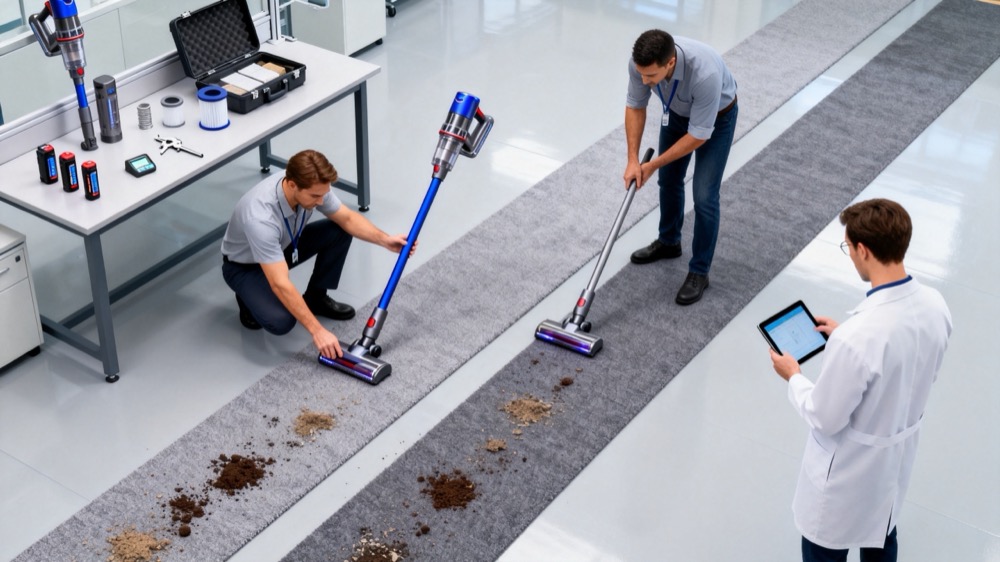
Battery transport depends on configuration, watt-hour rating, packing method, and applicable transport rules. IATA provides shipping guidance and emphasizes correct identification, packaging, marking, labeling, and documentation.
Before booking, have a battery-qualified forwarder confirm:
- Whether batteries are installed, packed with equipment, or shipped separately.
- Required battery testing and transport documentation.
- Packaging and labeling requirements.
- Carrier acceptance and applicable shipment restrictions.
- Treatment of replacement batteries and warranty returns.
Do not assume a spare battery can travel under exactly the same arrangements as a completed vacuum cleaner.
A strong bagless cordless stick vacuum supplier is not necessarily the company with the largest published factory or the most recognizable consumer brand. The right partner matches your order size, development needs, destination-market requirements, and service commitments—and can document how the approved product will remain consistent.
Ningbo Eyunhome Electric Technology Co., Ltd. provides a relevant starting point for buyers seeking a battery-cleaning specialist with a stated emphasis on customization and responsive service. Its published background supports further evaluation, while pricing competitiveness, available capacity, and model-specific compliance should be confirmed through samples and written documentation.
To begin a focused sourcing discussion, send Eyunhome your destination market, target retail price, opening-order forecast, required runtime conditions, accessory list, and branding requirements. Request a platform recommendation, itemized customization proposal, sample plan, compliance-document list, and spare-parts commitment—not merely a headline unit price.
Search the company name or certificate details in IAF CertSearch, then compare the legal entity, manufacturing site, standard, scope, and status. The platform supports verification and alerts for suspended, withdrawn, or expired certificates. If information is missing or inconsistent, contact the issuing certification body through independently verified details.
A valid certificate for a sales office does not automatically establish certification of the factory producing your order.
Do not assume so. Ask the responsible laboratory or compliance specialist to assess whether the change remains within the existing evidence or requires additional testing.
EU guidance states that product changes can require the declaration of conformity and supporting documentation to be reviewed and updated. A supplier's verbal statement that a replacement part is "equivalent" is not a substitute for that assessment.
Request the exact test method, laboratory report, tested configuration, and claimed filtration level. Establish whether the evidence covers the filter media alone or the complete assembled vacuum.
As a purchasing requirement, ask for testing of the configuration you will actually sell, including its seals and installed filter assembly. Avoid publishing an allergy-related or whole-machine filtration claim based only on a component description.
Separate ownership from exclusivity.
The agreement should identify who owns each mold, drawing, and custom component; who pays for maintenance; whether the tooling can be transferred; and whether the supplier may sell the same design to other buyers.
For exclusivity, define territory, channels, product scope, minimum purchasing commitments, and duration. Have appropriate legal counsel review enforceability rather than relying on a general promise of an "exclusive model."
Request a written lifecycle plan before approving the product.
It should cover battery and filter availability, engineering-change notification, last-time-buy arrangements, replacement-pack compatibility, and responsibilities if a cell or electronic component becomes unavailable.
For longer programs, consider whether component continuity, pack design ownership, and service-stock arrangements justify additional upfront cost. Battery availability is part of the product's commercial life, not merely an after-sales detail.
- China Household Electrical Appliances Association: "China's Home Appliance Industry in 2025: Performance Overview," published April 28, 2026. Provides the broader cleaning-appliance sales figures and industry context used in this article. [en.cheaa]
- General Administration of Customs of China: "China's Major Exports by Quantity and Value, Dec 2025." Provides official aggregate export information; it is not a standalone cordless stick vacuum dataset. [english.customs.gov]
- China Chamber of Commerce for Import and Export of Machinery and Electronic Products: Suzhou Chunju company profile, including its stated manufacturing capacity and cooperation model. [cccme]
- Ningbo Eyunhome: Company introduction, founding year, facility information, customization approach, and published compliance references. [eyunhome]
- KingClean and JIMMY: Corporate background, motor-technology focus, brand relationship, and engineering disclosures. [kingclean]
- EUP: Official corporate website and manufacturing-group information. [eupelectronics]
- Chunju: Official corporate website and international market coverage. [chunju]
- Cleva: Corporate manufacturing overview, European company history, and cordless stick product information. [eu.cleva]
- Dibea: Official company history and cordless vacuum OEM/ODM positioning. [dibea]
- LIYYOU: Current company introduction, OEM/ODM offering, and cordless stick platform. [liyyou]
- Dreame: Current corporate history and earlier brand-story material; current commercial access should be confirmed directly. [global.dreametech]
- Tineco: Official company history and manufacturing heritage. [us.tineco]
- Deerma: Official group introduction and cleaning-product portfolio. [deerma]
- International Electrotechnical Commission: IEC 62885-4 performance-measurement standard for cordless dry vacuum cleaners. [webstore.iec]


