
Views: 258 Author: Eyunhome Vacuum Publish Time: 2026-07-09 Origin: Site


Content Menu
● Airflow vs Suction: Why This Comparison Matters for Upright Vacuums
● What Is Airflow in Upright Vacuums?
● What Is Suction Power (Water Lift)?
● Air Watts: How Professionals Combine Airflow and Suction
● Deep Carpet Cleaning: Why Airflow Often Wins
● Bare Floors and Crevices: Where Suction Shows Its Strength
● Pet Hair Performance: Balancing Force and Flow
● Direct‑Air vs Bypass Uprights: Design Trade‑offs Behind the Specs
● How Independent Testing Measures Airflow and Suction
● Interpreting Vacuum Specs as a Buyer or Product Manager
● How a Chinese OEM/ODM Manufacturer Can Leverage Airflow vs Suction Strategically
● Practical Selection Steps for Brands and Buyers
● FAQs
Airflow vs. suction in upright vacuums is not an either–or choice: for modern brands and OEM partners, the winning strategy is to engineer the *right balance* for specific cleaning scenarios, then communicate that clearly to end users. [sourcing.hktdc]
When global buyers shortlist upright vacuums, they usually see a mix of "strong suction" claims and vague "powerful airflow" marketing – but rarely a clear explanation of which metric really drives cleaning performance. For OEM/ODM projects, understanding how airflow and suction interact is essential to designing products that *actually* perform in independent testing and real homes. [sourcing.hktdc]
From my perspective as a vacuum industry content strategist working closely with Chinese manufacturers, the most valuable approach is to treat airflow and suction as two complementary levers in product design and user communication: suction creates the pressure to lift debris, while airflow carries it through the system into the dustbin. [sourcing.hktdc]

Airflow is the volume of air the vacuum moves per unit of time, usually measured in CFM (cubic feet per minute) in lab and review environments. Think of airflow as the *wind* inside the vacuum: the higher the CFM at the cleaning head, the more dust, crumbs and hair can be transported every minute. [sourcing.hktdc]
Several key points matter for both engineers and brand owners:
- Airflow is shaped not just by motor size, but by air path design, filters, seals and nozzle geometry. [sourcing.hktdc]
- Restrictive filters or narrow passages can slash real-world CFM even on a high‑wattage motor. [sourcing.hktdc]
- Most upright retail boxes don't list CFM, so reviewers measure it with anemometers at the nozzle or hose to capture performance *where cleaning happens*. [sourcing.hktdc]
In practical terms, high, stable airflow is strongly correlated with better overall pickup, especially on carpets and mixed debris. [sourcing.hktdc]
Suction power is the vacuum's ability to create a pressure difference and pull matter by force, commonly measured as inches of water lift (inH₂O). In test labs, a manometer shows how high the vacuum can raise a column of water in a tube; higher water lift equals stronger sealed suction. [sourcing.hktdc]
From a UX and engineering perspective:
- Suction is the *raw pulling force* you feel when the hose end "sticks" to upholstery or a hard floor. [sourcing.hktdc]
- High suction is crucial for heavy debris, embedded grit and crevices, and for keeping performance usable as filters load with dust. [sourcing.hktdc]
- Many modern uprights, especially premium models, exceed 80–100 inches of water lift, but without solid airflow, that number does not guarantee great cleaning. [sourcing.hktdc]
Put simply: suction is the grip; airflow is the transport. You need both to deliver a satisfying user experience. [sourcing.hktdc]
To capture "output cleaning power" more realistically, engineers and independent reviewers use air watts, a metric that multiplies airflow and suction with a conversion factor. [sourcing.hktdc]
A common formula is:
Important implications for spec sheets and OEM discussions:
- Higher air watts generally indicate a better balance of airflow and suction at an operating point, not just a big motor. [sourcing.hktdc]
- Brands like Dyson highlight air watts instead of motor watts to show real cleaning output, and independent tests often treat air watts as more meaningful than simple amperage. [sourcing.hktdc]
- However, "air watts" can be measured at different positions (hose vs nozzle) and settings, so context still matters. [sourcing.hktdc]
For B2B buyers evaluating upright vacuums, air watts are useful within a brand or product family, while airflow and suction numbers reveal the underlying engineering. [sourcing.hktdc]
Thick carpets with sand, fine dust and pet dander represent the hardest test for any upright vacuum. Independent testers have repeatedly seen that high airflow at the nozzle is the single most decisive factor in deep carpet cleaning, even when competing models advertise higher sealed suction. [sourcing.hktdc]
One well‑known comparative insight from independent testing:
- A direct‑air upright with around 120 CFM but modest water lift significantly out‑cleaned a bagless upright that boasted over 100 inches of water lift but less than 60 CFM on deep carpet pickup. [sourcing.hktdc]
- The high‑airflow machine removed more embedded dirt in one pass, highlighting how crucial air volume through the carpet pile really is. [sourcing.hktdc]
From an OEM/ODM design standpoint:
- Airflow dislodges and carries fine dust from deep between fibers. [sourcing.hktdc]
- Suction supports heavy particles (sand, grit) and maintains a strong seal, so air is forced through the pile instead of leaking at the edges. [sourcing.hktdc]
- Brushroll design and nozzle height work together with airflow to agitate and lift dirt. [sourcing.hktdc]
For brands positioning upright vacuums as "deep‑clean carpet specialists," optimizing CFM at the floorhead and pairing it with a well‑designed brush system will usually deliver more real‑world value than chasing maximum sealed suction alone. [sourcing.hktdc]
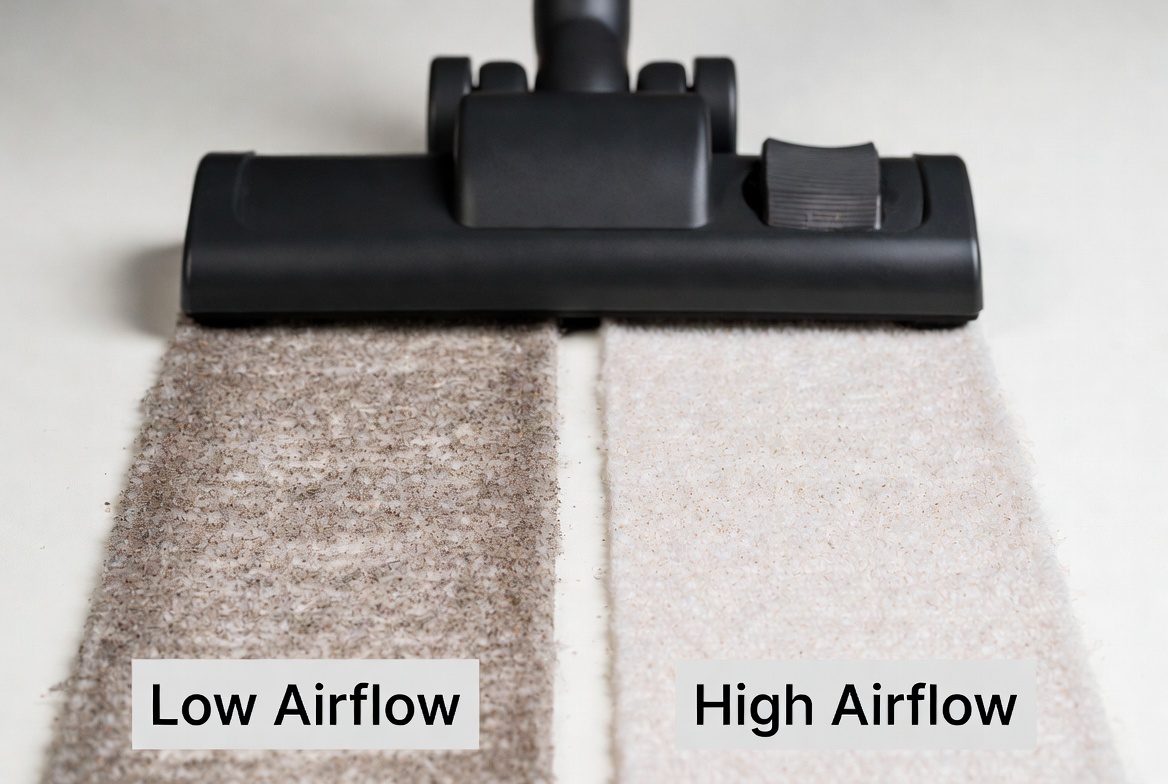
On hardwood, tile and other bare surfaces, there is no pile for air to flow through; the vacuum relies on suction at the nozzle to lift debris and airflow to transport it away. [sourcing.hktdc]
From user testing perspectives:
- Airflow sweeps fine dust and light particles into the intake and can pull dirt from shallow gaps and grout lines. [sourcing.hktdc]
- Poorly controlled airflow can scatter lightweight debris if nozzle design is weak, so soft rollers or strips are used to channel air and prevent "snow‑plowing." [sourcing.hktdc]
- Suction becomes critical for heavier crumbs, stuck grit and crevice pickup, especially along baseboards, between floorboards and inside grooves. [sourcing.hktdc]
Independent testers highlight crevice pickup on hard floors as a combined test of both metrics: airflow keeps particles moving once dislodged, while suction pries them out of tight spaces. [sourcing.hktdc]
For brands and OEM partners, this means:
- Uprights targeted at mixed flooring should emphasize balanced suction and controlled airflow, plus specialized hard‑floor heads to prevent scatter. [sourcing.hktdc]
- Excessive sealed suction on completely flat floors can make the head hard to push, so many designs incorporate vents or floor modes that slightly modulate suction and allow smooth movement. [sourcing.hktdc]
Pet hair introduces unique UX demands: it's light, clingy and prone to tangling in fibers and in the vacuum head itself. Independent experts and testers consistently point to the combination of suction, airflow and brushroll engineering as the foundation of strong pet hair performance. [sourcing.hktdc]
On carpets and rugs:
- Strong suction helps pull hair that's woven into carpet fibers once the brushroll agitates it free. [sourcing.hktdc]
- High airflow carries clumps of hair efficiently into the dustbin, reducing the chance of hair resettling or clogging the nozzle. [sourcing.hktdc]
On bare floors and upholstery:
- Controlled airflow can gently draw hair inward rather than blow it around, while concentrated suction at tools and attachments lifts hair from fabrics and corners. [sourcing.hktdc]
- Many "pet" uprights combine tangle‑resistant brushrolls with robust airflow paths and good filtration to avoid blockages and odor. [sourcing.hktdc]
For OEM and ODM projects targeting pet‑owner segments, engineering teams should treat pet hair as a dedicated scenario: tune suction and airflow profiles for carpet, bare floor and upholstery modes, and validate them with independent or in‑house tests that specifically track hair pickup and clogging behavior. [sourcing.hktdc]
Industry discussions often distinguish between direct‑air (dirty air) and bypass (clean air) upright architectures, and this choice heavily influences airflow and suction behavior. [sourcing.hktdc]
Key differences:
- Direct‑air designs route dirt directly past the fan before filtration, often delivering very high airflow at the floorhead and excellent deep‑carpet performance but less focus on sealed suction metrics and HEPA filtration. [sourcing.hktdc]
- Bypass designs keep the motor in a separate clean‑air path, enabling higher sealed suction and multi‑stage filtration, but can lose airflow due to filter resistance and more complex air routing. [sourcing.hktdc]
For brands collaborating with Chinese manufacturers, choosing an architecture is fundamentally a positioning decision:
- If deep carpet cleaning and airflow‑driven performance are the priority, lean toward designs that maximize CFM and use robust brush systems.
- If fine dust filtration, allergy claims and tool usage on upholstery and cars are critical, prioritize strong suction and sealed systems while still protecting airflow. [sourcing.hktdc]
Independent reviewers use structured lab methods to translate airflow and suction into meaningful performance scores. These tests are particularly important for OEM brands that want verifiable, E‑E‑A‑T‑friendly claims. [sourcing.hktdc]
Common practices include:
- Measuring airflow (CFM) at the cleaning head or hose with digital anemometers, not just at the motor outlet, to reflect usable performance. [sourcing.hktdc]
- Measuring suction (water lift or kPa) with manometers, sometimes in both fully sealed and slightly open ("unsealed suction") scenarios to mimic real floor contact. [sourcing.hktdc]
- Running deep‑clean carpet tests (e.g., embedding sand into carpet and weighing how much is removed in a set number of passes), hard‑floor crevice tests and pet hair tests to connect metrics to visible results. [sourcing.hktdc]
Testing findings often show:
- Airflow values differ widely among uprights, even more than suction, making CFM a key differentiator for performance. [sourcing.hktdc]
- Models that combine high airflow and high suction, supported by good head design, tend to dominate overall rankings on both carpets and hard floors. [sourcing.hktdc]
For OEM brands, this reinforces a simple truth: lab‑backed performance data underpins credible marketing, especially in markets where reviewers and comparison content strongly influence purchasing. [sourcing.hktdc]
When B2B buyers, distributors and brand owners read spec sheets, they often see motor watts or amps highlighted while meaningful airflow and suction numbers are buried or missing. [sourcing.hktdc]
More useful guidelines include:
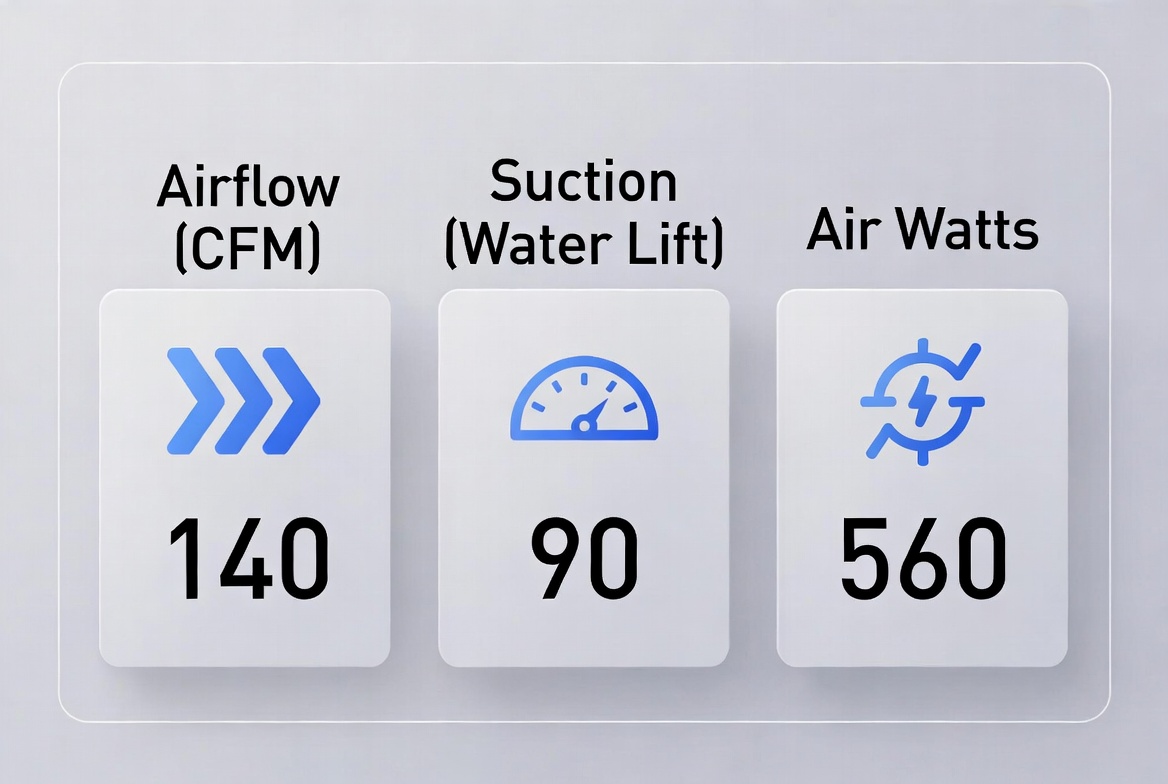
- CFM (airflow): Uprights delivering 50–70+ CFM at the nozzle are generally solid performers, while premium designs can exceed 100 CFM. [sourcing.hktdc]
- Water lift (sealed suction): Uprights in the 80–100+ inches range show strong pulling force, valuable for tools and heavy debris. [sourcing.hktdc]
- Air watts: Higher air watts indicate more effective conversion of motor power into cleaning power, but must be interpreted with knowledge of where and how they were measured. [sourcing.hktdc]
- Motor watts/amps: These only show energy use, not cleaning ability. Nearly all plug‑in uprights cluster around 10–12 amps due to outlet limits, so this spec is a weak differentiator. [sourcing.hktdc]
A practical expert rule of thumb is: don't rely on a single spec; look for airflow, suction and air watts together, and connect them to independent test data whenever possible. [sourcing.hktdc]
For a trusted upright vacuum manufacturer working with global brands, airflow vs suction is not just a technical topic; it's a strategic storytelling opportunity tied to E‑E‑A‑T and long‑term partnerships.
From a manufacturing and product‑development lens:
- Segment products by cleaning scenario.
- Carpet‑focused uprights: maximize CFM at nozzle, pair with strong brushrolls and stable seals.
- Mixed‑floor models: balance suction and airflow, add specialized heads for hard floors and pet hair.
- Design for testability. Build models with transparent specs and stable performance so independent reviews confirm marketing claims. [sourcing.hktdc]
- Communicate metrics clearly in B2B conversations. Share typical CFM ranges, suction values and air‑watt benchmarks, framed against common international standards and test protocols. [sourcing.hktdc]
By positioning airflow vs suction as a structured, data‑driven design choice rather than vague "power," a Chinese OEM/ODM supplier can stand out as a technical partner rather than just a price‑based vendor. [sourcing.hktdc]
For decision‑makers comparing upright vacuums or planning a new OEM line, a simple, expert‑style process can help narrow options:
1. Define priority surfaces.
- Mostly carpet: prioritize airflow and brush performance.
- Mixed hard floors and carpet: require balanced airflow and suction plus specialized heads.
2. Check realistic performance metrics.
- Ask for nozzle‑level CFM and water‑lift ranges, not just motor wattage or amps. [sourcing.hktdc]
- Where possible, review independent test data for deep carpet, hard floor crevice and pet hair performance. [sourcing.hktdc]
3. Align metrics with market messaging.
- Use data to support clear claims like "optimized airflow for deep‑carpet cleaning" or "high suction for crevice and pet hair pickup," rather than generic "powerful motor" language. [sourcing.hktdc]
Approached this way, airflow vs suction becomes an actionable framework that guides both engineering decisions and marketing narratives.
Q1: Is airflow or suction more important in an upright vacuum overall?
Airflow has a slight edge for overall floor cleaning, particularly deep carpet, because it's the moving air that carries dust and debris into the system, but suction remains critical for heavy debris, tools and crevices. [sourcing.hktdc]
Q2: Why can a high‑suction vacuum still perform poorly on carpets?
If airflow at the nozzle is too low, the vacuum may create strong sealed suction without enough moving air to transport dirt through the carpet pile and into the dustbin, leading to weaker real‑world pickup. [sourcing.hktdc]
Q3: What is a reasonable CFM target for a mid‑range upright vacuum?
Around 50–70 CFM at the cleaning head is a solid starting point for mid‑range uprights, with premium models topping this range for stronger deep‑clean performance. [sourcing.hktdc]
Q4: Are air watts more useful than motor watts when choosing a vacuum?
Yes. Air watts reflect how effectively a vacuum turns electrical power into suction and airflow at an operating point, while motor watts only show energy consumption and don't guarantee good cleaning. [sourcing.hktdc]
Q5: How should brands communicate airflow and suction to end users without overwhelming them?
Focus on scenarios ("deep‑carpet cleaning," "crevice pickup," "pet hair") and explain that the vacuum is engineered to balance airflow and suction for those tasks, using simple performance claims backed by test data. [sourcing.hktdc]
1. Vacuum Wars. "Airflow vs Suction: What's Better for Upright Vacuums?"
Available at: https://vacuumwars.com/airflow-vs-suction-whats-better-for-upright-vacuums/ [blog.csdn]
2. HKTDC Sourcing. "Ningbo Eyunhome Electric Technology Co., Ltd. – Company Overview."
Available at: https://sourcing.hktdc.com/en/Supplier-Store/Home/Ningbo-Eyunhome-Electric-Technology-Co-Ltd-/1S00O5ADN [blog.csdn]
3. Consumer Council Hong Kong. "Cordless Upright Vacuum Cleaners Performance Comparison."
Available at: https://www.consumer.org.hk/sc/media-library/video/497-cordless-upright-vacuum-cleaners [blog.csdn]
4. Consumer Council Hong Kong. "Understanding Cordless Upright Vacuum Cleaner Performance."
Available at: https://www.consumer.org.hk/tc/article/519-vaccum-cleaner/519-cleaner-result [blog.csdn]
5. Baidu B2B Wiki. "How to Evaluate Vacuum Cleaner Suction Power Scientifically."
Available at: https://b2bwiki.baidu.com/article/d1t29vhftjsse0b8hlmg [blog.csdn]


