
Views: 255 Author: Eyunhome Vacuum Publish Time: 2026-10-13 Origin: Site


Content Menu
● 15KPa vs 25KPa Cordless Vacuum: Quick Comparison
● What Does kPa Mean in a Cordless Vacuum?
>> Suction Pressure Is Not the Same as Cleaning Performance
>> Why Airflow and Brush Design Matter
● 15KPa vs 25KPa on Hard Floors, Carpets, and Pet Hair
>> Hard Floors: Prioritize Pickup and Debris Handling
>> Carpets: Look Beyond Surface Appearance
>> Pet Hair: Brush Maintenance Can Decide the Winner
● Battery Runtime: Compare the Mode You Will Actually Use
>> Request a Mode-by-Mode Runtime Table
● Filtration, Comfort, and Ownership Costs
>> A Filter Label Does Not Describe the Whole Machine
>> Evaluate Handling Before Paying for More Pressure
>> Compare Total Ownership Cost
● Practical Test: Compare 15KPa and 25KPa Before Buying
>> Step 1: Match the Starting Conditions
>> Step 2: Prepare Repeatable Cleaning Tasks
>> Step 4: Record More Than Visible Cleanliness
>> Step 5: Check Sustained Performance
● Expert Insight: Measure Cleaning per Charge, Not Just Peak Pressure
● Industry Insight: What Independent Testing Reveals
● OEM/ODM Buyers: Turn Suction Ratings into a Product Brief
● Final Verdict: Which Cordless Vacuum Is Worth Buying?
>> Is 15KPa Enough for a Cordless Vacuum?
>> Is a 25KPa Vacuum Much Better Than a 15KPa Vacuum?
>> Does Higher Suction Always Mean Shorter Battery Life?
>> Which Suction Rating Is Better for Pet Hair?
>> Can a 15KPa Vacuum Clean Carpets?
>> Why Does a Vacuum Lose Cleaning Performance?
A 15KPa cordless vacuum can be a sensible purchase for everyday hard-floor cleaning, while a 25KPa cordless vacuum deserves closer consideration for demanding tasks such as carpet cleaning and debris in crevices. However, the answer to "15KPa vs 25KPa cordless vacuum: which is worth buying?" depends on more than suction pressure. Floorhead design, airflow, battery runtime, filtration, and maintenance all influence the value you receive.
My buying recommendation is straightforward: choose the vacuum that cleans your floors effectively in a practical operating mode—not simply the one with the larger number.
This guide compares the two suction ratings from a buyer's and product-development perspective. It does not claim that two specific Eyunhome models have undergone head-to-head testing.
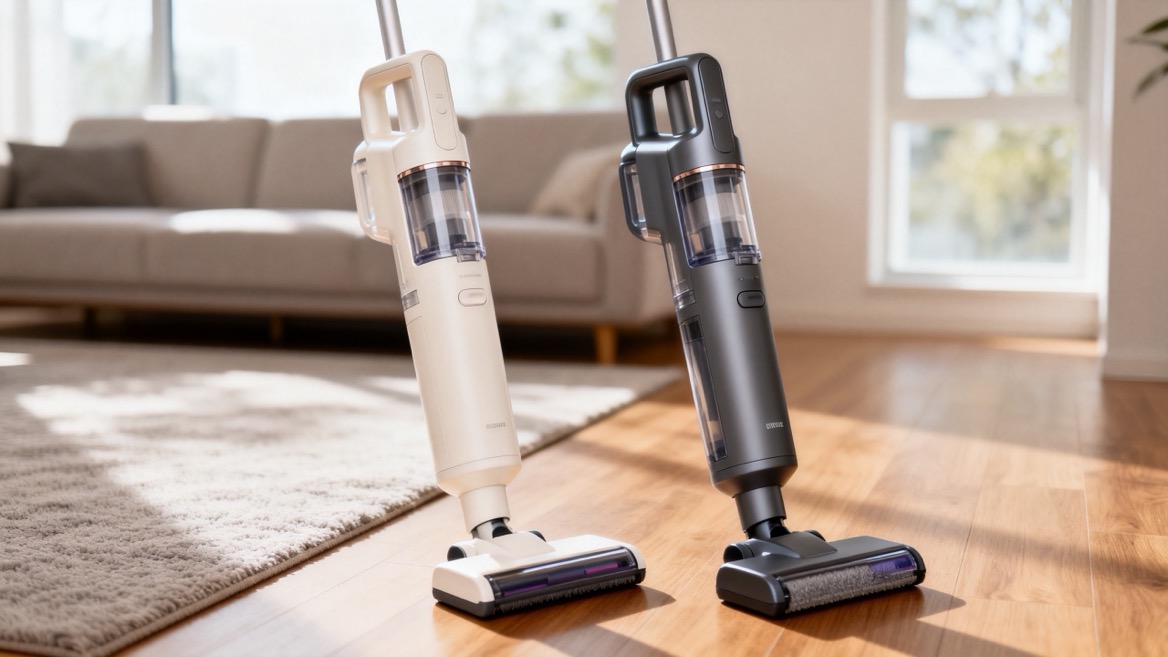
The following table is a purchasing framework, not a guarantee that every vacuum within either category performs identically.
| Comparison point | 15KPa cordless vacuum | 25KPa cordless vacuum |
|---|---|---|
| Advertised suction pressure | 15,000 pascals | 25,000 pascals |
| Buying scenario to investigate | Routine cleaning and lighter debris | More demanding cleaning and restricted-airflow tasks |
| Hard-floor suitability | Potentially sufficient with an effective floorhead | Also suitable, but extra pressure may not improve everyday pickup |
| Carpet suitability | Requires evidence of agitation and embedded-dirt pickup | Higher pressure offers potential, but testing remains essential |
| Pet-hair suitability | Depends heavily on brush and attachment design | Same requirement; higher pressure alone does not prevent tangles |
| Battery runtime | Cannot be determined from pressure alone | Cannot be determined from pressure alone |
| Weight, noise, and price | Model-specific | Model-specific |
| Purchase priority | Reliable performance at a suitable price | Demonstrable cleaning benefits that justify any premium |
The 25KPa rating is approximately 67% higher than 15KPa. That does not mean 67% better dirt pickup, faster cleaning, or longer product life.
Kilopascals, abbreviated kPa, measure pressure. In vacuum specifications, they describe the pressure difference a machine can generate under particular test conditions.
A higher reading indicates greater pressure capability at the measurement point. However, that point might be the motor inlet, handheld intake, or another location—not necessarily the floorhead during normal cleaning.
Ask three questions before comparing ratings:
- Where was the pressure measured?
- Which power mode was used?
- Was the inlet sealed or operating with airflow?
Without matching conditions, two advertised numbers may not provide a fair comparison.
Pressure and airflow perform related but different roles. Pressure helps establish the conditions that draw air inward. Airflow carries loosened debris through the vacuum into the dust container.
Brush agitation helps release dirt trapped in carpet fibers.
A useful way to assess cordless vacuum suction power is to consider the complete system:
- Pressure capability.
- Airflow through the assembled machine.
- Floorhead sealing and debris openings.
- Brush agitation.
- Resistance from filters and the air path.
This explains why a carefully designed 15KPa vacuum could outperform a poorly designed 25KPa vacuum in a particular pickup test.
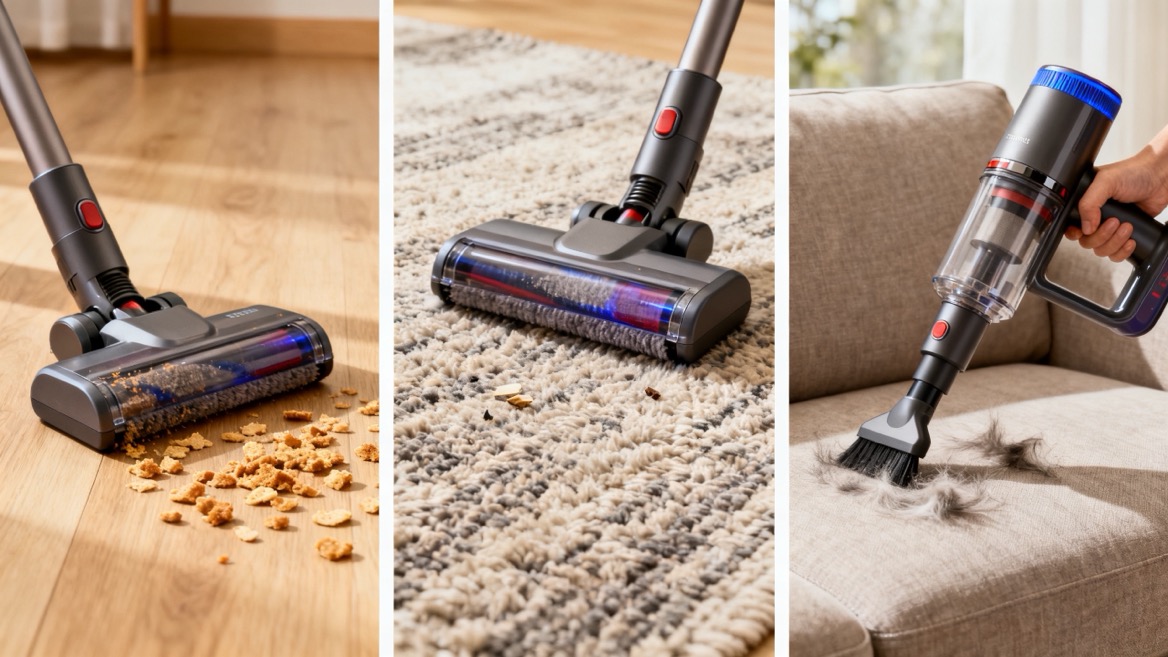
For tile, laminate, and hardwood, investigate whether the cleaner captures dust and crumbs without scattering them or pushing them forward.
A suitable soft roller or well-designed hard-floor head can make a substantial difference. Large debris also needs enough clearance to enter the cleaning path.
A 15KPa cordless vacuum may be worth buying when it passes these everyday tests comfortably. Paying extra for 25KPa makes less sense if both models clean your floors equally well.
Check:
- Fine-dust pickup.
- Larger-crumb pickup.
- Cleaning along walls.
- Access beneath furniture.
- Wheels and floor-contact materials appropriate for your flooring.
Carpet cleaning requires more than removing visible crumbs. Embedded particles need agitation, airflow, and an effective cleaning head.
A 25KPa cordless vacuum is worth investigating when carpets form a significant part of your cleaning routine. However, pressure alone cannot establish its deep-cleaning ability.
Look for results showing how much embedded debris the vacuum removes using a fixed number of passes.
Also test push resistance. A head that seals too aggressively against a rug may become difficult to move. More pressure is not automatically more convenient.
For pet owners, pickup and hair management are separate questions.
A vacuum might collect hair successfully while leaving substantial amounts wrapped around its roller. That creates an additional maintenance task.
Compare:
- Hair pickup on your actual flooring.
- Hair remaining around the brush.
- Roller-removal convenience.
- Upholstery-tool performance.
- Dustbin emptying.
For sofas and upholstered stairs, a powered attachment may matter more than upgrading the headline pressure rating.
An advertised maximum runtime and an advertised maximum suction rating may describe different operating conditions.
The longest runtime commonly relates to a low-power mode. Maximum pressure may require a high-power setting that consumes energy faster.
Do not combine both headline figures into an expectation of everyday performance.
Before buying, request runtime information for:
| Operating condition | Why it matters |
|---|---|
| Low mode with floorhead | Routine maintenance cleaning |
| Standard mode with floorhead | A realistic everyday comparison |
| Maximum mode with floorhead | Demanding cleaning tasks |
| Handheld use with specified attachment | Furniture, stairs, and vehicle interiors |
There is no reliable rule that every 15KPa model lasts longer than every 25KPa model. Battery energy, motor efficiency, attachments, and operating controls differ.
For larger homes, also investigate removable batteries, spare-battery availability, and charging time.
Suction pressure does not tell you how effectively a vacuum contains fine particles.
Filter quality matters, but so does system sealing. Air that bypasses the filter reduces the benefit of an otherwise capable filtration component.
Ask whether filtration claims refer to the filter material or the assembled vacuum. Request supporting test information where available.
Avoid treating a HEPA label as proof of complete-system performance.
Consider the experience of cleaning an entire room:
- Does the handle feel balanced?
- Can you steer around furniture?
- Must you continuously hold a trigger?
- Is the handheld configuration comfortable?
- Can you empty the bin without awkward handling?
Weight and operating noise cannot be predicted from the kPa rating alone. Evaluate the actual models in the modes you expect to use.
Purchase price is only one part of the decision.
Check replacement-filter prices, battery costs, brush availability, warranty terms, and service arrangements.
My purchasing preference would be a repairable, comfortable machine with documented cleaning performance over a higher-pressure model with unclear replacement-part support.
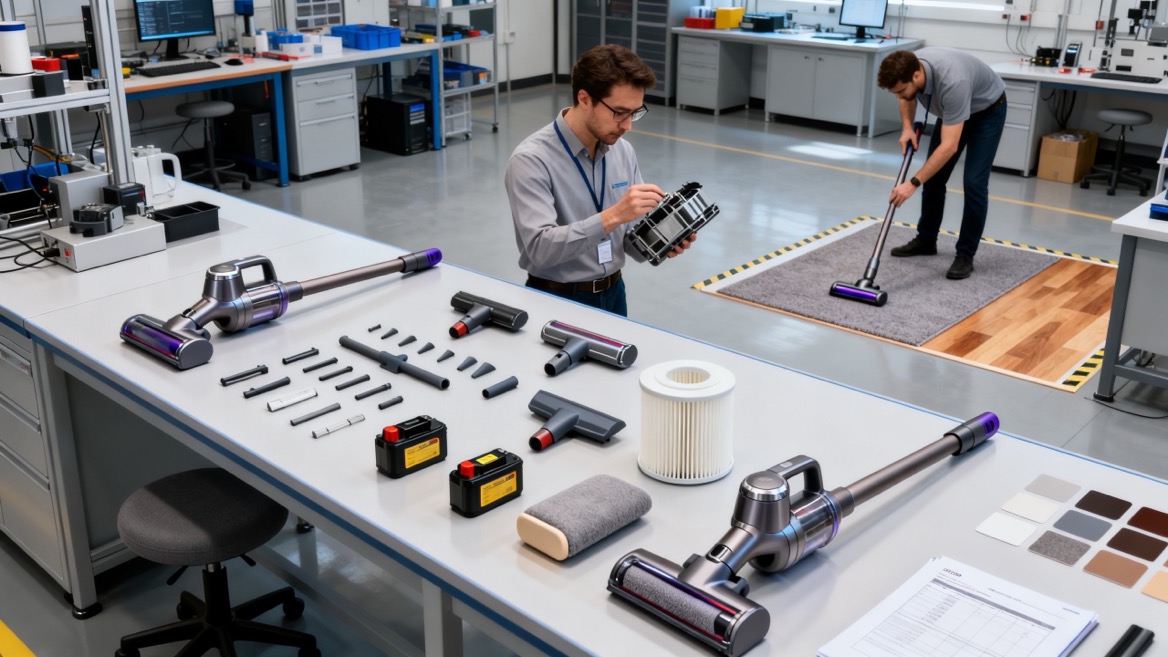
This simple comparison procedure can help household buyers assess demonstrations and help distributors evaluate samples. It is not a substitute for formal laboratory testing.
Fully charge both machines. Empty their bins and prepare their filters according to their instructions.
Use comparable floor surfaces and document the attachments and power modes.
Use dry, ordinary household debris compatible with each vacuum's instructions.
Separate fine particles, crumbs, and hair rather than mixing everything into one demonstration. Avoid liquids, hazardous powders, and materials prohibited by the manufacturer.
Move each vacuum over the same area using equal numbers of forward and backward passes.
Keep movement speed reasonably consistent. Otherwise, extra passes can disguise weaker pickup.
Note debris left behind, scattering, edge performance, hair wrapping, handling, and elapsed cleaning time.
Where practical, weigh collected debris and repeat the comparison.
Assess whether the vacuum completes your intended cleaning session in the selected mode.
A brief maximum-power demonstration cannot establish whole-home usefulness.
One useful purchasing metric is the amount of acceptable cleaning completed before charging becomes necessary.
Define "acceptable" first: for example, satisfactory pickup on your floors without excessive repeat passes.
Then compare completed cleaning area, operating time, and interruptions.
This approach connects performance with battery endurance. A machine with higher peak pressure may offer little practical advantage if its useful mode cannot finish the intended task.
Conversely, a powerful model may clean effectively below maximum mode, making its short boost runtime less important.
The relevant question is not simply "How strong is it?" It is "How much useful work does it complete?"
Vacuum Wars' published cordless-vacuum methodology illustrates why serious comparisons separate pressure, airflow, pickup, hair management, and battery endurance.
Its carpet deep-cleaning procedure uses 100 grams of embedded sand, controlled passes, and repeated testing. Maximum-power runtime is measured with the standard floorhead attached.
These methods provide a useful lesson: cleaning performance and battery performance need their own evidence.
They do not establish a universal winner between 15KPa and 25KPa. Instead, they show what buyers should request when pressure specifications look impressive but practical results remain unclear.
For importers and private-label brands, choosing between 15KPa and 25KPa should begin with customer requirements.
A hard-floor-focused product and a mixed-floor product may need different heads, batteries, accessories, and acceptance tests.
Before approving a cordless vacuum program, define:
1. Target flooring and debris.
2. Pressure-measurement conditions.
3. Pickup requirements and test passes.
4. Runtime by mode and attachment.
5. Filtration evidence required.
6. Handling and noise evaluation.
7. Replacement-part and after-sales arrangements.
Make these requirements part of sample approval rather than relying on a headline specification.
Ningbo Eyunhome Electric Technology Co., Ltd. offers upright, handheld, corded, and cordless vacuum solutions, alongside OEM/ODM services, stable production, and after-sales support. Specific configurations and performance claims should be confirmed through the relevant product documentation and samples.
Choose a 15KPa cordless vacuum when it demonstrates satisfactory everyday pickup, completes your cleaning routine, and offers better overall ownership value.
Consider a 25KPa cordless vacuum when your cleaning tasks are more demanding and testing confirms a meaningful improvement—without unacceptable compromises in runtime or handling.
For wholesale and private-label projects, contact Ningbo Eyunhome Electric Technology Co., Ltd. with your target market, flooring requirements, intended runtime, and price positioning. Request suitable configurations, supporting performance information, sample-evaluation options, and OEM/ODM details before finalizing your specification.
It can be enough for routine cleaning, particularly on hard floors, if the floorhead and airflow system perform effectively. Assess pickup on your intended surfaces rather than treating 15KPa as a universal performance threshold.
It has a higher advertised pressure rating under comparable measurement conditions. The improvement in actual cleaning depends on airflow, brush design, sealing, and the debris being collected.
No. Higher-power operation generally consumes more energy within the same machine, but comparisons between different models also depend on battery capacity, motor efficiency, and operating controls.
Neither rating guarantees superior pet-hair performance. Compare hair pickup, brush tangling, upholstery attachments, and maintenance convenience. A practical demonstration is more useful than pressure alone.
Potentially, but carpet type and cleaner-head performance matter. Ask for embedded-debris pickup results. Visible surface cleaning does not necessarily demonstrate effective deep cleaning.
Possible causes include loaded filters, blocked air paths, tangled brushes, or incorrectly fitted components. Follow the model's maintenance instructions and check these areas before assuming the motor has failed.
- [BestVacuum — Understanding Vacuum Specifications]. Technical background on suction pressure, airflow, air watts, agitation, filtration resistance, and ownership considerations. This is explanatory guidance, not a direct 15KPa-versus-25KPa product test. [bestvacuum]
- [Vacuum Wars — How Vacuum Wars Tests and Scores Cordless Vacuums]. Updated August 14, 2026. Methodology covering pressure and airflow measurements, controlled carpet and hard-floor pickup, hair management, filtration, and maximum-mode runtime. Supports the article's testing discussion and industry-methodology example. [vacuumwars]
- [V. Brøndum — Insight into the Technical Aspects of Vacuum Cleaners]. Additional technical explanation distinguishing negative pressure, airflow, and cleaning performance. Its equipment figures should not be treated as recommended thresholds for cordless household vacuums. [broendum]


