
Views: 243 Author: Eyunhome Vacuum Publish Time: 2026-10-11 Origin: Site


Content Menu
● Robot Vacuum Market Trends: What the Numbers Actually Show
>> Growth Does Not Automatically Mean Replacement
>> Avoid Mixing Incompatible Market Estimates
● Why Robot Vacuum Cleaners Are Gaining Ground
>> Automated Cleaning Offers Everyday Convenience
>> Vacuum-and-Mop Systems Broaden the Proposition
● Robot Vacuum vs. Traditional Vacuum: Match the Cleaning Task
● Why Traditional Vacuum Cleaners Still Matter
>> Upright Vacuums Serve Carpet-Focused Buyers
>> Handheld Vacuums Address Different Jobs
>> Corded and Cordless Describe Power Supply
● A Manufacturer's View: Compete on Cleaning Results
>> Suction Figures Need Context
>> Turn Features Into Verifiable Benefits
● Build a Complementary Vacuum Cleaner Product Portfolio
>> 1. Routine Floor Maintenance
>> 2. Flexible Household Cleaning
>> 3. Focused or Extended Cleaning
● How to Evaluate an OEM/ODM Vacuum Cleaner Supplier
>> Step 1: Define the Product Brief
>> Step 2: Compare Samples Under Consistent Conditions
>> Step 3: Clarify Customization and Production Controls
>> Step 4: Plan After-Sales Support Early
● Use Customer Reviews Without Inventing Customer Evidence
● Work With Ningbo Eyunhome on Your Next Vacuum Cleaner Range
>> Are Robot Vacuums Replacing Traditional Vacuum Cleaners?
>> Why Is the Robot Vacuum Market Growing?
>> Can a Robot Vacuum Replace an Upright for Pet Hair?
>> How Should Buyers Compare Corded and Cordless Vacuums?
>> What Should an OEM/ODM Buyer Request First?
>> Which Vacuum Cleaner Format Should a Private-Label Brand Launch?
Robot vacuum market trends point to growing demand for automated cleaning, but they do not mean traditional vacuum cleaners are becoming obsolete. For retailers, distributors, and private-label brands, the more useful question is how robotic, upright, handheld, corded, and cordless vacuum cleaners fit different customer needs.
At Ningbo Eyunhome Electric Technology Co., Ltd., our product-planning perspective starts with the cleaning task—not the most fashionable feature. A robot may maintain an open floor between deeper cleans. A cordless vacuum may handle unexpected messes. An upright may suit larger carpeted areas.
The commercial opportunity is therefore broader than choosing automation over manual cleaning. It lies in building a product range that delivers practical convenience, dependable performance, and clear value.

Grand View Research estimates that the U.S. household vacuum cleaner market was worth USD 1.55 billion in 2024. Its published forecast projects 9.2% compound annual growth from 2025 to 2030, reaching USD 2.64 billion by 2030.
Within that report, robotic vacuums are expected to record the fastest growth, at more than 11% annually over the forecast period.
These figures suggest expanding demand. They do not establish that upright, handheld, or cordless models will disappear.
Three distinctions matter when interpreting vacuum cleaner market data:
- Revenue growth is not the same as growth in units sold.
- Forecasts describe expected outcomes, not completed results.
- A U.S. household-market estimate cannot represent every international market.
A premium robot with a multifunction dock may generate considerably more revenue per sale than a basic handheld vacuum. Higher category revenue therefore does not prove that more households are abandoning manually operated machines.
Reports may define "vacuum cleaners" differently. Some cover household appliances; others include commercial equipment or narrower product categories.
Before using a market estimate for purchasing decisions, check its geography, product scope, base year, and forecast period. Compare like with like.
For a distributor, local sell-through, returns, and customer requests can be more useful than a headline growth percentage.
The central appeal of a robot vacuum is scheduled floor maintenance with less direct involvement.
Modern models may combine mapping, obstacle recognition, room selection, and automatic docking. These features help users maintain accessible floor areas while they work or attend to other tasks.
Independent testing also shows that lower-priced robots increasingly include features previously associated with premium products, such as mapping and self-emptying docks.
This creates pressure across the floor-care market: customers increasingly expect convenience to be tangible, not merely advertised.
Robot vacuum-and-mop combinations bring dry debris pickup and floor wiping into one device. Multifunction docks can also empty dust containers and wash or dry mop pads.
However, more automation does not eliminate maintenance.
Users may still need to refill water, remove accumulated debris, inspect brushes, and clean components according to the manual. Obstacle avoidance also varies between products and operating conditions.
For buyers, the meaningful promise is reduced intervention, not maintenance-free cleaning.
The following framework describes typical product roles. Individual designs and verified test results should guide final selection.
| Cleaning need | Relevant product format | What buyers should verify |
|---|---|---|
| Frequent cleaning of accessible floors | Robot vacuum | Coverage, navigation, obstacle handling |
| Carpet-focused household cleaning | Upright vacuum | Carpet pickup, brush control, maneuverability |
| Quick cleaning across several rooms | Cordless vacuum | Weight, usable runtime, charging |
| Longer sessions without battery limits | Corded vacuum | Cable reach, handling, cleaning performance |
| Upholstery, corners, and vehicle interiors | Handheld vacuum | Tool access, grip comfort, debris pickup |
| Stairs and above-floor surfaces | Portable manual vacuum | Carrying weight, attachments, reach |
Independent reviewers describe robot vacuums primarily as maintenance-cleaning tools rather than wholesale replacements for full-size manual machines.
That distinction matters commercially. A customer may purchase a robot for everyday floor care while keeping a traditional vacuum for heavier debris or targeted cleaning.
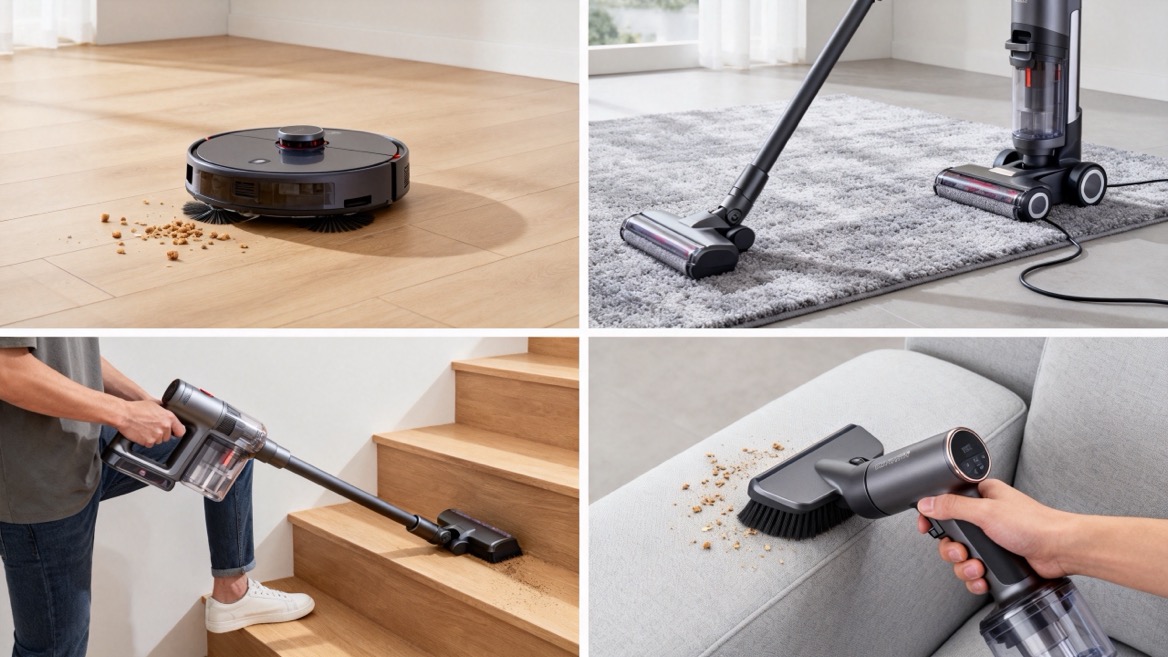
An upright vacuum remains a relevant option when customers prioritize floor cleaning and direct control over the cleaning path.
However, format alone does not guarantee performance. Brush design, airflow, nozzle behavior, and the interaction with different floor surfaces all require evaluation.
Brands should therefore avoid presenting "upright" as a universal performance claim. Demonstrate the model's results on the surfaces customers actually clean.
Handheld vacuum cleaners serve tasks outside routine floor maintenance.
These include cleaning upholstery, reaching confined spaces, and removing small messes from vehicle interiors. Useful attachments and comfortable handling may matter more here than a long feature list.
For private-label brands, this creates a distinct product proposition rather than a cheaper substitute for a robot.
Upright and handheld describe product formats. Corded and cordless describe how products receive power.
These categories overlap.
A handheld model can be cordless. An upright can be corded. Keeping the terminology precise helps customers compare products without confusing form, power source, and cleaning function.
Cordless buyers should examine runtime under realistic settings. Corded buyers should assess cable reach and handling alongside performance.
Headline suction specifications can attract attention, but they are not a complete measure of cleaning effectiveness.
Procurement teams should ask how a product performs as a system: motor, airflow path, filter, brush, nozzle, and collection chamber.
Performance-testing standards provide a more disciplined foundation. IEC 62885-4 addresses cordless dry vacuum cleaners, while IEC/ASTM 62885-7 covers dry-cleaning robots.
Importantly, the robot standard cautions against directly comparing its cleaning-performance results with manually operated vacuum products unless otherwise indicated.
A single number should therefore not become a universal ranking across different machine types.
Translate specifications into questions that a sample evaluation can answer:
- Does the brush collect representative debris on the intended floor?
- Can users empty the container without unnecessary difficulty?
- Is the product comfortable to move and carry?
- Are filters and attachments straightforward to access?
- Does the stated runtime identify the operating mode and test conditions?
For filtration claims, request relevant evidence and clear wording. Do not infer whole-machine dust containment from a filter description alone.
For brands and distributors, robot vacuum growth is a reason to reconsider product roles—not automatically to remove conventional products.
A practical portfolio can separate customer needs into three groups.
This group values repeatable, low-involvement cleaning.
Where a brand offers robotic products, the positioning should explain navigation, accessible coverage, docking, and remaining maintenance requirements.
This group wants one product that is easy to retrieve and use across different situations.
Cordless products may fit this role when handling, attachments, and usable runtime align with the target household.
This group prioritizes specific tasks, longer sessions, or accessible pricing.
Depending on the customer, an upright, corded, or handheld product may offer the clearest proposition.
These are planning categories, not a claim that every retailer needs every format. Start with the customer and channel before expanding the range.
Before requesting quotations, document:
- Target country and sales channel.
- Intended customer and cleaning tasks.
- Product format and target retail price.
- Required attachments and packaging.
- Performance expectations and applicable requirements.
A clear brief makes proposals more comparable and reduces misunderstandings.
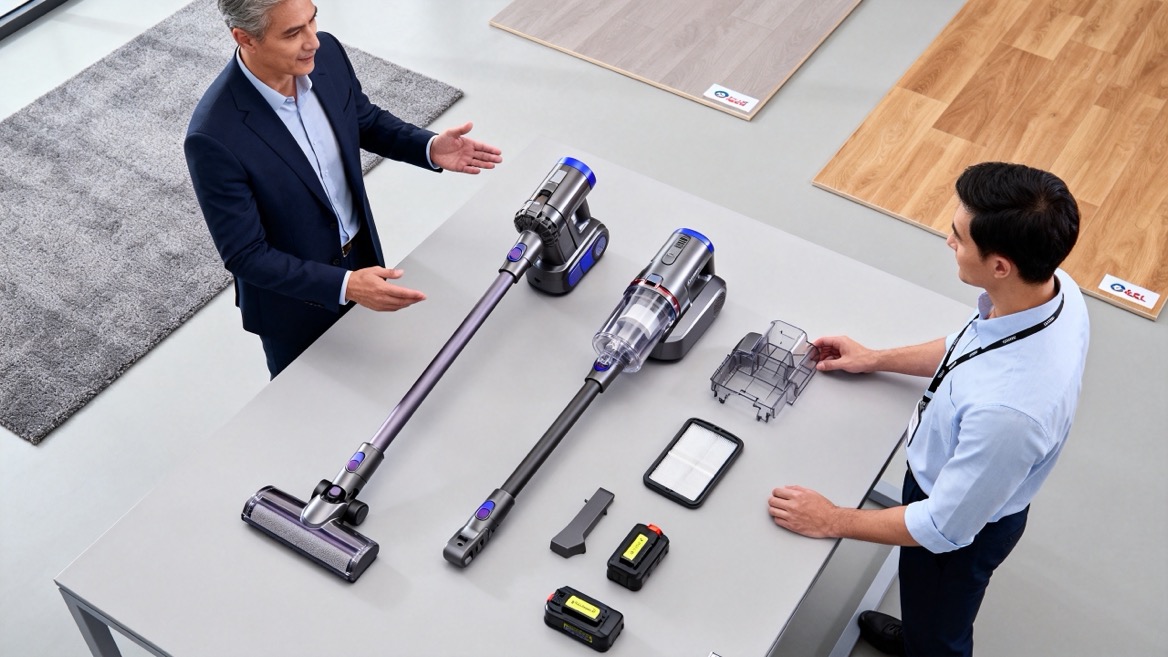
Use the same floor surfaces, debris types, settings, and cleaning procedure for each sample.
Record pickup results, handling, emptying, noise observations, and any operating interruptions. For cordless products, record the setting used during runtime evaluation.
An impressive demonstration should lead to a repeatable test—not replace one.
Confirm what OEM or ODM means for the specific project.
Is the request limited to branding, color, packaging, and accessories? Or does it involve structural changes and new development?
Discuss approval samples, change control, inspection arrangements, and responsibility for technical documentation before committing to production.
Ask which replacement parts and consumables will be available, how faults will be handled, and what information customers will receive.
A product strategy is incomplete if it ends at shipment. Service arrangements should be part of the commercial discussion from the beginning.
Market commentary explains category direction. Genuine customer feedback explains where individual products create satisfaction or frustration.
For an existing product range, organize verified reviews into recurring themes:
| Review theme | Product-development question |
|---|---|
| Difficult handling | Can weight distribution or grip design improve? |
| Hair accumulation | How accessible is the brush for cleaning? |
| Disappointing runtime | Were operating modes explained clearly? |
| Messy emptying | Can the collection chamber improve? |
| Missing replacement parts | Is the support process adequate? |
These are analysis categories, not customer quotations.
Count how often each issue appears, investigate the conditions behind it, and compare feedback with product testing. A repeated complaint deserves attention, but it should not become a technical conclusion without verification.
Publish authentic testimonials only with appropriate permission and attribution.
Ningbo Eyunhome Electric Technology Co., Ltd. provides upright, handheld, corded, and cordless vacuum cleaner solutions for business customers.
Our offering includes OEM/ODM services, stable production, and reliable after-sales support, with a focus on serving international market requirements.
For your next private-label project, send us your target market, preferred product format, expected order quantity, customization needs, and performance priorities.
Use that brief to begin a focused discussion about suitable product options, sample evaluation, and production planning.
The goal is not to chase every robot vacuum trend. It is to develop a vacuum cleaner range that solves defined customer problems and supports a credible commercial promise.
Not completely. Robot vacuums increasingly handle routine floor maintenance, while manual products remain relevant for heavier cleaning and tasks beyond accessible floors. Suitability depends on the individual product and household.
Convenience, improved navigation, broader automation, and more accessible advanced features help explain growing interest. Forecast growth should still be distinguished from actual sales results.
Not universally. Independent testing identifies carpet pet-hair pickup as a limitation for some robots. Compare model-specific results on representative surfaces rather than relying on category claims.
Compare the intended cleaning tasks, handling, attachments, and tested pickup results. For cordless models, check runtime conditions; for corded models, assess cable reach and practical movement.
Start with a defined product brief and suitable samples. Then clarify customization scope, testing expectations, production controls, documentation responsibilities, and after-sales arrangements.
There is no universal answer. Choose the format that fits the target customer, channel, price position, and support capability. Validate the decision through sample testing and relevant customer feedback.
1. [Vacuum Wars — "Robot Vacuum Market Trends: Are Traditional Vacuums Falling Behind?"]
Updated February 17, 2025. The supplied article provides the starting topic, market narrative, and discussion of automation. Its unverified share estimates, older brand rankings, and loosely sourced unit-sales claims were not carried forward. [vacuumwars]
2. [Grand View Research — "U.S. Household Vacuum Cleaner Market Size Report, 2030"]
Source for the USD 1.55 billion 2024 market estimate, 9.2% projected annual growth during 2025–2030, USD 2.64 billion projected 2030 value, and robotic-segment growth exceeding 11%. These are research estimates and forecasts, not verified future outcomes. [grandviewresearch]
3. [RTINGS — "The 4 Best Robot Vacuums of 2026"]
Source for independent observations about maintenance cleaning, increasingly available mapping and docking features, continuing maintenance requirements, obstacle-avoidance limitations, and model-specific carpet pet-hair performance. [rtings]
4. [Swedish Electrotechnical Standardization — SS-EN IEC 62885-4 Preview]
Standards preview describing performance measurement for cordless household dry vacuum cleaners and intended comparability with mains-connected vacuum results under IEC 62885-2. [elstandard]
Source for the dry-cleaning robot performance-testing scope and the caution against comparing robot cleaning-performance results directly with manually operated products unless otherwise indicated. [isrsm.gov]


