
Views: 264 Author: Eyunhome Vacuum Publish Time: 2026-10-10 Origin: Site


Content Menu
● Suction Power vs. Vacuum Performance: What Is the Difference?
>> What Suction Pressure Measures
>> What Overall Vacuum Performance Includes
● Understanding Vacuum Specifications: kPa, Airflow, Air Watts, and Input Watts
>> Why Airflow Matters Alongside Suction
>> Are Air Watts Better Than Input Watts?
● When Higher Suction Helps—and When It Becomes a Trade-Off
>> Situations Where More Suction Can Be Useful
>> Situations Where Maximum Suction Is Less Useful
● Comparing Vacuum Performance Across Floors and Debris
>> Hard Floors: Debris Admission Matters
>> Carpets: Agitation Changes the Comparison
>> Pet Hair: Pickup and Maintenance Are Different Questions
● Corded vs. Cordless Vacuums: Compare Usable Cleaning, Not Peak Claims
● Filtration: Cleaning Performance Includes Keeping Dust Inside
>> A Filter Label Is Not a Whole-Machine Result
● A Practical Vacuum Comparison Protocol for Buyers
>> Step 1: Define the Customer's Cleaning Task
>> Step 2: Normalize the Comparison Conditions
>> Step 3: Measure Pickup Instead of Relying on Appearance
>> Step 4: Repeat After Controlled Dust Loading
>> Step 5: Record the User Experience
● Expert Procurement Insight: Build a Claims-to-Evidence Checklist
● Choosing an OEM/ODM Vacuum Partner for Your Target Market
>> Is Higher Suction Always Better for a Vacuum Cleaner?
>> What Is a Good Suction Power for a Vacuum?
>> Are Air Watts More Useful Than Motor Watts?
>> Can a Lower-Suction Vacuum Clean Better?
>> Does a HEPA Filter Guarantee a Fully Sealed Vacuum?
>> How Should Buyers Compare Cordless Vacuum Runtime?
Higher suction is not always better. When comparing vacuum performance, suction pressure matters, but it does not tell the whole story. Airflow, floor-head design, brush agitation, filtration, and usable runtime determine whether a vacuum actually removes dirt efficiently.
For distributors, retailers, and private-label brands, this distinction has commercial consequences. A product with an impressive suction specification can still disappoint customers if it pushes debris forward, becomes difficult to maneuver, or requires frequent filter cleaning.
At Ningbo Eyunhome Electric Technology Co., Ltd., we offer upright, handheld, corded, and cordless vacuum cleaner solutions, supported by OEM/ODM services, stable production, and after-sales assistance. Our recommended purchasing principle is straightforward: prioritize performance, not an isolated headline number.
This guide explains how suction power compares with real-world cleaning performance—and how to evaluate both before selecting your next vacuum cleaner range.
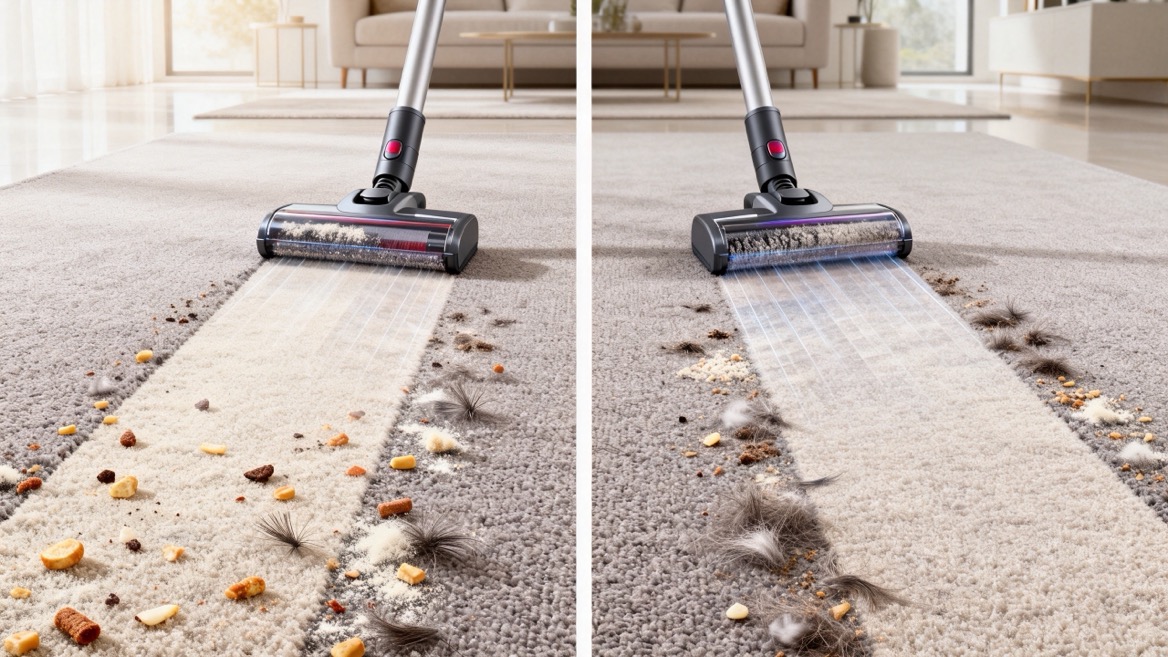
Suction power describes part of a vacuum's air-handling capability. Vacuum performance describes the results delivered by the complete cleaning system.
These concepts are related, but they are not interchangeable.
Suction pressure is the pressure difference a vacuum creates between its intake and the surrounding atmosphere. Manufacturers commonly express it in pascals, kilopascals, or inches of water lift.
A higher pressure differential can help maintain air movement against resistance. However, a maximum suction-pressure figure does not show how much air moves through the machine during cleaning.
Measurement conditions matter. A reading taken at a restricted inlet is not directly comparable with one taken through an attached floor head.
A useful vacuum performance comparison examines:
- Dirt pickup on the intended floor surfaces.
- Airflow through the working cleaning head.
- Removal of embedded dust and surface debris.
- Hair pickup and brush maintenance.
- Dust retention and filtration.
- Maneuverability, noise, and operating time.
- Performance as the bin and filters accumulate dirt.
My approach to comparing products is to start with the cleaning task, then interpret the specifications. Starting with the largest number reverses that logic.
Vacuum cleaner specifications become useful only when buyers understand what each measurement represents.
| Specification | What it describes | What it cannot establish alone |
|---|---|---|
| Suction pressure, Pa or kPa | Pressure differential | Actual dirt pickup |
| Airflow, L/s or CFM | Volume of air moving through the system | Effective brush agitation or dust retention |
| Air watts, AW | Air power combining pressure and airflow | Complete cleaning performance |
| Electrical input, W | Electrical power consumed | Useful air power or cleaning efficiency |
| Runtime, minutes | Operating duration under stated conditions | Duration with another mode or attachment |
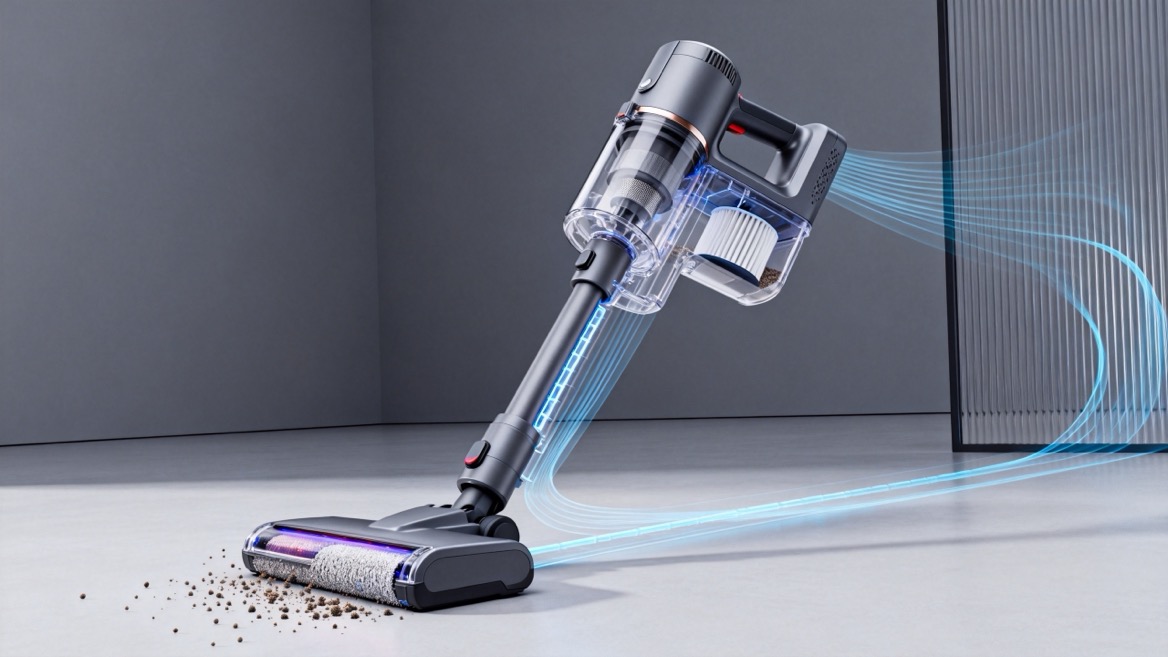
Pressure differential drives air movement; airflow transports loosened debris through the cleaner.
A vacuum can produce substantial maximum pressure yet deliver disappointing airflow under its normal operating conditions. Restrictions in filters, ducts, attachments, or the floor-head interface can change the result.
Consequently, "higher suction" should always prompt another question: higher suction where, and under which conditions?
Air watts are more relevant to air performance than electrical input watts because they combine pressure differential and airflow at a particular operating point.
However, air-watt claims still need context.
ASTM F558 measures air-performance characteristics, including suction, airflow, and air power. Its published scope explicitly distinguishes ideal air-performance testing from actual cleaning with tools and floor surfaces.
Do not multiply a product's separately advertised maximum pressure and maximum airflow to estimate its air watts. Those maximum values may occur at different operating points.
Higher suction can be beneficial when the complete system converts that capability into improved pickup.
It is not inherently wasteful or unnecessary. The problem is treating it as sufficient evidence of a better vacuum.
Additional pressure capability may help when:
- Cleaning through a narrow crevice attachment.
- Working with an airflow path that presents greater resistance.
- Supporting dirt pickup where a suitable nozzle maintains effective airflow.
- Providing a temporary boost for demanding cleaning tasks.
These benefits depend on the attachment, surface, and operating conditions. They should be demonstrated rather than assumed.
On some carpets, excessive sealing between the nozzle and surface can increase pushing effort. More power is then available, but the cleaning experience may become worse.
On hard floors, a poorly designed inlet may push larger particles ahead instead of admitting them. Increasing motor output does not necessarily correct that geometry.
In cordless vacuums, a higher-power setting can also shorten operating time. The practical question becomes whether better pickup compensates for reduced coverage.
The strongest product is therefore not always the strongest motor. It is the system that delivers the required cleaning result with acceptable effort, runtime, and maintenance.
There is no single ideal suction level for every household or market.
Surface type, debris characteristics, and customer expectations should shape the product specification.
| Cleaning application | Priority performance factors | Useful evaluation |
|---|---|---|
| Hard floors | Inlet geometry, debris admission, floor-head contact | Fine dust and larger debris pickup |
| Carpets | Agitation, airflow, nozzle interaction | Embedded dirt removal and pushing effort |
| Pet-owning households | Hair pickup, brush design, maintenance access | Hair collection and removal from the brush |
| Furniture and stairs | Attachment suitability, weight, handling | Pickup using the supplied tools |
| Mixed-floor homes | Balanced head design and power control | Results across all intended surfaces |
Fine dust and larger particles present different challenges.
A head may collect powder effectively yet struggle with cereal-sized debris. Buyers should therefore avoid accepting one demonstration as proof of universal hard-floor performance.
Ask whether the cleaner collects both debris types without excessive scattering, repeated passes, or lifting the head.
Carpet cleaning requires more than collecting visible material from the surface.
A powered brush can help loosen embedded dirt, while airflow carries released material into the cleaner. Brush configuration, floor-head contact, and operating speed influence the outcome.
ASTM F608 specifically addresses embedded dirt removal from carpets. Its scope does not cover surface litter and debris, which require separate evaluation.
A vacuum may pick up hair successfully but leave it wrapped around the brush.
For pet-focused products, evaluate both collection and maintenance. Check how easily users can access the roller, remove wrapped material, and restore normal operation.
Avoid presenting hair pickup and anti-tangle performance as the same claim.
Corded and cordless vacuums solve different usability problems.
Neither format is automatically superior.
Corded models avoid battery-runtime limits during use, making them worth considering where customers prioritize longer cleaning sessions.
Nevertheless, cord length, outlet access, storage, weight, and handling still affect convenience. Continuous electrical supply does not guarantee superior pickup.
Cordless models remove the operating cord and can suit quick cleaning, stairs, and movement between rooms.
Their runtime figures need careful interpretation. Ask which power mode, attachment, surface, and battery condition produced the advertised duration.
A maximum-runtime claim should not be read as maximum-power runtime unless supporting documentation explicitly confirms it.
IEC 62885-4 provides performance-measurement methods for cordless dry vacuum cleaners. Its scope includes characteristics relevant to users, rather than treating suction alone as the defining result.
Picking up dust is only part of the job. The cleaner must also retain it.
The U.S. Environmental Protection Agency describes a HEPA filter as capable of removing at least 99.97% of airborne particles measuring 0.3 microns under the relevant definition.
That figure describes filter efficiency. It does not automatically establish the performance of an assembled vacuum.
Air can bypass filtration if the complete machine is not properly sealed.
For a filtration-focused product, request evidence covering:
- Filter efficiency and the applicable test method.
- Sealing around the filter and dust container.
- Whether testing evaluates the filter or complete appliance.
- Installation and maintenance requirements.
Avoid unsupported claims about allergy relief or medical benefits. Product-level filtration evidence supports a narrower, more defensible message: how effectively the machine retains particles under stated conditions.
The following screening process helps turn product samples into a useful purchasing decision.
It is a proposed comparative workflow, not a replacement for standardized laboratory testing.
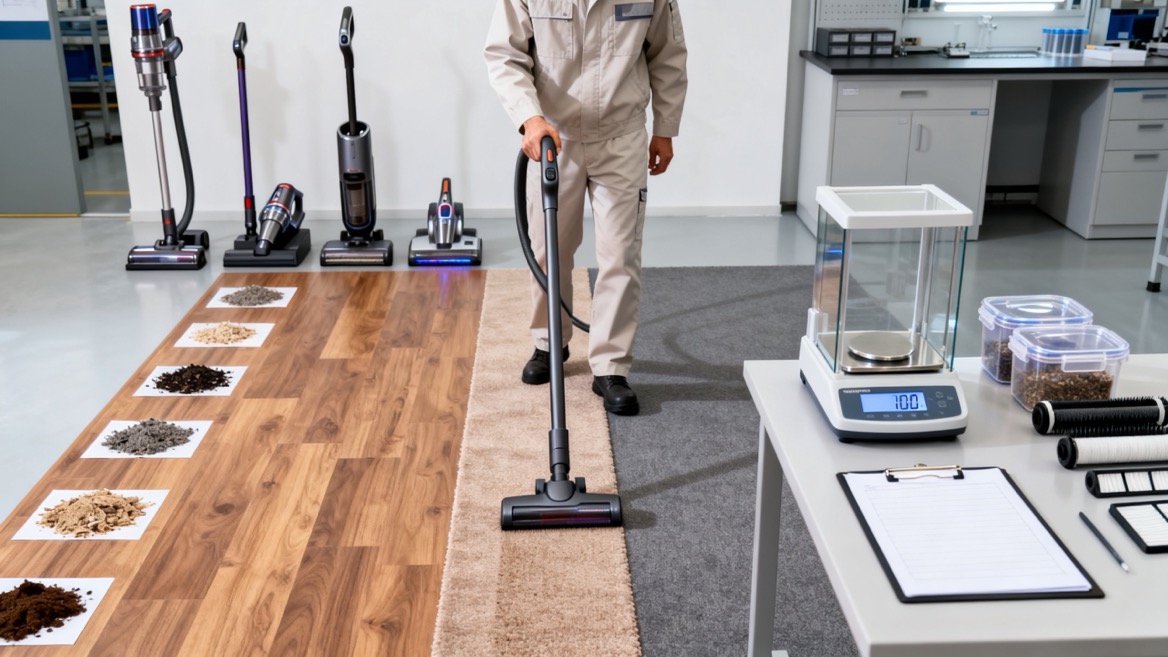
Specify the intended surfaces, debris, cleaning duration, and preferred product format.
A lightweight handheld vacuum for furniture should not be judged by the same priorities as an upright intended for carpets.
Use the same test area, debris quantities, pass count, and operating procedure.
Document the power mode, supplied attachment, filter condition, and battery state. Compare products in the same environment wherever possible.
For an internal screening test, weigh the debris applied and the material recovered.
Pickup percentage equals collected debris mass divided by applied debris mass, multiplied by 100.
Account for handling losses and escaped material. Repeat the test and report variability rather than selecting only the best result.
Compare the clean-machine result with performance after a defined loading procedure.
Keep the loading material, quantity, and maintenance intervals consistent. This helps identify products whose attractive initial results depend heavily on freshly cleaned filters.
Measure or document pushing effort, handling, interruptions, emptying, brush cleaning, and operating time.
A strong procurement decision combines cleaning evidence with usability evidence.
Before approving packaging or a product listing, connect each proposed claim to an appropriate test.
| Proposed claim | Evidence to request |
|---|---|
| "Powerful suction" | Pressure or air-performance report with measurement conditions |
| "Deep carpet cleaning" | Embedded dirt removal testing |
| "Long runtime" | Duration with specified mode and attachment |
| "Effective filtration" | Filter or whole-machine report, clearly identified |
| "Easy pet-hair maintenance" | Defined hair test and documented brush-cleaning procedure |
This checklist exposes mismatches early.
For example, an inlet air-power result cannot independently substantiate superior carpet cleaning. Likewise, a filter certificate cannot independently prove that the entire appliance prevents bypass leakage.
Request the applicable standard edition, sample identification, test setup, and reporting limitations. A standard number on a brochure is not equivalent to a complete report.
For private-label buyers, the comparison should extend beyond the sample machine.
Discuss how the approved design will translate into repeatable production and manageable after-sales support.
With Ningbo Eyunhome Electric Technology Co., Ltd., buyers can discuss upright, handheld, corded, and cordless solutions alongside OEM/ODM requirements.
A practical development brief should include:
- Target customer and floor types.
- Required cleaning outcomes and operating modes.
- Weight, handling, noise, and runtime priorities.
- Filtration requirements and claim-verification plans.
- Accessories, packaging, and maintenance instructions.
- Production consistency and spare-parts expectations.
Contact Ningbo Eyunhome Electric Technology Co., Ltd. with your target market, preferred vacuum format, cleaning applications, and performance priorities. Request a product discussion and sample-evaluation plan that compares measurable cleaning results—not suction figures alone.
No. Higher suction is useful when it improves pickup under actual cleaning conditions. Airflow, floor-head design, agitation, filtration, and handling determine whether that additional capability benefits users.
There is no universal figure suitable for every format and cleaning task. Compare products with equivalent measurement conditions, then check pickup results on the surfaces your customers actually use.
Air watts describe air power, while motor input watts describe electrical consumption. Air watts are more relevant to air performance, but neither measurement independently establishes real-world cleaning effectiveness.
Yes. A cleaner with better debris admission, brush action, or operating airflow can outperform a higher-pressure model on a particular task. That conclusion should come from controlled pickup comparisons.
No. Filter efficiency and whole-machine sealing are separate issues. Ask whether the complete appliance has been evaluated and whether all intended exhaust airflow passes through the filtration system.
Compare runtime using the same operating mode, attachment, and surface conditions. Evaluate pickup alongside duration, because longer operation at a weak setting may not deliver the required cleaning result.
1. ASTM International. "ASTM F558-21: Standard Test Method for Measuring Air Performance Characteristics of Vacuum Cleaners." Basis for distinguishing suction, airflow, air power, and ideal air-performance testing from actual cleaning. [astm]
2. ASTM International. "ASTM F608-24: Standard Test Method for Evaluation of Carpet Embedded Dirt Removal Effectiveness of Household/Commercial Vacuum Cleaners." Basis for the carpet-testing discussion and its distinction from surface-debris removal. [store.astm]
3. Airmid Healthgroup. "IEC 62885-2:2021—Surface Cleaning Appliances—Vacuum Cleaners." Laboratory overview of mains-operated vacuum performance testing and the value of controlled comparative conditions. [airmidhealthgroup]
4. Swedish Institute for Standards. "IEC 62885-4:2020+AMD1:2023 CSV—Cordless Dry Vacuum Cleaners for Household or Similar Use—Methods for Measuring the Performance." Standard identification and cordless testing scope. [sis]
5. IEC. "IEC 62885-4:2020+AMD1:2023 CSV," publicly available preview hosted by iTeh Standards. Supports the discussion of cordless performance characteristics, carpet runtime, and related measurements. [cdn.standards.iteh]
6. U.S. Environmental Protection Agency. "What Is a HEPA Filter?" Source of the stated 99.97% efficiency at 0.3 microns and the explanation of particle filtration. [epa]
7. U.S. Environmental Protection Agency. "The RRP Rule Requires HEPA Vacuums…What Should I Look For When Purchasing a HEPA Vacuum?" Supports the distinction between a HEPA filter and a vacuum designed to prevent filtration bypass. Its regulatory context concerns renovation dust, not general certification of household products. [epa]


