
Views: 218 Author: Eyunhome Vacuum Publish Time: 2026-08-28 Origin: Site


Content Menu
● What Makes a Cordless Vacuum Worth Buying?
● Leading Design Directions Under $600
● Choose by Your Cleaning Situation
>> Mixed Floors and Daily Crumbs
>> Apartments and Lightweight Cleaning
>> Larger Homes and Longer Sessions
● How to Compare Runtime Honestly
● Filtration Is More Than a HEPA Label
● From Consumer Insight to OEM/ODM Product Planning
>> A practical development checklist
● Why Manufacturing Support Shapes Product Value
>> What is the best cordless vacuum under $600 for mixed floors?
>> Is a removable battery important?
>> How long should a cordless vacuum run?
>> Are anti-tangle brush rolls worth it?
>> Does HEPA filtration guarantee a cleaner exhaust air stream?
>> What should brands provide in an OEM/ODM vacuum brief?
>> Can a cordless vacuum replace a corded upright vacuum?
The best cordless vacuum under $600 is no longer defined by price alone. Today's strongest models combine effective debris pickup, usable battery runtime, anti-tangle brush systems, sealed filtration, and an ergonomic form that makes frequent cleaning easier—not harder.
For homeowners, the right choice depends on floor type, pet hair, home size, storage space, and how often the vacuum will be used in handheld mode. For brands and retailers, the same factors translate into product-definition priorities: stable suction performance, credible runtime claims, safe battery integration, repeatable production quality, and support after delivery.
Ningbo Eyunhome Electric Technology Co., Ltd. develops upright, handheld, corded, and cordless vacuum solutions for global markets. Through professional OEM/ODM cooperation, dependable production planning, and responsive after-sales support, we help partners turn real consumer needs into competitive vacuum products.

A cordless vacuum should remove everyday debris quickly while remaining comfortable enough to use several times a week. Buyers increasingly expect one machine to handle hard floors, rugs, low-pile carpet, stairs, sofas, vehicles, and narrow gaps.
The most useful models under $600 tend to balance five essentials:
- Floor-head performance on both hard floors and carpet
- Battery usability in real cleaning modes, not only in low-power claims
- Hair management for homes with pets or long hair
- Weight and maneuverability for stairs, furniture, and overhead cleaning
- Filtration and dust containment to reduce fine-particle escape during use
Independent testing illustrates why a balanced specification matters. Vacuum Wars evaluated more than 110 cordless models using comparable tests, including pickup, carpet deep cleaning, runtime, filtration, and usability. Its featured products show that high-performing designs do not all take the same route: some prioritize dual-roller heads, some lightweight handling, and others automatic dirt detection or self-emptying docks.
The table below highlights the different product strategies visible in popular cordless models. These figures are useful benchmarks, but shoppers should confirm final specifications, included accessories, and local warranty terms before purchasing.
| Model | Best-fit user | Notable strengths | Points to consider |
|---|---|---|---|
| Bissell PowerClean DualBrush 4196K | Value-focused homes with mixed flooring | Dual-roller cleaning head, removable battery, automatic suction adjustment | Small 400 ml dust bin; reported noise level is relatively high |
| Shark PowerDetect Clean & Empty | Users seeking automation and convenient disposal | Dirt and edge detection, folding wand, auto-empty dock option, anti-hair-wrap rollers | Larger dock format may not suit compact storage areas |
| Dyson V12 Detect Slim | Users who prioritize low handle weight and detail cleaning | Lightweight body, laser dust illumination, particle display, push-button control | Small bin and shorter high-power sessions may require more frequent emptying |
| Shark Stratos Cordless | Homes with carpets, hard floors, and pet hair | Strong carpet and hard-floor test results, anti-hair-wrap rollers, flexible wand | Attachment package may vary by retailer |
| Shark Vertex Pro | Larger cleaning areas and users who prefer bin capacity | Dual-roller head, larger 1,100 ml bin, optional second battery | Handheld balance may feel less natural for some users |
The Bissell PowerClean DualBrush reportedly achieved a 94% carpet deep-cleaning result in Vacuum Wars testing, compared with a 93% cordless-vacuum average. The Shark Stratos recorded a 100% result in that site's carpet deep-clean test, while the Dyson V12 stands out for its lower 1,480 g handle weight. These examples show why "more suction" is not a complete buying criterion: the floor head, airflow path, brush design, battery mode, and handling geometry all shape actual cleaning results.
For a home with hard floors, area rugs, and low-pile carpet, look for a dual-roller or multi-surface floor head. A soft roller can help collect fine dust and larger particles from hard floors, while a bristled roller supports carpet agitation.
Useful features include:
- Automatic suction adjustment
- Floor-head lighting
- Swivel steering
- A removable handheld unit
- A combination crevice and dusting tool
Avoid assuming that a vacuum with a high maximum suction figure will automatically clean every surface better. In practical use, pickup depends on how well the floor head seals, channels debris, resists scattering, and maintains brush contact across different floor types.
Pet owners should prioritize a brush roll designed for active hair removal or anti-tangle performance. A strong motor alone cannot solve hair wrapping around the roller, especially in homes with long human hair, pet fur, or carpeted rooms.
Check these details before buying:
1. Is the brush roll removable for cleaning?
2. Does the floor head have a comb, scraper, or hair-separation mechanism?
3. Is a motorized mini tool included for upholstery and pet beds?
4. Does the bin empty cleanly without clumps remaining in the shroud?
5. Can replacement filters, rollers, and batteries be purchased locally?
A practical product should reduce maintenance rather than merely move it from the floor to the user's hands.
For apartments, smaller homes, or users who frequently clean stairs, a lighter model can be more valuable than a larger bin or a long claimed runtime. The Dyson V12 is a relevant example because its lower handle weight and button-based operation address fatigue during handheld cleaning.
For this segment, target a vacuum that is easy to grab, easy to store, and quick to convert. A machine that feels inconvenient will often remain on its charging dock while a basic broom does the work.
For larger spaces, battery strategy matters more than a single advertised runtime number. Independent reviewers note that cordless-vacuum batteries commonly deliver around 30 to 40 minutes of real-use cleaning, while lower-power modes can run longer. In one cited test, the Shark ran for about 58 minutes in eco mode, despite a manufacturer claim of up to 70 minutes.
The better buying approach is to ask:
- How long does the vacuum run with the motorized floor head attached?
- What runtime is available in normal and maximum modes?
- Is the battery removable?
- Can a second battery be purchased?
- How long does a full recharge take?
For brands planning a cordless range, these questions should become part of the product brief—not an afterthought during marketing.
Runtime claims can confuse even experienced buyers because operating conditions vary widely. A "60-minute runtime" may refer to low-power mode, a non-motorized tool, a clean filter, a new battery, and a specific laboratory condition.
Use this comparison method:
1. Separate maximum, standard, and eco modes. Each mode serves a different job.
2. Confirm the floor-head condition. A motorized brush head generally uses more energy than a crevice tool.
3. Check battery removability. A replaceable battery can extend useful service life and reduce downtime.
4. Consider the cleaning route. Deep carpet cleaning requires more power than quick hard-floor maintenance.
5. Ask for recharge time and battery-care guidance. These influence day-to-day satisfaction after purchase.
Current category guidance commonly treats 60+ minutes as a strong maximum-runtime target for smaller homes or apartments, while recharge time can still reach three to four hours for less expensive products.
For product teams, credible runtime communication should identify the mode, attachment, battery condition, and test setup. This protects consumer trust and helps retailers compare products fairly.
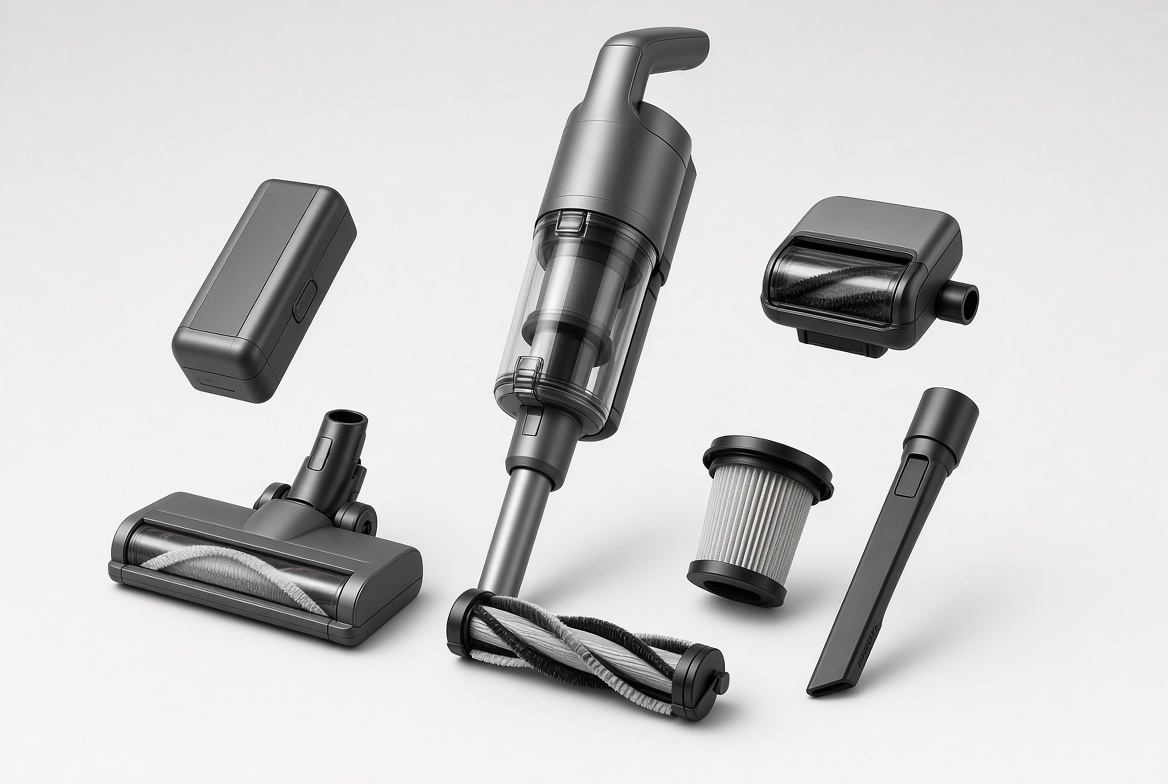
Filtration should be viewed as a complete system: dust bin sealing, gasket fit, filter media, airflow design, and how effectively the vacuum prevents fine particles from escaping during operation.
A HEPA-labelled filter can be valuable, but the consumer experience depends on whether the entire air path is well sealed. Independent vacuum testing often evaluates visible fine-particle leakage rather than simply repeating a filter claim.
For homes with pets, fine dust, or allergy concerns, look for:
- Sealed filtration construction
- Washable or replaceable filters with clear maintenance instructions
- A bin-emptying design that limits dust clouds
- Accessible replacement parts
- Transparent performance documentation
ASTM F3150 provides test methods and minimum efficiency requirements for residential and commercial vacuum filtration systems claiming HEPA performance. This is especially relevant to brands developing products for markets where consumers increasingly scrutinize filtration claims.
The under-$600 cordless category is crowded, but it also offers clear differentiation opportunities. Rather than copying a single competitor, successful private-label programs combine proven essentials with a focused user proposition.
1. Define the primary household profile.
Choose a clear target: pet owners, compact apartments, mixed-floor families, large homes, or commercial light-duty users.
2. Set measurable priorities.
Specify desired pickup performance, usable runtime, noise level, dust-bin capacity, weight, charging time, and attachment package.
3. Match the floor head to the market.
A dual-roller head may appeal to mixed-floor households, while a focused carpet head may better suit regions with extensive carpeting.
4. Validate battery and charging integration.
Battery cells, battery management systems, chargers, and thermal design must be evaluated as one system.
5. Plan serviceability early.
Filters, rollers, batteries, and common wear parts should be replaceable without unnecessary complexity.
6. Test production consistency.
Pilot samples are not enough. Brands should establish inspection standards for suction, noise, charging, fit, function, and cosmetic quality throughout production.
Electric vacuum cleaners are covered by IEC 60335-2-2 safety requirements, while IEC 60335-1 outlines general safety requirements for household and similar electrical appliances. Applicable testing and market requirements should always be confirmed with qualified laboratories and compliance specialists for the destination market.
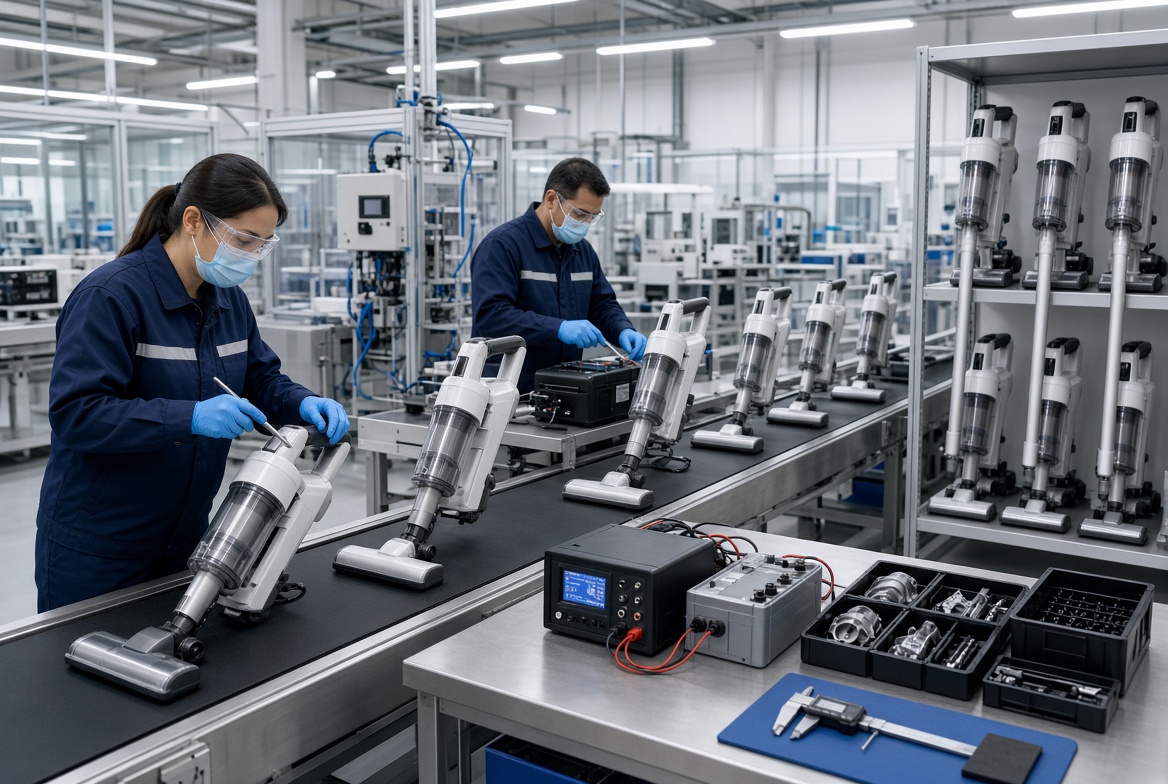
A strong product concept can lose value if production quality, spare-part availability, packaging protection, or response speed is inconsistent. For importers and brand owners, selecting a vacuum supplier should therefore involve more than reviewing a sample.
Look for a manufacturing partner that can support:
- OEM/ODM customization for appearance, features, accessories, packaging, and branding
- Stable production scheduling and quality-control processes
- Transparent communication during sampling and mass production
- Documentation support for target-market requirements
- Reliable after-sales coordination and spare-part planning
Ningbo Eyunhome Electric Technology Co., Ltd. provides upright, handheld, corded, and cordless vacuum solutions designed around these commercial needs. Whether you are building an entry-level cordless range, developing a pet-hair-focused model, or sourcing a multi-surface vacuum for retail distribution, our team can help define a product package that fits your market, target price, and customer expectations.
Contact Ningbo Eyunhome Electric Technology Co., Ltd. to discuss your OEM/ODM cordless vacuum project, request product information, or explore a tailored vacuum solution for your brand.
Choose a model with a multi-surface or dual-roller floor head, strong hard-floor pickup, effective carpet agitation, and adjustable suction. Features such as LED lighting and swivel steering can also improve daily usability.
Yes, especially for larger homes or frequent cleaning. A removable battery enables longer sessions with a spare battery and can make future servicing more practical.
The answer depends on mode and floor head. Maximum claims can exceed 60 minutes, but standard or high-power cleaning with a motorized head will often be shorter. Compare runtime by mode rather than relying on one headline number.
For homes with pets or long hair, they can significantly reduce manual roller cleaning. Confirm that the design includes a real hair-management mechanism and that the brush roll remains accessible for maintenance.
Not by itself. The filter is only one part of the system. Seals, gaskets, bin construction, airflow design, and maintenance all affect whether fine particles escape during use.
Include the target market, user profile, price range, floor types, expected runtime by mode, battery configuration, suction target, noise limit, bin capacity, filtration requirement, accessories, packaging, and compliance requirements.
For everyday maintenance, many cordless models can. For very large carpeted homes, extended deep cleaning, or heavy debris, a corded upright or a cordless model with spare batteries may still be the more practical choice.
1. [Vacuum Wars — The Best Cordless Vacuums Under $600]
2. [Vacuum Wars — How We Test and Score Cordless Vacuums]
3. [Wirecutter — The Best Cordless Stick Vacuums]
4. [RTINGS — The Best Cordless Vacuums]
5. [IECEE — IEC 60335-2-2:2019]
6. [Intertek — IEC 60335-1 and Appliance Safety]
7. [ASTM F3150-18(2024) — HEPA Filtration for Vacuum Cleaners]


