
Views: 212 Author: Eyunhome Vacuum Publish Time: 2026-08-29 Origin: Site


Content Menu
● Quick Answer: Are Wireless and Cordless Vacuums the Same?
>> Why "cordless vacuum" is the preferred industry term
>> When the term needs clarification
● Wireless Vacuum vs Cordless Vacuum: Side-by-Side Comparison
● Why Terminology Matters for Vacuum Brands
>> Better naming creates better commercial outcomes
● The Technical Factors Buyers Should Compare
>> 1. Battery configuration and runtime
>> 2. Suction and pickup performance
>> 4. Filtration and dust management
>> 5. Weight, balance, and conversion design
● An Expert Sourcing Framework for Buyers
>> Step 1: Define the cleaning scenario
>> Step 2: Convert expectations into measurable requirements
>> Step 3: Validate the final user experience
● OEM and ODM Considerations for Cordless Vacuum Projects
>> Common customization opportunities
>> Calling every battery vacuum "smart"
>> Listing only maximum runtime
>> Comparing motor watts alone
>> Ignoring replacement consumables
>> Using inconsistent terminology
● Choose Clear Language and Better Product Requirements
>> Is a wireless vacuum the same as a cordless vacuum?
>> Which term should brands use: wireless vacuum or cordless vacuum?
>> Do cordless vacuums have enough power for carpets?
>> How long should a cordless vacuum run on one charge?
>> Is a removable battery better than a fixed battery?
>> What should importers check before ordering a cordless vacuum?
>> Can a cordless vacuum replace a corded vacuum?
For buyers, importers, and private-label brands, the terms wireless vacuum and cordless vacuum can appear interchangeable—but they do not always communicate the same thing in product listings, buyer searches, and technical discussions. In most consumer-appliance contexts, a cordless vacuum specifically means a vacuum cleaner powered by a rechargeable battery with no mains cable during use, while wireless vacuum is often a broader marketing term that may also imply smart connectivity, app control, or cable-free operation.
For Ningbo Eyunhome Electric Technology Co., Ltd., understanding this distinction is important when developing upright, handheld, corded, and battery-powered vacuum solutions for global brands. Clear terminology helps buyers source the right product platform, build accurate product pages, and avoid mismatched customer expectations.

In everyday retail language, many people use "wireless vacuum" and "cordless vacuum" to describe the same product: a rechargeable vacuum cleaner that operates without a power cable.
However, from a product-development and commercial perspective, cordless vacuum is the more precise and established term for a battery-operated vacuum cleaner. "Wireless" can describe the absence of a power cord, but it can also suggest Wi-Fi, Bluetooth, smart sensors, or connection to a mobile application.
This distinction matters because buyers search differently in different markets. A customer looking for a "cordless stick vacuum" is usually focused on battery runtime, charging, weight, suction performance, and cleaning versatility. A customer searching "wireless vacuum" may be looking for the same product—or may expect connected features.
| Term | Primary Meaning | Typical Buyer Expectation | Recommended Use |
|---|---|---|---|
| Cordless vacuum | A vacuum powered by a rechargeable battery | Battery runtime, charging time, suction, portability | Product titles, specifications, manuals, B2B sourcing |
| Wireless vacuum | A cable-free vacuum; sometimes a marketing synonym for cordless | Cord-free use, convenience, possibly smart connectivity | Secondary keywords, consumer-facing marketing |
| Smart vacuum | A connected or automated vacuum with digital functions | Wi-Fi, app control, sensors, automation | Smart-home and robotic product categories |
| Corded vacuum | A vacuum powered through a mains cable | Consistent cleaning time and stable power supply | Commercial, deep-cleaning, and extended-use applications |
A cordless vacuum cleaner normally uses a lithium-ion battery pack and can be designed as a stick vacuum, handheld vacuum, upright vacuum, mini vacuum, or convertible 2-in-1 model. Industry glossaries commonly define cordless vacuum cleaners as battery-powered appliances, often using lithium-ion battery technology.
A cordless vacuum is a vacuum cleaner that runs on an onboard rechargeable battery instead of being connected to an electrical wall outlet while in use.
The term directly describes the core product structure: there is no power cord connecting the appliance to the mains supply during cleaning. This gives users more freedom to move between rooms, stairs, cars, upholstery, corners, and other difficult-to-reach areas.
Modern cordless vacuums are commonly built around several key components:
- A rechargeable lithium-ion battery pack
- A high-speed motor, often brushless in higher-specification designs
- A motorized floor brush or electric roller brush
- A dust cup or dust bin
- Cyclonic dust separation
- Primary and post-motor filtration
- A wall mount, charging dock, or plug-in charger
- Accessories such as crevice nozzles, combination brushes, mattresses tools, and mini motorized brushes
Cordless vacuum cleaner performance is influenced by more than the motor's maximum power rating. Buyers should assess airflow, suction pressure, nozzle sealing, brush-roll design, filtration resistance, battery capacity, and real-world runtime as a complete system.
For product specifications, purchasing documents, certification files, packaging, and instruction manuals, "cordless vacuum" is usually clearer because it describes the power arrangement without making an unproven promise about digital connectivity.
For example:
> "This cordless stick vacuum uses a removable lithium-ion battery and includes a motorized floor head."
This statement clearly tells a buyer that the vacuum is rechargeable and cable-free during cleaning.
By contrast:
> "This wireless vacuum offers intelligent cleaning."
This statement may be attractive for marketing, but it leaves open important questions. Is the product battery-powered only? Does it use Bluetooth? Is there an app? Does it include a smart dust sensor? Is it a robot vacuum?
For B2B communication, clarity protects both the brand and the manufacturer.
A wireless vacuum generally refers to a vacuum cleaner that can be used without a power cable. In many online listings, the phrase is simply used as an alternative name for a cordless vacuum.
Yet the word "wireless" has a wider meaning in modern consumer electronics. It can refer to communication without physical cables, such as:
- Wi-Fi connection
- Bluetooth pairing
- App-based controls
- Cloud-connected maintenance alerts
- Smart-home integration
- Wireless charging in certain product categories
- Automated sensor systems
Because of this broader association, "wireless vacuum" can create ambiguity.
"Wireless vacuum" can work effectively in consumer-oriented content when the product's main promise is freedom of movement. It is especially useful in headlines, social advertising, lifestyle content, and long-tail search phrases such as:
- Best wireless vacuum for apartments
- Lightweight wireless vacuum for stairs
- Wireless handheld vacuum for car cleaning
- Wireless vacuum cleaner with removable battery
- Wireless vacuum for pet hair
The term can help a brand reach buyers who describe cable-free cleaning in everyday language rather than technical product language.
Brands should avoid relying on "wireless" alone when selling to distributors, retailers, or professional procurement teams. The specification should clearly state whether the appliance is:
- Battery-powered
- Cordless during operation
- Equipped with a removable or fixed battery
- Compatible with a charging dock
- Connected through Wi-Fi or Bluetooth
- App-enabled or non-connected
- Designed for domestic, light-commercial, or professional use
A good product title can include both phrases while prioritizing precision:
Cordless Stick Vacuum Cleaner | Wireless Rechargeable Vacuum with Removable Battery
This structure captures broader search behavior while making the product's true configuration easy to understand.
Although the two terms overlap, their commercial and technical implications are different.
| Comparison Area | Wireless Vacuum | Cordless Vacuum |
|---|---|---|
| Main meaning | A broad phrase for cable-free use; may imply connectivity | A battery-operated vacuum with no mains cord during cleaning |
| Technical precision | Less precise | More precise |
| Battery requirement | Usually expected, but not always explicitly stated | Essential |
| Smart-function expectation | May imply Wi-Fi, Bluetooth, sensors, or app functions | Does not imply connectivity |
| Best use in product specifications | Use only with clear supporting details | Highly suitable |
| Best use in consumer marketing | Useful for convenience-oriented messaging | Useful for both product and performance messaging |
| Common formats | Stick, handheld, robot, portable cleaner | Stick, handheld, upright, convertible 2-in-1 |
| Risk of buyer confusion | Higher if connectivity is not explained | Lower |
| Recommended keyword role | Supporting keyword | Primary category keyword |
The key conclusion is straightforward: every cordless vacuum may be marketed as wireless, but not every "wireless vacuum" description tells buyers enough about the actual product.
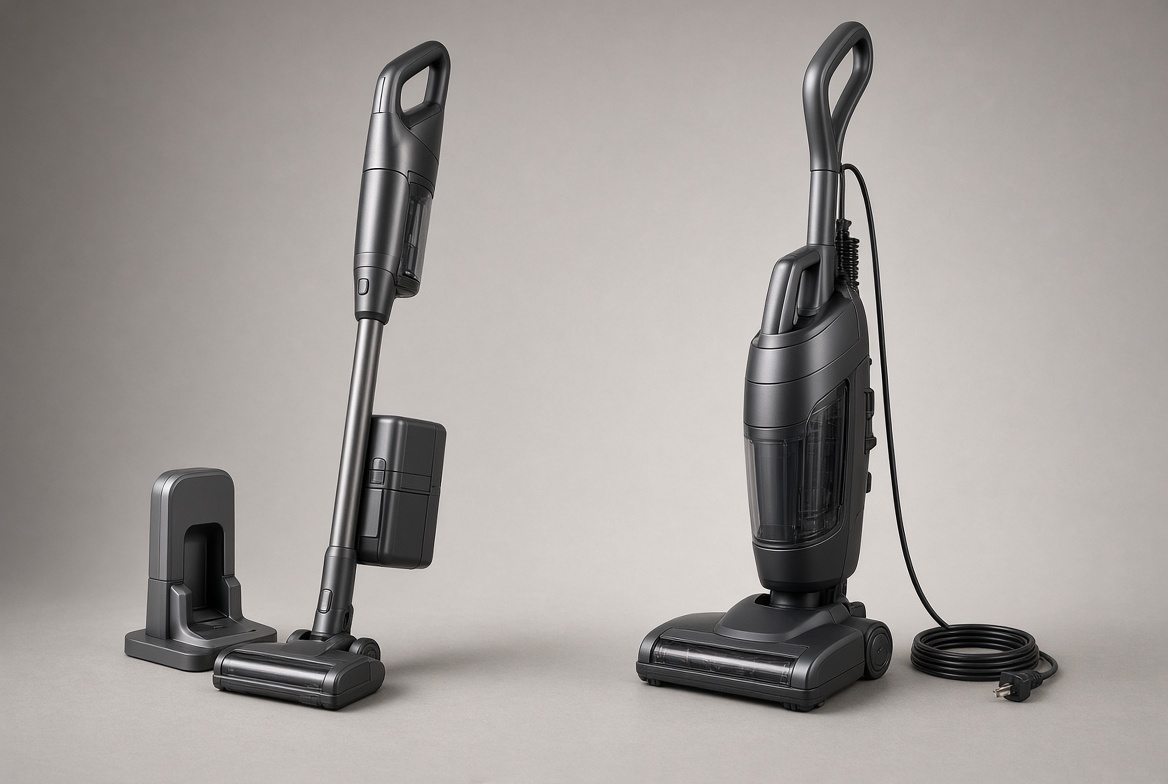
For a global vacuum brand, terminology affects product positioning at every stage—from industrial design and sourcing to packaging, online listings, after-sales support, and customer reviews.
A buyer who expects a connected vacuum but receives a standard battery-powered model may not consider the product defective. However, they may still feel that the listing was unclear. That can increase return risk, reduce review quality, and create unnecessary customer-service costs.
For this reason, product language should match product capability.
Clear category naming can help brands achieve several practical goals:
- Improve search relevance for battery-powered vacuum products
- Reduce confusion between corded, cordless, and robotic models
- Make retail listings easier to compare
- Support more accurate packaging claims
- Help distributors understand product positioning
- Improve communication between brands, factories, and sourcing teams
- Reduce avoidable questions about charging, runtime, and accessories
For OEM and ODM projects, the naming decision should happen early. It should be aligned with the product requirement document, packaging artwork, user manual, online retail copy, and after-sales materials.
Whether a buyer calls the product a wireless vacuum or cordless vacuum, the commercial decision should be based on measurable product performance.
Battery design is one of the most important decision points in a cordless vacuum project. Runtime depends on battery voltage, capacity, motor efficiency, cleaning mode, floor type, brush operation, and airflow resistance.
A stated maximum runtime can be useful, but it should be interpreted carefully. The longest figure is commonly achieved in a lower-power mode and may not represent runtime with a motorized floor head operating on thick carpet.
A reliable product brief should define:
- Battery chemistry
- Nominal voltage
- Battery capacity
- Fixed or removable battery structure
- Standard-mode runtime
- High-power or max-mode runtime
- Charging time
- Battery replacement policy
- Overcharge, over-discharge, and thermal protection requirements
Many cordless vacuums provide approximately 20 to 60 minutes of runtime per charge, depending on cleaning mode and surface conditions. Thick carpet, turbo mode, and motorized brushes usually reduce available operating time.
A strong vacuum is not defined by a single number. Air watts, airflow, vacuum pressure, nozzle engineering, brush-roll speed, and filtration condition all affect debris pickup.
Air watts are a vacuum-specific metric that combines airflow and pressure, helping describe useful cleaning power rather than simply electrical input.
For product development, brands should test pickup across real cleaning conditions:
- Fine dust on hard floors
- Larger debris on hard floors
- Hair pickup on carpet
- Embedded debris on carpet
- Edge cleaning near walls
- Pet hair on upholstery
- Crevice cleaning
- Long-hair resistance around the brush roll
A compact handheld vacuum may need strong localized suction and a practical crevice tool. A cordless stick vacuum needs a balanced cleaning head that can pick up dust, crumbs, hair, and larger debris without pushing it forward.
The floor head often has a greater effect on real user satisfaction than the motor claim printed on the box.
A well-designed floor head should balance several requirements:
- Sufficient nozzle sealing for dust pickup
- Controlled airflow for larger debris
- Brush-roll agitation for carpet cleaning
- Smooth movement on hard floors
- Hair-management features
- Low-profile access under furniture
- Easy brush-roll removal and cleaning
For example, a low front opening may improve deep carpet pickup because it creates a more controlled air path. However, if the opening is too restricted, larger crumbs can be pushed rather than collected. This is why product testing should include both fine dust and larger debris, not just one laboratory condition.
Filtration is a major factor in user comfort and long-term performance. A vacuum should be designed to retain collected debris while maintaining airflow as the dust bin fills.
Key questions include:
- Is the filter washable?
- Does the product use multi-stage filtration?
- Is there a sealed filtration path?
- How easy is the dust cup to empty?
- Can users empty the bin without touching debris?
- Does the cyclone reduce filter blockage?
- Are replacement filters readily available?
When brands use high-efficiency filtration claims, they should ensure that product documentation, test methods, and claim wording are consistent with applicable market requirements.
Cordless vacuum ownership is closely tied to convenience. A product can have impressive specifications but still feel tiring if the center of gravity is poorly placed.
For a stick vacuum, evaluate:
- Handheld unit weight
- Weight at the user's wrist
- Balance when cleaning above the floor
- Maneuverability around furniture
- Ease of converting to handheld mode
- Storage footprint
- Docking convenience
- Accessory organization
This is particularly important for apartments, stair cleaning, older users, and frequent quick-cleaning routines.
From a manufacturing perspective, the best sourcing decision is rarely based on appearance alone. A successful cordless vacuum program balances target cost, performance expectations, product reliability, compliance needs, user behavior, and the intended retail channel.
Start with the primary use case rather than the desired appearance.
Ask:
1. Is the product for daily hard-floor cleaning, mixed flooring, carpet, cars, pet homes, or hospitality use?
2. Is lightweight handling more important than maximum runtime?
3. Does the target buyer need a detachable battery?
4. Will the product be sold as an entry-level, mid-range, or premium model?
5. Is a wall dock, stand, or compact storage solution required?
6. Does the local market expect replacement batteries and filters?
A single "best cordless vacuum" does not exist. The right model depends on the customer's cleaning environment and price position.
Instead of requesting "high suction" or "long battery life," turn each goal into an agreed technical target.
For example:
| Buyer Requirement | Better Development Requirement |
|---|---|
| Strong suction | Defined pickup test results on hard floor and carpet |
| Long runtime | Minimum runtime in standard and maximum modes, with specified tools |
| Easy maintenance | Removable brush roll, washable filter, simple bin-emptying structure |
| Lightweight design | Maximum complete machine weight and handheld-unit weight |
| Premium appearance | Defined color, finish, mold texture, trim material, and display requirements |
| Reliable after-sales support | Agreed spare parts, battery availability, manuals, and warranty process |
This approach creates a clearer bridge between a brand team and an OEM/ODM manufacturer.
Before mass production, evaluate prototypes as a customer would—not only as an engineering sample.
A practical validation process should include:
- Charging and first-use setup
- Floor-head maneuverability
- Noise perception
- Dust-bin emptying
- Filter removal and reinstallation
- Hair removal from the brush roll
- Switching between cleaning modes
- Conversion from stick to handheld
- Storage and dock installation
- Packaging opening and accessory identification
A product that is easy to understand on the first day is more likely to produce positive consumer feedback over time.
For private-label buyers, a cordless vacuum is not simply a finished appliance. It is a system that can be configured around market positioning.
Ningbo Eyunhome Electric Technology Co., Ltd. can support vacuum cleaner development for brands seeking upright, handheld, corded, and cordless product solutions. The company is listed as a manufacturer in Zhejiang, China, giving international buyers a verified starting point when assessing potential vacuum supply partners.
Depending on the project stage and production requirements, OEM and ODM vacuum customization can include:
- Product color and surface finish
- Brand logo placement
- Packaging design
- Instruction manual localization
- Plug and charger configuration
- Battery capacity options
- Floor-head and accessory combinations
- Filter configurations
- Dust-bin capacity
- Wall mount or charging dock design
- Tooling development for differentiated product appearance
- Spare-parts and after-sales support planning
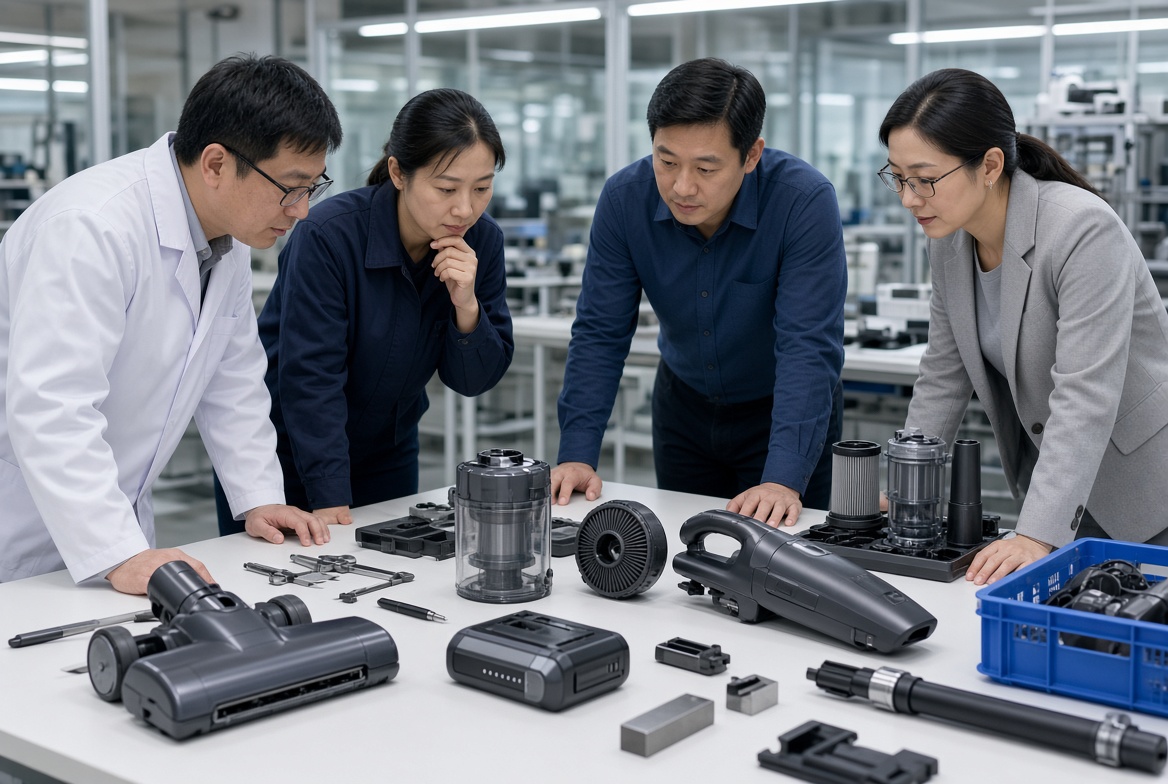
The most effective projects begin with a detailed brief. Buyers should share target retail price, market destination, desired channel, annual volume estimate, target user profile, competitive references, compliance needs, and preferred delivery schedule.
A rechargeable vacuum is not automatically a smart vacuum. Do not use connectivity language unless the product includes the relevant functions.
A maximum runtime claim without mode and accessory conditions can disappoint customers. State runtime clearly for standard and high-power operation.
Input watts do not tell the full cleaning story. Assess pickup, airflow, pressure, brush-roll design, filtration, noise, and runtime together.
Filters, batteries, brush rolls, and chargers are part of the ownership experience. Plan their availability before launch.
Use "cordless vacuum" consistently in specifications. Use "wireless vacuum" as a supporting consumer-search term where appropriate, but explain the product configuration clearly.
The difference between a wireless vacuum and a cordless vacuum may appear small, but precise language creates better purchasing decisions. For most product pages, technical specifications, and sourcing documents, cordless vacuum cleaner is the clearest description of a rechargeable, cable-free vacuum. "Wireless vacuum" can broaden consumer reach, but it should never replace clear information about battery power and product functions.
If you are developing a private-label vacuum cleaner range, Ningbo Eyunhome Electric Technology Co., Ltd. can help you evaluate suitable upright, handheld, corded, and cordless vacuum solutions for your market. Share your target market, product category, feature requirements, and expected order volume to begin building a practical OEM or ODM development plan.
Usually, yes. Both terms often describe a rechargeable vacuum that operates without a mains power cord. However, "cordless vacuum" is more precise because it clearly identifies a battery-powered appliance, while "wireless vacuum" can also suggest Wi-Fi, Bluetooth, or smart functions.
Brands should use cordless vacuum as the main technical and commercial category term. "Wireless vacuum" can be used naturally in marketing copy and secondary product keywords, provided the listing clearly explains whether the model includes smart connectivity.
Some cordless vacuums can clean carpets effectively, especially when they combine adequate airflow, suction pressure, a well-sealed nozzle, and a motorized brush roll. Performance should be verified through real pickup tests on the carpet types relevant to the target market.
Runtime varies by battery capacity, power mode, floor type, and accessory use. Many models operate for around 20 to 60 minutes per charge, while lower-power modes may run longer. High-power modes and motorized floor heads generally reduce runtime.
A removable battery can make charging more flexible and allows users to purchase an additional pack for longer cleaning sessions. A fixed battery may support a more integrated design. The better choice depends on target price, product positioning, user needs, and after-sales strategy.
Importers should evaluate battery specifications, runtime under defined conditions, charging time, pickup performance, filtration, noise, product weight, accessories, certification requirements, packaging, spare-parts support, warranty processes, and factory quality-control procedures.
For daily cleaning in apartments, homes, cars, and light-duty applications, a cordless vacuum can be highly practical. For very large areas, extended cleaning sessions, or demanding commercial work, a corded vacuum may remain the better option because it provides continuous power without charging downtime.
1. [Cleva UK — Vacuum Cleaner Glossary]
2. [Levoit — Corded vs Cordless Vacuums: Which Is Better?]
3. [RTINGS — The Best Cordless Vacuums]
4. [Vacuum Wars — The Cordless Vacuum Buyer's Guide]
5. [Hong Kong Trade Development Council — Ningbo Eyunhome Electric Technology Co., Ltd. Catalogue]
6. [Klinsmann — How Long Do Cordless Vacuums Last?]
7. [Strategic Market Research — Cordless Vacuum Cleaner Market Report]


