
Views: 220 Author: Eyunhome Vacuum Publish Time: 2026-08-27 Origin: Site


Content Menu
● Quick Answer: Wireless Vacuum vs Cordless Vacuum
● Cordless Vacuum vs Wireless Vacuum: Feature Comparison
● Cordless Does Not Always Mean Stick Vacuum
● Battery Power: What Buyers Should Ask
● How to Choose the Right Product Type
>> Choose a Cordless or Wireless Vacuum When You Need
>> Choose a Corded Vacuum When You Need
>> Use Both for a Complete Range
● Expert Sourcing Insight: Define the Product Before Naming It
● A Practical Product Brief Checklist
● Why Terminology Matters for Product Pages
● Build Your Cordless Vacuum Program
● FAQ
>> Is a wireless vacuum the same as a cordless vacuum?
>> Why is "cordless vacuum" more precise?
>> Is a cordless stick vacuum always battery-powered?
>> Are cordless vacuums powerful enough for carpets?
>> How long should a cordless vacuum run?
>> Can a cordless vacuum replace a corded vacuum?
>> What should brands consider when developing a private-label cordless vacuum?
In most product conversations, "wireless vacuum" and "cordless vacuum" describe the same type of appliance: a vacuum cleaner powered by a rechargeable battery rather than a wall outlet. The practical difference is usually not in the machine itself, but in how brands, retailers, and buyers use the language.
For a vacuum cleaner brand, importer, or sourcing team, understanding the distinction matters. "Cordless vacuum" is generally the more precise product-category term, while "wireless vacuum" is often a consumer-friendly phrase that emphasizes freedom of movement. Both can be used in product content when they accurately describe a rechargeable vacuum cleaner with no power cord during operation.
At Ningbo Eyunhome Electric Technology Co., Ltd., we develop upright, handheld, corded, and battery-powered vacuum cleaner solutions for international brands. From an OEM/ODM manufacturing perspective, the right terminology should always be matched with the product's actual structure, battery system, usage scenario, and target market.

A cordless vacuum cleaner is a vacuum that operates with a rechargeable battery and does not need to remain connected to mains electricity while cleaning.
A wireless vacuum cleaner usually means exactly the same thing. It highlights the absence of a restrictive cable rather than introducing a separate technical category.
However, there is one important wording issue: "wireless" can sometimes imply smart connectivity, such as app control, Wi-Fi, Bluetooth, or communication with a charging dock. A standard battery vacuum does not need those features to be called cordless.
| Term | Main Meaning | Best Use | Potential Ambiguity |
|---|---|---|---|
| Cordless vacuum | Battery-powered vacuum with no mains cable during use | Product specifications, sourcing documents, category pages | Very low |
| Wireless vacuum | Common alternative for a vacuum without a power cord | Consumer-facing copy, advertising, keyword variations | May be confused with Wi-Fi or smart-device connectivity |
| Corded vacuum | Vacuum powered directly through a mains cable | High-runtime or continuous-use products | No ambiguity |
| Stick vacuum | Slim, wand-style vacuum format | Describing form factor | Can be corded or cordless |
| Handheld vacuum | Compact, portable vacuum format | Car, upholstery, desktop, and quick-cleaning use | Can be corded or cordless |
The key point is simple: cordless describes the power supply, while stick and handheld describe the physical design. A stick vacuum can be cordless, but not every cordless vacuum is a stick vacuum. For example, rechargeable handheld units, portable car vacuums, and battery-powered upright models also belong to the cordless category.
The vacuum cleaner industry often uses several terms for the same product because different audiences search and shop differently.
Retail buyers may search "wireless vacuum cleaner" because they want a machine that is easy to carry from room to room. Procurement teams and product managers are more likely to use "cordless vacuum cleaner" because it is widely understood in technical specifications, supplier quotations, packaging requirements, and category structures.
In practice, both phrases communicate the core value proposition:
- No power cable to manage
- Rechargeable battery operation
- Flexible movement around furniture and stairs
- Fast access for spot cleaning
- Portable cleaning for cars, sofas, curtains, and tight spaces
For a product listing, the strongest approach is to use "cordless vacuum" as the primary technical term, then introduce "wireless vacuum" naturally where it helps the copy sound more accessible.
For example:
> This cordless stick vacuum delivers flexible, wireless cleaning for hard floors, carpets, upholstery, stairs, and vehicle interiors.
This wording is clear because it explains that "wireless" refers to the cleaning experience, while "cordless" identifies the product type.
Although the terms usually refer to the same product class, buyers should focus less on the name and more on actual performance specifications.
| Buying Factor | What to Check | Why It Matters |
|---|---|---|
| Battery type | Lithium-ion chemistry, battery capacity, removable battery option | Influences runtime, charging behavior, weight, and replacement planning |
| Runtime | Eco, standard, and maximum-mode runtime | A single "up to" claim may not reflect high-power cleaning time |
| Charging time | Full charging duration and docking format | Determines how quickly the product can return to service |
| Motor performance | Motor design, airflow, sealed suction path, cleaning head efficiency | Strong cleaning results depend on the total system, not one number alone |
| Floor compatibility | Hard floors, low-pile carpet, medium-pile carpet, rugs | The floor head and brush roll must suit the target market |
| Filtration | Multi-stage filtration, washable filters, sealed construction | Important for dust control, maintenance, and repeat use |
| Dust cup | Capacity, one-touch emptying, anti-tangle design | Affects convenience and customer satisfaction |
| Weight and balance | Handheld weight, center of gravity, conversion method | Directly affects comfort during above-floor cleaning |
| Attachments | Crevice tool, dusting brush, motorized mini tool, flexible hose | Broadens use cases and supports product differentiation |
| Serviceability | Replaceable battery, filters, brush rolls, spare-part access | Reduces long-term ownership friction and supports after-sales programs |
A cordless model's real-world usability depends on how these factors work together. A long runtime is less useful if the unit feels top-heavy. Strong suction is less valuable if the brush head cannot pick up hair effectively from carpet edges. Likewise, a premium battery should be paired with a practical charging solution and clear care instructions.
One of the most common category mistakes is treating "cordless vacuum" and "cordless stick vacuum" as identical.
They are related, but not interchangeable.
A cordless stick vacuum normally has:
- A slim wand
- A floor head
- A motor and dust cup near the handle
- A rechargeable battery
- A detachable handheld configuration on many models
This design is popular for whole-home, everyday floor cleaning. It can often be converted for furniture, shelving, stairs, curtains, and car interiors.
A cordless handheld vacuum is smaller and more focused on quick, localized tasks, such as:
- Cleaning car seats and footwells
- Removing crumbs from sofas
- Cleaning pet hair from upholstery
- Vacuuming drawers and cabinets
- Maintaining keyboards, workstations, or small storage areas
A handheld unit is usually lighter and easier to store, but it often has a smaller dust cup and shorter runtime than a stick model.
A cordless upright vacuum uses a more traditional upright structure but relies on battery power. It may offer a larger dust capacity, wider floor head, and a more substantial cleaning path than a lightweight stick format.
For brands planning a product range, these distinctions are useful. A coordinated portfolio may include a high-performance cordless stick vacuum, a compact wireless handheld vacuum, and a corded upright model for buyers who prioritize extended operation.
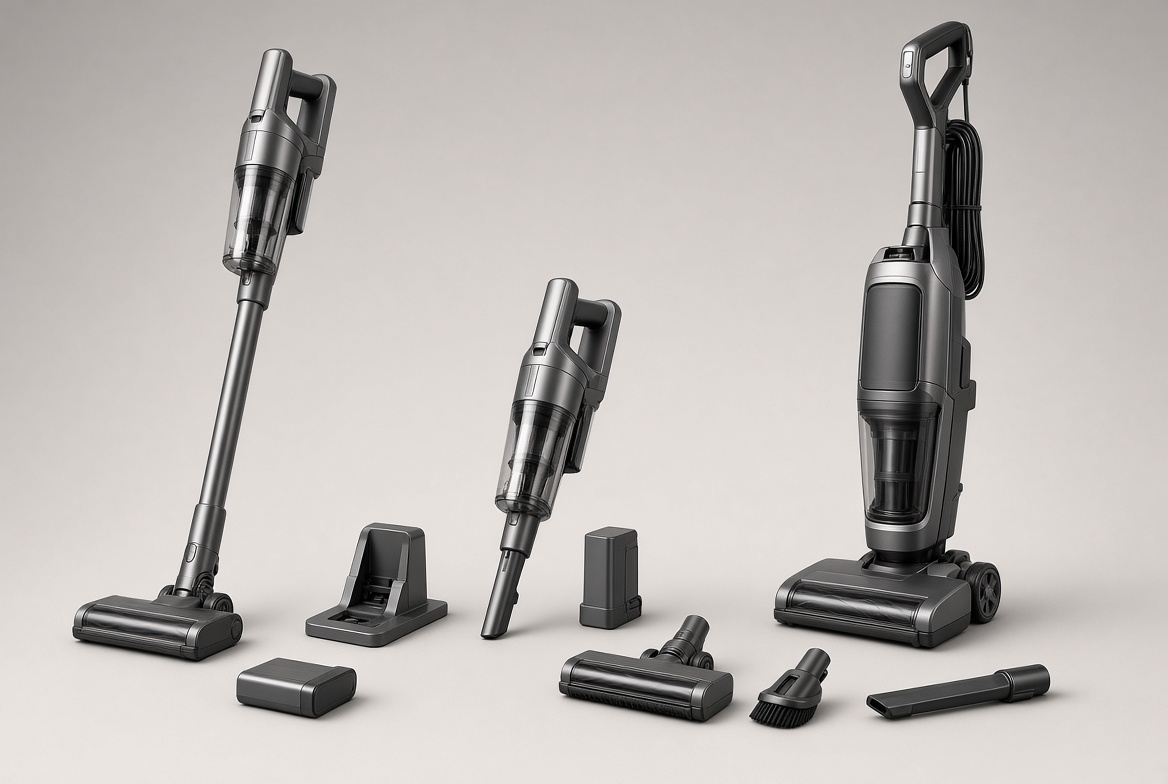
Battery performance is the primary technical difference between a battery-powered vacuum and a corded vacuum. A corded machine can operate continuously while connected to electricity. A cordless model offers mobility, but it must be recharged after use.
That trade-off is not a weakness by default. It simply means the product must be designed around realistic cleaning habits.
When assessing a cordless vacuum cleaner, ask these questions:
1. What runtime is available in each power mode?
Low-power runtime can be much longer than maximum-mode runtime. Both figures should be communicated clearly.
2. Is the battery removable?
A removable battery can simplify replacement, enable multi-battery cleaning sessions, and support easier service.
3. How long does charging take?
Faster charging can improve convenience, especially for compact homes, commercial samples, and frequent use.
4. Does the product protect battery health?
A well-designed battery management system helps manage charging, temperature, and operating load.
5. What is the intended cleaning area?
A lightweight handheld vacuum may be ideal for a vehicle or sofa. A larger home with carpets may require a stick vacuum with a larger battery pack or a spare battery option.
Industry reporting consistently identifies battery life and sustained performance as key buyer concerns, especially for larger cleaning tasks. This makes transparent runtime communication and battery-service planning essential for a reliable cordless vacuum program.
The best choice depends on the user's cleaning environment, frequency, and expectations.
- Fast daily cleaning for dust, crumbs, hair, and small debris
- Easy movement across stairs, rooms, vehicles, and furniture
- Flexible above-floor cleaning with a handheld conversion
- Compact storage in apartments, smaller homes, or offices
- Convenient spot cleaning without finding a nearby outlet
A battery-powered vacuum works particularly well as a daily-use tool. It encourages users to clean a small mess immediately rather than postponing the task.
- Unlimited operating time for long cleaning sessions
- Consistent power supply without recharging pauses
- Routine deep cleaning across larger carpeted areas
- A value-focused product without battery-pack cost considerations
- Commercial or high-frequency use where continuous operation matters
Corded vacuums remain relevant because a direct power connection supports long, uninterrupted cleaning sessions. They can be a practical option for larger homes, hospitality environments, and buyers who place runtime above portability.
For many private-label brands and distributors, the most effective product strategy is not choosing one format only. It is offering different solutions for distinct buyer needs.
| Customer Need | Suitable Product Direction |
|---|---|
| Quick daily cleaning | Cordless stick vacuum |
| Car and upholstery maintenance | Cordless handheld vacuum |
| Large-area or extended cleaning | Corded upright vacuum |
| Entry-level retail program | Compact corded or basic cordless model |
| Premium home appliance collection | Cordless stick vacuum with removable battery and motorized accessories |
| Pet-focused line | Anti-tangle floor head, mini motorized tool, larger dust cup |
From a manufacturing and product-development perspective, the product name should never replace a detailed specification sheet.
A buyer may ask for a "wireless vacuum," but the supplier still needs to clarify the complete requirement:
- Target retail price and market position
- Required battery runtime
- Battery configuration and charging method
- Motor type and cleaning modes
- Floor-head structure
- Filtration configuration
- Noise target
- Dust cup capacity
- Accessories and packaging
- Color, branding, logo, and user manual language
- Required market certifications
- Spare parts and warranty expectations
This is where OEM/ODM collaboration creates value. The strongest product is not necessarily the one with the longest specification list. It is the one whose battery, motor, floor head, filtration, ergonomics, accessories, and target price work together for the intended customer.
For example, a retailer focused on compact urban homes may prioritize wall-mount storage, low handheld weight, and rapid daily cleaning. A pet-product brand may prioritize anti-tangle technology, a motorized mini brush, and easy dust-bin emptying. A value retailer may prioritize stable production, essential functions, dependable materials, and simple after-sales support.

Before requesting a quotation for a cordless or wireless vacuum cleaner, prepare this brief:
1. Define your target user. Identify whether the product is for apartments, families with pets, car owners, large homes, or professional cleaning use.
2. Choose the product structure. Decide between stick, handheld, upright, or a multi-functional platform.
3. Set realistic runtime expectations. Request mode-by-mode runtime rather than relying only on a maximum claim.
4. Specify your core cleaning surfaces. Confirm whether the vacuum must perform on hard floors, carpet, upholstery, stairs, or mixed surfaces.
5. Plan your accessory kit. Select only attachments that fit the end user's real cleaning routine.
6. Confirm maintenance needs. Ask about filter washing, brush-roll cleaning, battery replacement, and spare-part availability.
7. Align quality and service requirements. Define inspection standards, packaging tests, production lead time, warranty policy, and after-sales support before mass production.
This process reduces avoidable revisions and helps create a product that is easier to market, easier to use, and easier to support after launch.
Using both "wireless vacuum" and "cordless vacuum" appropriately can improve clarity for international buyers. The terms should support the buyer journey, not create confusion.
A strong category page can use:
- Cordless vacuum cleaner for category and specification language
- Wireless vacuum in benefit-led paragraphs
- Cordless stick vacuum for slim, wand-style models
- Cordless handheld vacuum for portable quick-clean units
- Rechargeable vacuum cleaner when emphasizing battery operation
Avoid calling a corded product "wireless," even if it has smart controls. Also avoid presenting all stick vacuums as cordless. Some stick-format vacuums use a power cable, so the product's electrical design must always be stated accurately.
Whether your customers call it a wireless vacuum or a cordless vacuum, they expect the same result: reliable cleaning performance without the inconvenience of a power cable.
Ningbo Eyunhome Electric Technology Co., Ltd. supports global partners with upright, handheld, corded, and cordless vacuum cleaner solutions. Our team can help translate your market requirements into a practical OEM/ODM product specification, from concept selection and accessory configuration to stable production, quality control, packaging, and after-sales support.
Contact Ningbo Eyunhome today to discuss your next cordless vacuum cleaner project and develop a product range built for your target market.
Usually, yes. Both terms commonly refer to a rechargeable vacuum cleaner that operates without being plugged into a wall outlet during cleaning.
"Cordless" directly explains that the vacuum has no power cable during operation. "Wireless" can also describe products that use Wi-Fi, Bluetooth, or app connectivity, so it may be slightly less specific in technical product documentation.
In most cases, yes, but "stick" describes the shape rather than the power source. A stick vacuum can be corded or battery-powered, so product specifications should confirm the power type.
They can be effective on carpets when the motor, sealed airflow path, brush roll, and floor head are designed for that purpose. Buyers should compare tested performance across the floor types most relevant to their market rather than judging only by a single suction figure.
The right runtime depends on the cleaning area, power mode, floor type, and accessory used. Ask for separate runtime figures for eco, standard, and high-power modes, since maximum suction typically uses more battery power.
For quick daily cleaning, many users can rely mainly on a cordless vacuum. For large homes, extended sessions, or continuous deep cleaning, a corded vacuum may still be the better primary tool because it does not require recharging.
Brands should evaluate the complete product system: battery safety, runtime, charging time, motor performance, floor-head design, filtration, accessories, ergonomics, packaging, certifications, quality control, spare parts, and after-sales support.
- [RTINGS — The 4 Best Stick Vacuums]
- [Levoit — Corded vs Cordless Vacuums: Which Is Better?]
- [Business Research Insights — Cordless Vacuum Cleaner Market Size, Trends & Forecast]
- [Dataintelo — Cordless Vacuum Cleaner Market Research Report]
- [DJI — Robot Vacuum vs. Cordless Vacuum: Why Your Home Needs Both]
- [HKTDC Sourcing — Ningbo Eyunhome Electric Technology Co., Ltd.]


