
Views: 243 Author: Eyunhome Vacuum Publish Time: 2026-08-26 Origin: Site


Content Menu
● What Buyers Expect From a Cordless Vacuum Under $200
>> The Most Important Purchase Criteria
● Why "High Suction" Is Not Enough
● Realistic Runtime: The Claim Must Match the Cleaning Mode
● Filtration Is a System, Not a Label
● Floorhead Design Determines Everyday Results
● A Better Product Specification for Private-Label Buyers
>> Recommended Specification Checklist
● Manufacturing Insight: How to Avoid Common Budget-Vacuum Failures
>> Practical Quality-Control Actions
● Which Cordless Vacuum Features Create the Strongest Value?
● Partner With a Reliable Cordless Vacuum Manufacturer
● FAQ
>> What is the best cordless vacuum under $200 for everyday cleaning?
>> Is 60 minutes of cordless vacuum runtime realistic?
>> Is a detachable battery worth having?
>> Do budget cordless vacuums work on carpet?
>> Is HEPA filtration enough for better air quality?
>> What accessories should a cordless stick vacuum include?
>> What should importers verify before placing an OEM order?
A best cordless vacuum under $200 is no longer defined only by a low shelf price. For consumers, it must deliver dependable pickup, manageable weight, usable battery life, straightforward maintenance, and confidence that replacement parts and support will still be available after purchase.
For private-label brands, importers, and retail buyers, the opportunity is clear: a well-engineered cordless stick vacuum can meet everyday cleaning needs without premium-market pricing. The challenge is specifying the right balance of motor performance, battery system, floorhead design, filtration, usability, and quality control before the product reaches the market.

The sub-$200 category is highly competitive because it serves several practical use cases:
- Quick daily cleaning in apartments and family homes
- A lightweight second vacuum for upstairs rooms
- Pet-hair cleanup between deeper cleaning sessions
- Handheld cleaning for sofas, stairs, cars, and corners
- Affordable replacement purchases for value-conscious households
Independent testing of more than 110 cordless vacuums shows that budget products can perform well when manufacturers focus on the features that matter in daily use: debris pickup, hair resistance, runtime, filtration, maneuverability, and useful accessories. However, specifications alone do not guarantee a satisfying ownership experience.
A buyer comparing models should look beyond statements such as "45 kPa suction" or "60-minute runtime." Those claims may be accurate under specific conditions, but real cleaning performance depends on the full system: airflow path, floorhead seal, brushroll design, battery capacity, power management, and dustbin maintenance.
| Buying factor | Why it matters | What to ask for |
|---|---|---|
| Floor performance | Hard floors and carpets need different brushroll behavior | Pickup tests on fine dust, cereal, hair, and larger debris |
| Runtime | Max mode can drain a battery far faster than standard mode | Runtime by mode, test surface, and battery configuration |
| Filtration | A filter is not enough if air leaks around the system | Evidence of sealed-path and exhaust filtration testing |
| Anti-tangle performance | Hair wrap affects cleaning quality and maintenance time | Long-hair tests and brushroll cleaning demonstrations |
| Weight and balance | Handle weight matters more than total product weight during use | In-hand weight, center of gravity, and stair-cleaning feedback |
| Spare parts | Batteries, filters, brushrolls, and chargers affect long-term value | Replacement-part plan and local service support |
| Noise | High noise can discourage regular use | Measured sound level at normal and maximum power |
| Quality consistency | A strong sample is not the same as stable production | Incoming inspection, aging tests, and final-product checks |
Many product pages lead with peak suction pressure. That number can be useful, but it should not be treated as the single measure of cleaning ability.
A cordless vacuum is a complete airflow-and-cleaning system. Strong pressure at the motor does not automatically mean effective pickup at the floorhead. The machine must also maintain airflow through the cyclone, filters, tube, brush chamber, and dustbin while moving across real surfaces.
A strong product-development process therefore evaluates:
- Fine dust pickup from hard floors and textured tile
- Embedded debris removal from low- and medium-pile carpet
- Large-debris handling without pushing material forward
- Hair pickup and hair-wrap resistance
- Airflow retention as the dustbin fills
- Cleaning performance at each power setting
- Performance after repeated filter cleaning and battery cycles
For example, the Tikom V500 was recognized in independent testing for its light handling, large 1.3-liter bin, anti-tangle brushroll, display, and useful everyday balance. Yet its measured suction and runtime were below some category averages. That illustrates an important product lesson: a vacuum can earn consumer approval through a well-balanced ownership experience, not only a headline number.
Battery runtime is one of the most misunderstood features in the cordless vacuum category. A "60-minute runtime" is often measured in the lowest power mode, sometimes with a non-motorized tool or under light-load conditions. It does not mean the vacuum will deliver full-power carpet cleaning for one hour.
As a practical rule, a model rated for 60 minutes in low mode may deliver approximately:
| Power mode | Typical practical expectation |
|---|---|
| Low / eco mode | Up to 40–60 minutes, depending on tool and surface |
| Medium mode | Around half of low-mode runtime |
| Max / boost mode | Often only 5–10 minutes of intensive cleaning |
This does not make a long low-mode claim misleading by itself. It simply means brands should communicate it clearly. Consumers appreciate straightforward information such as: "Up to 60 minutes in eco mode with a non-motorized attachment; shorter runtime with motorized floorhead or boost mode."
The best product programs also provide:
1. A removable battery for easy charging and replacement
2. A battery indicator with remaining-time or percentage information
3. A stable charging dock or wall mount
4. Sensible low-battery protection
5. Optional second-battery availability for larger homes and commercial bundles
Independent buying guidance similarly emphasizes that runtime changes substantially by power setting and recommends confirming whether a removable replacement battery is actually available for purchase.
Consumers increasingly look for HEPA filtration, especially in homes with pets, children, or allergy concerns. But the meaningful question is not simply whether a vacuum contains a HEPA filter.
The key question is: Does the product force the exhaust air through the filter without leakage?
A high-quality filtration design should combine:
- Cyclonic separation to reduce dust loading on the final filter
- A washable pre-filter or metal mesh filter
- A high-efficiency post-motor filter
- Reliable seals at the dustbin, filter housing, and motor assembly
- Clear maintenance instructions and replacement schedules
One budget model in independent testing, the KARDV V06, achieved competitive carpet performance and a long claimed runtime, but its filtration was identified as a major weakness after visible exhaust leakage in a fog test. This is precisely why retail buyers should request filtration validation instead of relying only on packaging terminology.
For performance benchmarking, IEC 62885-2:2026 covers measurements for mains-operated and cordless dry vacuum cleaners. The standard addresses performance measurement for household or similar-use products, creating a more consistent basis for evaluating claims across designs.
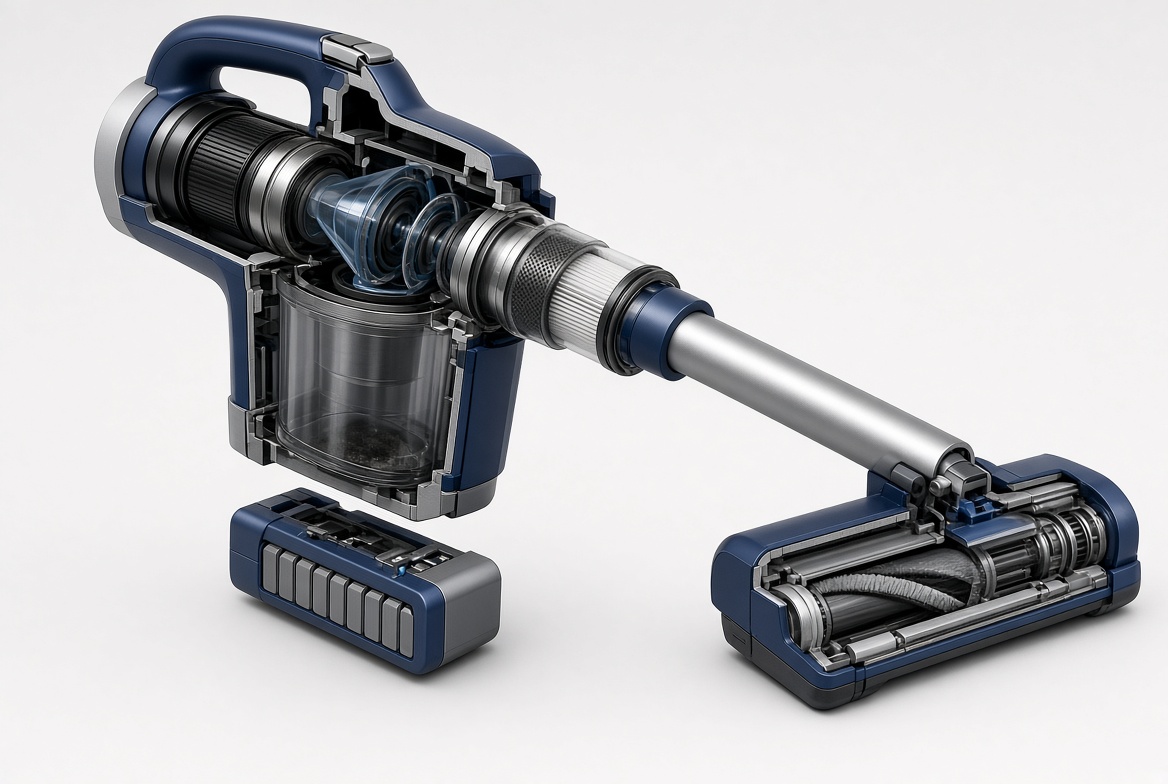
The motorized floorhead is often the most important assembly in a cordless stick vacuum. It directly affects how the machine handles dust, crumbs, pet hair, carpet fibers, and hard-floor debris.
For hard floors, the ideal floorhead should pick up fine dust without scattering it. Buyers often benefit from:
- A soft roller or felt strip for fine dust and powder
- A well-controlled front opening for larger debris
- Smooth swivel steering around chair legs and furniture
- LED headlights for low-light cleaning under beds and cabinets
- A floorhead geometry that reduces "snowplowing" of larger particles
For carpets, the floorhead must agitate fibers while preserving airflow. Important features include:
- A motorized brushroll with effective bristle placement
- Adequate nozzle sealing for fine-particle pickup
- Anti-tangle combs or active hair-removal systems
- Sufficient torque for carpet agitation
- A brushroll that can be removed without complicated tools
The Smoture VAC02, for example, was highlighted for its strong carpet performance, auto-adjustment capability, detachable battery, large bin, and pet-oriented usefulness. Its listed 60-minute standard-mode claim still needs to be interpreted in the context of power setting and cleaning load.
For importers and brands building a cordless vacuum line, the most effective product brief is not "make it powerful." It is a measurable specification that connects consumer expectations to engineering and factory controls.
| Area | Recommended requirement |
|---|---|
| Product format | Stick vacuum with handheld conversion |
| Floorhead | Motorized multi-surface head with anti-tangle function |
| Cleaning modes | Eco, standard, and boost; or intelligent automatic adjustment |
| Battery | Detachable lithium-ion battery with protected charging system |
| Display | Battery percentage or remaining-time display |
| Filtration | Multi-stage filtration with verified sealed airflow path |
| Dustbin | Easy-empty bin with sufficient capacity for target market |
| Accessories | Crevice tool, dusting brush, and optional motorized mini tool |
| Storage | Wall dock, charging base, or stable self-standing design |
| Serviceability | Available filters, batteries, brushrolls, and chargers |
| Validation | Runtime, pickup, noise, drop, aging, and packaging tests |
A model should also be designed for the market where it will be sold. Battery-powered appliances require careful safety evaluation because potential hazards include overheating, fire, and electric shock. UL 2595 addresses general safety requirements for battery-powered appliances, while IEC 62133-2 addresses safety requirements for portable sealed lithium batteries under normal use and foreseeable misuse conditions.
The lowest-cost design is not always the lowest-cost product after returns, negative reviews, replacements, and lost retailer confidence are considered. The most common problems in value-tier cordless vacuums are often preventable during development and production.
- Inconsistent battery cells or inadequate battery protection
- Loose dustbin seals that reduce filtration effectiveness
- Weak latches on battery packs, dustbins, or wand connections
- Hair tangling around the brushroll after repeated use
- Declining suction from poor cyclone design or clogged filters
- Cracked floorhead housings after impact
- Inaccurate battery displays
- Unavailable replacement consumables
- Overstated runtime claims that create post-purchase disappointment
1. Verify each incoming batch of motors, battery packs, filters, and plastic components.
2. Conduct full-function testing before packaging, including charging, motor operation, display response, and floorhead rotation.
3. Run aging tests that simulate repeated starts, charging cycles, brushroll operation, and bin removal.
4. Test pickup on representative hard-floor and carpet materials rather than relying only on motor measurements.
5. Review packaging drop resistance and accessory fit before shipment.
6. Maintain traceability for core components so any field issue can be isolated quickly.
For retailers, this approach supports fewer returns. For end users, it creates a vacuum that remains convenient after the first few weeks of ownership.
The strongest value proposition is usually not the product with the longest feature list. It is the model that solves the most common frustrations without adding unnecessary complexity.
Prioritize these benefits:
- Lightweight handling for fast daily use
- Detachable battery for flexibility and replacement support
- Anti-tangle brushroll for households with long hair or pets
- Reliable sealed filtration rather than an unverified filter claim
- Clear battery display to avoid unexpected shutdowns
- Easy bin emptying with minimal dust contact
- Useful attachments instead of excessive accessories
- Stable parts supply for filters, batteries, and brushrolls
A thoughtfully engineered cordless vacuum under $200 can be a primary cleaner for smaller homes or a highly effective supplementary vacuum for larger households. The winning formula is not maximum suction alone. It is reliable, repeatable cleaning performance combined with transparent specifications and dependable support.
Ningbo Eyunhome Electric Technology Co., Ltd. supplies upright, handheld, corded, and cordless vacuum solutions for global brands and distributors. We support professional OEM and ODM projects with stable manufacturing, product customization, quality-focused production management, and responsive after-sales support.
Whether you are developing a value cordless stick vacuum, a pet-hair cleaning range, or a retail-ready private-label program, our team can help translate your target-market requirements into a practical product specification.
Contact Ningbo Eyunhome Electric Technology Co., Ltd. to discuss your cordless vacuum OEM/ODM project, target features, packaging requirements, and production plan.

The best choice depends on the home's flooring, pet-hair needs, and expected cleaning duration. In general, choose a lightweight model with a motorized multi-surface floorhead, removable battery, practical dustbin size, and proven filtration performance.
It can be realistic in eco mode under light-load conditions. Runtime is usually much shorter with a motorized floorhead, carpet cleaning, or maximum suction. Always compare runtime by power mode and attachment.
Yes. A detachable battery makes charging more flexible, supports future replacement, and allows users to continue cleaning with a spare battery where available.
Many do, but results vary widely by floorhead design, brushroll agitation, airflow, and battery power. Ask for carpet pickup and deep-cleaning test data rather than relying only on suction figures.
Not necessarily. The product should also have a well-sealed airflow system. If air leaks around the filter or dustbin, fine particles may escape before reaching the exhaust filter.
A crevice tool and dusting brush are essential for most households. A motorized mini brush is especially useful for pet hair, upholstery, stairs, and vehicle interiors.
Verify product safety documentation, battery specifications, performance claims, filtration design, component quality, inspection procedures, packaging, replacement-parts availability, lead times, and after-sales support arrangements.
1. [Vacuum Wars — The Best Cordless Vacuums Under $200]
2. [International Electrotechnical Commission — IEC 62885-2:2026]
3. [U.S. Consumer Product Safety Commission — Battery Standards and Safety]
4. [Vacuum Wars — The Cordless Vacuum Buyer's Guide]
5. [Testfakta — How Vacuum Cleaners Are Tested]
6. [RTINGS — Best Cordless Vacuums]
7. [Battery University — UL 2595 for Battery-Powered Appliances]


