
Views: 243 Author: Eyunhome Vacuum Publish Time: 2026-08-19 Origin: Site


Content Menu
● Start With the Cleaning Environment
● Compare the Main Vacuum Cleaner Types
>> Upright Vacuum Cleaners for Carpeted Homes
>> Cordless Stick Vacuums for Everyday Convenience
>> Handheld Vacuums for Cars and Spot Cleaning
● Look Beyond Wattage: What Actually Affects Cleaning Performance?
>> A Practical Performance Checklist
● Choose Filtration for the Right User Needs
>> Filtration Features Worth Evaluating
● Match the Floor Head to the Floor
>> For Pet Hair
● Evaluate Ergonomics Before You Buy
● Consider Total Cost, Not Just Purchase Price
● A Better Product Selection Process for Buyers
● Build a Vacuum Cleaner Range With Eyunhome
● FAQ
>> What type of vacuum cleaner is best for mixed floors?
>> Is higher wattage always better in a vacuum cleaner?
>> Are cordless vacuum cleaners powerful enough for daily home cleaning?
>> What should pet owners look for in a vacuum cleaner?
>> Why is a sealed filtration system important?
>> How often should vacuum filters be cleaned or replaced?
>> What should B2B buyers ask an OEM/ODM vacuum cleaner manufacturer?
Choosing the right vacuum cleaner is not simply about finding the highest wattage or the lowest price. The best vacuum cleaner is the one that matches the floor types, cleaning frequency, household needs, and maintenance expectations of its intended users. For retailers, distributors, and private-label buyers, it must also deliver consistent performance, dependable supply, and product features that fit the target market.
As a China vacuum cleaner manufacturer, Ningbo Eyunhome Electric Technology Co., Ltd. provides upright, handheld, corded, and cordless vacuum cleaner solutions for global brands and buyers. This guide explains how to evaluate vacuum cleaner types, performance features, usability, and long-term ownership costs—so consumers can buy with confidence and B2B partners can build better product ranges.

A vacuum cleaner should be selected around where and how it will be used. A compact apartment with hard flooring needs a different cleaning solution from a family home with carpets, pets, stairs, and multiple rooms.
Before comparing models, define the main cleaning conditions:
- Floor surfaces: Carpet, area rugs, hardwood, laminate, tile, vinyl, or mixed flooring
- Household size: Small apartments, family homes, shared spaces, or large residences
- Common debris: Fine dust, pet hair, crumbs, long hair, sand, and dry debris
- Cleaning frequency: Quick daily touch-ups, weekly deep cleaning, or both
- Storage space: Closet storage, wall-mounted charging, or compact cabinet storage
- Mobility needs: Stairs, vehicles, upholstery, corners, and high surfaces
A product that works well in one setting may be inconvenient in another. For example, a powerful corded upright vacuum may be ideal for frequent carpet cleaning, while a lightweight cordless stick vacuum may be more practical for daily hard-floor maintenance.
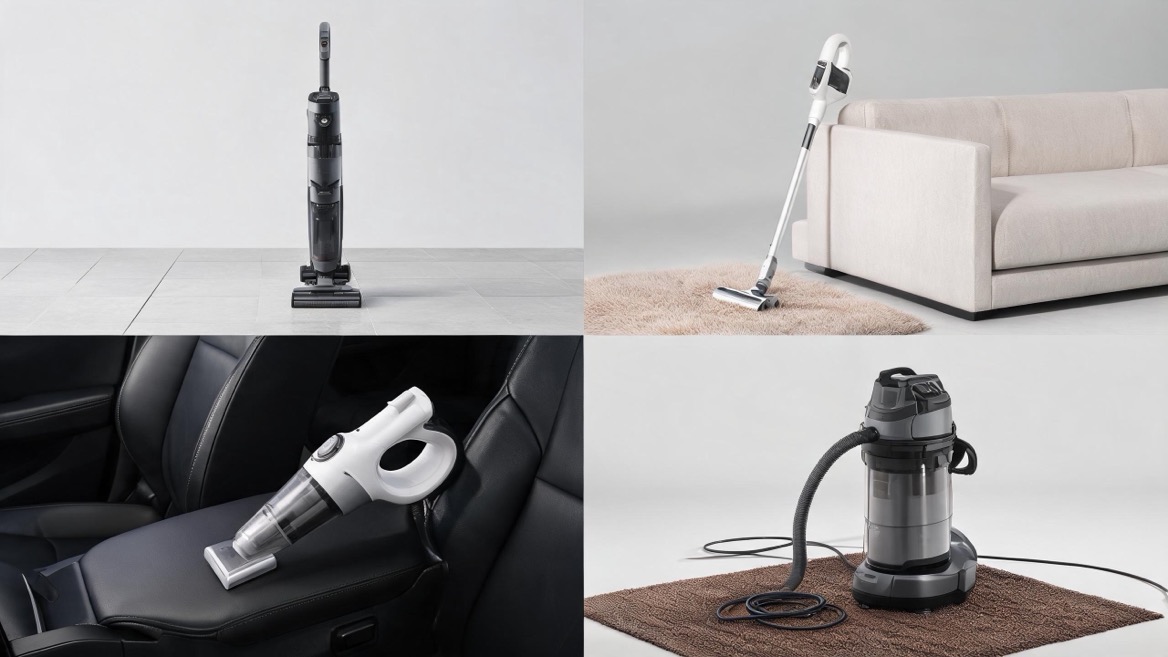
Each vacuum cleaner category solves a different cleaning problem. A strong product assortment often includes more than one format because users increasingly combine a primary deep-cleaning machine with a compact secondary unit.
| Vacuum Cleaner Type | Best For | Main Advantages | Points to Consider |
|---|---|---|---|
| Upright vacuum cleaner | Carpets, larger rooms, deep cleaning | Strong floor coverage, familiar handling, effective brush-roll cleaning | Can be heavier and less convenient on stairs |
| Corded vacuum cleaner | Long cleaning sessions and larger homes | Continuous runtime, stable power, no charging wait | Requires access to power outlets |
| Cordless stick vacuum | Daily cleaning, mixed floors, apartments | Lightweight, flexible, quick to use, easy storage | Runtime and battery management matter |
| Handheld vacuum cleaner | Cars, sofas, desks, quick spills | Compact, portable, easy to carry | Not designed as a full-home primary vacuum |
| 2-in-1 vacuum cleaner | Flexible household cleaning | Converts between stick and handheld use | Product balance matters: weight, battery, bin capacity, and tools |
| Canister vacuum cleaner | Hard floors, furniture, under-furniture cleaning | Good maneuverability and versatile attachments | Requires separate body-and-hose handling |
An upright vacuum cleaner is often the practical choice for homes with broad carpeted areas. Its floor head usually covers more space per pass, and a motorized brush roll can help lift embedded debris, hair, and surface dust from carpet fibers.
For product buyers, important design points include:
- Brush-roll performance on low-pile and medium-pile carpets
- Adjustable cleaning modes for carpet and hard floors
- Stable upright parking position
- Easy-access dust cup or bag system
- Long power cord and practical operating radius
- Replacement-part availability for filters, belts, and brush rolls
A well-designed upright model should feel stable when pushed forward, easy to steer around furniture, and simple to empty after cleaning.
A cordless vacuum cleaner is designed around speed and accessibility. When users can quickly remove a vacuum from a wall mount or storage area, they are more likely to clean small messes before they spread.
Cordless models are particularly useful for:
- Daily kitchen and dining-area cleanup
- Pet hair on hard floors and sofas
- Small apartments and multi-level homes
- Under-furniture cleaning
- Short, frequent cleaning sessions
- Users who prefer a lighter machine
However, cordless performance should not be judged by runtime alone. Buyers should review battery capacity, charging time, motor efficiency, floor-head design, dust-bin capacity, and the usability of power modes. A long advertised runtime may apply only to the lowest setting and a non-motorized accessory.
A handheld vacuum cleaner is an excellent complementary product. It is designed for fast cleaning in spaces where a full-size vacuum is inconvenient: car interiors, sofas, pet beds, drawers, stairs, keyboards, and upholstered furniture.
A useful handheld design typically includes:
- A crevice nozzle for narrow gaps
- A brush tool for fabrics and delicate surfaces
- A washable filter where appropriate
- A clear dust cup for easy monitoring
- Comfortable grip balance
- Simple one-button emptying
For private-label programs, handheld vacuums can be an attractive entry-level product or an add-on item within a larger cleaning appliance range.
One of the most common purchasing mistakes is treating motor wattage as the only measure of vacuum performance. Wattage describes electrical power consumption, not necessarily real debris pickup at the floor head.
Effective cleaning depends on the complete airflow system:
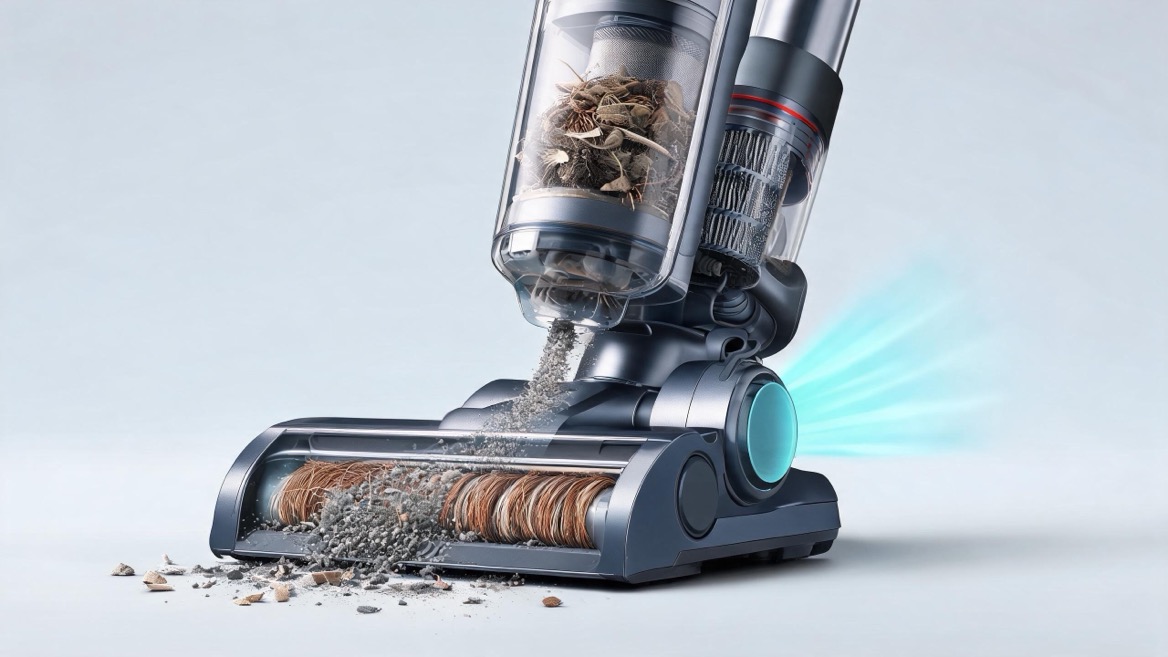
- Airflow: Moves dust and debris through the nozzle, tube, and filtration path
- Suction pressure: Helps lift debris from surfaces
- Floor-head design: Determines how effectively the vacuum interacts with carpet, rugs, and hard floors
- Brush-roll action: Helps agitate carpet fibers and collect hair
- Air-path sealing: Reduces unwanted leaks that can affect filtration efficiency
- Filter condition: A clogged filter can reduce airflow and cleaning performance
Standardized vacuum performance methods can measure airflow, suction, air power, and input power under defined operating conditions. This is why product development should focus on the system as a whole rather than a single number on the packaging.
When evaluating a vacuum cleaner, ask these questions:
1. Does it pick up visible debris effectively from the intended floor type?
2. Does the floor head collect long hair without frequent tangling?
3. Can users switch easily between carpet and hard-floor cleaning?
4. Is suction still stable as the dust bin begins to fill?
5. Is the machine easy to push, steer, and carry?
6. Can filters and dust containers be cleaned without creating unnecessary mess?
7. Are accessories included for crevices, upholstery, and elevated surfaces?
For manufacturers and brand owners, these questions should become part of product testing and user-feedback evaluation before mass production.
Filtration matters because a vacuum cleaner does more than collect visible dirt. It also handles fine dust that can otherwise circulate in the indoor environment.
For homes with allergy concerns, pets, or frequent fine-dust accumulation, buyers should pay attention to both the filter specification and the overall air path. A true HEPA filter is designed to remove at least 99.97% of particles measuring 0.3 microns under specified test conditions.
However, a HEPA filter alone is not the whole story. If air leaks through gaps in the vacuum body or around filter fittings, unfiltered exhaust may bypass the filtration stage. For this reason, a sealed filtration design, well-fitted components, and proper maintenance are all important.
- Multi-stage filtration: Separates larger debris before fine-particle filtration
- Washable pre-filter: Helps extend the life of the main filter when maintained correctly
- HEPA-grade or true HEPA option: Relevant for markets and users focused on fine-particle filtration
- Sealed air-path design: Helps direct exhaust air through the intended filter system
- Easy filter access: Encourages timely cleaning and replacement
- Clear maintenance guidance: Prevents performance loss caused by neglected filters
The American College of Allergy, Asthma & Immunology recommends using a vacuum with a HEPA filter to reduce dust, pet dander, and other allergens.
The floor head is where cleaning performance becomes visible. A good motor cannot compensate for a poorly designed nozzle, weak brush roll, or unsuitable bristle configuration.
Hard floors require controlled pickup without scattering debris or scratching sensitive surfaces. Useful features may include:
- Soft roller or soft-bristle floor head
- Strong edge-cleaning design
- Smooth wheels suitable for wood or laminate
- Lower-profile head for furniture access
- Adjustable suction for lightweight rugs
Carpet cleaning often benefits from agitation as well as airflow. Look for:
- Motorized brush roll
- Brush-roll on/off control for surface changes
- Anti-tangle hair-removal design
- Height adjustment where appropriate
- Strong pickup performance along edges and transitions
Pet households need more than high suction. Hair can wrap around brush rolls, cling to upholstery, and accumulate in corners.
A pet-focused vacuum cleaner should consider:
- Anti-tangle roller design
- Motorized mini tool for furniture and stairs
- Easy hair removal from brush components
- Adequate dust-bin capacity
- Effective filtration and sealed construction
- Crevice tool for baseboards and narrow spaces
A vacuum cleaner can have strong technical specifications and still receive poor user feedback if it is awkward to use. Comfort directly influences whether the product becomes part of a household's normal cleaning routine.
Key ergonomic factors include:
- Weight distribution: A lighter product is not always easier if the handle or motor is poorly balanced
- Handle comfort: Grip shape and control placement affect fatigue
- Steering: Flexible swivel movement helps around furniture
- Reach: Tube length, hose flexibility, and cord length affect real usability
- Dust-bin emptying: The process should be intuitive and minimize direct contact with debris
- Storage: Wall mounts, compact profiles, and accessory holders improve everyday convenience
- Noise expectations: Lower perceived noise can improve user satisfaction, especially in apartments
A useful product test is simple: ask a first-time user to assemble, operate, empty, clean, and store the vacuum without assistance. Any point of confusion is a potential design or instruction improvement.
The initial price of a vacuum cleaner is only one part of ownership. Long-term value depends on durability, consumables, repairability, and ongoing cleaning performance.
| Cost Area | What Buyers Should Check |
|---|---|
| Filters | Washable or replaceable; expected replacement intervals |
| Batteries | Capacity, charging time, replaceability, and service availability |
| Brush rolls | Hair-removal design, replacement access, and wear resistance |
| Dust system | Bagged or bagless preference; bin size and emptying convenience |
| Accessories | Included tools versus separately purchased attachments |
| Service support | Spare parts, warranty process, manuals, and after-sales response |
For B2B buyers, this is also a brand-building issue. A reliable supply of filters, batteries, brush rolls, and accessories can protect customer satisfaction long after the first sale.
Whether you are purchasing for a household or building a branded vacuum cleaner range, use a structured evaluation process.
1. Define the primary user and cleaning environment. Start with floor types, room size, pets, storage, and cleaning frequency.
2. Choose the product format. Decide whether upright, corded stick, cordless stick, handheld, or a multi-product range is the best fit.
3. Prioritize the cleaning system. Assess floor-head design, airflow, suction path, brush-roll action, and debris pickup—not wattage alone.
4. Confirm filtration requirements. Match the filter system to the intended customer profile and ensure maintenance instructions are clear.
5. Test real handling. Evaluate weight, steering, emptying, storage, noise, and accessory changes through actual use.
6. Review lifetime support. Confirm consumable parts, production consistency, quality control, packaging, manuals, and after-sales service.
7. Request product customization when needed. For private-label projects, evaluate color, logo, packaging, accessories, performance configuration, certification requirements, and market-specific instructions.
The right vacuum cleaner should make cleaning easier, not more complicated. It should fit the user's home, routine, and expectations while delivering dependable performance over time.
Ningbo Eyunhome Electric Technology Co., Ltd. supports global buyers with upright, handheld, corded, and cordless vacuum cleaner solutions. Our OEM and ODM capabilities help brands develop products that align with their market positioning, feature requirements, packaging needs, and supply-chain plans.
If you are sourcing a vacuum cleaner manufacturer in China, contact Eyunhome to discuss your product concept, target market, technical requirements, and customization needs.
A cordless stick vacuum or an upright vacuum with a carpet-to-hard-floor switching function is often a practical choice. The best option depends on home size, carpet coverage, runtime needs, and whether the vacuum will be used for daily cleaning or deeper weekly cleaning.
No. Higher wattage does not automatically mean better cleaning. Real performance depends on airflow, suction pressure, floor-head design, brush-roll action, filtration condition, and the overall efficiency of the air path.
Many cordless vacuum cleaners are suitable for daily cleaning, especially in apartments, hard-floor homes, and households that clean frequently. For large carpeted homes or extended cleaning sessions, a corded model may still offer advantages in continuous runtime.
Pet owners should prioritize an anti-tangle brush roll, motorized upholstery tool, strong edge cleaning, easy dust-bin emptying, and an effective filtration system. A vacuum that is easy to maintain is especially important because pet hair can accumulate quickly.
A sealed system helps ensure that air passes through the intended filtration stages before it exits the machine. This is particularly relevant for users concerned about fine dust, pet dander, and allergen management.
Follow the product manual because timing depends on filter type, cleaning frequency, and the amount of dust collected. Washable filters should be fully dry before being reinstalled, while replaceable filters should be changed when performance declines or the recommended service interval is reached.
Buyers should ask about product testing, quality-control procedures, minimum order quantities, customization options, certification support, lead times, battery and filter supply, packaging, spare parts, warranty handling, and after-sales service processes.
1. [Eureka: How to Choose the Right Vacuum Cleaner—A Guide for Consumers]
2. [U.S. Environmental Protection Agency: What Is a HEPA Filter?]
3. [ASTM F558: Standard Test Method for Measuring Air Performance Characteristics of Vacuum Cleaners]
4. [ENERGY STAR: Scoping Report—Vacuums]
5. [American College of Allergy, Asthma & Immunology: Air Filters]
6. [European Commission: Consumer Guide to Energy-Efficient Vacuum Cleaners]


