
Views: 219 Author: Eyunhome Vacuum Publish Time: 2026-10-23 Origin: Site


Content Menu
● What Makes the Best Cordless Vacuum Cleaner?
● What Independent Cordless Vacuum Reviews Actually Show
>> Battery Figures Need Context
● Match Cordless Vacuum Features to Real Cleaning Needs
>> Best Cordless Vacuum for Hard Floors
>> Best Cordless Vacuum for Pet Hair
● Understand Suction, Airflow, and Floorhead Design
● Choose Battery Life You Can Actually Use
>> Compare Equivalent Configurations
>> Evaluate Battery Safety as a System
● Look Beyond the Filter Label
● Turn User Feedback Into Better Product Requirements
● A Six-Step Cordless Vacuum Sample Evaluation
>> 1. Define the Intended User
>> 2. Prepare Repeatable Tasks
>> 3. Record Results and Conditions
>> 4. Check Handling Beyond the Floor
>> 5. Inspect Maintenance Access
>> 6. Document Failures Before Approval
● How to Source OEM and ODM Cordless Vacuum Cleaners
>> Build a Measurable Development Brief
>> Verify Production and After-Sales Arrangements
● Build a Cordless Vacuum Range Around Real Needs
>> What Is the Best Cordless Vacuum Cleaner for Everyday Use?
>> How Long Should a Cordless Vacuum Battery Last?
>> Are Cordless Vacuums Suitable for Pet Hair?
>> Does Higher Suction Mean Better Cleaning?
>> What Should Importers Request Before Ordering?
>> Can Eyunhome Support Private-Label Vacuum Projects?
The best cordless vacuum cleaners combine reliable pickup, practical battery life, comfortable handling, and straightforward maintenance. Whether you are choosing a cordless stick vacuum for your home or developing a private-label range, the right decision starts with cleaning needs—not the largest suction number.
At Ningbo Eyunhome Electric Technology Co., Ltd., we offer upright, handheld, corded, and cordless vacuum cleaner solutions, supported by OEM/ODM services, production support, and after-sales assistance. Our perspective is simple: performance should be judged as a complete system, from the floorhead to the replacement filter.
This guide explains how to compare cordless vacuums, interpret independent reviews, and turn product requirements into a clearer purchasing brief.

No single model is best for every household. A carpet-heavy home needs effective agitation and embedded-dirt removal. An apartment with hard floors may benefit more from maneuverability, gentle floor contact, and convenient storage.
Start with five questions:
- Which surfaces need cleaning most often?
- Is the vacuum for quick pickups or longer sessions?
- Will it regularly collect pet hair?
- Who will carry it upstairs or use it overhead?
- How easily can filters, rollers, and batteries be replaced?
For retailers, these questions also define product positioning. A lightweight everyday cleaner and a premium pet-focused vacuum should not be developed around identical priorities.
Independent testing helps separate attractive specifications from useful cleaning results. However, scores remain specific to each reviewer's procedures, weighting, and tested configuration.
In its October 16, 2026 update, Vacuum Wars identified the Dyson V15 Detect as its best overall cordless vacuum. Its evaluation includes pickup, carpet deep cleaning, filtration, runtime, handling, and other practical factors.
That ranking is a useful benchmark, not a permanent market verdict. Prices, competing products, and scoring methods change. Buyers should examine the underlying strengths and weaknesses rather than treating a single position as universally decisive.
A particularly useful example comes from RTINGS' Shark PowerDetect Cordless IP1251 review. It recorded approximately 13.8 minutes in its minimum-runtime test and 78.1 minutes in its maximum-runtime test.
Those results used different configurations: Boost mode with the powered floorhead versus Eco mode with an upholstery tool. They illustrate why two runtime figures can both be accurate without describing the same cleaning task.
When comparing products, ask for the mode, attachment, surface, and test conditions behind every runtime claim.
| Cleaning requirement | Prioritize | Check before buying |
|---|---|---|
| Mostly hard floors | Fine-dust pickup and controlled debris entry | Scattering, scratching, and edge pickup |
| Carpeted rooms | Brush agitation and embedded-dirt removal | Push resistance and usable runtime |
| Pet-owning households | Hair pickup and accessible rollers | Tangling and upholstery-tool performance |
| Stairs and furniture | Balanced handheld configuration | Wrist strain and attachment access |
| Small apartments | Compact storage and convenient charging | Dock dimensions and outlet location |
This approach makes comparisons more meaningful. An accessory-rich package offers limited value if its main floorhead performs poorly on the buyer's dominant surface.
Look beyond visible crumbs. Fine dust, debris beside skirting boards, and dirt in joints can expose weaknesses that a quick demonstration misses.
A suitable soft roller can help collect fine material, but overall results still depend on floorhead geometry, airflow, and debris entry. Test both forward and backward passes.
Separate hair pickup from tangle resistance. A machine may collect hair effectively while leaving substantial strands wrapped around its roller.
Check how easily the roller opens, whether hair reaches bearings, and whether the upholstery attachment removes embedded strands. "Anti-tangle" should describe demonstrated behavior, not imply maintenance-free operation.
A high pressure figure does not establish how much dirt a vacuum removes from carpet or collects beside a wall.
The motor, air pathway, seals, brushroll, and floorhead opening work together. Excessive resistance can make a head difficult to push, while unsuitable geometry can push larger debris ahead of the machine.
For practical comparisons, request separate results for:
- Fine dust on hard flooring.
- Larger particles and mixed debris.
- Embedded material in carpet.
- Edges and crevices.
- Hair pickup and roller tangling.
Avoid directly comparing suction figures measured at different locations or under undisclosed conditions.
For private-label development, specify the cleaning outcome first. Then evaluate whether the proposed design achieves it consistently.
Maximum runtime is only one part of battery usability. Charging time, replacement availability, power-mode selection, and floorhead demand also affect everyday convenience.
A useful supplier report should identify:
1. The exact model and battery pack.
2. The power setting.
3. Whether a motorized attachment was connected.
4. The test procedure and stopping point.
5. The number of trials and observed variation.
A removable battery can make replacement or extended cleaning more convenient. However, buyers should confirm availability, compatibility, price, and warranty terms rather than assuming every detachable pack remains obtainable.
Battery safety involves the cells, pack electronics, charger, and finished appliance. The U.S. Consumer Product Safety Commission emphasizes testing batteries with the intended product and charger as a system.
For sourcing projects, request model-specific documentation and qualified advice on destination-market requirements. A battery document alone should not be treated as complete approval of the finished vacuum.
A filter is only one part of dust containment. Air can bypass filtration through poorly sealed connections, incorrectly fitted components, or damaged gaskets.
Ask whether filtration claims concern the filter material or the assembled vacuum. Review the test method and configuration before repeating a percentage on packaging.
Bin emptying deserves attention too. A cleaner that captures dust effectively may still be unpleasant to empty if users must pull debris out by hand.
Useful design checks include:
- Clear filter-installation guidance.
- Accessible seals and components.
- Controlled bin opening.
- Understandable cleaning instructions.
- Readily available replacement filters.
Wash components only when the manufacturer permits it, and follow the stated drying instructions before reinstalling them.
Customer feedback becomes more valuable when it is translated into a repeatable inspection or test.
The following are illustrative complaint categories, not quotations from verified Eyunhome customers.
| Feedback theme | Possible issue to investigate | Product requirement to validate |
|---|---|---|
| "The battery finishes too soon" | Expectations differ from tested conditions | Runtime disclosure by mode and attachment |
| "It feels heavy on stairs" | Handheld balance or grip discomfort | Stair-use handling assessment |
| "Hair is difficult to remove" | Restricted roller access | Timed roller-cleaning exercise |
| "It loses pickup" | Blockage, loading, or maintenance difficulty | Inspection after representative debris loading |
| "Emptying creates a mess" | Bin geometry or tangled debris | Emptying assessment with realistic contents |
Actual review analysis should record the product version, review date, usage context, and complaint frequency. A repeated issue across comparable units deserves more attention than an isolated comment.
This process connects customer language with engineering decisions without presenting anecdotes as laboratory evidence.
A structured sample check can reveal practical weaknesses before a larger purchase.
Document floor types, typical debris, storage constraints, and expected cleaning duration. For retail programs, specify the target price segment and main selling proposition.
Use consistent surfaces, measured debris quantities, and the same number of passes. Separate fine dust, larger particles, and hair rather than combining everything into one demonstration.
Note the power mode, attachment, battery state, pickup result, and visible scattering. Repeat important tasks to identify inconsistent outcomes.
Try stairs, upholstery, under-furniture access, attachment changes, and bin emptying. Evaluate the configurations customers will actually use.
Remove the roller and filters according to the instructions. Check whether components refit securely and whether likely blockages are accessible.
Photograph issues and agree corrective actions in writing. Keep an approved reference sample and confirm that production specifications match it.
This is a practical screening process, not a substitute for accredited safety testing or a complete durability program.
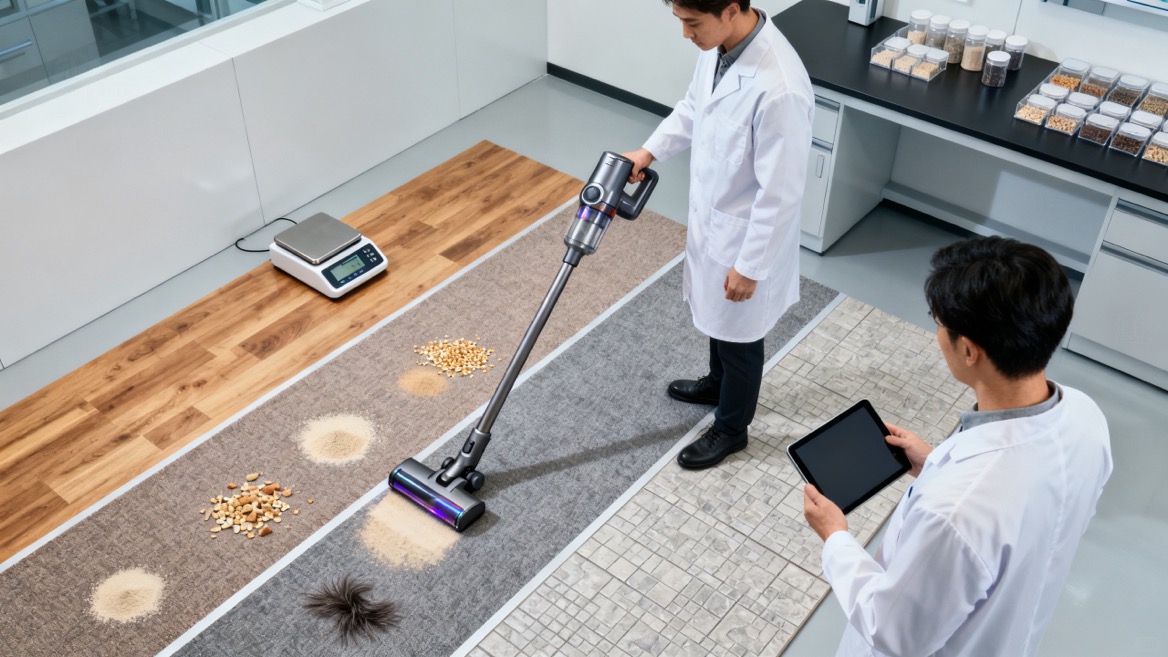
Successful sourcing starts with a clear product brief rather than a request for the lowest unit price.
OEM and ODM arrangements can overlap in practice. Confirm who controls the design, tooling, intellectual property, specifications, and future modifications.
Include:
- Target customers and destination markets.
- Floor types and cleaning priorities.
- Required configurations and accessories.
- Runtime targets with defined conditions.
- Weight, handling, and storage requirements.
- Filtration claims requiring verification.
- Packaging, manuals, and spare-parts plans.
Distinguish essential requirements from optional upgrades. This helps protect investment in core cleaning and usability before adding displays, lighting, or elaborate docks.
Before placing an order, agree the inspection plan, traceability requirements, approved components, change-control process, and defect-handling procedure.
Also clarify replacement-part availability, troubleshooting support, warranty responsibilities, and response expectations. Stable supply depends on documented arrangements, not broad promises alone.
At Eyunhome, we welcome discussions about upright, handheld, corded, and cordless vacuum programs. The appropriate configuration should follow your market requirements and the capabilities verified for the selected model.
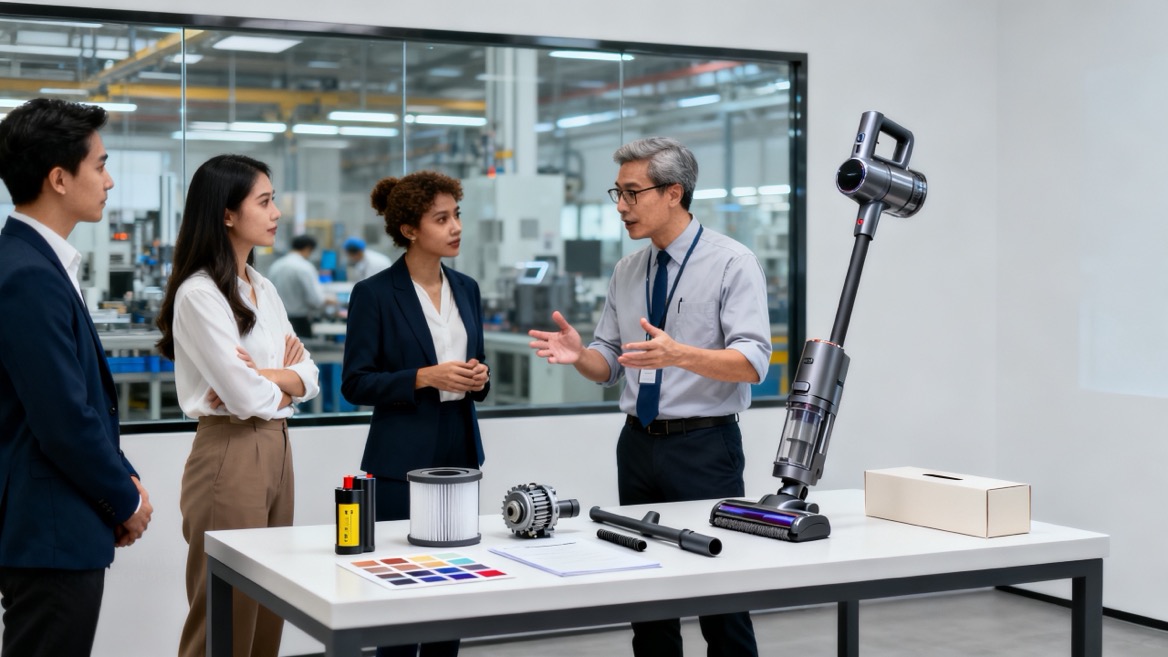
The strongest cordless vacuum proposition connects cleaning results with usable runtime, comfortable handling, manageable maintenance, and dependable product support.
For brands, retailers, and importers, these priorities also create a clearer development brief and a more defensible product promise.
Contact Ningbo Eyunhome Electric Technology Co., Ltd. with your target market, preferred vacuum format, expected order quantity, price positioning, and customization requirements. Request a model-specific proposal covering samples, specifications, documentation, production arrangements, and after-sales support.
The best choice depends on flooring, cleaning duration, handling preferences, and maintenance expectations. Prioritize demonstrated pickup and comfortable operation before optional features. Independent rankings can help create a shortlist, but their results should be matched to your own requirements.
There is no universal runtime target. Compare tested duration in the mode and configuration you expect to use. A low-power result without a motorized head does not establish how long the machine will clean carpets at higher power.
Many are, but performance varies. Examine floor and upholstery pickup separately, then assess roller tangling and cleaning access. A pet-focused accessory package is useful only when its tools perform effectively.
Not necessarily. Suction contributes to cleaning, but airflow, agitation, floorhead geometry, sealing, and surface compatibility also matter. Compare pickup results under equivalent conditions rather than choosing by pressure figures alone.
Request approved samples, agreed specifications, applicable model-specific documentation, inspection criteria, packaging details, spare-parts terms, and written warranty responsibilities. Verify the relationship between tested units and the proposed production configuration.
Eyunhome offers OEM/ODM services for vacuum cleaner programs. Available configurations, customization scope, order quantities, schedules, documentation, and after-sales arrangements should be confirmed for the specific project before commitment.
1. [Vacuum Wars — The Best Cordless Vacuums of 2026]. Updated October 16, 2026. Source for the dated Dyson V15 Detect ranking, review categories, and discussion of performance-based product comparisons. Rankings and prices may change. [vacuumwars]
2. [RTINGS — Shark PowerDetect Cordless IP1251 Review]. Source for approximately 13.8-minute minimum and 78.1-minute maximum runtime results, their different test configurations, and maintenance observations. These are reviewer-specific results, not Eyunhome product specifications. [rtings]
3. [RTINGS — Our Vacuum Design Tests: Battery]. Source for distinctions between minimum and maximum battery testing, attachment conditions, charging time, battery indicators, and replaceability. [rtings]
4. [U.S. Consumer Product Safety Commission — Batteries]. Authoritative background on battery and charger hazards and the importance of evaluating cells, batteries, chargers, and finished products together. [cpsc]
5. [Vacuum Wars — The Cordless Vacuum Buyer's Guide]. Background on floorheads, runtime interpretation, filtration, brush maintenance, and blockage checks. [vacuumwars]
6. [RTINGS — How We Test Vacuums: Turning Data Into Objective Reviews]. Background on structured evaluation and the assessment of maintenance accessibility. [rtings]


