
Views: 288 Author: Eyunhome Vacuum Publish Time: 2026-10-22 Origin: Site


Content Menu
● Single Battery vs Dual Battery Cordless Vacuum: Quick Comparison
● What Is a Single-Battery Cordless Vacuum?
● What Is a Dual-Battery Cordless Vacuum?
>> Two Batteries Do Not Guarantee Continuous Cleaning
● Runtime: Compare Real Cleaning Conditions, Not Just Maximum Minutes
>> An Independent Test Shows Why Conditions Matter
>> A Practical Runtime Calculation
● Does a Dual-Battery Vacuum Have More Suction?
>> Compare Watt-Hours, Not Capacity Labels Alone
● Weight, Ergonomics, and Everyday Convenience
>> Test More Than Floor Cleaning
● Battery Lifespan, Maintenance, and Replacement
>> Replacement Support Is Part of Product Value
● Purchase Price vs Long-Term Ownership Cost
● An OEM/ODM Evaluation Framework for Importers and Brands
>> Step 1: Define the Intended Cleaning Task
>> Step 2: Request Comparable Performance Evidence
>> Step 3: Verify Shipping and Service Readiness
● A Practical Acceptance Test Before Placing an Order
● Which Battery Configuration Should You Choose?
>> Does a dual-battery cordless vacuum run twice as long?
>> Can I add another battery to a single-battery vacuum?
>> Are dual-battery cordless vacuums better for pet hair?
>> Can I charge one battery while using the other?
>> Is a dual-battery cordless vacuum heavier?
>> How should used vacuum batteries be disposed of?
The single battery vs dual battery cordless vacuum decision comes down to one practical question: how much cleaning must you complete before stopping to recharge? A single-battery model can suit quick daily cleaning and cost-conscious product ranges. A dual-battery package offers more available runtime, particularly when its removable batteries can be charged independently.
However, two batteries do not automatically mean stronger suction, lighter handling, or uninterrupted operation.
At Ningbo Eyunhome Electric Technology Co., Ltd., we approach this comparison from a manufacturer's perspective: match the battery configuration to the cleaning task, then evaluate performance, usability, and long-term support. For homeowners, that means choosing a vacuum that fits everyday routines. For importers and private-label brands, it means building a product specification customers can understand and trust.
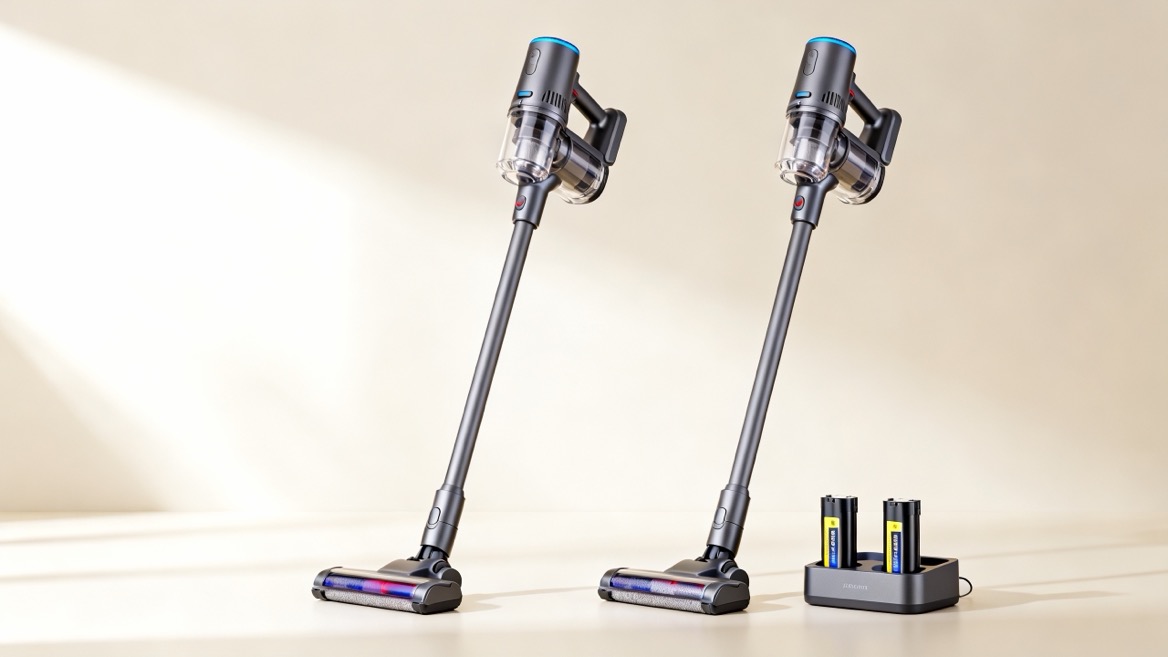
For this article, a dual-battery cordless vacuum means a vacuum supplied with two interchangeable batteries, used one at a time. It does not mean a machine that necessarily operates on two batteries simultaneously.
| Comparison point | Single-battery cordless vacuum | Dual-battery cordless vacuum |
|---|---|---|
| Battery configuration | One supplied battery; fixed or removable | Two supplied interchangeable batteries |
| Available runtime | Limited to one charged pack | Combined usable runtime of both charged packs |
| Suction performance | Depends on the complete vacuum system | Not automatically higher |
| In-use weight | Depends on the installed pack and machine | Similar if the same machine uses one identical pack |
| Charging workflow | Recharge after depletion unless another pack is purchased | Swap packs; charging flexibility depends on accessories |
| Purchase cost | Usually lower for an otherwise equivalent package | Usually higher because another pack is included |
| Storage requirements | Fewer components | Space needed for the spare and possibly another charger |
| Best fit | Short cleaning sessions and value-focused ranges | Longer sessions and runtime-focused bundles |
The most useful comparison is therefore usable runtime, not battery count alone.
A single-battery cordless vacuum comes with one battery pack. That pack may be built into the appliance, removable with tools, or designed for quick release.
These differences matter. A single-battery vacuum with a user-removable pack may support an additional battery later, provided the manufacturer offers a compatible option. A fixed-battery design does not provide the same swapping convenience.
One battery can be a sensible choice for:
- Daily crumbs and localized messes.
- Short cleaning sessions between deeper cleans.
- Apartments with limited storage.
- Buyers prioritizing a lower initial price.
- Product ranges positioned around straightforward convenience.
Do not judge suitability by floor area alone. A home with thick rugs, stairs, and pet hair may demand more energy than a larger home with mostly hard flooring.
From a product-planning perspective, I would first ask how customers clean—not simply how large their homes are.
A dual-battery cordless vacuum package includes a second compatible pack. When the installed battery runs low, the user switches off the appliance and replaces it according to the manufacturer's instructions.
The principal advantage is additional stored energy available for the cleaning session.
Charging architecture determines how useful the second battery becomes.
Check whether:
1. The spare can charge separately from the vacuum.
2. Both batteries can charge at the same time.
3. An additional charger or charging cradle is included.
4. A warm battery must cool before charging.
5. Charging takes longer than the operating time of the other pack.
A spare reduces interruptions, but it does not guarantee an endless cleaning rotation. If each battery runs for 25 minutes and charging takes several hours, both packs can still become depleted before either is ready again.
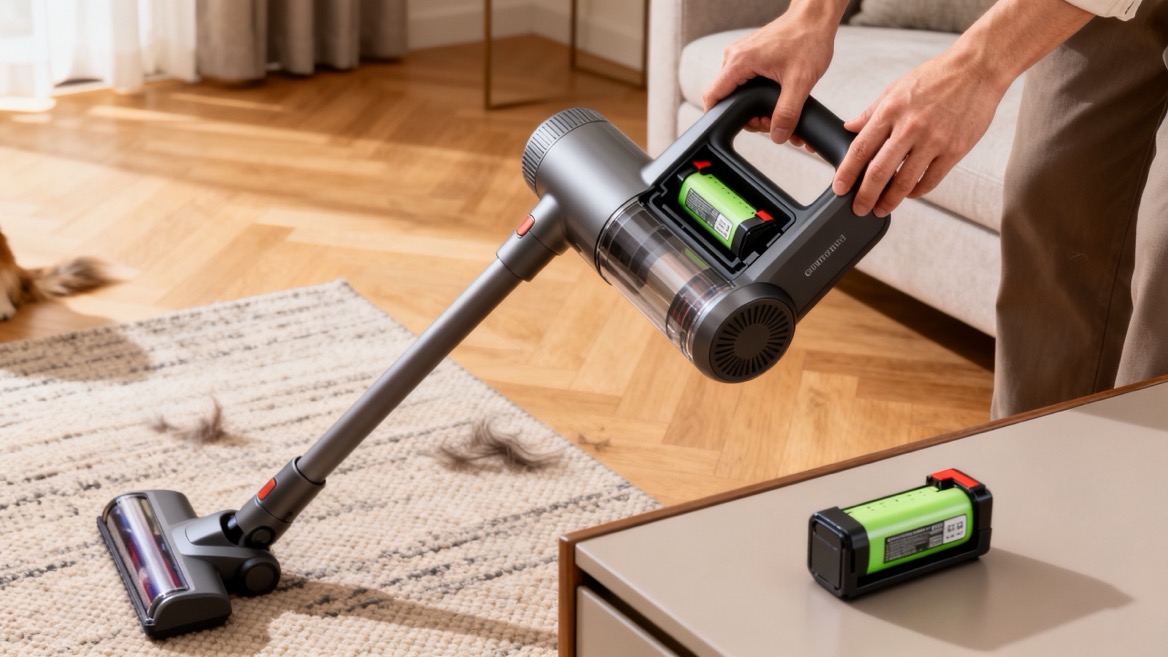
Battery runtime depends on the power setting, attachment, flooring, battery condition, and operating conditions.
An "up to" figure is incomplete without those details. A result achieved with a non-motorized tool at minimum power should not be presented as equivalent to carpet cleaning with a powered floorhead.
In its Samsung Bespoke Jet review, RTINGS reported more than an hour from one pack at the lowest suction setting. However, runtime fell to approximately 25 minutes in MID mode with the Jet Dual Brush floorhead, and around 10 minutes in JET mode.
Those figures describe that tested model, not every cordless vacuum. Their value is the lesson: the operating mode can change the buying decision more than the headline battery count.
For a brand selling a dual-battery cordless stick vacuum, publishing realistic floor-cleaning runtime helps customers understand what the second pack actually delivers.
Consider this illustrative planning example—not an Eyunhome product claim:
- Cleaning requires 35 minutes of active vacuuming.
- One battery supplies 25 minutes under the intended conditions.
- Two equally charged, equivalent batteries supply approximately 50 minutes combined.
One pack leaves a 10-minute shortfall. Two provide an estimated 15-minute reserve before accounting for battery aging or changes in cleaning conditions.
The calculation is straightforward:
Combined runtime ≈ usable runtime per battery × number of charged batteries.
It works only when the packs and test conditions are comparable.
Not simply because it includes another battery.
For a system that uses one pack at a time, the spare does not add its power to the installed battery. Cleaning performance depends on the motor, airflow path, floorhead, sealing, filtration condition, and electrical controls.
Battery specifications still matter, but they require careful interpretation.
Milliamp-hours describe charge capacity. Watt-hours describe nominal stored energy and are more useful when comparing batteries with different voltages.
For example:
- A 22.2 V, 2.5 Ah pack stores approximately 55.5 Wh.
- Two identical packs store approximately 111 Wh combined.
This does not predict exact cleaning time. Energy consumption and usable battery capacity vary with the appliance and operating conditions.
Ask suppliers to identify nominal voltage, capacity, watt-hours, and the testing basis. Avoid treating a larger capacity number as proof of better floor-cleaning performance.
Two supplied batteries do not necessarily make the vacuum heavier during use.
If two packages contain the same vacuum and identical battery packs, the user carries only the installed pack. The spare remains elsewhere.
However, comparisons between different models may involve different battery sizes, motor housings, and floorheads. Weigh the complete operating configuration rather than relying on the main-body weight.
During sample evaluation, check:
- Wrist comfort when cleaning shelves.
- Balance in handheld mode.
- Ease of carrying the vacuum upstairs.
- Battery-release accessibility.
- Whether the pack clicks securely into place.
- How clearly the display communicates remaining charge.
For older users or customers cleaning above shoulder height, balance may be more important than maximum runtime.
A useful assessment includes repeated transitions between floor, handheld, and above-floor cleaning—not just a brief showroom demonstration.
Runtime per charge and battery lifespan are different measurements.
A second pack increases the energy available for a session. It does not automatically double the service life of the battery system. Lithium-ion batteries also age over time, so an unused spare is not preserved indefinitely.
Dyson's battery-care guidance illustrates the importance of operating habits: it recommends normal operating modes for everyday cleaning and reserves Boost or Max for short intensive tasks. Buyers should follow the instructions for their specific appliance.
Before purchasing or specifying a model, confirm:
- Battery model identification and compatibility.
- Replacement price and ordering process.
- Warranty terms for the battery.
- Charger compatibility.
- Expected spare-parts availability.
- Safe handling and disposal instructions.
For private-label products, a removable battery has limited long-term value if customers cannot obtain a compatible replacement.
Stop using damaged or swollen packs and seek the manufacturer's guidance. Never improvise compatibility based only on connector shape.
A fair single battery vs dual battery cordless vacuum comparison includes more than the retail price.
Assess the complete package:
| Cost factor | Question to ask |
|---|---|
| Initial purchase | What does the second battery add to the price? |
| Charging accessories | Is independent spare-battery charging included? |
| Replacement batteries | What will a compatible replacement cost? |
| Service support | Who handles battery and charger claims? |
| Cleaning interruptions | Does one pack regularly leave tasks unfinished? |
| Storage | Can the customer conveniently store and charge the spare? |
For occasional cleaning, a second pack may provide little practical value. For longer sessions, it may remove a recurring inconvenience.
Neither arrangement is universally more economical. The better choice depends on how often the extra runtime is actually used.
For international buyers, battery configuration should form part of a documented product brief—not an isolated marketing feature.
At Ningbo Eyunhome Electric Technology Co., Ltd., our upright, handheld, corded, and cordless vacuum solutions support different product-positioning needs. Our OEM/ODM services, production support, and after-sales support provide a starting point for discussing those requirements. Specific battery configurations and performance claims should be confirmed against the proposed model.
Specify the target user, flooring mix, expected active cleaning time, attachments, and price position.
A compact secondary vacuum and a primary whole-home cleaner should not share an identical runtime brief.
Ask for reports identifying:
- Operating mode and floorhead.
- Test surface and debris.
- Battery condition and charge preparation.
- Runtime endpoint.
- Dust pickup results.
- Relevant environmental conditions.
IEC 62885-4 provides a recognized performance-measurement framework for cordless dry household vacuums. Ask which standard and edition the report follows; a reference to a standard is not, by itself, proof of certification.
Request applicable battery transport documentation, including the UN 38.3 test summary where required. Confirm shipment requirements with a qualified logistics provider.
Separately, establish spare-battery supply, warranty handling, and replacement instructions. Transport documentation does not establish cleaning performance or complete finished-product compliance.
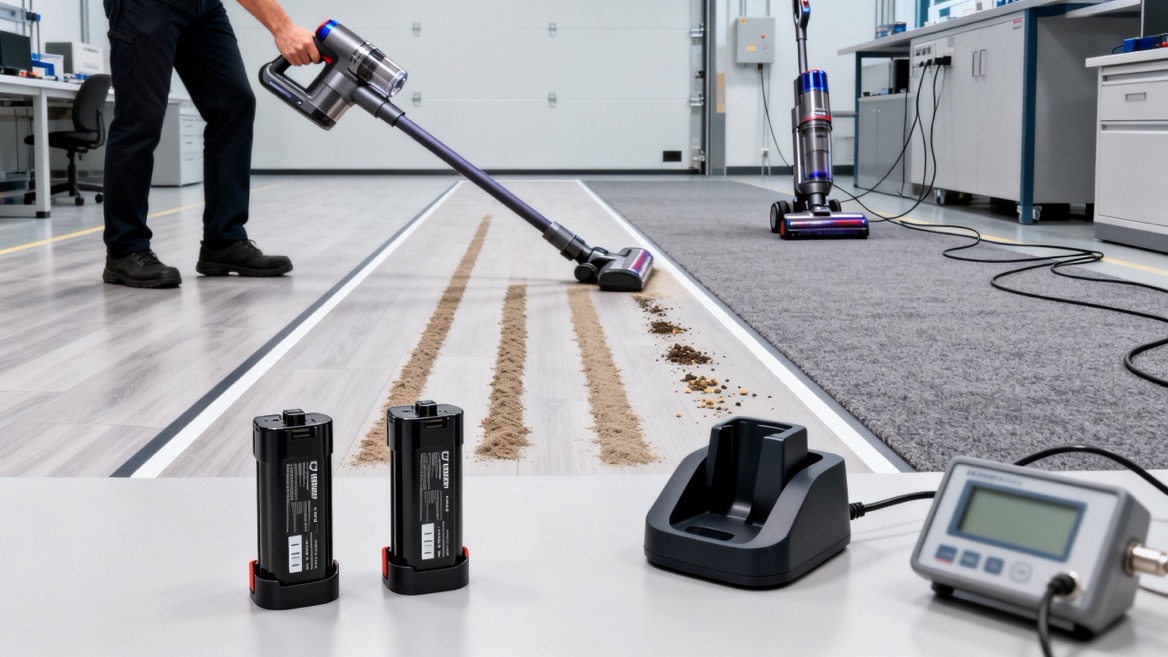
This repeatable sample test can expose weaknesses hidden by maximum-runtime claims:
1. Fully charge both packs using the supplied equipment.
2. Use the same floorhead, mode, and representative floor route.
3. Record active cleaning time and remaining charge.
4. Repeat with the second battery under comparable conditions.
5. Check swapping effort, locking security, and charging behavior.
6. Repeat trials to identify inconsistent results.
Evaluate dust pickup alongside runtime. A vacuum that runs longer while requiring repeated passes may not complete the task faster.
This approach gives purchasing, engineering, and customer-service teams a shared basis for approving the product.
Choose a single-battery cordless vacuum when one verified charge comfortably covers the intended task, storage is limited, and purchase price matters most.
Choose a dual-battery cordless vacuum when longer sessions regularly exceed one pack's practical runtime, easy swapping is available, and the charging arrangement supports the intended workflow.
For importers and private-label brands, contact Ningbo Eyunhome Electric Technology Co., Ltd. with your target market, cleaning applications, preferred battery arrangement, and expected order volume. Request a model-specific OEM/ODM proposal covering performance evidence, charging accessories, production requirements, and after-sales support.
Approximately, if it includes two identical, fully charged batteries used under equivalent conditions. Different pack capacities, battery health, and operating modes change the result.
Only when the model supports a compatible removable battery. Confirm the exact battery reference and charging requirements before buying.
Extra runtime can help, but pet-hair pickup also depends on the brush design, floorhead, airflow, and maintenance. Two batteries do not guarantee better pickup.
Only if the system supports independent battery charging. A removable battery does not automatically include a separate charger.
Not necessarily. With a one-pack-at-a-time design, the spare does not contribute to operating weight. Compare complete machines with their installed batteries and attachments.
Follow local collection requirements. In the United States, EPA advises taking lithium-ion batteries to suitable battery-recycling or hazardous-waste collection points, not household trash or curbside recycling.
- RTINGS. "Samsung Bespoke Jet Vacuum Review." Independent runtime observations, operating-mode differences, and charging arrangements. [rtings]
- Dyson. "Vacuum Battery Care." Manufacturer guidance on operating modes, temperature, charging, and battery deterioration. [dyson]
- International Electrotechnical Commission. "IEC 62885-4:2020+AMD1:2023 CSV: Surface Cleaning Appliances—Part 4: Cordless Dry Vacuum Cleaners for Household or Similar Use—Methods for Measuring the Performance." [webstore.iec]
- International Air Transport Association. "Battery Guidance Document." Lithium-battery transport guidance and UN 38.3 test-summary requirements. [iata]
- United States Environmental Protection Agency. "Used Lithium-Ion Batteries." Collection, recycling, and handling guidance. [epa]


