
Views: 215 Author: Eyunhome Vacuum Publish Time: 2026-10-20 Origin: Site


Content Menu
● Lithium-Ion vs NiMH Vacuum Cleaner Batteries: Quick Comparison
● How Do Lithium-Ion and NiMH Vacuum Batteries Work?
>> Lithium-ion batteries: compact energy storage
>> NiMH batteries: a different pack architecture
● Which Battery Delivers Better Vacuum Cleaner Performance?
>> Suction depends on the complete system
>> Sustained output matters more than startup power
● Runtime Comparison: Look Beyond Voltage and Milliamp-Hours
>> Why advertised runtime can be misleading
● Weight, Balance, and Everyday Comfort
● Charging Speed, Storage, and Battery Care
>> Charging time is a design choice
>> Charge retention varies by cell type
>> Avoid universal battery-care rules
● Battery Lifespan, Replacement, and Total Ownership Cost
>> Calculate serviceability, not just purchase price
● Safety and Shipping: Compare Responsibilities, Not Labels
>> Lithium-ion requires coordinated protection
>> NiMH still needs careful engineering
● A Practical Battery Validation Plan for Vacuum Cleaner Buyers
>> Step 1: Establish the actual cleaning task
>> Step 2: Compare equal tasks
>> Step 3: Measure thermal behavior
>> Step 4: Repeat after controlled aging
>> Step 5: Check service and shipment readiness
● Which Battery Should Your Vacuum Cleaner Project Use?
● Developing the Right Vacuum Cleaner with Eyunhome
>> Is a lithium-ion vacuum cleaner always better than a NiMH model?
>> Which vacuum battery lasts longer between charges?
>> Can I replace a NiMH vacuum battery with lithium-ion?
>> Does higher battery voltage mean stronger suction?
>> Should I fully discharge my vacuum before charging?
>> Are removable batteries worth choosing?
Choosing a lithium-ion battery vs NiMH battery vacuum cleaner affects more than charging convenience. It influences product weight, usable runtime, storage performance, maintenance, and long-term ownership costs. For brands and importers, it also shapes battery sourcing, product development, shipping, and after-sales support.
For most lightweight cordless vacuum cleaner projects, lithium-ion is the stronger starting point because it generally stores more energy relative to its weight. However, nickel-metal hydride, commonly called NiMH, can remain suitable for established platforms and certain cost-sensitive applications.
My recommendation is to compare complete vacuum systems—not battery labels alone. A well-matched battery, motor, charger, and airflow design matters more than a headline voltage or an impressive runtime claim.
This guide explains the technical differences and translates them into practical decisions for consumers, distributors, and manufacturers.
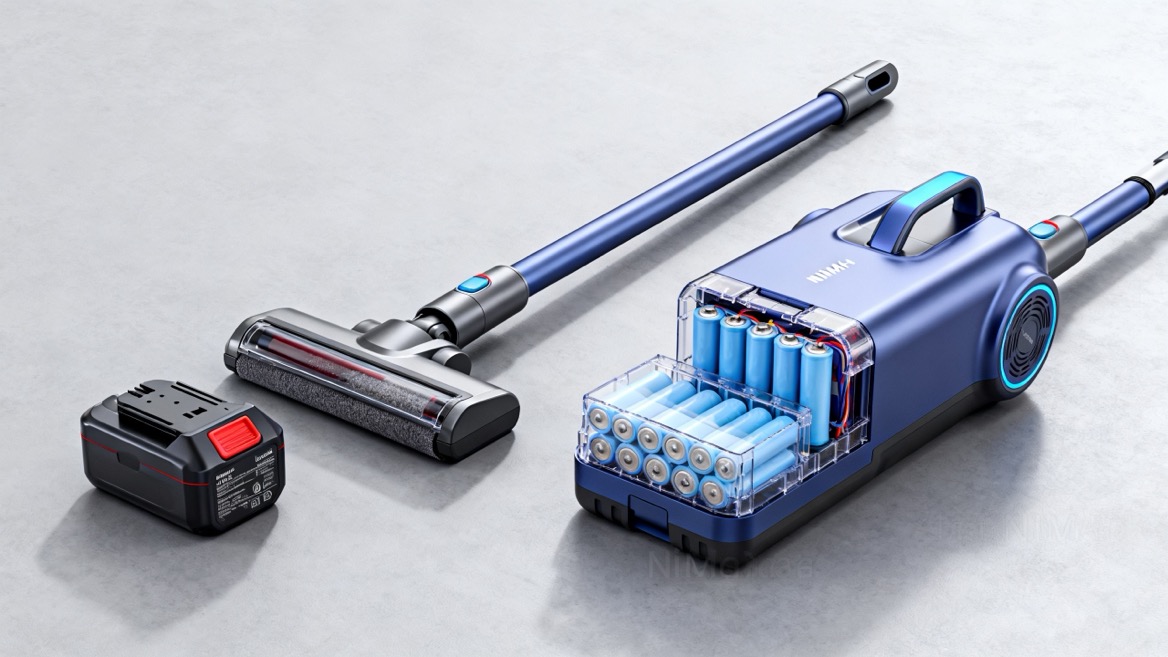
Both technologies are rechargeable, but they differ in cell voltage, energy storage, charging requirements, and system integration.
| Comparison factor | Lithium-ion battery vacuum cleaner | NiMH battery vacuum cleaner |
|---|---|---|
| Energy relative to weight | Generally higher | Generally lower |
| Typical nominal cell voltage | Commonly 3.6–3.7 V; chemistry-dependent | Approximately 1.2 V |
| Battery size at comparable energy | Usually more compact | Usually larger |
| Charge retention | Generally good; electronics also consume energy | Conventional cells lose charge faster; low-self-discharge variants improve retention |
| Charging method | Controlled voltage and current with protection | Chemistry-specific charge termination and temperature monitoring |
| Cleaning performance | Depends on the complete appliance | Depends on the complete appliance |
| Battery lifespan | Depends on temperature, load, charging, and cell quality | Depends on temperature, load, charging, and cell quality |
| Commercial fit | Lightweight, compact cordless platforms | Selected established or application-specific platforms |
Neither chemistry automatically guarantees longer runtime, stronger suction, or lower ownership costs.
Lithium-ion batteries transfer lithium ions between electrodes during charging and discharging. Their relatively high energy density helps manufacturers design cordless stick vacuums and handheld cleaners without adding excessive battery weight.
"Lithium-ion" describes a family of chemistries, not one identical cell design. Cells optimized for maximum capacity may behave differently from cells designed for higher current output.
For vacuum cleaner development, the cell must support the motor's electrical demand—not simply provide an attractive capacity figure.
NiMH batteries use nickel-based positive electrodes and hydrogen-storage alloy negative electrodes. Their nominal voltage is approximately 1.2 V per cell.
Consequently, a NiMH pack generally requires more cells in series to reach a voltage similar to a conventional lithium-ion pack.
More cells can affect packaging, electrical connections, and weight. Nevertheless, a properly engineered NiMH system can provide useful performance when its power requirements and physical dimensions suit the application.
A lithium-ion battery does not create stronger suction by itself.
Cleaning performance depends on:
- Motor efficiency and operating speed.
- Fan and air-path design.
- Floorhead sealing and brush agitation.
- Filter condition and airflow resistance.
- Battery current capability and voltage under load.
- Electronic controls and thermal limits.
A poorly designed lithium-ion vacuum can clean less effectively than a well-engineered NiMH model.
When comparing cordless vacuum cleaners, examine debris pickup and sustained performance rather than treating battery chemistry as a direct measure of cleaning power.
Vacuum motors impose a substantial electrical load. If battery voltage falls under that load, motor performance may change unless the control system compensates.
Effective compensation also has limits: electronics cannot create energy that the pack cannot supply.
For procurement, request performance measurements at the beginning, middle, and end of discharge. This reveals whether the appliance maintains useful cleaning performance throughout its advertised operating period.
Battery capacity expressed in milliamp-hours can mislead buyers when pack voltages differ.
Watt-hours provide a more useful starting point:
Energy (Wh)=Nominal voltage (V)×Capacity (Ah)
For illustration:
| Hypothetical pack | Nominal capacity | Nominal stored energy |
|---|---|---|
| 21.6 V pack | 2.0 Ah | 43.2 Wh |
| 12 V pack | 3.0 Ah | 36 Wh |
The second pack has a higher amp-hour rating but less nominal energy.
These are illustrative calculations, not specifications for Eyunhome products. Actual runtime also depends on usable energy, motor demand, brush power, temperature, and protective cutoffs.
A runtime claim may describe operation in the lowest power mode, without a powered floorhead.
That figure does not necessarily represent carpet cleaning or maximum suction operation.
For a meaningful lithium-ion vs NiMH vacuum cleaner comparison, ask:
1. Which power setting was tested?
2. Was a motorized brush attached?
3. What surface and loading conditions were used?
4. What defined the end of useful runtime?
5. How many samples were measured?
IEC 62885-4 provides methods for measuring cordless dry vacuum cleaner performance. Using a recognized framework helps make comparisons more repeatable.
Lithium-ion's energy-to-weight advantage is particularly valuable in handheld vacuum cleaners and stick vacuums with motors positioned near the handle.
However, total appliance weight does not tell the whole story.
A heavier battery near the grip can change wrist loading. A lower-mounted pack may produce a different handling experience, even when total weight stays unchanged.
For product evaluation, consider:
- One-handed maneuvering.
- Cleaning stairs and upholstery.
- Reaching under furniture.
- Overhead use.
- Battery removal and installation.
- Balance with different attachments.
From a product-planning perspective, battery placement deserves attention alongside battery chemistry. A comfortable appliance can deliver more practical value than a lighter but poorly balanced design.
Lithium-ion batteries are not automatically fast-charging, and NiMH batteries are not automatically slow-charging.
Charging time depends on cell specifications, charger output, temperature, and the manufacturer's charging strategy.
Faster charging can increase thermal demands. A shorter advertised charging time should therefore be evaluated together with temperature control and battery durability.
Never substitute chargers between lithium-ion and NiMH systems. Their charging requirements differ.
Lithium-ion generally retains charge well during storage, although protection electronics and connected appliance functions can consume energy.
Conventional NiMH cells typically have higher self-discharge. Low-self-discharge NiMH cells improve retention, so older generalizations do not describe every modern pack.
For occasional-use handheld vacuums, request storage-retention results for the actual battery assembly.
Regularly running every rechargeable vacuum completely flat is not a sound general rule.
Follow the appliance instructions and battery supplier's limits. Use the specified charger, avoid excessive heat, and observe any stated storage recommendations.
For lithium-ion systems, repeated deep discharge is not required to prevent a memory effect.
No single cycle-life figure reliably describes every lithium-ion or NiMH vacuum battery.
Battery durability depends on operating temperature, depth of discharge, charging conditions, current demand, and cell quality. Capacity also changes with calendar age, even when a product receives limited use.
A claim such as "500 cycles" needs context. Buyers should ask what remaining capacity defines failure and how the test was conducted.
For a commercial buying decision, consider:
- Initial appliance and battery cost.
- Expected replacement frequency.
- Replacement-pack pricing.
- Labor and shipping for warranty cases.
- Availability of compatible packs.
- Product downtime.
- Disposal and recycling arrangements.
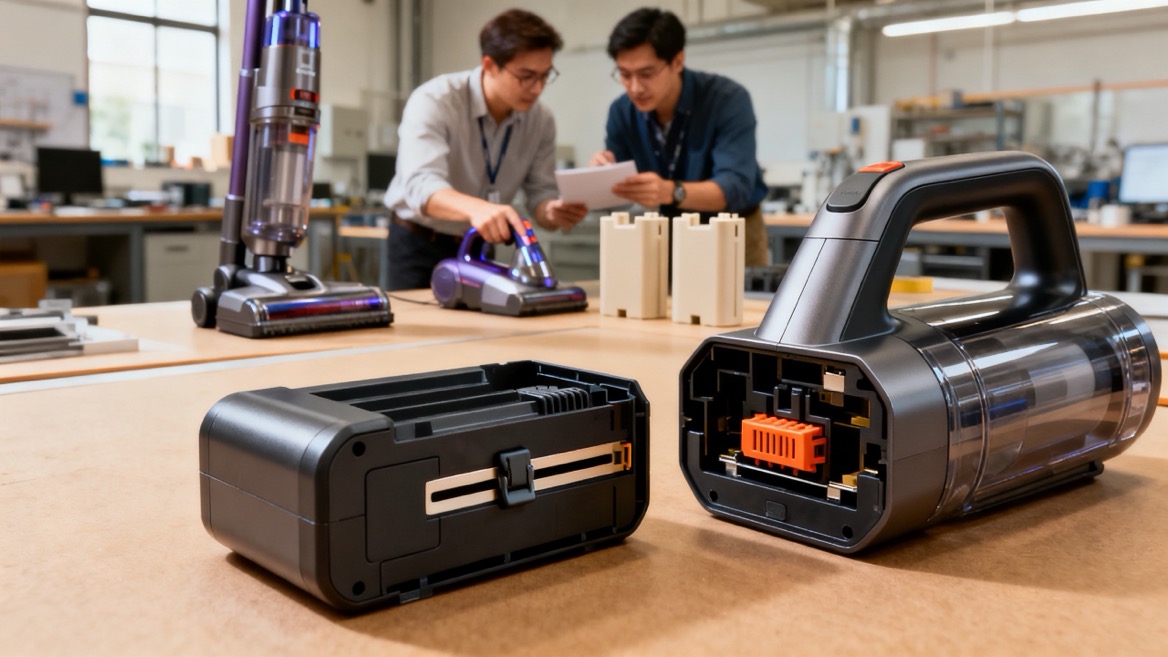
A removable battery can simplify replacement and support longer product use. However, the latch, connector, protection system, and spare-parts plan must also be reliable.
The lowest initial quotation is not necessarily the lowest-cost product over its service life.
Lithium-ion battery systems require suitable protection against conditions such as overcharging, excessive discharge, short circuits, and unsafe temperatures.
Cell selection, pack assembly, protective electronics, charger compatibility, and mechanical design must work together.
For transportation, lithium battery designs are subject to applicable UN 38.3 testing requirements. Relevant test summaries must be available as required by transport rules.
Shipping conditions vary according to configuration, transport mode, battery rating, and other factors. Shipping a replacement pack separately can involve different requirements from shipping a battery installed in a vacuum.
NiMH should not be described as risk-free. Incorrect charging, short circuits, and overheating can damage packs and create hazards.
Temperature monitoring, appropriate charge termination, electrical insulation, and robust connections remain important.
Neither chemistry replaces complete appliance safety evaluation. Transport documentation also does not prove cleaning performance or compliance with every requirement in a destination market.
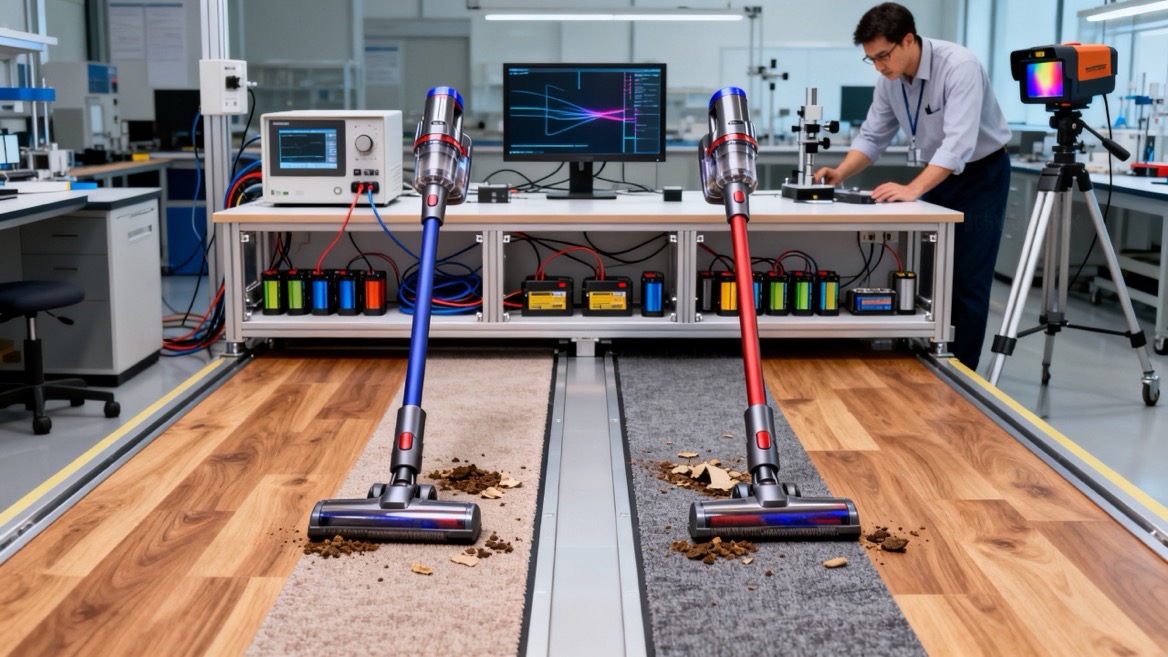
One useful way to improve sourcing decisions is to test the proposed system under realistic conditions before approving production.
Define the intended floor types, cleaning area, power modes, attachments, and expected session length.
A compact car vacuum and a full-size cordless upright should not share identical battery targets.
Test both products using the same surface, debris, accessory, and operating mode.
Record debris pickup alongside runtime. A vacuum that operates longer but leaves more dirt behind may not provide better value.
Monitor battery and charger temperatures within the approved test procedure.
Include demanding conditions such as extended high-power operation. Investigate premature shutdown rather than simply recording it as a short runtime.
Measure runtime and cleaning performance again after an agreed charging and discharge program.
Define the acceptance threshold before testing. This converts a vague durability promise into a measurable purchasing requirement.
Verify replacement-pack compatibility, labeling, traceability, applicable documentation, and warranty procedures.
These checks help identify problems that a successful showroom demonstration cannot reveal.
For a new lightweight cordless stick or handheld vacuum, I would generally shortlist lithium-ion first. Its energy-to-weight advantage gives designers useful flexibility.
NiMH deserves consideration when an established platform, specific application, or validated cost structure supports it. Retaining NiMH should be a deliberate engineering decision—not an assumption that it is always cheaper or safer.
| Project priority | Practical direction |
|---|---|
| Lightweight handheld operation | Evaluate lithium-ion first |
| Compact pack with substantial stored energy | Evaluate lithium-ion first |
| Existing NiMH product platform | Compare retention, redesign costs, and service needs |
| Long cleaning sessions | Evaluate usable energy, efficiency, and swappable-pack options |
| Lowest lifetime cost | Compare validated durability and replacement support |
| Continuous operation | Consider whether a corded design is more suitable |
Ningbo Eyunhome Electric Technology Co., Ltd. offers upright, handheld, corded, and cordless vacuum cleaner solutions, alongside OEM/ODM services, stable production, and after-sales support.
For a battery-powered project, the most productive starting point is a clear specification covering:
- Target market and intended application.
- Required cleaning performance and usable runtime.
- Acceptable appliance weight.
- Battery replacement expectations.
- Charging arrangements.
- Destination-market requirements.
- Target cost and warranty strategy.
Contact Eyunhome with these requirements to discuss a suitable vacuum platform and define the battery, validation, production, and service scope before finalizing your order.
No. Lithium-ion generally offers better energy storage relative to weight, but cleaning performance depends on the motor, airflow, floorhead, battery capability, and controls. Compare complete appliances under equivalent conditions.
The model with more usable energy relative to its power consumption. Battery chemistry alone cannot determine runtime. Compare watt-hours, operating mode, powered attachments, and measured cleaning performance.
Not as a simple substitution. The charger, voltage limits, protection electronics, temperature monitoring, and physical connections may be incompatible. Use only manufacturer-approved replacement packs.
Not necessarily. Voltage is one electrical parameter. Motor design, current capability, airflow restrictions, and floorhead engineering also determine cleaning performance.
Follow the manufacturer's instructions. Lithium-ion batteries do not require routine full discharge to prevent memory effect. Avoid applying charging advice from one battery chemistry to another.
They can simplify replacement and enable extended cleaning with an approved spare. Their value depends on replacement availability, connector durability, pack pricing, and continued support.
1. University of Washington, Clean Energy Institute. "Lithium-Ion Battery." Background on operating principles, self-discharge, and memory effect. [cei.washington]
2. Panasonic Energy. "Ni-MH Batteries Handbook." Technical guidance on NiMH characteristics, nominal cell voltage, charging, and application considerations. [energy.panasonic]
3. Texas Instruments. "Using NiMH and Li-Ion Batteries in Portable Applications." Application guidance comparing charging, discharge behavior, and battery management. [ti]
4. Battery University. "Understanding Lithium-ion." Discussion of lithium-ion characteristics and the distinction between specific energy and specific power. [batteryuniversity]
5. International Electrotechnical Commission. "IEC 62885-4:2020/AMD1:2023: Surface Cleaning Appliances—Part 4: Cordless Dry Vacuum Cleaners for Household or Similar Use—Methods for Measuring the Performance." [webstore.iec]
6. U.S. Pipeline and Hazardous Materials Safety Administration. "Lithium Battery Test Summaries." Explanation of UN 38.3 design testing and test-summary requirements. [phmsa.dot]
7. International Air Transport Association. "Battery Guidance Document." Guidance on lithium battery classification, testing, documentation, and air-transport conditions. [iata]


