
Views: 247 Author: Eyunhome Vacuum Publish Time: 2026-08-30 Origin: Site


Content Menu
● Strong Suction Is More Than a Single Number
● How Cordless Vacuum Suction Is Measured
>> Air Watts
>> Motor Power
>> Runtime
● The Best Suction Setup for Each Floor Type
>> Hard Floors: Prioritize Pickup Without Scattering
>> Carpet: Combine Suction With Brush Agitation
>> Pet Hair: Build for Hair, Dander, and Daily Use
● A Better Way to Compare Cordless Stick Vacuums
>> Step 1: Identify the Primary Cleaning Job
>> Step 2: Check Cleaning Performance by Surface
>> Step 3: Evaluate Normal-Mode Runtime
>> Step 4: Inspect the Floor Head
>> Step 5: Look at Filtration and Maintenance
● Why Real-World Runtime Matters More Than a Headline Claim
● Design Features That Improve Actual Cleaning Results
>> Multi-Cyclonic Dust Separation
>> Washable, Accessible Filters
>> Convertible Handheld Function
● What Retailers and Brands Should Ask a Vacuum Manufacturer
● How Ningbo Eyunhome Supports Vacuum Cleaner Brands
>> OEM and ODM Product Development
>> Stable Production for Global Supply
>> Practical After-Sales Support
● FAQ
>> 1. What is considered strong suction for a cordless stick vacuum?
>> 2. Is a higher kPa rating always better?
>> 3. How long should a cordless vacuum run on one charge?
>> 4. Are cordless stick vacuums good for pet hair?
>> 5. Is a cordless vacuum better than a corded vacuum?
>> 6. What should a private-label vacuum brand ask an OEM/ODM factory?
>> 7. Why does suction seem weaker after several months of use?
Choosing the best cordless stick vacuum with strong suction is not as simple as picking the model with the highest number on its product page. For real homes, cleaning results depend on a complete system: airflow, brush-roll design, floor-head sealing, filtration, battery output, bin capacity, and the user's flooring mix.
For distributors, private-label brands, retailers, and e-commerce sellers, this matters even more. A cordless vacuum must not only perform well in a short demonstration—it must deliver consistent results over repeated use, meet the needs of local buyers, and be supported by dependable manufacturing and after-sales service.
Ningbo Eyunhome Electric Technology Co., Ltd. develops upright, handheld, corded, and cordless vacuum cleaner solutions for global businesses. With professional OEM/ODM support, stable production capacity, and practical product-development experience, we help brands build vacuum cleaner ranges that balance suction performance, usability, reliability, and market positioning.

Many buyers search for a cordless stick vacuum with the "strongest suction." However, suction alone does not tell the entire performance story.
A high-pressure motor can create impressive suction at the inlet, but a vacuum still needs to move dust, hair, crumbs, and fine particles through the floor head, wand, cyclone system, filters, and into the dust bin. If one part of that airflow path is poorly designed, the real cleaning result may be disappointing.
That is why experienced product teams assess several connected factors rather than relying on one headline specification.
| Performance factor | Why it matters | What buyers should look for |
|---|---|---|
| Suction pressure | Helps lift dirt from surfaces and gaps | A clearly stated, consistently tested value |
| Airflow | Moves debris from the floor head to the dust bin | Efficient air channels and low air-loss design |
| Motorized brush roll | Loosens embedded dirt and hair | Strong agitation with anti-tangle features |
| Floor-head sealing | Helps the vacuum collect debris rather than scatter it | A head designed for carpets, hard floors, or both |
| Filtration | Protects airflow while capturing fine dust | Multi-stage filtration and washable components where appropriate |
| Battery output | Determines stable cleaning performance | A practical runtime at normal and high power levels |
| Dust-bin design | Affects convenience and airflow consistency | Easy emptying, adequate capacity, and a hygienic structure |
The key lesson is simple: the strongest cordless stick vacuum is the one that removes debris effectively on the floors your customers actually have.
For example, a vacuum used in a small apartment with hard flooring may benefit most from a soft roller, moderate power mode, light weight, and fast daily pickup. A vacuum designed for homes with rugs, pets, and children needs stronger carpet agitation, better hair pickup, larger bin capacity, and a removable battery option.
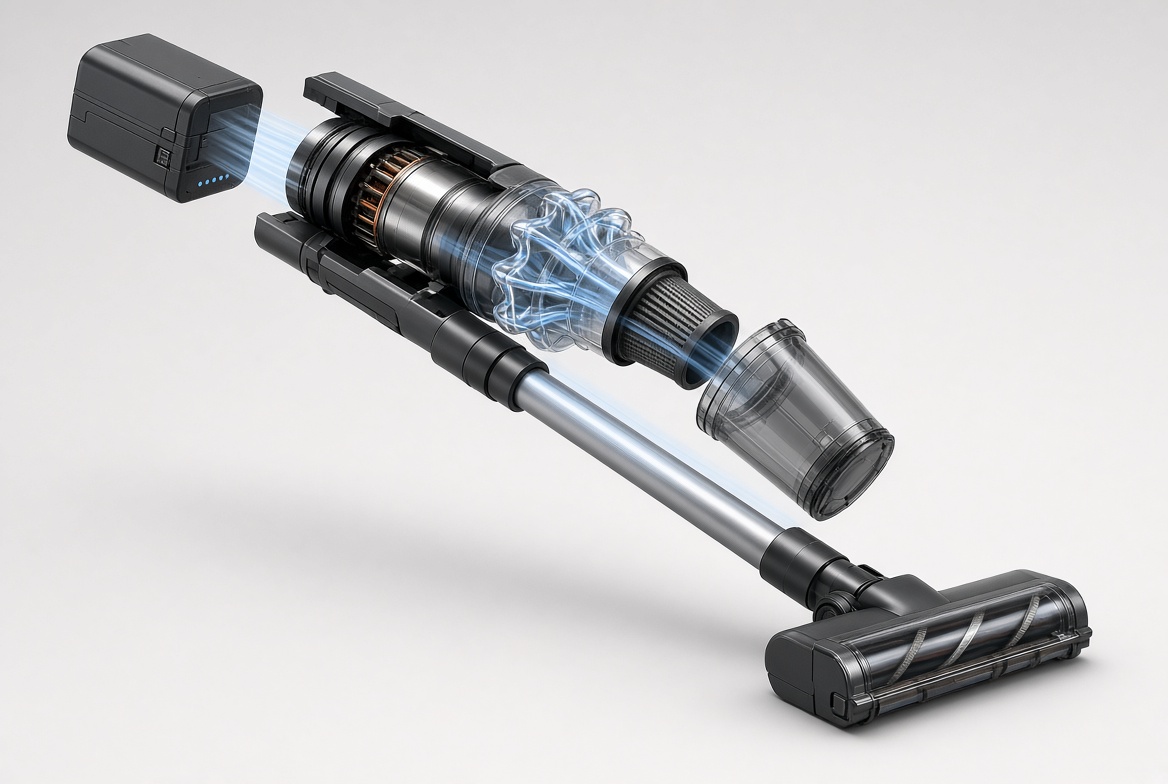
Vacuum cleaner performance can be described using several measurements. The challenge is that these figures are not always presented under the same conditions. A brand may promote motor wattage, suction pressure, air watts, or runtime, but each metric tells only part of the story.
Air watts combine airflow and suction pressure into a single performance measurement. They can be useful when comparing products tested under similar conditions, but an air-watt number should never be treated as the only buying decision.
A high air-watt value may indicate strong potential, yet floor-head design and brush-roll agitation still determine how effectively the vacuum removes debris from carpet fibers and hard-floor gaps.
Suction pressure is often described in kilopascals (kPa) or water lift. This measurement shows the vacuum's pulling force under controlled conditions.
Higher pressure can help with heavier debris, dust in crevices, and more demanding carpet cleaning. But pressure alone does not guarantee that the vacuum can efficiently transport collected debris through the full airflow system.
Motor wattage is often misunderstood. A more powerful motor does not automatically mean better cleaning. The result depends on motor efficiency, battery management, airflow engineering, nozzle design, filtration resistance, and the selected power mode.
For product sourcing, buyers should ask manufacturers how the whole machine performs—not only how large the motor specification appears.
Cordless vacuum runtime should be evaluated realistically. Advertised maximum runtime commonly refers to the lowest power setting under favorable conditions. Actual runtime can drop significantly when the motorized floor head is active or when the vacuum runs in high-power mode.
Independent testing regularly shows that cordless vacuums may operate for far shorter periods on maximum mode than on eco mode. For example, one reviewed premium cordless model was reported to run about 70 minutes on low power but roughly 8 minutes on high power. This does not make the product unsuitable; it shows why brands should communicate runtime honestly and design battery capacity around real cleaning habits.
There is no single cordless stick vacuum configuration that is perfect for every home. The right solution depends on flooring, debris type, home size, cleaning frequency, and price category.
Hard floors often contain fine dust, crumbs, hair, and debris along edges. Strong suction is useful, but the floor head is equally important.
A soft roller or a carefully designed multi-surface roller can improve pickup of fine dust while reducing the risk of pushing larger crumbs forward. For hard-floor households, product developers should focus on:
- Soft roller technology for fine dust and larger debris
- Edge-cleaning performance near walls and furniture
- Controlled airflow that avoids blowing debris away
- Lower operating noise for frequent daily use
- LED lighting to make hidden dust visible
- Lightweight handling for fast kitchen and living-room cleaning
A product with extreme maximum suction but poor hard-floor pickup can create a frustrating customer experience. The best design captures debris efficiently in one or two passes without requiring users to change settings constantly.
Carpet cleaning requires more than high suction. Dirt, sand, hair, and fine dust can settle below the surface of carpet fibers. A motorized brush roll helps loosen that debris so the airflow system can remove it.
For carpet-focused cordless vacuum programs, consider:
- A motorized brush roll with firm, balanced bristles
- A sealed or semi-sealed nozzle design that improves pickup
- Adjustable suction modes for low-pile and medium-pile carpets
- A brush-roll system that resists hair wrap
- Stable battery output during higher-power cleaning
- Wheels and swivel steering that keep the floor head easy to control
Strong airflow is particularly important for transporting loosened debris into the dust bin. A vacuum with a powerful motor but weak internal airflow may leave dirt behind or lose performance as the bin fills.
Pet owners are often among the most demanding cordless vacuum buyers. They expect a vacuum to handle visible hair, fine dander, tracked-in debris, upholstery, stairs, and vehicle interiors.
A competitive pet-focused model should include a combination of features rather than only a "pet" label:
- Anti-tangle brush-roll design to reduce manual hair removal
- Motorized mini tool for upholstery, mattresses, and car seats
- Fine-dust filtration for dander and household particles
- Easy-to-empty dust bin to reduce contact with collected hair
- Crevice tool for baseboards, cushions, and narrow spaces
- Removable battery options for larger homes
- Durable brush-roll bearings and sealing components
From a product-development viewpoint, pet hair testing should include long hair, short hair, carpet fibers, hard-floor surfaces, and multiple bin-fill conditions. A vacuum that works only on a clean test surface may not meet real household expectations.
Instead of asking only, "Which cordless stick vacuum has the highest suction?" use a structured comparison process.
Start with the main use case:
- Daily hard-floor maintenance
- Whole-home mixed-floor cleaning
- Carpet cleaning
- Pet hair removal
- Small apartments and quick cleanup
- Car and upholstery cleaning
- Commercial or light-duty professional use
A lightweight handheld-convertible cordless vacuum may be ideal for apartments and car cleaning. A larger upright cordless configuration may be more suitable for families, carpets, pets, and larger homes.
Ask whether the vacuum has been evaluated on:
- Hard floors
- Low-pile carpet
- Medium-pile carpet
- Fine dust
- Large debris
- Pet hair
- Edge areas
- Upholstery
A product video can be useful, but it should not replace controlled performance checks. Retail buyers and product managers should request test procedures, sample evaluations, and clear product specifications before confirming a large order.
High-power mode is valuable for difficult debris, but most users clean primarily in normal or automatic mode. Therefore, normal-mode runtime is often more important than the maximum runtime claim.
A practical cordless vacuum should let users clean key spaces without creating battery anxiety. For larger homes, a removable battery or dual-battery package can be a meaningful competitive advantage.
The floor head has an outsized effect on customer satisfaction. Review:
- Brush-roll material
- Roller speed
- Anti-tangle structure
- Height and profile of the cleaning head
- Front opening for larger debris
- Edge-cleaning path
- Wheel durability
- Ability to move under furniture
- Noise and vibration during use
A well-engineered floor head can make a moderate-power vacuum feel more effective than a higher-powered model with poor debris pickup.
Filtration should protect both indoor air quality and machine performance. However, filters also create airflow resistance when they become dirty. The best solution combines effective particle capture with simple maintenance.
Helpful features include washable pre-filters, easy-access filter placement, clear maintenance instructions, and replacement-filter availability. Brands should also consider whether their target market expects a sealed filtration system, a HEPA-grade filter, or a washable filter solution.
Runtime is one of the most important purchasing factors for cordless vacuum users—and one of the easiest specifications to misunderstand.
A vacuum might advertise "up to 60 minutes" of runtime. That can be accurate under a low-power setting, possibly with a non-motorized attachment. However, the same product may deliver far less time when cleaning carpet with a powered floor head.
For this reason, a trustworthy product listing should explain runtime by power mode and operating condition.
| Usage scenario | Typical power need | Buyer expectation |
|---|---|---|
| Quick hard-floor cleanup | Low or normal mode | Long runtime and light handling |
| Daily mixed-floor cleaning | Normal or auto mode | Balanced suction and usable runtime |
| Embedded carpet dirt | High or boost mode | Short bursts of stronger cleaning power |
| Pet hair on upholstery | Motorized mini tool | Focused power and anti-tangle performance |
| Whole-home cleaning | Normal mode plus battery backup | Removable or additional battery option |
A transparent product page can reduce returns and improve reviews because customers know what to expect before purchasing.
For brands, the goal is not to claim the longest possible runtime. The goal is to provide useful cleaning time that matches the customer's home size and cleaning routine.
The strongest cordless stick vacuum designs typically combine several practical features. These features support performance, but they also improve comfort, convenience, and long-term satisfaction.
A well-designed cyclone system separates larger dust from the airflow before air reaches the final filter. This can help maintain airflow as the bin fills and reduce filter-loading frequency.
Users are more likely to maintain filters when they are easy to remove and clean. Clear visual instructions and accessible replacement parts support better long-term performance.
A removable battery allows users to charge separately, replace an aging battery, or extend cleaning time with an additional pack. This is especially valuable in homes with multiple rooms, carpets, pets, or frequent cleaning needs.
Hair wrap is a common source of dissatisfaction. Anti-tangle combs, optimized bristle layouts, and dedicated hair-removal structures can reduce maintenance time and create a stronger product story for pet owners.
A hygienic, one-touch dust-bin release reduces the mess associated with emptying. This feature is particularly important for customers with allergies, pet hair concerns, or frequent vacuum use.
A stick vacuum that converts into a handheld unit offers more use cases without requiring a second device. With the right accessories, it can clean furniture, stairs, ceilings, shelves, cars, and tight corners.
For businesses launching or expanding a vacuum cleaner range, product selection should go beyond appearance and an initial sample demonstration.
A professional manufacturer should be able to discuss product configuration, test expectations, customization possibilities, production consistency, packaging, certifications, spare parts, and post-sale support.
Before selecting an OEM/ODM partner, ask these questions:
1. What performance tests are used for suction, dust pickup, runtime, noise, and durability?
2. Can the supplier explain the difference between maximum suction and real cleaning performance?
3. Which battery cells, BMS design, charging protection, and battery-life safeguards are used?
4. Can the brush-roll, floor head, filtration system, colors, accessories, packaging, and branding be customized?
5. What quality-control checks are completed before shipment?
6. Can the supplier provide stable production schedules and consistent components for repeat orders?
7. Are replacement filters, batteries, brush rolls, and accessories available for after-sales support?
8. What documentation is available for target markets, including product specifications and compliance requirements?
A strong manufacturing relationship helps brands avoid a common problem: launching a visually attractive product that later produces avoidable returns because of battery complaints, weak accessories, unstable components, or insufficient spare-parts planning.
Ningbo Eyunhome Electric Technology Co., Ltd. provides vacuum cleaner solutions for businesses seeking dependable products and flexible customization. Our portfolio includes cordless stick vacuums, corded vacuum cleaners, upright vacuum cleaners, and handheld vacuum solutions for different market needs.
We support customers through the full product journey, from initial product direction to scalable delivery.
Every market has different expectations. Some buyers prioritize lightweight cordless convenience. Others need stronger carpet cleaning, longer runtime, pet-hair tools, cost-effective entry models, or premium styling.
Our OEM/ODM service can support customization across areas such as:
- Product appearance and color options
- Private-label logos and packaging
- Motor and battery configurations
- Floor-head and accessory combinations
- Dust-bin and filtration design
- Product bundles for different retail channels
- User manuals and market-specific packaging
- Spare parts and after-sales planning
Product consistency matters as much as a strong first sample. A brand needs confidence that repeat orders will match approved specifications, packaging standards, and quality expectations.
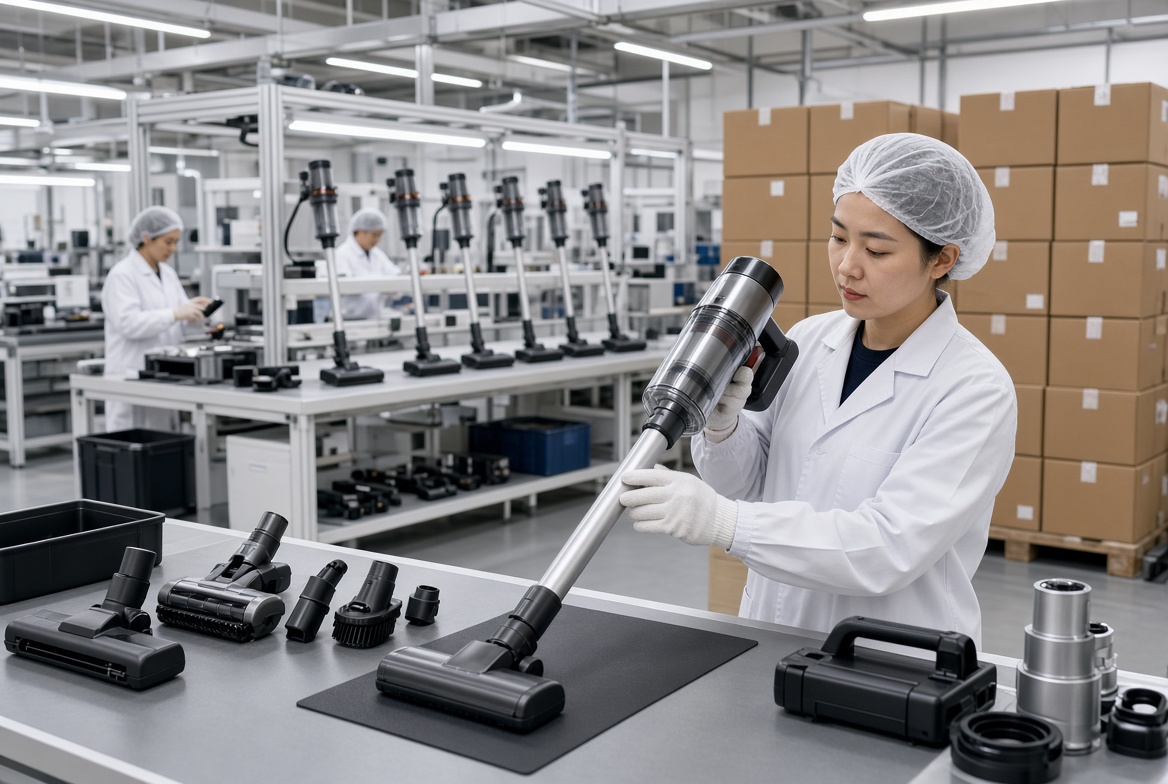
A reliable vacuum cleaner manufacturing program should include controlled assembly processes, functional inspections, component consistency, and clear communication throughout production. These elements help importers, distributors, and retailers manage inventory planning and protect their customer experience.
Vacuum cleaners are long-use consumer products. Filters, batteries, brush rolls, chargers, and tools may require replacement over time. Planning for these parts from the beginning helps brands build better customer loyalty and reduce avoidable support issues.
For global buyers, after-sales support should be considered during product development—not after the first shipment. This includes spare-parts availability, product documentation, maintenance guidance, and packaging designed to protect the product during transportation.
The cordless stick vacuum with the "strongest suction" is not always the best choice. The best model combines effective airflow, a suitable motorized floor head, practical runtime, filtration, anti-tangle performance, comfortable handling, and dependable after-sales support.
For consumers, evaluate vacuums based on how they clean your actual floors and how long they run in normal use. For retailers and private-label brands, choose a product partner that understands the complete cleaning system—not just a single suction number.
If you are sourcing upright, handheld, corded, or cordless vacuum cleaner products for your business, Ningbo Eyunhome Electric Technology Co., Ltd. can help you develop a market-ready OEM/ODM solution that fits your target customers, positioning, and sales channel. Contact our team to discuss your vacuum cleaner project, request product information, or explore customized private-label options.
Strong suction depends on how it is measured and how the vacuum is designed. Rather than focusing on one number, look for a combination of sufficient suction pressure, efficient airflow, a motorized brush roll, and a well-designed floor head. These factors together determine real debris pickup.
No. A higher kPa rating indicates stronger suction pressure, but it does not fully show how well a vacuum moves debris through the floor head and into the bin. Airflow, brush-roll agitation, nozzle design, filtration, and sealing are also important.
It depends on the power setting and cleaning task. Low-power claims can be much longer than real carpet-cleaning time with a motorized head. For everyday use, buyers should compare runtime at normal power with the floor head attached and consider removable batteries for larger homes.
Yes, if they include the right features. Look for strong airflow, a motorized floor head, anti-tangle brush-roll technology, a mini motorized tool for upholstery, and a filtration system designed to capture fine dust and dander.
Cordless vacuums offer portability, fast daily cleaning, and easier access to stairs, cars, and tight spaces. Corded vacuums generally offer unlimited runtime and can be better for extended whole-home cleaning. The best choice depends on home size, flooring, and cleaning routine.
Ask about testing methods, battery configuration, motor options, quality control, customization scope, certifications for the destination market, packaging, spare parts, production lead times, and after-sales support. Request samples and evaluate real cleaning performance before placing a large order.
Common causes include clogged filters, a full dust bin, hair wrapped around the brush roll, blocked air passages, or a battery that no longer holds the same charge. Regular filter cleaning and brush-roll maintenance help preserve performance.
- [Eureka — Which Cordless Stick Vacuum Has the Strongest Suction?]
- [IEC 62885-2:2026 — Surface Cleaning Appliances: Performance Measurement for Vacuum Cleaners]
- [IEC 62885-4:2020 + Amendment 1:2023 — Performance Measurement for Cordless Dry Vacuum Cleaners]
- [Consumer Reports — Best Stick Vacuums]
- [Consumer Reports — Cordless Stick Vacuums With the Best Battery Life]
- [Consumer Reports — Dyson V15 Detect Review]


