
Views: 218 Author: Eyunhome Vacuum Publish Time: 2026-11-26 Origin: Site


Content Menu
● Budget Cordless Vacuum vs High-End Cordless Vacuum at a Glance
● Cleaning Performance: Compare Pickup, Not Just Suction Claims
>> Why the Largest Suction Number Does Not Automatically Win
>> Hard Floors, Carpets, and Pet Hair Need Different Tests
● Battery Life: Advertised Runtime vs Useful Cleaning Time
>> Compare Equivalent Operating Conditions
>> Replacement Access Can Matter More Than Extra Minutes
● Filtration: Evaluate the Whole Vacuum
>> A Filter Label Is Only Part of the Story
>> Emptying Also Deserves Attention
● Ergonomics, Noise, and Everyday Convenience
● Durability, Maintenance, and After-Sales Support
● A Five-Step Cordless Vacuum Sample Evaluation
>> Step 1: Define the Intended Cleaning Job
>> Step 2: Create Matching Conditions
>> Step 3: Record Performance and Effort
>> Step 4: Repeat After Controlled Use
>> Step 5: Turn Findings Into Acceptance Criteria
● Compare Total Ownership Cost, Not Purchase Price Alone
● OEM/ODM Strategy: Build Around a Customer, Not a Feature List
>> Designing a Value-Focused Range
● Which Cordless Vacuum Should You Choose?
>> 1. Are Budget Cordless Vacuums Worth Buying?
>> 2. Do High-End Cordless Vacuums Always Have Better Suction?
>> 3. Which Cordless Vacuum Is Better for Pet Hair?
>> 4. How Much Battery Runtime Do I Need?
>> 5. Is a Replaceable Battery Worth Paying For?
>> 6. What Should Importers Request From a Manufacturer?
Choosing between a budget cordless vacuum and a high-end cordless vacuum is not simply about buying less or spending more. It is about matching cleaning performance, battery usability, filtration, and maintenance costs to the job. An affordable model may suit quick apartment cleanups, while a premium machine may justify its price through better carpet pickup, more useful attachments, or easier maintenance.
For retailers, distributors, and private-label brands, the comparison also raises a commercial question: which features create genuine customer value?
At Ningbo Eyunhome Electric Technology Co., Ltd., we approach this decision from a product-planning perspective. Rather than treating price as proof of quality, we recommend comparing measurable performance against clearly defined customer needs.
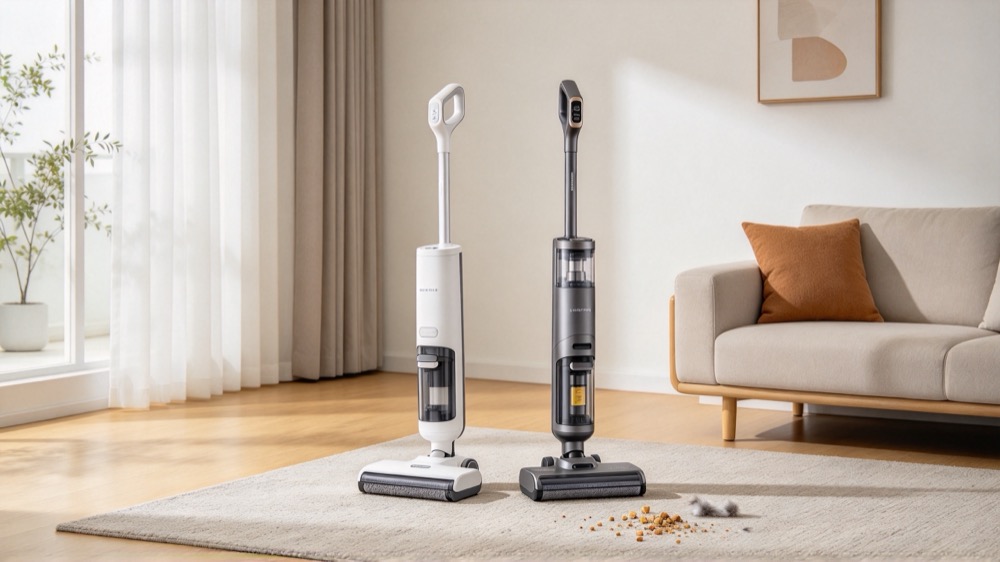
"Budget" and "high-end" are market positions, not standardized technical categories. Prices vary by country, promotion, accessories, and distribution channel.
The following table describes common positioning differences—not guaranteed features.
| Comparison factor | Budget cordless vacuum | High-end cordless vacuum |
|---|---|---|
| Main appeal | Accessible price and everyday convenience | Broader capability and added convenience |
| Cleaning performance | May suit lighter, targeted tasks | May offer stronger performance across difficult surfaces |
| Battery usability | Check working runtime and replacement options | May include better runtime management or battery options |
| Filtration | Effective filtration is possible; verify evidence | Sealed filtration may be available; still verify |
| Floorhead design | Often simpler or less specialized | May include specialized rollers and floor detection |
| Accessories | Usually a smaller selection | May include powered upholstery tools |
| Controls | Basic settings and indicators | May add automatic adjustment and detailed displays |
| Ownership costs | Lower initial purchase price | Higher initial cost; long-term value varies |
| Best buying approach | Protect essential performance | Pay for benefits customers actually use |
Independent testing shows considerable overlap between price tiers. Some inexpensive models provide effective particle filtration, while some costlier models offer advantages primarily in cleaning versatility or convenience.
My first comparison question would be: "How much debris does this vacuum remove from the intended surface?"
A prominent suction figure cannot answer that alone. Buyers should also examine floorhead design, brush agitation, airflow through the assembled machine, and performance with different debris.
Avoid treating motor input watts, pressure in pascals, and air watts as interchangeable measurements. When comparing supplier specifications, request the measurement method and test conditions.
For commercial buyers, demonstrated pickup is a more useful purchasing requirement than an isolated headline number.
A cordless vacuum for hard floors should collect fine dust and larger particles without excessive scattering.
Carpet adds another challenge: debris can become embedded within fibers. Pet hair also demands attention to brush design, upholstery tools, and how easily wrapped hair can be removed.
A useful comparison includes:
- Fine dust and larger debris on hard flooring.
- Embedded material on representative carpet.
- Pet hair on flooring and upholstery.
- Edge cleaning near skirting boards.
- Performance after a controlled amount of dust loading.
A premium model deserves its higher price when it produces a meaningful improvement in the tasks the customer performs—not simply because it has more settings.
Maximum runtime is not the same as runtime during demanding cleaning.
Independent reviews illustrate how sharply battery life can change between low-power and maximum-power settings. One reviewed premium stick vacuum exceeded an hour on its lowest setting but lasted approximately seven minutes at its strongest setting.
That is a model-specific result, not a rule for every premium vacuum. It demonstrates why an "up to" claim needs context.
Ask for runtime measured with:
1. The supplied powered floorhead attached.
2. Each relevant power mode identified.
3. The test surface specified.
4. A fully charged battery.
5. A documented stopping point.
For a budget cordless vacuum vs high-end cordless vacuum comparison, usable runtime under matching conditions matters more than the largest number on the packaging.
Check whether the battery is removable, replaceable through service, or unavailable separately.
A removable battery creates an opportunity to extend cleaning time, but only if compatible replacements remain obtainable.
Before buying or sourcing, establish:
- Replacement battery price.
- Ordering and delivery arrangements.
- Compatibility identification.
- Battery warranty terms.
- Expected parts-support period.
Do not assume that a higher selling price guarantees affordable replacement batteries.
Fine-particle control depends on more than the filter installed inside the machine.
Independent filtration research identifies secure seals and multiple filtration stages as important contributors to particle containment. A well-performing filter cannot compensate fully for leakage elsewhere in the airflow path.
For households concerned about airborne dust, request whole-machine particle-emission evidence where available.
Avoid presenting a filter specification as proof that the assembled vacuum achieves identical performance.
A vacuum can contain particles effectively during operation yet expose users to dust when its bin is emptied.
Assess whether the dust cup releases debris cleanly, whether users must pull out trapped hair, and whether filters can be removed without unnecessary contact.
Premium pricing does not eliminate these questions. Equally, an affordable vacuum should not be dismissed without examining its actual filtration results.
A vacuum that feels awkward may discourage regular cleaning, regardless of its specifications.
During sample evaluation, I would check:
- Grip comfort and wrist position.
- Balance during floor and above-floor cleaning.
- Steering around furniture.
- Access beneath beds and sofas.
- Trigger operation versus continuous-running controls.
- Dustbin removal and reinstallation.
- Storage stability and charging access.
Weight alone is insufficient. Compare the complete working configuration and ask several users to handle it.
Noise also requires fair measurement. Compare products under equivalent operating conditions, with the measurement method disclosed. International test methods address noise from cordless vacuum cleaners, including operation on carpet and hard flooring.
Treat quieter operation as a verified benefit, not an assumption about price.
The budget-versus-premium decision continues after checkout.
Before approving either category, inspect routine maintenance:
- Can the brushroll be removed easily?
- Are filters clearly identified?
- Are replacement accessories available?
- Can users clear common blockages?
- Are maintenance instructions understandable?
- Who handles warranty claims in the destination market?
Separate written commitments from broad promises such as "long-lasting" or "maintenance-free."
For importers, request a parts list and agree on support responsibilities before production. A low purchase price loses its appeal if a minor component failure makes the entire product unusable.
A premium product also needs a credible service plan; appearance and packaging are not substitutes.
A structured sample comparison helps both household buyers and sourcing teams avoid decisions driven by demonstrations alone.
This is a practical screening procedure, not a substitute for laboratory testing.
Specify floor types, cleaning frequency, pet ownership, storage constraints, and expected session length.
For business buyers, describe the target customer rather than requesting a vague "best-selling configuration."
Use equivalent debris quantities, floor areas, cleaning passes, and starting battery conditions.
Document the selected mode and attachment for each machine.
Measure collected debris where practical. Also record missed material, scattering, repeated passes, and hair wrapping.
A product that needs substantially more passes may offer less practical value despite an attractive specification.
Repeat selected tests after a documented dust load and normal maintenance.
Keep the loading procedure consistent. Otherwise, differences may reflect unequal conditions rather than product capability.
Convert the results into requirements for pickup, working runtime, maintenance access, packaging, and spare parts.
For formal verification, specify the applicable standard and edition with the laboratory. IEC 62885-2:2026 covers performance measurement for both mains-operated and cordless dry vacuum cleaners.
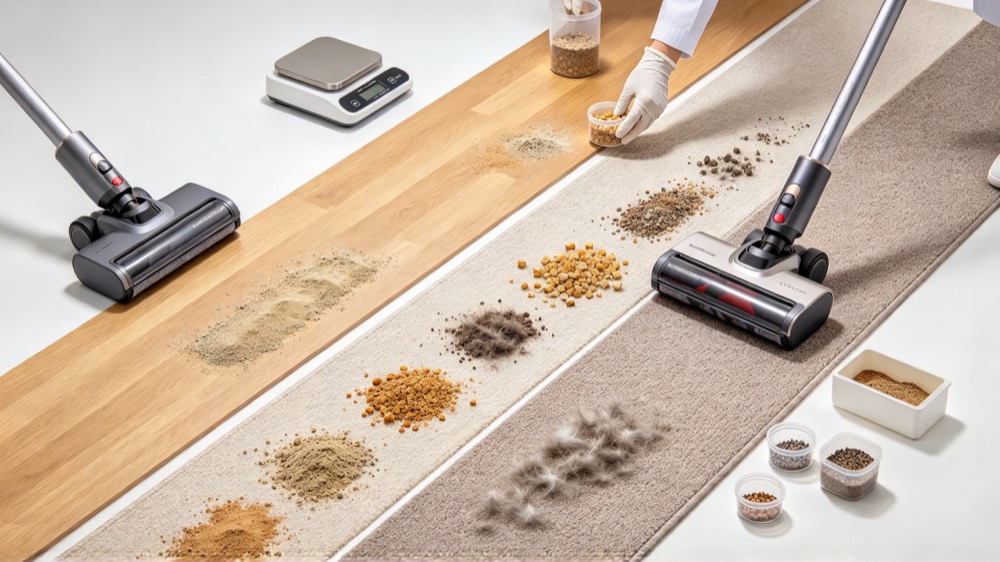
Total ownership cost provides a clearer framework:
Purchase price + replacement batteries + filters and parts + service costs.
Consider this hypothetical three-year comparison:
| Illustrative expense | Budget model | High-end model |
|---|---|---|
| Initial purchase | $150 | $500 |
| Replacement battery | $60 | $100 |
| Filters and maintenance parts | $45 | $60 |
| Total | $255 | $660 |
These figures are illustrative assumptions, not market averages, quotations, or lifespan predictions. Electricity, labor, downtime, and unexpected repairs are excluded.
The premium model costs $405 more in this example. Whether that difference is worthwhile depends on demonstrated benefits.
For a household, those benefits might include easier pet-hair removal. For a retailer, they might support a differentiated product offering. Neither outcome should be assumed without evidence.
For private-label brands, choosing a cordless vacuum manufacturer starts with defining the intended product position.
For an entry-level range, I would prioritize:
- Reliable pickup on the intended flooring.
- Honest, reproducible runtime claims.
- Simple controls and maintenance.
- Clearly documented filtration.
- Accessible consumables and service parts.
Decorative displays should not displace essential performance within a limited product budget.
For a premium range, additional investment should address identifiable customer problems.
Potential priorities include specialized floorheads, easier hair removal, better battery usability, refined handling, and verified particle containment.
Request a clear explanation of what each upgrade changes. A more expensive component is commercially useful only when it contributes to a benefit customers recognize.
Ningbo Eyunhome Electric Technology Co., Ltd. provides upright, handheld, corded, and cordless vacuum solutions with OEM/ODM services. Specific configurations, performance targets, production requirements, and after-sales arrangements should be confirmed during project development.
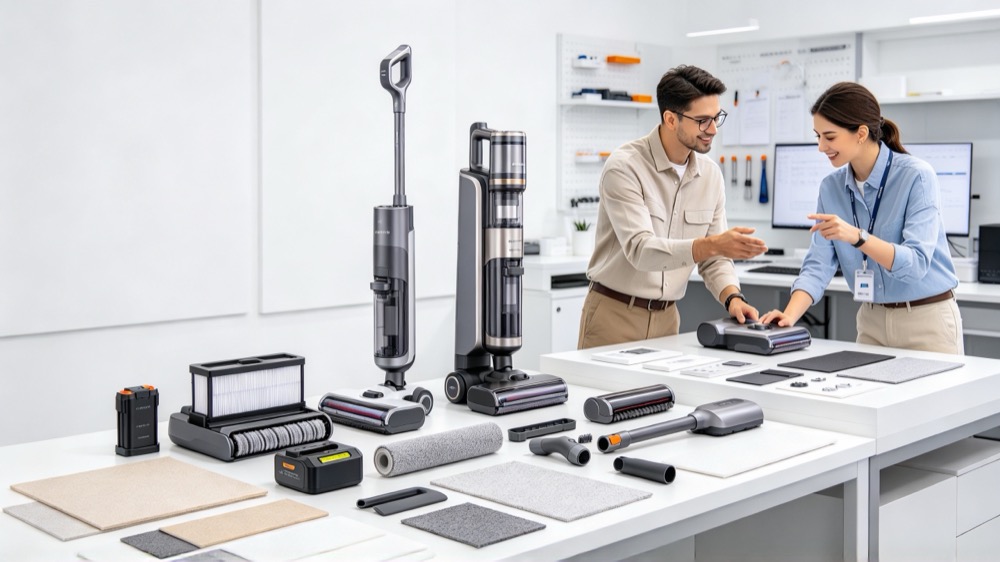
Choose a budget cordless vacuum when the intended tasks are straightforward and the specific model demonstrates acceptable pickup, runtime, filtration, and maintenance access.
Choose a high-end cordless vacuum when verified improvements solve recurring problems—such as difficult pet-hair removal, demanding mixed-floor cleaning, or inconvenient maintenance.
For sourcing teams, the strongest decision is a documented product brief followed by sample verification.
To develop your next range, contact Ningbo Eyunhome Electric Technology Co., Ltd. with your target market, retail price position, flooring requirements, preferred battery arrangement, and order volume. Request a configuration proposal, sample-evaluation plan, and written after-sales terms before finalizing the specification.
Yes, when the individual model meets the intended cleaning requirements. Compare demonstrated pickup, usable runtime, filtration, and parts access rather than assuming every affordable model performs alike.
Do not assume so from price alone. Compare measurements made under equivalent conditions, then examine actual debris pickup. A suction figure does not describe every aspect of cleaning performance.
Prioritize verified hair pickup, suitable powered tools, and easy brushroll cleaning. If airborne particles are a concern, assess filtration separately from hair-removal performance.
Measure your typical cleaning session, then compare runtime using the intended attachment and power mode. Maximum-runtime advertising may describe a less demanding operating condition.
It can be valuable for longer sessions and future servicing. Confirm replacement availability, price, compatibility, and warranty terms before treating it as a meaningful advantage.
Request a detailed specification, documented test conditions, representative samples, packaging requirements, warranty responsibilities, and spare-parts arrangements. Agree on production acceptance criteria before placing the order.
1. [RTINGS — The Best Cordless Vacuums]. Independent comparisons covering cleaning performance, battery life, filtration, and portability; supports the model-specific evaluation approach. [rtings]
2. [RTINGS — The Best Stick Vacuums]. Provides comparative findings on handling, floor pickup, and the difference between low-power and maximum-power runtime. [rtings]
3. [RTINGS — Bagged Vacuums Keep Your Air Cleaner: Vacuum Filtration Research]. Supports discussion of sealing, filtration stages, and particle containment during operation. [rtings]
4. [IEC — IEC 62885-2:2026]. Official scope and revision details for household dry-vacuum performance measurement, including cordless products. [webstore.iec]
5. [IEC — IEC 60704-2-1:2026 EXV]. Official description of airborne-noise measurement for mains-operated and cordless vacuum cleaners. [webstore.iec]


