
Views: 298 Author: Eyunhome Vacuum Publish Time: 2026-11-23 Origin: Site


Content Menu
● France's Vacuum Cleaner Market: Why Buyers Should Pay Attention
>> Where France's Industrial Strength Actually Lies
● How These Suppliers Were Selected
● 1. Ningbo Eyunhome Electric Technology Co., Ltd.
>> China-Based OEM/ODM Option for Brands Supplying France
>> Core Strengths and Product Fit
>> Markets, Quality Claims, and Verification
>> Established Consumer Brand with Documented French Manufacturing
>> Core Strengths and Market Focus
>> OEM/ODM Scope and Limitations
>> Broad Cleaning-Equipment Supplier for Consumer and Professional Buyers
>> Core Strengths and Market Focus
>> OEM/ODM Scope and Limitations
>> Professional and Industrial Cleaning Specialist
>> Core Strengths and Market Focus
>> OEM/ODM Scope and Limitations
● 5. Numatic International / Numatic France
>> Commercial Vacuum Cleaner Manufacturer with a French Support Presence
>> Core Strengths and Market Focus
>> OEM/ODM Scope and Limitations
● Supplier Comparison: Capacity, MOQ, and Compliance Evidence
● Technical Buyer's Guide: What to Verify Before Ordering
>> 1. Compare Cleaning Performance Under the Same Conditions
>> 2. Specify Materials and Components, Not Just Appearance
>> 3. Review Compliance as a Model-Specific Evidence Package
>> 4. Build French Repairability Requirements into Development
>> 5. Audit the Factory and Approve a Controlled Sample
● Common Procurement Pitfalls—and How to Avoid Them
>> Material or Component Substitution
>> Incomplete Compliance Files
>> Unrealistic Lead-Time Promises
>> Unclear After-Sales Responsibility
● An Overlooked Procurement Trap: The Approved Sample Without an Approved Configuration
● Logistics and Landed-Cost Planning
● Conclusion: Match the Supplier to the Procurement Model
>> 1. How Can We Verify Whether a Factory's ISO Certificate Has Expired or Been Suspended?
>> 2. Does a "CE Certificate" Mean Our Private-Label Vacuum Cleaner Is Ready for Sale in France?
>> 3. How Should We Negotiate MOQ When We Want a Small Launch but Extensive Customization?
>> 4. How Can We Prevent the First Bulk Shipment from Performing Worse Than the Sample?
>> 5. Can We Market a Vacuum Cleaner as French-Made Because We Buy It from a French Supplier?
France offers several sourcing routes for vacuum cleaner buyers: established consumer-appliance brands, international professional-cleaning suppliers with French operations, and overseas factories supporting private-label distribution into France. These routes serve different commercial objectives and should not be treated as interchangeable.
For purchasing managers, a strong supplier is not simply the company with the most recognizable name or the lowest quotation. The more useful questions concern manufacturing responsibility, product development capability, quality-control discipline, delivery reliability, regulatory documentation, and spare-parts support.
This guide compares five vacuum cleaner manufacturers and suppliers relevant to the French market. Ningbo Eyunhome Electric Technology Co., Ltd. appears first as a China-based OEM/ODM alternative for importers and developing brands. The remaining companies represent established branded supply channels serving France.
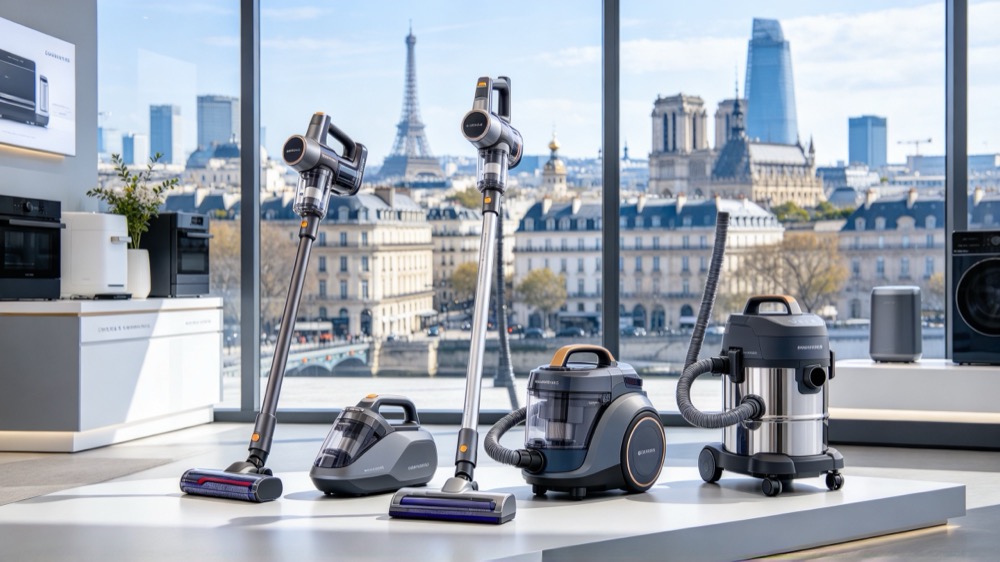
France remains an important market for floor-care appliances, with demand increasingly shaped by convenience, repairability, and multifunctional cleaning.
According to Gifam's February 2026 review, prepared with NielsenIQ-GfK, French small-appliance sales reached €4.41 billion in 2025, increasing 2.9% in value. Floor care represented approximately one-third of small-appliance market value and grew 9.2%. Within that category, vacuum-washer sales increased 66% in value, while robot vacuum sales grew 28%. These figures describe different market segments; they should not be presented as the growth rate of all vacuum cleaners.
Repairability is also commercially significant. Gifam reported that models scoring above 8.1/10 on the repairability index represented 52% of vacuum cleaner sales in 2025, compared with 46% in 2024. For buyers, this strengthens the case for evaluating replacement batteries, accessible filters, repair documentation, and component availability before selecting a product range.
France's vacuum cleaner ecosystem combines appliance engineering, selected domestic production, brand management, and professional distribution.
Vernon in Normandy provides a concrete example of domestic floor-care manufacturing: Groupe SEB identifies the site as the location where Rowenta's X-Ô vacuum cleaner was designed and manufactured. This is evidence for that product and site—not proof that every Rowenta vacuum cleaner is made in France.
The Paris region also supports international cleaning-equipment operations. Kärcher established its first foreign subsidiary in France in 1962, while Numatic established a subsidiary near Paris in 1995. These operations illustrate France's role as a sales and support base for international manufacturers.
Rather than describing France as one concentrated vacuum cleaner production cluster, buyers should distinguish domestic manufacturing locations from regional commercial and service networks.
This is a desk-researched procurement shortlist, not a factory-audit ranking. Company histories and published capabilities were reviewed alongside French industry data and official compliance information. No independent factory visits, production trials, or comparative laboratory tests are claimed.
The evaluation framework covers seven purchasing priorities:
| Selection criterion | Evidence buyers should request |
|---|---|
| Manufacturing identity | Legal entity, factory address, production responsibility, and subcontracting disclosure |
| Product development | Engineering ownership, tooling capability, prototype process, and design-change control |
| Quality management | Current certificates where applicable, inspection plans, traceability, and corrective-action records |
| Product performance | Comparable test conditions for pickup, airflow, runtime, noise, and filtration |
| Delivery reliability | Available capacity, component lead times, production-slot confirmation, and shipment history |
| Compliance readiness | Model-specific declarations, supporting reports, material documentation, and French-market information |
| After-sales support | Spare-parts terms, warranty workflow, repair guidance, and failure-analysis procedures |
A company's founding year or brand recognition can provide context, but neither substitutes for evidence covering the exact model being purchased.
Commercial details such as minimum order quantity, monthly production capacity, tooling charges, and private-label availability must be confirmed directly. Where reliable figures were unavailable, this guide leaves them undisclosed rather than estimating them.
Established: 2011
Location: Ningbo, Zhejiang, China
Supply route: Overseas manufacturing for importers, distributors, and private-label brands
Ningbo Eyunhome Electric Technology Co., Ltd. states that it was established in 2011 and operates from a 7,500-square-meter facility in Ningbo. Its company introduction emphasizes handheld vacuum cleaners and battery-powered cleaning products, together with engineering support and customized product suggestions.
For buyers researching vacuum cleaner suppliers in France, Eyunhome represents a different sourcing model from the branded companies below. It is not a French manufacturer; it is a potential manufacturing partner for businesses developing products for the French market.
Eyunhome's published information emphasizes rechargeable cleaning products, engineering involvement, personalized solutions, and responsive customer communication. These characteristics make it relevant to smaller and developing brands seeking direct discussion of product modifications rather than purchasing only an established brand's catalog. However, communication speed and development effectiveness should be tested during the quotation and sample stages.
The company's stated offering includes upright, handheld, corded, and cordless vacuum cleaner solutions. Its public introduction provides the clearest background for handheld and battery-powered products, so buyers should request current catalogs and production evidence for each additional category.
For an initial development brief, buyers can ask Eyunhome to assess:
- Housing colors, surface finishes, and branding.
- Accessory combinations and packaging.
- Battery configuration and charging arrangements.
- Performance targets and operating modes.
- French-language instructions and product labeling.
- Tooling changes, design ownership, and replacement-part support.
These are RFQ discussion points, not confirmation that every modification is available on every platform.
Eyunhome presents itself as serving customers across different countries and regions, but its introduction does not disclose a verified country-by-country sales breakdown. It also references an ISO 9000-based quality system and lists several product-compliance and audit-related claims. Buyers should request current documents for the correct legal entity, production address, and proposed model.
Importantly, BSCI is a social-compliance audit framework, not a product safety certificate. Likewise, a website's ISO 9000 wording should not be treated as proof of a current ISO 9001 certificate.
Eyunhome is worth evaluating when the objective is a cost-conscious private-label program with direct engineering communication and customization support. Whether it offers better value than competing factories can only be established through like-for-like quotations, approved samples, compliance review, and an initial production assessment.
Its published facility size should not be converted into an assumed monthly output. Request available capacity for the selected model and delivery period.
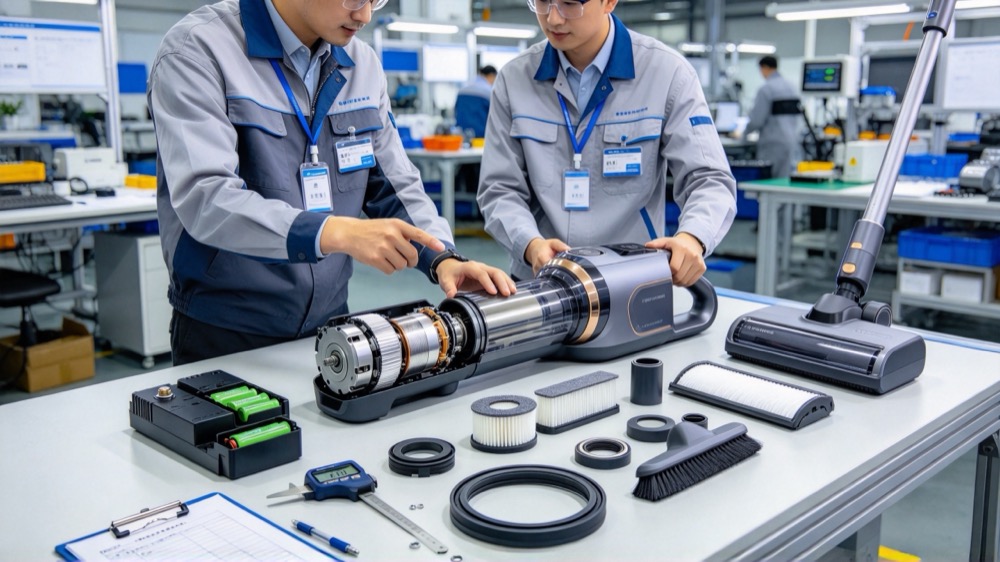
Brand established: 1909
Origin: Germany; part of France-based Groupe SEB
Supply route: Branded consumer appliances
Rowenta's history dates the brand's establishment to December 1909. Today, its relevance to French procurement includes its position within Groupe SEB and documented vacuum cleaner development and manufacturing at Vernon.
Rowenta is relevant to household-appliance retailers, distributors, and buyers prioritizing an established consumer brand. Its published floor-care history includes upright, wet-and-dry, compact, bagless, and cordless product development.
Repair support is a particularly useful purchasing consideration. Rowenta states that its 15-year repairability commitment applies to qualifying products, with the program extended from January 2022. Buyers should check the exact reference, market coverage, and conditions rather than interpreting this as an unconditional promise for every product or component.
The sources reviewed do not establish a general private-label OEM/ODM program for outside brands. Procurement discussions should therefore focus first on authorized distribution, branded product supply, territorial rights, and service arrangements.
For buyers seeking their own logo and proprietary industrial design, Rowenta is not a directly comparable sourcing route to a contract manufacturer.
Shortlist Rowenta when brand recognition, consumer positioning, and a documented repair-support framework are more important than deep private-label customization.
If French origin is part of the purchasing specification, verify the manufacturing origin of each model rather than relying on the group's nationality.
Company established: 1935
Origin: Germany
French subsidiary established: 1962
Supply route: Branded cleaning equipment and associated support
Kärcher was founded in 1935 and remains headquartered in Winnenden, Germany. Its French subsidiary, established in 1962, was the company's first foreign subsidiary.
Kärcher is relevant to buyers looking for a broader cleaning-equipment relationship rather than a standalone household vacuum cleaner transaction. Its established cleaning-technology background makes it a useful candidate for organizations evaluating multiple cleaning applications and equipment categories.
Purchasers should nevertheless evaluate the exact vacuum cleaner series against the application. A compact dry vacuum, a wet-and-dry machine, and a specialist dust extractor should not be compared solely by motor wattage or tank capacity.
The reviewed company material does not establish an open private-label manufacturing service. Treat Kärcher primarily as a branded procurement channel unless its commercial team confirms another arrangement in writing.
For France-based projects, request the applicable distribution terms, service coverage, parts availability, and any restrictions on cross-border resale.
Kärcher merits consideration for buyers seeking an established branded cleaning-equipment supplier with a long-standing French operation. Confirm model-level origin and documentation; a French sales organization does not imply French production.
Company established: 1906
Origin: Denmark
Supply route: Professional cleaning equipment supplied internationally, including France
Nilfisk traces its history to Copenhagen in 1906 and states that it supplies cleaning solutions to customers in more than 100 countries. Its development includes a long-standing focus on professional and industrial cleaning applications.
Nilfisk is particularly relevant to professional procurement. Its French-market vacuum offering includes commercial machines, wet-and-dry equipment, industrial vacuum cleaners, and specialist dust-control configurations. French distributor information also identifies models for safety classes and explosive-atmosphere applications. Such approvals must be checked against the exact machine configuration and intended use.
For factories and contractors, application fit matters more than appearance or advertised peak suction. Buyers should define the collected material, duty cycle, dust hazard, disposal process, and operating environment before requesting a quotation.
A general private-label manufacturing program was not established in the reviewed sources. Nilfisk should therefore be approached primarily as a branded equipment and application-support supplier.
Specialist equipment requires specialist documentation. A filter specification alone should not be accepted as proof that the complete machine is suitable for hazardous dust.
Nilfisk is a strong candidate for professional buyers whose purchasing decision depends on application suitability and documented equipment configuration rather than consumer styling or low-entry private-label orders.
Company established: 1969
Origin: United Kingdom
French subsidiary established: 1995
Supply route: Branded commercial cleaning equipment
Numatic was founded in Crewkerne, southwest England, in 1969, initially producing a commercial vacuum cleaner for boiler-cleaning applications. The company established a subsidiary near Paris in 1995 to support its overseas business.
Numatic's commercial-cleaning background makes it relevant to facilities-management buyers and distributors assessing equipment for repeated professional use. Its company history also identifies a dedicated international support structure that includes France.
For these buyers, procurement should extend beyond the machine price. Consumable availability, replacement accessories, repair procedures, and the ability to standardize equipment across sites can materially affect purchasing decisions.
The reviewed sources do not establish an open OEM/ODM program for unrelated private-label brands. Buyers should confirm branded distribution arrangements and any permitted customization directly.
Numatic is worth shortlisting for commercial vacuum cleaner procurement where service planning and repeat purchasing matter more than proprietary product development.
The company's 1969 founding date and its French subsidiary's 1995 establishment date describe different entities and should not be used interchangeably.
The table separates published facts from information that requires a supplier quotation or document review. "Not disclosed" means no reliable model-level figure was established from the sources reviewed; it does not mean that the supplier lacks capacity or certification.
| Supplier | Primary purchasing fit | Capacity information | MOQ | Certification and compliance position | OEM/ODM position |
|---|---|---|---|---|---|
| Ningbo Eyunhome | Private-label handheld and battery-powered products; wider range subject to confirmation | Published facility area: 7,500 m²; monthly output not disclosed | Request by platform and customization level | Website lists multiple compliance claims; verify current model reports and factory documents | Customization promoted; confirm engineering scope and commercial terms |
| Rowenta / Groupe SEB | Branded household floor care | Vernon production documented for X-Ô; available model capacity not disclosed | Request through the relevant commercial channel | Model-specific declarations and repairability conditions require review | No general external private-label program established |
| Kärcher | Branded consumer and professional cleaning equipment | Available vacuum cleaner capacity not established | Request by channel and order type | Request the exact model's declaration and supporting documentation | No open private-label program established |
| Nilfisk | Professional and industrial applications | Available model capacity not established | Request by configuration and project | Specialist approvals must match the complete configuration and application | No open private-label program established |
| Numatic | Commercial cleaning and repeat equipment procurement | Available model capacity not established | Request from the relevant sales channel | Request current model documentation and applicable approvals | No open private-label program established |
For contract manufacturing, ask suppliers to quote available monthly capacity after existing orders, not simply theoretical maximum output. For branded distribution, stock availability and replenishment lead time may be more useful than factory-wide production figures.
Avoid comparing vacuum cleaners using motor input power alone.
A useful technical specification should define:
- Dust pickup on the intended floor surfaces.
- Airflow and suction measured at stated locations.
- Performance with the floor head and filters installed.
- Runtime with the motorized brush operating.
- Noise under a defined operating mode.
- Performance as the dust container fills.
- Battery recharge time and thermal behavior.
Ask the supplier to identify the test method, equipment configuration, and acceptance limits. Treat figures measured under different conditions as non-comparable until proven otherwise.
For cordless products, request runtime at every operating mode. A low-power runtime figure is not an adequate substitute for runtime during the cleaning task your customer actually expects.
For an OEM project, the approved specification should identify critical material and component requirements.
Examples include:
- Housing resin grade and permitted substitutions.
- Dust-container material and impact requirements.
- Seals, latches, and accessory connection tolerances.
- Motor and control-board identification.
- Battery cell specification and protection functions.
- Filter construction and replacement compatibility.
- Cable, plug, and charger specifications.
Do not prescribe one plastic as universally superior. The appropriate material depends on mechanical load, temperature, chemical exposure, appearance, and the product's safety design.
Request material declarations and test evidence where relevant. For restricted substances, the European Commission's RoHS guidance explains that manufacturers must maintain technical documentation and address the applicable restrictions through the conformity-assessment process.
CE marking is not a universal third-party quality certificate. It represents the responsible manufacturer's declaration that the product meets applicable requirements and that the relevant conformity-assessment procedures have been completed.
Before committing to a shipment, request:
1. The EU Declaration of Conformity for the proposed model.
2. Supporting safety and electromagnetic-compatibility reports, as applicable.
3. RoHS technical documentation.
4. A model list linking the purchased version to the supporting reports.
5. Product labels, traceability markings, and French-language instructions.
6. A written assessment of any additional requirements relevant to batteries, wireless functions, packaging, or the chosen sales route.
Do not automatically apply the same legislation to a mains-powered vacuum cleaner, a low-voltage cordless unit, its charger, and a connected robot. Ask a qualified compliance specialist to assess the actual configuration.
Published vacuum cleaner declarations illustrate why the details matter: they identify specific models and list relevant legislation and standards rather than merely displaying a collection of certification logos.
France extended repairability-index requirements to household vacuum cleaners from 4 November 2022. Official information also emphasizes the need to communicate the index and its supporting calculation information through the supply chain.
For a private-label launch, ask early for:
- Disassembly information.
- Spare-parts lists and pricing.
- Parts-availability commitments.
- Repair documentation.
- The relevant scoring worksheet and supporting evidence.
- Clear responsibility for preparing and supplying the required information.
Leaving this work until the packaging stage can force changes to service arrangements, documentation, or product claims.
For a direct manufacturing relationship, use a staged process:
1. Verify the legal entity and production location.
2. Review development and quality-management procedures.
3. Obtain an engineering sample against a written brief.
4. Record requested changes and approve the revised specification.
5. Approve a production-intent sample.
6. Conduct a pilot order or initial production assessment.
7. Inspect mass production against agreed criteria.
The approved sample should have an identification number, configuration record, and documented acceptance results. Keep equivalent reference samples with both parties.
For an established branded supplier, adapt the process to focus on authorized distribution, reference verification, model documentation, and the service agreement.
A visually identical product may use different resin, battery cells, seals, motors, or filters.
Prevention: attach an approved component list to the purchase agreement, identify critical parts, and require written approval before substitutions.
A report may cover a different model, electrical rating, charger, or product revision.
Prevention: reconcile the quotation, product label, declaration, test reports, and shipped configuration before release.
A supplier may quote assembly time without accounting for customized packaging, tooling approval, or component procurement.
Prevention: request a milestone schedule separating material readiness, production, inspection, and dispatch.
A low purchase price can become expensive if replacement batteries, motors, or accessories are unavailable.
Prevention: agree spare-part pricing, warranty evidence requirements, technical response procedures, and responsibility for freight before the first order.
One of the most useful safeguards in vacuum cleaner procurement is also easy to overlook: approving a sample is not enough unless the production configuration is frozen.
A machine can retain the same external appearance while changes to its filter, seals, motor controller, battery cells, or brush assembly alter performance. The purchasing problem is therefore not only whether the sample works—it is whether future production remains equivalent.
Use a practical three-part control:
- Freeze the critical bill of materials and software or firmware version where relevant.
- Require a written engineering-change notice before changes to critical components.
- Select verification units from ordinary production, not only supplier-prepared samples.
Include a loaded-condition test in the acceptance plan. Ask the supplier to demonstrate performance with a defined quantity and type of collected material, rather than checking only a clean machine.
This is a proposed risk-control method, not a claim that any supplier in this guide makes unauthorized substitutions.
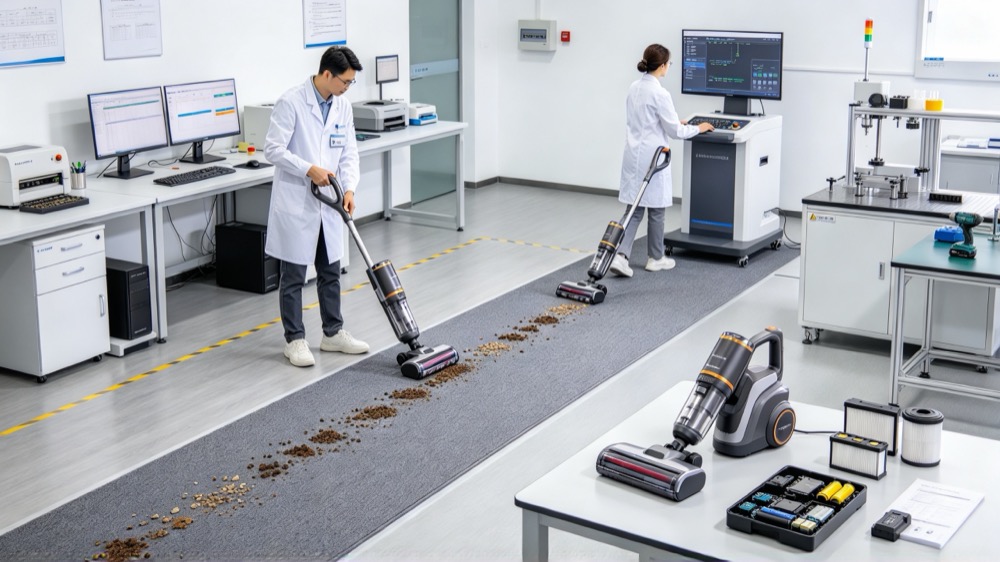
For imported vacuum cleaners, compare quotations using the same delivery basis and the same included scope.
Your landed-cost worksheet should separate:
- Product and accessory costs.
- Tooling and development charges.
- Packaging and labeling.
- Inspection and laboratory testing.
- Freight and insurance.
- Customs clearance and applicable duties.
- Local compliance and producer-responsibility costs.
- Spare-parts inventory and warranty handling.
For cordless shipments, obtain the battery documentation required by the carrier and freight forwarder before booking. Have the logistics provider confirm the classification and packaging requirements for the actual battery configuration and transport mode.
Also confirm pallet dimensions, carton strength, stacking limits, and replacement arrangements for transit damage. Do not assume a supplier's domestic packaging is suitable for your distribution network.
The right shortlist depends first on what your business is buying.
For branded household appliances, Rowenta offers an established consumer proposition with documented French manufacturing for selected products. Kärcher, Nilfisk, and Numatic provide different routes into branded professional or commercial cleaning procurement, supported by their respective histories and market structures.
For an own-brand range, Ningbo Eyunhome Electric Technology Co., Ltd. is a relevant manufacturing candidate to evaluate, particularly for handheld and battery-powered cleaning products. Its published engineering and customization emphasis provides a starting point—not a substitute for factory verification, sample testing, and commercial due diligence.
To begin a focused OEM/ODM discussion with Eyunhome, submit a brief covering product format, target retail price, order forecast, performance requirements, French-market documentation, packaging, and spare-parts expectations. Request a model-specific quotation and evidence package before negotiating a production commitment.
Request the complete certificate, not a cropped image. Check the legal entity, site address, standard, certification scope, certificate number, issue date, and expiry date.
Then verify its current status through the issuing certification body or its official verification service. A certificate can be suspended before its printed expiry date, so checking the date alone is insufficient.
For Eyunhome specifically, the public introduction's reference to an ISO 9000 system should trigger a request for the exact current certificate rather than an assumption about ISO 9001 certification.
No. Review the applicable conformity-assessment process, technical documentation, EU Declaration of Conformity, labeling, and market-specific obligations.
The European Commission explains that CE marking represents conformity with applicable requirements; it is not a substitute for the underlying technical file. A logo or standalone document cannot establish that the purchased configuration is compliant.
Have the responsibilities of the manufacturer, importer, and brand owner reviewed before launch.
Separate the order into customization layers.
Request individual minimums and charges for:
- A standard platform.
- Logo application.
- Custom color.
- Printed packaging.
- Modified accessories.
- Electrical changes.
- New tooling.
Ask which minimums arise from production efficiency and which come from component or packaging suppliers. A smaller initial order may be possible on an existing platform, while deeper changes may require separate development costs or commitments.
Avoid negotiating a single headline MOQ before the configuration is defined.
Approve a production-intent configuration, freeze critical components, and define measurable acceptance criteria.
Inspect randomly selected production units for performance, assembly quality, charging behavior, accessories, labels, and packaging. Use the same test conditions applied to the approved sample and retain samples from the shipment for later investigation.
For critical applications, agree in advance when independent laboratory testing is required.
Do not infer manufacturing origin from the supplier's address, brand ownership, or sales office.
Request model-specific origin information and obtain qualified advice before making origin claims. Groupe SEB's statement about X-Ô production at Vernon is a useful example of product-specific evidence; it should not be generalized to an entire catalog.
The same distinction applies to international suppliers with French subsidiaries: local commercial support and local manufacturing are different facts.
- Gifam and NielsenIQ-GfK, *2025 French Household Appliance Market Review*, published 12 February 2026. [gifam]
- Groupe SEB, *Rowenta X-Ô: Design and Manufacturing at Vernon*. [groupeseb]
- French Senate, *Repairability-Index Compliance: Government Response and Vacuum Cleaner Requirements*. [senat]
- European Commission, *RoHS 2: Frequently Asked Questions and Guidance*. [environment.ec.europa]
- French government open-data portal, *Corded Vacuum Cleaner Repairability-Index Dataset*. [data.gouv]
- Rowenta, *Company History* and *Repairability Commitment*. [rowenta]
- Kärcher, *Company Information* and *Corporate History*. [kaercher]
- Nilfisk, *Company History*. [nilfisk]
- Numatic International, *Company History*. [numatic]
- Ningbo Eyunhome Electric Technology Co., Ltd., *Company Introduction*. [eyunhome]


