
Views: 299 Author: Eyunhome Vacuum Publish Time: 2026-11-24 Origin: Site


Content Menu
● Compact Handheld Vacuum vs Multifunctional Stick Vacuum at a Glance
● What Is a Compact Handheld Vacuum?
>> Where a Compact Handheld Vacuum Works Best
>> Where Handheld Vacuums Have Limitations
● What Is a Multifunctional Stick Vacuum?
>> Where a Multifunctional Stick Vacuum Works Best
>> Where Multifunctional Stick Vacuums Have Limitations
● Cleaning Performance: Compare Pickup, Not Just Suction Claims
>> Why a Higher Suction Figure Is Not the Whole Answer
>> Hard Floors, Carpets, and Pet Hair
● Corded vs Cordless: A Separate Buying Decision
>> Cordless Convenience and Runtime Trade-Offs
>> When a Corded Vacuum Makes Sense
● Handling, Storage, and Maintenance
>> Weight Distribution Matters as Much as Weight
>> Dustbin Emptying and Filter Access
● Filtration: Assess the Complete System
>> What a HEPA Claim Establishes
● A Practical Five-Step Sample Evaluation
>> Step 1: Define the Customer's Main Task
>> Step 2: Standardize the Test Conditions
>> Step 3: Measure Useful Pickup
>> Step 4: Record Task-Based Runtime
>> Step 5: Inspect the After-Cleaning Experience
● Choosing the Right OEM/ODM Product Strategy
>> Position a Compact Handheld Vacuum Around Convenience
>> Position a Multifunctional Stick Vacuum Around Useful Versatility
>> Compare Total Ownership Costs
● Build a Vacuum Range Around Real Cleaning Needs
>> Can a compact handheld vacuum replace a stick vacuum?
>> Is a multifunctional stick vacuum always more powerful?
>> Which vacuum is better for cleaning a car?
>> Which type is better for pet hair?
>> Does a HEPA filter guarantee a sealed vacuum?
>> What should private-label buyers confirm before ordering?
A compact handheld vacuum is usually the better choice for quick, localized cleaning, while a multifunctional stick vacuum is better suited to regular floor cleaning and room-to-room versatility. For retailers, distributors, and private-label brands, the right choice depends on the cleaning problem your customers want to solve—not simply which product has more attachments.
At Ningbo Eyunhome Electric Technology Co., Ltd., we approach this comparison from a product-planning perspective: start with the intended task, then evaluate cleaning performance, handling, maintenance, and ownership costs.
This guide explains where each format delivers value, where compromises appear, and what business buyers should verify before selecting an OEM/ODM solution.
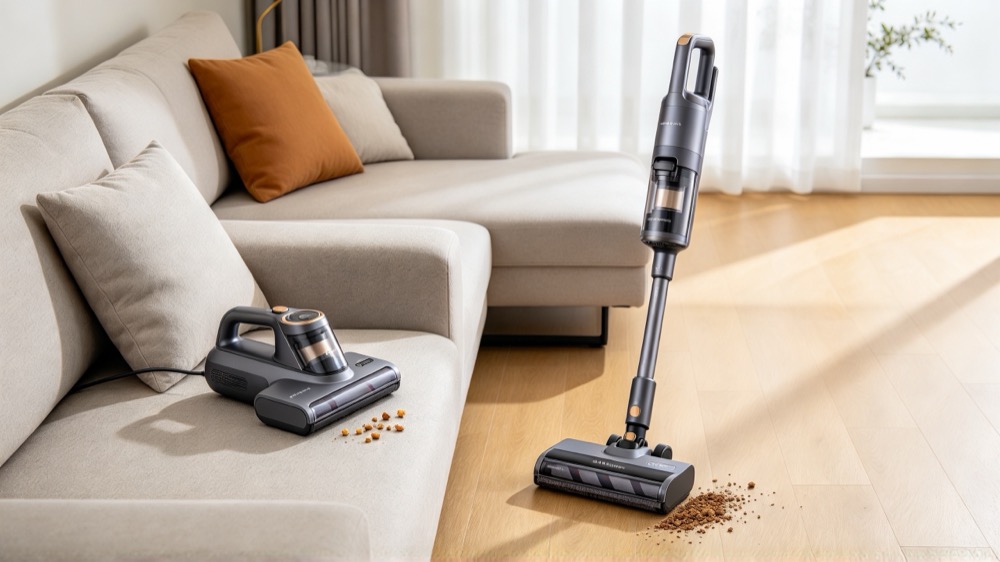
The main distinction is design priority. Handheld vacuums prioritize convenient spot cleaning. Multifunctional stick vacuums combine floor-cleaning reach with detachable tools or handheld conversion.
These categories overlap, but they are not interchangeable.
| Comparison factor | Compact handheld vacuum | Multifunctional stick vacuum |
|---|---|---|
| Primary purpose | Small, concentrated messes | Floors plus above-floor cleaning |
| Typical applications | Car interiors, upholstery, crumbs | Hard floors, rugs, stairs, furniture |
| Floor-cleaning convenience | Limited without an extension system | Designed around standing operation |
| Tight-space access | Often convenient with suitable nozzles | Depends on detached-body dimensions |
| Storage | Usually compact | Requires space for wand and floorhead |
| Attachments | Often a focused accessory set | Often a broader conversion system |
| Main trade-off | Limited floor coverage | More components and configuration changes |
| Best positioning | Convenient secondary cleaner | Versatile everyday cleaning system |
These are category tendencies, not guaranteed specifications. Buyers should compare complete configurations rather than assuming every product follows the same pattern.
A compact handheld vacuum integrates the motor, dust container, and handle into a unit intended to be carried during cleaning.
Its appeal is straightforward: users can address a small mess without assembling a floor-cleaning system.
Typical applications include:
- Crumbs on upholstered seating.
- Dirt around car seats and floor mats.
- Dust along furniture edges.
- Debris on stair treads.
- Small household spills involving dry materials.
For a handheld vacuum for car interiors, nozzle geometry matters considerably. A compact body may still struggle between seats if the tool is too short or the dust container obstructs access.
My starting question would therefore be: "Can the user reach the dirt comfortably?" Maximum suction means little if the nozzle cannot reach the cleaning area.
A dedicated handheld is generally inconvenient for cleaning an entire floor. Its narrow cleaning path and lack of a standing-height wand can increase effort.
Small dust containers may also require frequent emptying during larger jobs. For a brand, this makes clear positioning essential: sell convenient spot cleaning rather than implying full-home capability without supporting tests.
A multifunctional stick vacuum typically combines a main cleaning unit, extension wand, floorhead, and interchangeable accessories. Many models convert into handheld cleaners.
"Multifunctional" should describe useful configurations, not merely a high accessory count.
This format is well suited to customers seeking one system for:
- Routine hard-floor cleaning.
- Rugs and carpets, where the floorhead is suitable.
- Stair cleaning with a shorter configuration.
- Upholstery cleaning with an appropriate attachment.
- Reaching under furniture or toward elevated surfaces.
The attraction is continuity: users can move from floors to furniture without switching to a separate appliance.
Conversion does not automatically produce a comfortable handheld vacuum.
The detached motor unit may remain bulky around car seats or tiring during overhead work. Additional joints, tools, and powered attachments also create more components to store, maintain, and potentially replace.
Buyers should evaluate every advertised configuration independently.
Neither format wins automatically on cleaning performance. The result depends on the interaction between suction, airflow, nozzle design, brush action, and the surface being cleaned.
A pressure figure expressed in pascals or kilopascals describes one aspect of performance. It does not directly establish how effectively a vacuum removes crumbs, hair, or embedded dust.
Independent testing separates suction, airflow, and surface pickup because these measurements answer different questions.
When comparing supplier specifications, request:
- The measurement location.
- The operating mode.
- The attached nozzle or floorhead.
- The filter condition.
- The test method.
For product selection, I would prioritize repeatable pickup results over a large headline number.
On hard floors, check fine-dust pickup, larger debris collection, edge cleaning, and whether the floorhead pushes particles forward.
On carpets, evaluate the interaction between brush agitation and suction. A powerful motor cannot compensate for every unsuitable floorhead design.
For pet hair, test both floors and upholstery. Motorized upholstery tools can improve hair removal, but their usefulness depends on brush design, access, and maintenance.
A compact handheld vacuum with the right pet tool may outperform an awkward stick conversion on a sofa, even when the stick system is more versatile overall.
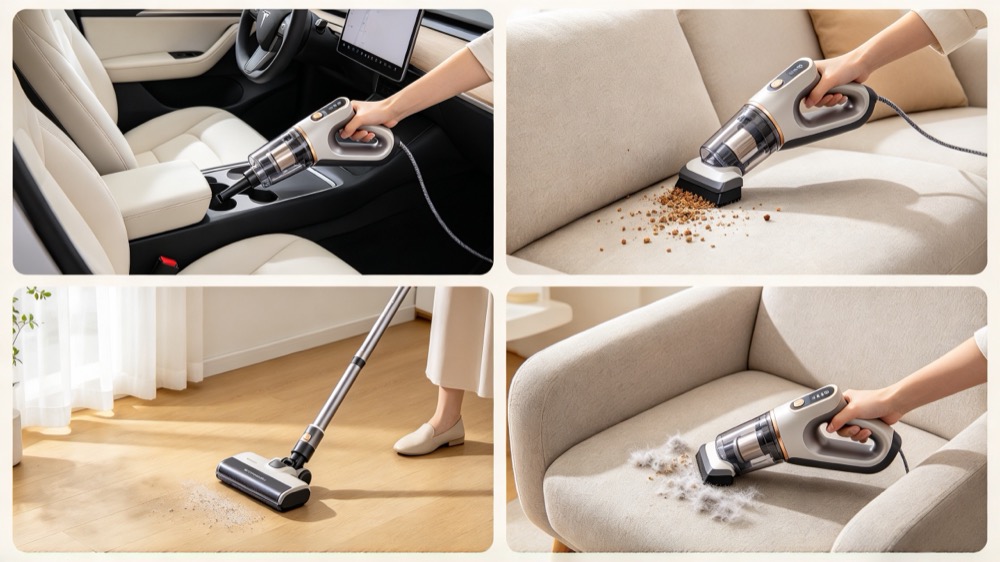
Handheld versus stick describes the product format. Corded versus cordless describes its power supply.
Keeping these decisions separate prevents misleading comparisons.
Cordless handheld and stick vacuums offer freedom from outlet positioning. However, battery duration changes with operating mode and attachment.
A maximum-runtime claim may describe low-power use without a powered floorhead. It should not be treated as the expected duration for demanding carpet cleaning.
Ask suppliers to specify:
- Runtime by power setting.
- Whether a powered tool was attached.
- Recharge time.
- Battery removability.
- Replacement battery availability.
For longer sessions, a replaceable battery can improve flexibility, provided approved compatible packs are available.
Corded products avoid battery-related cleaning interruptions. They may suit customers who prioritize longer sessions over unrestricted movement.
However, cord length and outlet access still affect convenience. Corded operation also does not guarantee superior pickup; the complete cleaning system remains decisive.
A vacuum that looks convenient on a specification sheet may feel different in daily use.
Total weight alone does not explain comfort. Handle shape, balance, trigger operation, and accessory reach influence how demanding a vacuum feels.
For sample evaluation, ask users to perform three tasks:
1. Clean a floor with the complete assembly.
2. Clean upholstery in handheld mode.
3. Reach an elevated surface with the intended attachment.
Record comfort separately for each task. This is particularly important when promoting a stick vacuum as an all-purpose system.
Compare how easily users can:
- Open and empty the dust container.
- Remove hair from the brushroll.
- Access filters.
- Reassemble components correctly.
- Obtain replacement consumables.
Follow model-specific maintenance instructions. A washable component should only be washed when the manual permits it and returned to service after the required drying process.
For brands, straightforward maintenance instructions can help prevent avoidable complaints and incorrect use.
Neither handheld nor stick construction guarantees better filtration.
The important distinction is between a filter's efficiency and the assembled vacuum's ability to contain collected particles.
The commonly cited HEPA benchmark is at least 99.97% removal efficiency for particles measuring 0.3 micrometers.
However, that filter specification alone does not prove equivalent whole-machine performance. Air leakage around seals or filter housings can undermine particle containment.
For buyers targeting dust-sensitive households, request documentation covering the exact product configuration. Avoid treating a filter label as proof of complete-system performance or promising medical outcomes.
Dustbin emptying also deserves attention because exposure can occur during disposal, not just operation.
The following is a proposed purchasing workflow, not a report of Eyunhome laboratory results.
It gives importers and private-label buyers a more useful basis for comparison than specifications alone.
Choose a clear priority, such as:
- Quick car-interior maintenance.
- Daily apartment floor cleaning.
- Pet-hair removal from furniture.
A product optimized for one task may be unnecessarily complicated for another.
Use matching surfaces, debris quantities, operating modes, and cleaning passes.
For cordless samples, begin with fully charged batteries and record the attached tool. Repeat tests rather than relying on a single demonstration.
Weigh the debris applied and the debris remaining after the defined cleaning sequence.
A simple comparison is:
Pickup percentage = (debris applied − debris remaining) ÷ debris applied × 100.
Use suitable measuring equipment and repeatable collection methods. This internal comparison should not be presented as a certified result unless independently validated.
Measure whether the vacuum completes the intended task, not merely how long its motor runs.
A shorter advertised runtime may still be adequate for localized car cleaning, while a floor-cleaning product needs evaluation with its actual floorhead.
Empty the bin, remove wrapped hair, inspect filters, and store every accessory.
This final step reveals practical inconveniences that a short sales demonstration may overlook.
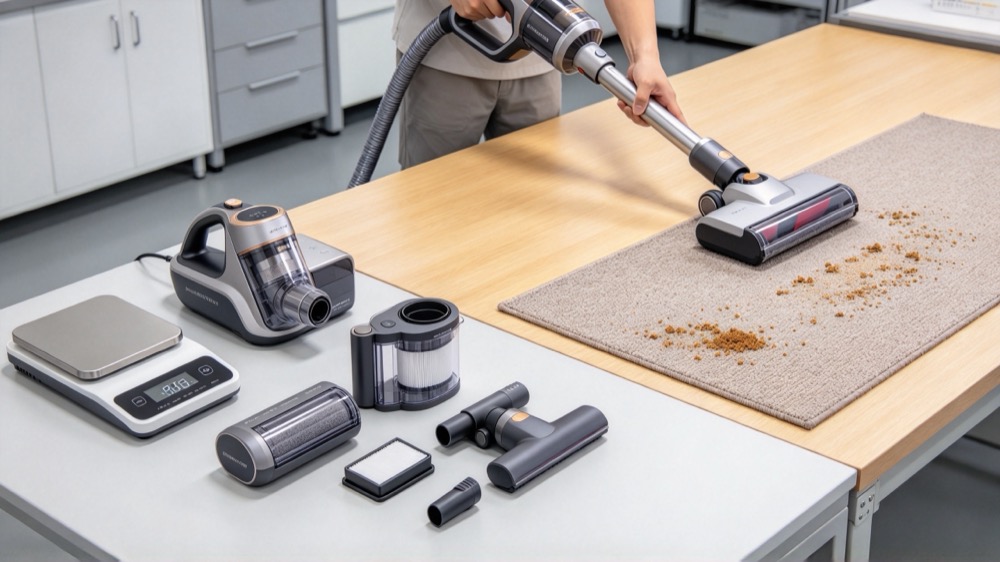
For business buyers, the best vacuum is the one that aligns customer expectations with a repeatable product specification.
A focused handheld range can serve customers who already own a primary floor cleaner.
Its proposition should emphasize a defined benefit: accessible car cleaning, fast crumb pickup, or convenient upholstery maintenance.
Choose accessories that support that benefit rather than adding tools without a clear purpose.
A stick range suits customers seeking broader cleaning coverage from one system.
Differentiate configurations through meaningful choices:
- Floorhead suitability.
- Handheld handling.
- Battery options.
- Storage arrangements.
- Maintenance access.
- Replacement-part support.
A larger accessory bundle is valuable only when customers can use and store it comfortably.
Look beyond the purchase price.
Request information on replacement filters, batteries, brushrolls, chargers, warranty procedures, and spare-part availability. Also confirm packaging dimensions and accessory contents before comparing quotations.
Two similar-looking products may create very different after-sales requirements.
Choose a compact handheld vacuum when localized cleaning and easy access are the priorities. Choose a multifunctional stick vacuum when customers need standing-height floor cleaning with useful conversion options.
Ningbo Eyunhome Electric Technology Co., Ltd. offers upright, handheld, corded, and cordless vacuum solutions, supported by OEM/ODM services, stable production, and after-sales support.
Send our team your target market, intended cleaning applications, preferred power format, accessory requirements, and expected order volume. Request a model-specific proposal and samples so you can evaluate performance before finalizing your range.
Usually not for regular floor cleaning. A handheld is better positioned for localized tasks, while a stick vacuum provides a wand and floorhead for standing operation.
No. Product format does not establish cleaning performance. Compare pickup results, airflow, suction measurements, and tool suitability under matching conditions.
A compact handheld often offers convenient access. However, a stick vacuum's detached unit may also work well if its dimensions, hose, and crevice tools suit the interior.
The attachment and surface matter more than the category alone. Evaluate floor pickup, upholstery performance, brush tangling, and the ease of removing collected hair.
No. Filter efficiency and whole-machine containment are different. Request evidence for the assembled product rather than relying exclusively on the filter specification.
Confirm the approved specification, runtime conditions, included accessories, destination-market requirements, packaging, warranty terms, and replacement-part arrangements. Use approved samples as the reference for production expectations.
1. U.S. Environmental Protection Agency. ["What Is a HEPA Filter?"] Explains the HEPA filtration benchmark and the significance of the 0.3-micrometer particle size. [epa]
2. U.S. Environmental Protection Agency. ["Frequent Questions About Work Practice Standards Under the RRP Rule."] Provides a whole-machine HEPA vacuum definition in the specific context of renovation-dust requirements; used here only to explain filter bypass and containment. [epa]
3. RTINGS. ["Our Vacuum Design Tests: Battery."] Describes runtime testing at different power settings and with specified attachments, plus recharge-time measurement. [rtings]
4. RTINGS. ["The Best Vacuum Cleaners With Good Suction."] Supports distinguishing suction measurements, airflow, and cleaning performance across surfaces. [rtings]
5. RTINGS. ["The Best Cordless Vacuums for Pet Hair."] Discusses pet-hair attachments and the trade-off between operating power and battery duration. [rtings]
6. RTINGS. ["The Best Stick Vacuums."] Discusses stick-vacuum configurations, runtime limitations, and replaceable-battery considerations. [rtings]


