
Views: 264 Author: Eyunhome Vacuum Publish Time: 2026-11-21 Origin: Site


Content Menu
● What Single SKU and Multi-SKU Mean for Vacuum Products
>> Single-SKU Vacuum Product Strategy
>> Multi-SKU Vacuum Product Strategy
● Single SKU vs Multi-SKU Vacuum Product Strategy: Comparison Table
● When a Single-SKU Vacuum Strategy Works Best
>> Launching into an Unproven Market
>> Protecting Limited Working Capital
● When a Multi-SKU Vacuum Strategy Creates More Value
>> Serving Genuinely Different Cleaning Needs
>> Supporting Different Channels and Price Tiers
● Compare Total Profit, Not Just Factory Prices
>> Build a Contribution Model for Every SKU
>> Illustrative Break-Even Example
● The Hidden Risk: One Platform Can Become Many SKUs
>> Control Variants Before They Multiply
● A Practical Alternative: One Core Platform, Controlled Expansion
>> Stage 1: Validate the Core Configuration
>> Stage 2: Add One Distinct Extension
>> Stage 3: Review Component Commonality
● Cordless Vacuum Portfolios Need a Battery Lifecycle Plan
● A Six-Step Vacuum Assortment Planning Process
>> 1. Define the Primary Customer
>> 2. Separate Essential Features from Optional Variations
>> 3. Confirm Minimums and Lead Times
>> 4. Compare Conservative Demand Scenarios
>> 5. Prepare Service Before Shipment
>> 6. Set Expansion and Retirement Rules
● Planning Your Range with Ningbo Eyunhome
>> Is a single-SKU strategy better for a new vacuum brand?
>> How many vacuum SKUs should a distributor launch?
>> Can one vacuum model have multiple SKUs?
>> Does a multi-SKU strategy always increase inventory?
>> How can a brand reduce cannibalization between vacuum models?
>> What should buyers confirm with an OEM/ODM vacuum manufacturer?
A single SKU vacuum product strategy concentrates your investment on one sellable configuration. A multi-SKU vacuum product strategy spreads it across several. For vacuum brands, importers, and distributors, the better choice depends on demand certainty, working capital, channel requirements, and after-sales capacity—not simply catalog size.
My recommendation is to start with the smallest assortment that serves a clearly defined customer need, then expand when another product can generate incremental profit rather than redistribute existing sales.
For businesses sourcing upright, handheld, corded, or cordless vacuums, this guide compares both approaches and explains how to build a commercially sustainable range with an OEM/ODM manufacturing partner.
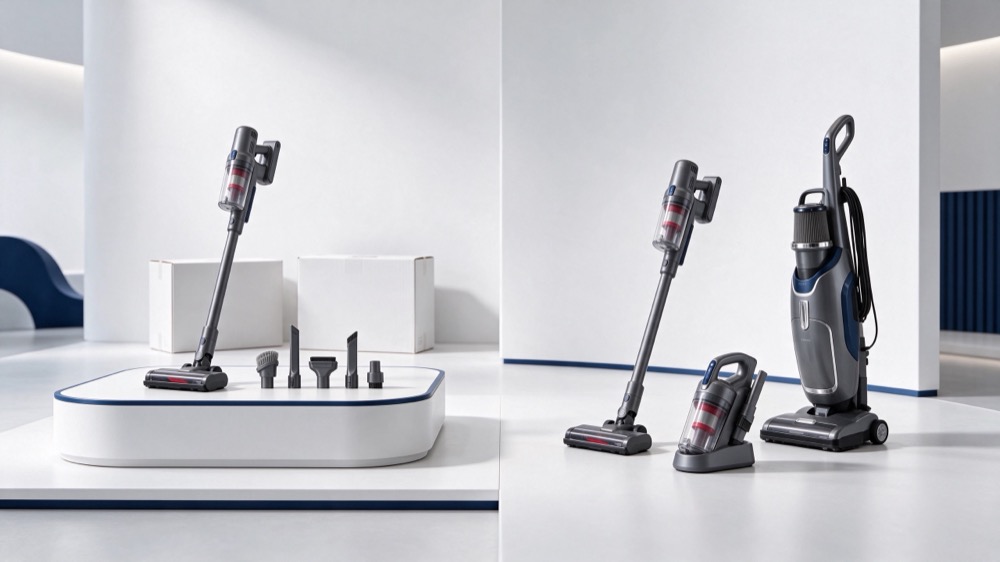
A stock keeping unit, or SKU, identifies a separately managed inventory item. It is not necessarily the same as a product model.
One cordless vacuum platform might generate several SKUs through different battery configurations, accessory bundles, colors, or market-specific electrical versions.
A single-SKU strategy offers one defined configuration to a target market: for example, one cordless stick vacuum with a specified battery, floorhead, accessory set, and packaging format.
This concentrates purchasing, inventory, product messaging, and customer-support preparation.
However, selling the "same model" in several countries may still require separate SKUs for plugs, chargers, labeling, or instructions.
A multi-SKU strategy offers multiple configurations or models to address distinct purchasing needs.
A range might include:
- A corded upright for extended cleaning sessions.
- A cordless stick vacuum for everyday convenience.
- A handheld vacuum for compact cleanup tasks.
- A premium bundle with additional compatible accessories.
The critical distinction is meaningful choice. Four nearly identical products do not automatically create four valuable customer propositions.
| Decision factor | Single-SKU approach | Multi-SKU approach |
|---|---|---|
| Initial investment | Concentrated in one configuration | Distributed across several configurations |
| Demand forecasting | Fewer forecasts to manage | Requires SKU-level demand planning |
| Minimum orders | Easier to concentrate volume | Minimums may apply separately by variant |
| Customer coverage | Strong fit for one defined segment | Broader coverage across needs and budgets |
| Inventory exposure | Less fragmentation, concentrated product risk | More fragmentation, potentially diversified demand |
| Production planning | Fewer configuration changes | More scheduling and material coordination |
| Marketing | One main value proposition | Separate positioning and comparison content |
| After-sales support | Fewer parts and instructions | More compatibility and spare-parts requirements |
| Main commercial risk | Dependence on one product | Complexity and overlapping sales |
| Best fit | Focused launches and demand validation | Proven segments and established distribution |
Neither strategy guarantees lower total costs. Order volume, component commonality, demand variability, and service commitments determine the actual outcome.
When customer demand remains uncertain, a focused launch can make results easier to interpret.
Suppose your target customer wants a lightweight cordless vacuum for small apartments. Starting with one well-defined configuration lets you evaluate price acceptance, cleaning expectations, returns, and repeat demand without dividing attention across multiple models.
You can investigate specific questions:
- Does the product meet everyday cleaning expectations?
- Are runtime claims understood correctly?
- Which accessories actually influence purchases?
- What causes dissatisfaction or returns?
One product still requires disciplined validation. A narrow assortment does not compensate for weak product-market fit.
A single configuration reduces the number of finished-goods positions you must replenish.
It can also concentrate order volume, although better pricing is not automatic. Ask the manufacturer which savings come from shared components, production quantities, packaging quantities, or reduced changeovers.
The limitation is concentration risk. If the product misses customer expectations or becomes unavailable, there is no alternative model to absorb demand.
Multi-SKU planning becomes attractive when customer requirements diverge.
A handheld vacuum intended for quick spot cleaning should not be positioned as a direct replacement for every full-size vacuum. Likewise, customers prioritizing unrestricted movement may evaluate cordless products differently from buyers seeking operation without battery recharge interruptions.
Build the assortment around cleaning tasks, not arbitrary model counts.
Useful segmentation variables include:
- Primary floor surfaces.
- Cleaning-session length.
- Storage constraints.
- Portability requirements.
- Purchase budget.
- Accessory requirements.
Each proposed SKU should have a clear reason to exist.
An established distributor may need entry-level, mid-range, and premium offers. Retail partners may also request distinct bundles.
This can improve channel fit, but differentiation should remain understandable. If customers cannot explain why one version costs more, the range needs clearer positioning.
My preferred test is simple: describe each product's intended customer and main advantage in one sentence. If the descriptions are interchangeable, reconsider the assortment.
Research on product variety identifies operational burdens such as additional setups, inventory, and supply-chain complexity. For vacuum sourcing, these issues can appear through separate packaging runs, component minimums, spare-parts stocks, and slower-moving finished goods.
A lower quoted unit price is therefore only one part of the decision.
Evaluate each product using consistent cost definitions:
> Unit contribution = net selling revenue − landed product cost − variable selling, fulfillment, return, and warranty costs.
Then estimate the additional fixed costs required to launch and maintain it.
These may include:
- Tooling and engineering.
- Testing and documentation.
- Photography and product content.
- Packaging development.
- Channel setup.
- Incremental service preparation.
Avoid double-counting costs already included in another category.
Assume a proposed handheld vacuum requires $12,000 in incremental launch expenditure and generates $15 contribution per unit.
It would need 800 units to recover that expenditure before contributing toward shared overhead and profit.
These figures are hypothetical, not an Eyunhome quotation or industry benchmark.
The calculation also assumes genuinely additional sales. If customers switch from an existing product, subtract the contribution lost on those displaced purchases.
This is why revenue growth alone cannot prove that assortment expansion worked.
Product platforms and inventory assortments should be planned separately.
Consider one vacuum offered in:
- Two colors.
- Three accessory bundles.
- Two market-specific electrical configurations.
If every combination is stocked separately, the business has 12 finished-goods SKUs—even though the core vacuum platform remains unchanged.
Each combination needs its own demand allocation, replenishment decision, and inventory visibility.
Before approving a new variation, ask:
1. Does it satisfy a documented customer or channel requirement?
2. Can it share components with an existing version?
3. Does it require separate minimum orders?
4. Will it create additional testing or documentation work?
5. Who owns the remaining inventory if demand disappoints?
Where practical, discuss whether final bundling or packaging can occur later in the process. Delayed differentiation may reduce premature inventory commitments, but its feasibility depends on production workflows, traceability, and market requirements.
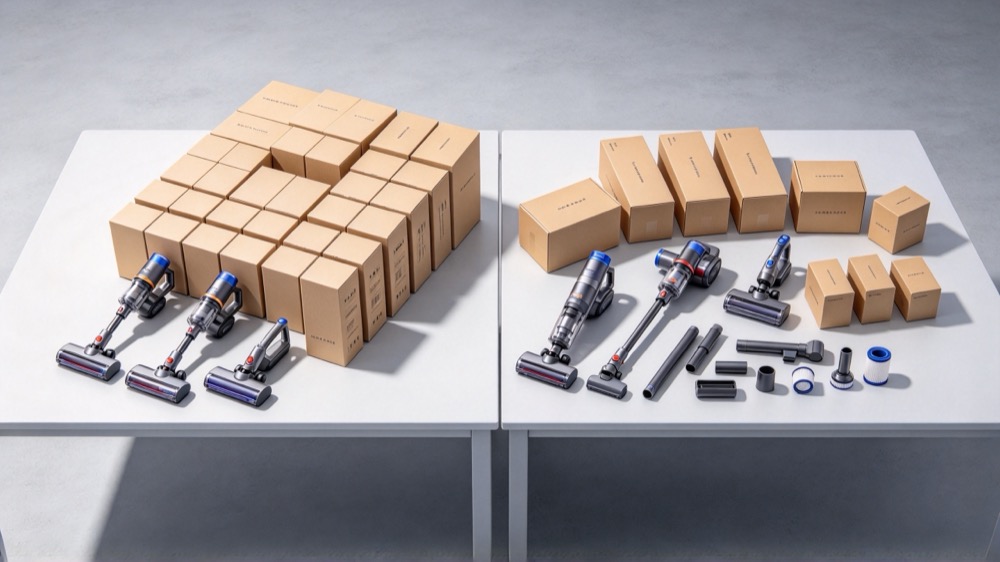
The strongest option is often neither permanent single-SKU dependence nor rapid catalog expansion.
It is a staged portfolio built around a validated core product.
Launch one configuration for a defined customer segment.
Measure sales alongside contribution, return reasons, stock availability, and support demand. Strong sales driven entirely by discounting may not justify expansion.
Choose the next SKU from observed needs.
For example, repeated requests for compact cleanup could justify evaluating a handheld model. Demand for additional reach or specialized cleaning tools might instead support a compatible accessory bundle.
Do not assume both extensions deserve investment.
Ask your OEM/ODM partner which parts can be shared safely and consistently.
Potential candidates include filters, connectors, selected housings, or packaging elements. Battery and charger sharing requires particular care: mechanical fit alone does not establish electrical, thermal, software, or safety compatibility.
Commonality can simplify operations, but shared components can also spread a defect across multiple products.
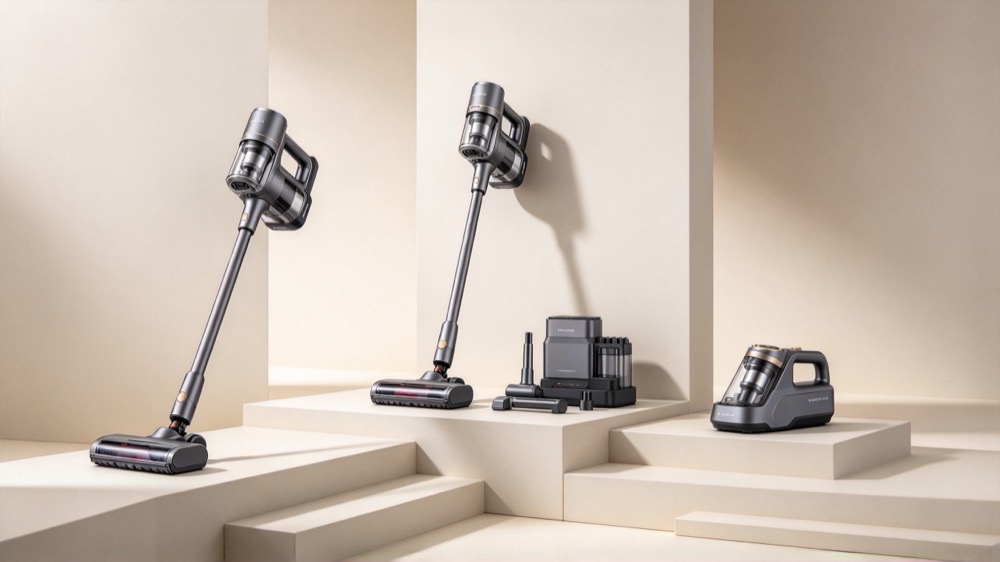
Battery decisions affect more than runtime and purchase price. They also influence replacement support, compatibility management, and product architecture.
For EU-bound products incorporating portable batteries, removability and replaceability requirements generally apply from February 18, 2027, subject to applicable derogations and exemptions. Related obligations include replacement-battery availability for at least five years after the last unit of the equipment model is placed on the market.
Confirm product-specific applicability with a qualified compliance specialist before approving designs.
For portfolio planning, establish:
- Which battery belongs to each model.
- Whether approved cross-model compatibility exists.
- How replacements will be identified.
- Who will hold replacement stock.
- How design changes will be communicated.
A larger cordless assortment without this structure can create avoidable service confusion.
Specify the cleaning task, target market, price range, and sales channel.
"General household use" is usually too broad to guide a disciplined launch.
List what customers need to complete the cleaning task. Treat colors and bundles as separate commercial decisions rather than automatic additions.
Request minimum order quantities by model, color, accessory bundle, and packaging version.
Also distinguish initial-order lead time from repeat-order replenishment time.
Model slower-than-expected sales, delayed replenishment, and higher returns.
Evaluate both unsold inventory exposure and the cost of missing demand. Neither strategy should be assessed only under an optimistic forecast.
Agree on spare parts, troubleshooting documents, claim evidence, warranty responsibilities, and response procedures.
For multiple SKUs, maintain an unambiguous compatibility matrix.
Approve additions only when they meet your contribution and customer-need criteria.
Review weak SKUs for repositioning, consolidation, or retirement. Plan remaining stock and service obligations before discontinuing a model.
Ningbo Eyunhome Electric Technology Co., Ltd. is a China-based vacuum manufacturer offering upright, handheld, corded, and cordless solutions, with OEM/ODM services and after-sales support.
For sourcing discussions, the most useful starting point is a commercial brief—not a request for the largest possible catalog.
Share your target market, customer segment, intended retail price, estimated order volume, and preferred product format. Request a comparison between one focused configuration and a small, differentiated range.
Ask the team to clarify customization scope, minimum orders, production timing, applicable documentation, and spare-parts arrangements for the proposed products.
Contact Ningbo Eyunhome with that brief to request an OEM/ODM proposal aligned with your launch budget and expansion plan.
Often, when budgets are limited and demand is unproven. It concentrates learning and investment. However, it also creates dependence on one product, so validation and supply planning remain essential.
There is no universally correct number. Start with the smallest assortment that covers demonstrably different customer needs and can be supported through purchasing, replenishment, marketing, and service.
Yes. Different colors, bundles, batteries, electrical versions, or packaging configurations can require separate inventory identities. Count the sellable configurations you actually manage, not just the underlying model names.
Not necessarily. Total inventory depends on demand, lead times, replenishment policies, and component sharing. However, additional finished-goods variants can fragment stock and leave some versions overstocked while others sell out.
Give each model a distinct customer, cleaning task, or price-value proposition. Track whether the new product attracts incremental demand or mainly replaces purchases of an existing model.
Confirm specifications, customization boundaries, variant-level minimums, lead times, testing responsibilities, documentation, packaging, warranty handling, and spare-parts availability. Record agreed requirements before placing production orders.
- Staśkiewicz, A. M., et al. (2022). *A procedure for reducing stock–keeping unit variety by linking internal and external product variety.* Research supporting the distinction between customer-facing variety and internal operational complexity. [sciencedirect]
- *Why Your Product Variety Management Strategy May Fail: Barriers in the Reduction of the Product Variety.* Operations and Supply Chain Management research discussing setup burdens, excess inventory, and barriers to portfolio simplification. [journal.oscm-forum]
- Eindhoven University of Technology repository. *Managing operational complexities and product portfolio through SKU rationalization.* Manufacturing-focused research examining changeovers, yield loss, write-offs, and inventory as complexity-cost drivers. [pure.tue]
- Nyman, Andreas. Intertek. June 27, 2025. *Navigating 2027 requirements for removability and replaceability of batteries in electrical products.* Technical explanation of the implementation date, general requirements, exceptions, and replacement-battery obligations. [intertek]
- Cooley, Productwise. February 13, 2025. *European Commission Publishes Guidance on EU Batteries Regulation Removability Requirements.* Legal commentary explaining Article 11 guidance and the February 2027 application date. [products.cooley]


