
Views: 268 Author: Eyunhome Vacuum Publish Time: 2026-11-22 Origin: Site


Content Menu
● Plastic Housing vs Metal Housing Vacuum Cleaner: Quick Comparison
● What Does "Housing" Mean in a Vacuum Cleaner?
>> Common Plastic Housing Materials
>> Common Metal Housing Materials
● Weight and Ergonomics: Where Plastic Often Has an Advantage
>> Why Weight Distribution Matters More Than a Single Number
● Durability: Cracking vs Denting Is Only the Beginning
>> How Plastic Housings Can Fail
>> How Metal Housings Can Fail
● Suction, Filtration, and Noise: Compare the System
>> Does Housing Material Affect Suction Power?
>> Which Housing Material Is Quieter?
● Heat, Electrical Safety, and Chemical Exposure
>> Heat Resistance Is Not a Single Material Claim
>> Metal Does Not Automatically Mean Safer
>> Match the Housing to Cleaning Chemicals
● Manufacturing Cost: Compare the Complete Project
>> Plastic Housing Cost Factors
● Three Often-Overlooked Factors That Improve Buying Decisions
>> 1. Use a Total Cost of Ownership Model
>> 2. Consider Hybrid Construction
>> 3. Separate Recyclability from Environmental Performance
● How to Validate a Plastic or Metal Vacuum Housing Before Ordering
>> Step 1: Define the Application
>> Step 2: Freeze the Material Specification
>> Step 3: Agree on Acceptance Tests
>> Step 4: Recheck Performance After Mechanical Testing
>> Step 5: Connect Approval to Production Control
● Which Housing Should Your Business Choose?
● Plan Your OEM/ODM Vacuum Cleaner with Eyunhome
>> 1. Are metal housing vacuum cleaners more durable?
>> 2. Does plastic housing reduce vacuum cleaner suction?
>> 3. Which material is better for cordless vacuum cleaners?
>> 4. Is stainless steel housing rustproof?
>> 5. Does a metal tank make a vacuum suitable for hazardous dust?
>> 6. Can a plastic vacuum cleaner look premium?
Choosing a plastic housing vs metal housing vacuum cleaner is not simply a decision between lightweight convenience and heavy-duty strength. For importers, distributors, and private-label brands, housing material influences handling, durability, tooling investment, appearance, and after-sales costs. However, it does not independently determine suction power or cleaning quality.
At Ningbo Eyunhome Electric Technology Co., Ltd., our focus is helping businesses develop upright, handheld, corded, and cordless vacuum cleaner solutions through OEM/ODM services. From a product-planning perspective, we recommend starting with the cleaning environment and customer expectations—not the assumption that one material is universally better.
This guide compares both options and explains what buyers should verify before approving production.
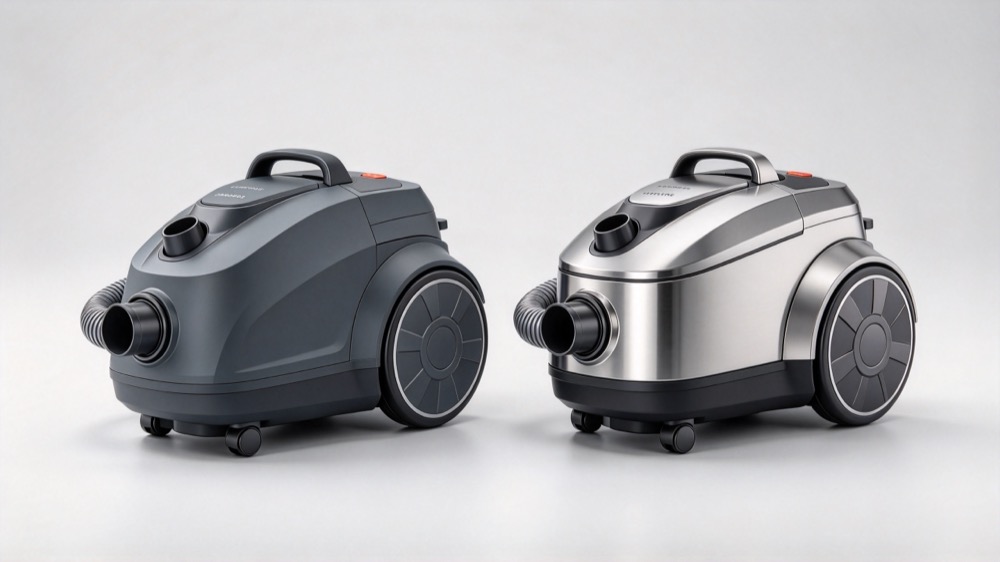
For many portable household applications, engineered plastic is the practical starting point. Metal deserves consideration where structural rigidity, specific exposure conditions, or product positioning justify its weight and manufacturing requirements.
| Buying consideration | Plastic housing | Metal housing |
|---|---|---|
| Weight | Generally supports lightweight construction | Depends on alloy, thickness, and component size |
| Impact behavior | May flex, scuff, crack, or break at joints | May dent, scratch, or permanently deform |
| Appearance | Flexible colors, textures, and molded shapes | Distinctive metallic finish and rigid feel |
| Corrosion | Does not rust, but chemical compatibility varies | Depends on alloy, coating, and environment |
| Heat behavior | Requires appropriate resin and temperature design | Conducts heat readily; touch temperatures need evaluation |
| Manufacturing | Injection tooling can integrate complex features | May require forming, machining, joining, and finishing |
| Maintenance | Replaceability depends on assembly design | Repairability depends on access and construction |
| Cleaning performance | Determined by the complete cleaning system | Determined by the complete cleaning system |
These are design tendencies, not guarantees. Compare complete machines rather than material labels alone.
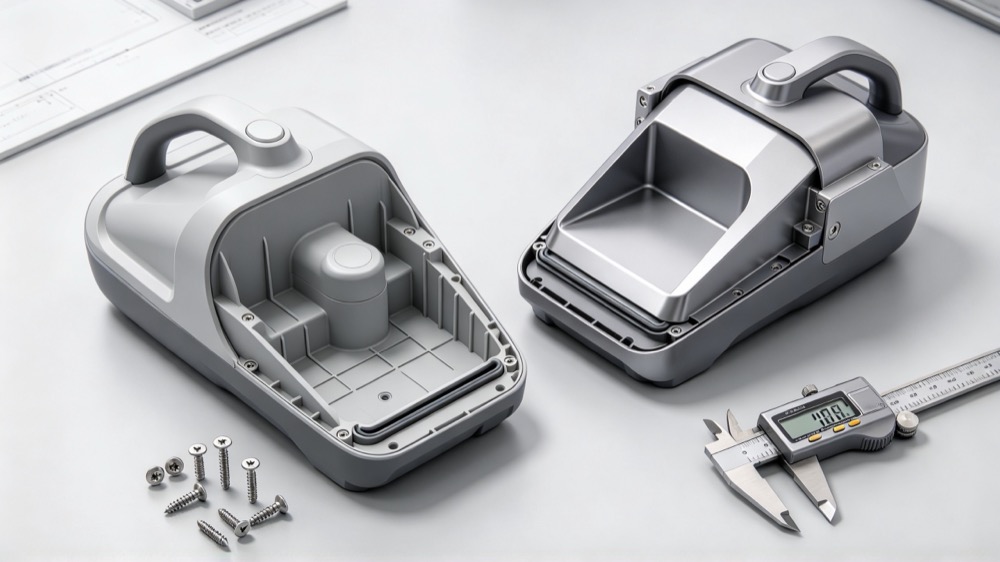
A meaningful vacuum cleaner housing material comparison starts by identifying the component being discussed.
"Housing" may refer to:
- The outer cosmetic shell.
- The motor enclosure.
- The dust container or collection tank.
- The structural frame.
- The floorhead cover or protective guard.
A vacuum advertised with a metal tank may still use plastic handles, wheels, motor covers, and internal components. Likewise, a plastic-bodied cordless vacuum may include a metal wand, motor parts, and reinforced attachment points.
Specify the relevant component in the purchasing brief. Otherwise, two suppliers may quote fundamentally different constructions under the same description.
ABS offers surface quality and a useful balance of rigidity and toughness. Different grades provide different impact and heat-resistance characteristics.
Polypropylene, or PP, combines low density with useful chemical resistance. Its suitability still depends on formulation, temperature, mechanical loading, and the cleaning substances involved.
Polycarbonate and PC/ABS blends offer additional options where impact performance, dimensional stability, or transparency matters. The exact grade must match the component's function.
Metal options include stainless steel, coated steel, and aluminum alloys.
They are not interchangeable. Buyers should specify alloy or grade, thickness, surface treatment, corrosion expectations, and joining methods rather than requesting only a "metal body."
For handheld and cordless vacuum cleaners, housing weight directly affects the product's usability.
Material density helps explain the lightweight potential of plastics. Published typical values place PP around 0.905 g/cm³ and ABS around 1.0–1.05 g/cm³. These are material figures, not finished-product weight predictions.
Actual weight also depends on wall thickness, reinforcement, battery size, motor selection, and accessories.
A product can be relatively light yet tiring if too much mass sits near the user's wrist.
During sample evaluation, ask users to:
1. Clean a floor area.
2. Lift the machine onto stairs.
3. Reach beneath furniture.
4. Use an above-floor attachment.
5. Empty and reinstall the dust container.
Our recommended purchasing approach is to assess balance and control alongside total weight. This is particularly important for cordless handheld vacuum cleaner designs.
For wheeled equipment, handle geometry, wheel performance, and stability may matter more than minimizing shell weight alone.
Plastic can crack. Metal can dent. Neither observation establishes which finished vacuum lasts longer.
Potential weak points include:
- Screw bosses.
- Handle junctions.
- Snap-fit clips.
- Battery attachment interfaces.
- Thin sections around openings.
Performance depends on resin selection, molding quality, geometry, and assembly stress. A reinforced connection can matter more than a thicker cosmetic panel.
Metal components may suffer permanent deformation, damaged coatings, corrosion, or failure around fasteners and seams.
A dent can be cosmetic, but it can also interfere with lid alignment or sealing. Similarly, a small plastic crack near a latch may compromise usability before the rest of the shell shows wear.
For either material, request testing that reflects likely handling: tipping, impacts, transport vibration, repeated opening, and attachment changes.
Durability should mean continued function after realistic use—not simply an undamaged appearance.
A metal housing vacuum cleaner does not automatically provide stronger suction. A plastic housing vacuum cleaner is not automatically quieter.
Housing design matters when it influences air leakage, duct geometry, or dimensional stability. However, cleaning performance also depends on:
- Motor and fan characteristics.
- Airflow resistance.
- Floorhead design.
- Brush agitation.
- Filter loading.
- Dust-container sealing.
When reviewing competing samples, compare debris pickup under matching conditions rather than relying on motor wattage or casing material.
IEC 62885-2 provides performance measurement methods for household and similar dry vacuum cleaners within its scope. Handheld products have important scope limitations, so the test plan must suit the actual product.
Neither material guarantees low noise.
The motor, airflow passages, vibration mounts, panel geometry, and assembly interfaces all influence the result. Plastic panels may vibrate; metal panels may resonate.
Request sound measurements under equivalent operating modes and floor conditions. Also evaluate rattles, tonal noise, and how the sound changes as the filter loads.
Material properties must be translated into complete-appliance safety.
A metal enclosure can conduct heat away from a local area, but this does not prove that the motor or battery remains adequately cooled.
Plastic requires a grade appropriate to the operating temperature and safety requirements. A resin's melting point alone is not an acceptable service-temperature specification.
The cooling path, ventilation, thermal protection, and distance between components all require evaluation.
Conductive accessible parts require suitable electrical protection. Plastic construction also requires proper insulation design, mechanical integrity, and appropriate material selection.
IEC 60335-2-2 addresses household and similar vacuum cleaner safety. IEC 60335-2-69 addresses relevant commercial vacuum cleaners and dust extractors.
Confirm the applicable requirements and accepted editions for the destination market. A material choice is not evidence that a finished appliance complies.
Plastic does not rust, but some chemicals can damage particular resins. Metals vary in corrosion resistance, and coatings can become vulnerable when scratched.
Provide the manufacturer with the intended cleaning substances, concentrations, exposure times, and temperatures. Do not assume that an ordinary vacuum is suitable for solvents, hot debris, or hazardous dust.
The cheaper raw material does not necessarily produce the cheaper finished product.
Injection molding can combine ribs, mounting points, textures, and other features in one part. This can simplify assembly.
However, project cost depends on:
- Mold complexity and cavity count.
- Surface appearance requirements.
- Resin specification.
- Dimensional tolerances.
- Production volume.
- Cosmetic rejection criteria.
Lower-volume projects can be especially sensitive to tooling amortization.
Metal construction may involve cutting, forming, welding, machining, coating, or polishing.
Depending on geometry and volume, it may offer a suitable production route—or add substantial processing and inspection requirements.
Ask suppliers to separate tooling, unit pricing, finishing, packaging, and replacement-part costs. This makes plastic vs metal vacuum cleaner cost comparisons much more useful.
Purchase price is only one part of the commercial equation.
A practical planning model is:
Total ownership cost = purchase cost + allocated tooling + logistics + maintenance + expected warranty and replacement costs.
Treat warranty assumptions as estimates until supported by reliable field data. Do not invent failure-rate advantages for either material.
For a private-label program, repair time and spare-part availability may outweigh a small difference in initial price.
The best solution may combine materials rather than choose one throughout.
A proposed design might use:
- A molded plastic shell for shape and handling.
- A metal tube for reach and stiffness.
- Reinforcement around highly loaded interfaces.
- Replaceable guards at impact-prone locations.
These are design options, not claims about a particular Eyunhome model.
Hybrid construction is worth discussing when one material cannot efficiently satisfy every requirement.
A recyclable material does not automatically make a more sustainable appliance.
Service life, repairability, material combinations, dismantling difficulty, and local collection infrastructure all matter.
Ask whether batteries, housings, motors, and electronics can be separated for servicing and end-of-life processing. Avoid environmental comparisons without a defined assessment method and product-specific evidence.
A structured sample-approval process reduces uncertainty more effectively than broad material claims.
Record the intended user, cleaning frequency, floor types, debris, storage environment, and expected handling.
Distinguish household cleaning from commercial or specialized applications.
For plastics, identify the resin grade and any permitted substitutions.
For metals, define the grade or alloy, thickness, finish, and corrosion requirements.
Create a product-specific plan covering relevant impacts, repeated latch operation, handle loading, transport conditions, thermal behavior, and chemical exposure.
Set measurable acceptance criteria before testing.
Inspect more than visible damage.
Reassess seals, airflow, container fit, attachment security, noise, and safe operation. A sample can look acceptable while suffering functional deterioration.
Agree on inspection records, traceability expectations, material-change approval, and spare-part support.
An approved sample is useful only when production units consistently match its specification.
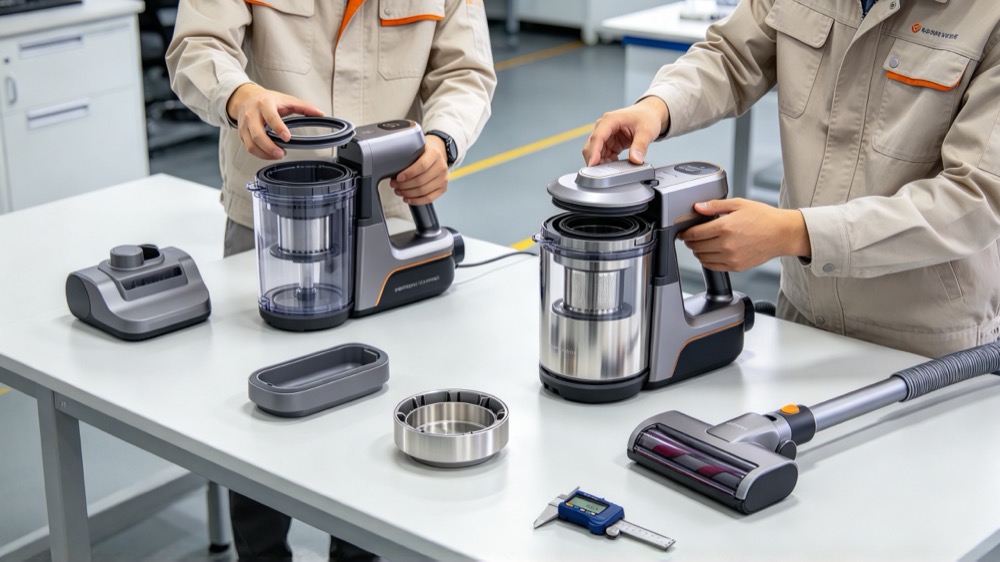
Use the product brief to guide the decision.
| Product direction | Sensible starting point | Main verification priority |
|---|---|---|
| Cordless handheld vacuum | Engineered plastic | Balance, attachment strength, thermal design |
| Household upright vacuum | Plastic or hybrid | Handle strength, impact behavior, service access |
| Corded household cleaner | Application-dependent | Cleaning performance, sealing, durability |
| Wheeled commercial machine | Plastic, metal, or hybrid | Duty cycle, chemicals, corrosion, mobility |
| Premium private-label range | Application-dependent | Finish consistency, repairability, customer value |
Corded or cordless power alone does not determine the correct housing material. Neither does a premium price position.
Ningbo Eyunhome Electric Technology Co., Ltd. provides upright, handheld, corded, and cordless vacuum cleaner solutions, supported by OEM/ODM services, stable production, and after-sales support.
Share your target market, product format, expected order volume, target price, and operating conditions. Ask our team to review the suitable platform, housing specification, customization scope, and sample-validation requirements.
The objective is a verified specification that fits your customers—not simply a plastic or metal label.
Not necessarily. Durability depends on the material grade, geometry, joints, finish, and operating conditions. Compare completed products through relevant testing.
Not inherently. Airflow design, sealing, filtration, the motor system, and the floorhead are more useful performance indicators than shell material.
Engineered plastic is often a suitable starting point because of its lightweight design potential. Final selection should consider balance, strength, heat, and repair access.
Do not treat it as universally rustproof. Performance depends on grade, surface condition, contaminants, cleaning chemicals, and exposure.
No. Specialized dust collection requires an appropriately designed and approved complete system. Tank material alone is insufficient.
Yes. Shape, texture, color consistency, panel alignment, and assembly quality can create a premium appearance without a metal outer shell.
1. British Plastics Federation. "Acrylonitrile Butadiene Styrene (ABS) and Other Specialist Styrenics." Reference for ABS properties, grade variation, and typical density. [bpf.co]
2. British Plastics Federation. "Polypropylene (PP)." Reference for PP properties, chemical resistance, grade differences, and typical density. [bpf.co]
3. British Plastics Federation. "Polycarbonate (PC)." Reference for polycarbonate properties and PC/ABS blends. [bpf.co]
4. International Electrotechnical Commission. "IEC 62885-2:2026—Surface Cleaning Appliances—Part 2: Dry Vacuum Cleaners for Household or Similar Use—Methods for Measuring the Performance." Reference for performance measurement scope and handheld exclusions. [webstore.iec]
5. International Electrotechnical Commission. "IEC 60335-2-2:2026—Household and Similar Electrical Appliances—Safety—Part 2-2: Particular Requirements for Vacuum Cleaners and Water-Suction Cleaning Appliances." Reference for household appliance safety scope and exclusions. [webstore.iec]
6. International Electrotechnical Commission. "IEC 60335-2-69:2021—Household and Similar Electrical Appliances—Safety—Part 2-69: Particular Requirements for Wet and Dry Vacuum Cleaners, Including Power Brush, for Commercial Use." Reference for commercial appliance safety scope. [webstore.iec]


