
Views: 241 Author: Eyunhome Vacuum Publish Time: 2026-09-06 Origin: Site


Content Menu
● Quick Comparison: Canister Vacuum vs. Bucket Vacuum
● What Is a Canister Vacuum Cleaner?
>> Why Consumers Choose Canister Vacuums
>> Where Canister Vacuums Work Best
● What Is a Bucket Vacuum Cleaner?
>> Why Buyers Choose Bucket Vacuums
>> Common Bucket Vacuum Applications
● Canister Vacuum vs. Bucket Vacuum: The Real Buying Factors
>> 1. Start With the Cleaning Environment
>> 2. Consider Debris Size and Volume
>> 3. Compare Mobility, Not Just Weight
>> 4. Evaluate Filtration as a Complete System
● Practical Selection Checklist for Buyers
● Performance Claims: What Responsible Brands Should Measure
● Product Development Insights for Private-Label Vacuum Brands
>> Features That Can Differentiate a Canister Vacuum
>> Features That Can Differentiate a Bucket Vacuum
● Maintenance Practices That Protect Performance
>> Canister Vacuum Maintenance
● Which Vacuum Cleaner Should You Choose?
● Build Your Vacuum Cleaner Program With Eyunhome
>> What is the main difference between a canister vacuum and a bucket vacuum?
>> Is a bucket vacuum cleaner suitable for home use?
>> Can a canister vacuum clean carpets and hard floors?
>> Are wet-and-dry bucket vacuums safe for liquid spills?
>> Does higher wattage always mean better vacuum cleaning?
>> What should importers ask a vacuum cleaner manufacturer before placing an order?
>> What OEM/ODM customization is available for vacuum cleaners?
Choosing between a canister vacuum cleaner and a bucket vacuum cleaner is not simply a matter of shape. For retailers, importers, distributors, property-service providers, and private-label brands, the decision affects cleaning performance, user comfort, product positioning, accessory strategy, shipment planning, and after-sales requirements.
A canister vacuum cleaner is typically designed for flexible whole-home cleaning, while a bucket vacuum cleaner—often called a drum vacuum or wet-and-dry vacuum—is built for larger debris, tougher environments, and more demanding cleanup tasks. The right choice depends on the target user, floor types, expected debris, storage space, and whether wet pickup is needed.
At Ningbo Eyunhome Electric Technology Co., Ltd., we support global vacuum cleaner brands and buyers with upright, handheld, corded, cordless, canister, and bucket vacuum solutions. Our OEM/ODM capability helps businesses tailor product functions, appearance, packaging, accessories, and performance specifications for different sales channels and regional markets.
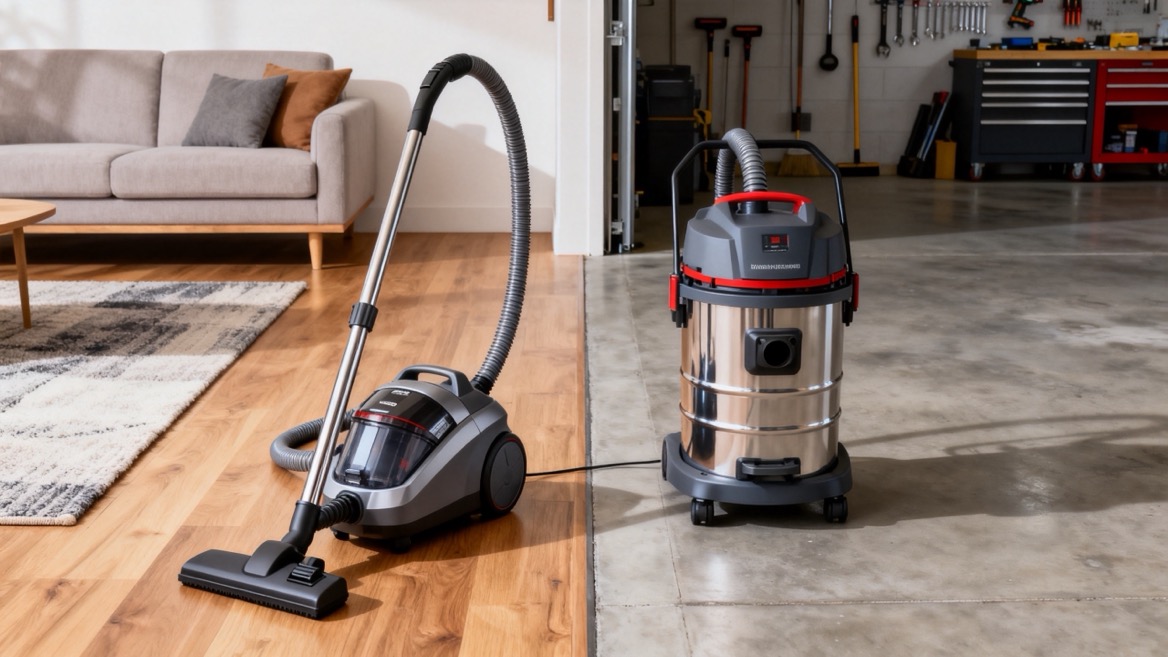
| Feature | Canister Vacuum Cleaner | Bucket Vacuum Cleaner |
|---|---|---|
| Primary use | Everyday indoor cleaning | Heavy-duty cleanup and larger debris |
| Typical environment | Homes, apartments, offices, hotels | Garages, workshops, warehouses, renovation sites |
| Floor suitability | Hard floors, rugs, stairs, furniture, under-bed areas | Concrete, tile, utility rooms, garages, outdoor-adjacent spaces |
| Debris type | Dust, crumbs, hair, light dry debris | Sawdust, leaves, workshop debris, larger dry waste, and sometimes liquids |
| Wet pickup | Usually not available | Available on many wet-and-dry models |
| Maneuverability | High, especially around furniture | Moderate; better for open areas |
| Noise and handling | Often designed for routine indoor use | Often prioritizes durability and tank capacity |
| Tank/bin capacity | Small to medium | Medium to large |
| Typical buyer priority | Convenience, reach, filtration, floor care | Capacity, durability, suction, wet/dry versatility |
| Best retail positioning | Home appliance and lifestyle categories | DIY, hardware, workshop, utility, and professional-use categories |
The key distinction is simple: canister vacuums prioritize versatility and reach, while bucket vacuums prioritize capacity and rugged utility.
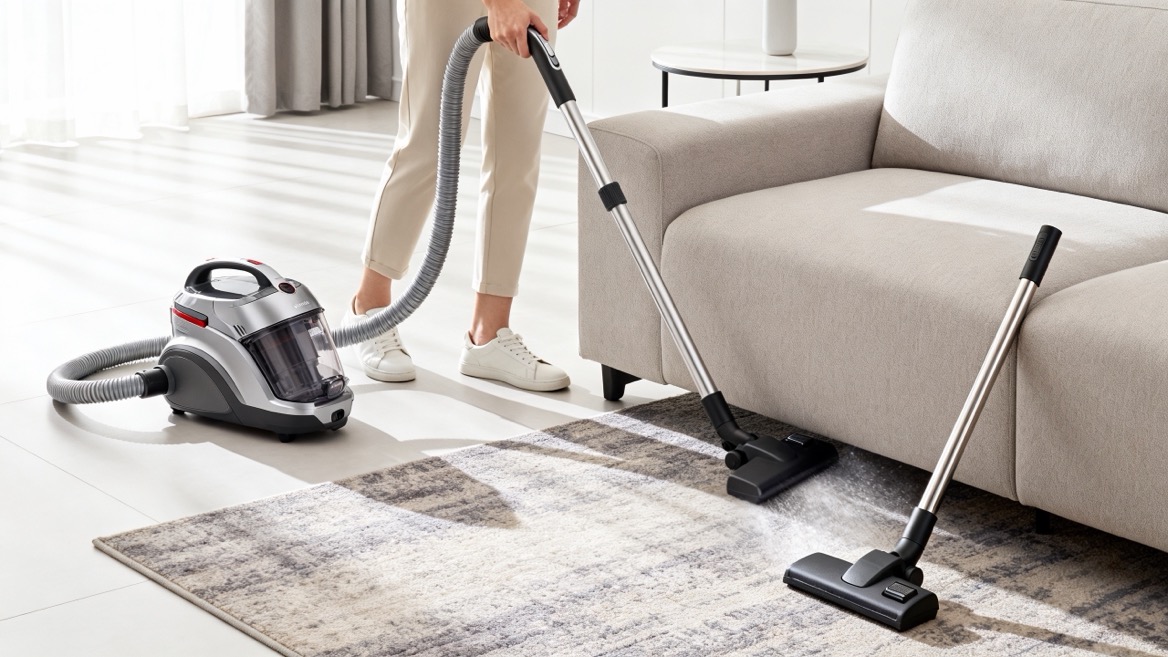
A canister vacuum cleaner separates the motor and dust collection chamber from the cleaning head. The main body rolls behind the user on wheels and connects to a hose, wand, and floor nozzle.
This structure gives canister vacuums a practical advantage in homes with furniture, mixed flooring, stairs, curtains, upholstery, and narrow spaces. Instead of moving one large upright machine everywhere, the user guides a lighter cleaning head while the canister follows behind.
Canister vacuums are often favored by users who need an adaptable machine for detailed household cleaning. Their hose-and-wand design can make it easier to clean areas that are difficult to reach with a traditional upright model.
Common advantages include:
- Better access under furniture, such as sofas, beds, and cabinets
- More flexible cleaning around corners and table legs
- Useful above-floor cleaning, including stairs, curtains, shelves, and upholstery
- Floor-head versatility for hard floors, low-pile carpets, rugs, and delicate surfaces
- Accessory-friendly design, often supporting crevice tools, dusting brushes, and upholstery nozzles
- Potentially lower hand weight because users move the nozzle rather than lifting the full motor unit
For private-label brands, a canister vacuum can also support a strong accessory story. A basic model may focus on hard floors and everyday dust, while an upgraded version can include a motorized brush, pet tool, telescopic metal tube, premium filtration system, or additional storage solutions.
A canister vacuum cleaner is usually a strong choice for:
- Apartments and condominiums
- Homes with hard flooring and area rugs
- Multi-level homes with stairs
- Households that regularly clean upholstery and curtains
- Hospitality environments with frequent room turnover
- Consumers who value maneuverability and detailed cleaning
A canister format is especially relevant when the buyer wants one appliance that can address floors, corners, furniture, and elevated surfaces without switching to a separate handheld vacuum.
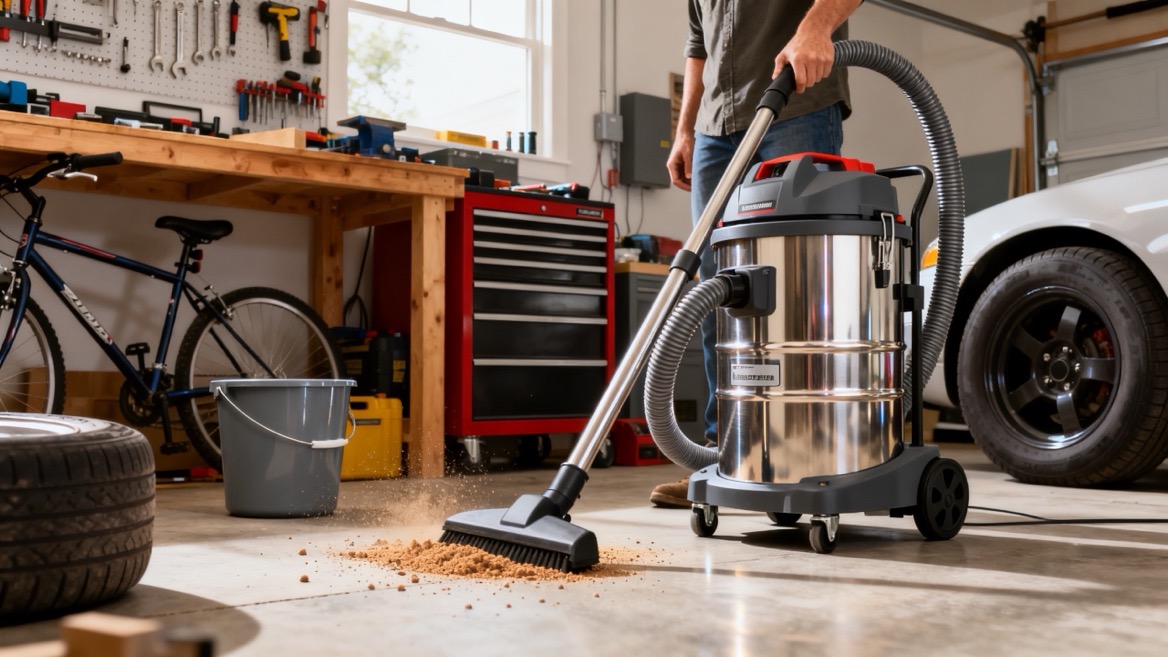
A bucket vacuum cleaner is a larger-capacity vacuum with a cylindrical or drum-style collection tank. Many models are designed as wet-and-dry vacuum cleaners, allowing users to collect dry debris and, when configured correctly, small liquid spills.
The term "bucket vacuum" can describe several product types. In the market, buyers may also search for:
- Drum vacuum cleaner
- Wet and dry vacuum
- Shop vacuum
- Workshop vacuum
- Garage vacuum
- Utility vacuum cleaner
- Industrial-style vacuum cleaner
Although some bucket vacuums are marketed for household use, their core strength is practical cleanup in environments where ordinary domestic vacuums may be too limited.
Bucket vacuums are designed for jobs involving more debris, larger spaces, and more demanding materials. The collection tank is normally larger than that of a standard household vacuum, which can reduce the frequency of emptying during longer cleaning sessions.
Their main advantages include:
- Large tank capacity for longer operation
- Strong utility positioning for garages, workshops, and renovation cleanup
- Ability to collect larger dry debris than many domestic vacuums
- Wet-and-dry options for spills and damp messes, depending on model design
- Robust wheels and tank construction for frequent movement on hard surfaces
- Blower functions on selected models for clearing leaves or dust from outdoor-adjacent areas
- Commercial and DIY appeal for hardware, home-improvement, and tool channels
A bucket vacuum is not necessarily the best choice for delicate curtains or daily apartment cleaning. However, it may be the more convincing option for a buyer who needs capacity, durability, and multi-purpose cleanup.
Bucket vacuum cleaners are often used in:
- Garages and car-care areas
- Workshops and maker spaces
- Home renovation projects
- Warehouses and utility rooms
- Small commercial premises
- Outdoor patios and entry areas
- Construction-related cleanup, where the machine is suitable for the material being collected
- Vehicle interiors, especially when paired with narrow nozzles and flexible hoses
For business buyers, the value proposition is clear: one machine can support dust collection, large debris removal, vehicle cleaning, and—in wet-and-dry designs—liquid-spill cleanup.
The best product is not always the one with the largest motor rating or biggest tank. A successful vacuum cleaner should match the actual cleaning task.
The first question is: where will the vacuum be used most often?
Choose a canister vacuum cleaner when the main environment includes:
- Living rooms and bedrooms
- Rugs and hard floors
- Furniture-heavy spaces
- Stairs
- Curtains and upholstery
- Small or medium-sized residences
Choose a bucket vacuum cleaner when the main environment includes:
- Garages and workshops
- Large tile, concrete, or utility floors
- Car interiors
- DIY and renovation areas
- Larger debris or higher cleaning volume
- Occasional wet-spill cleanup
A canister vacuum can feel more refined in a finished home. A bucket vacuum can feel more capable in a utility environment. Product-market fit matters more than trying to sell one machine as perfect for every situation.
Fine household dust, pet hair, cereal crumbs, and everyday dirt are usually well suited to a canister vacuum with the right floor tool and filtration system.
Larger debris—such as wood shavings, dry leaves, workshop dust, loose soil, or renovation waste—may be more appropriate for a bucket vacuum with a larger tank and suitable filter configuration.
However, buyers should avoid assuming that every bucket vacuum is suitable for every material. Fine construction dust, ash, hazardous debris, liquids, or chemical residues may require specialized equipment, filters, safety procedures, or local compliance considerations.
A canister vacuum may have a smaller body, but the user pulls it behind them. A bucket vacuum may have a bigger tank, but its wheels can make it easy to move across an open garage or workshop.
The practical question is not only "Which vacuum is lighter?" It is:
- Can the user move around furniture easily?
- Can the machine clean stairs safely?
- Can it pass through narrow rooms and doorways?
- Does the hose reach the intended cleaning area?
- Is the unit stable when pulled or pushed?
- Is storage space limited?
For compact urban homes, a slim canister may be easier to store. For a garage or tool room, a larger bucket vacuum may be acceptable because storage and maneuvering space are less restrictive.
Filtration should never be treated as a simple label. A strong cleaning experience depends on the entire airflow path: the dust container or bag, pre-filter, main filter, seals, filter fit, exhaust design, and maintenance routine.
For consumers concerned about dust, pet dander, or fine particles, buyers should look beyond promotional language and ask practical questions:
- Is the filtration system sealed or likely to leak around the filter area?
- Is the filter washable, replaceable, or both?
- How easy is it to remove the dust bin without creating a dust cloud?
- Are replacement filters available in the intended market?
- Is the filter designed for dry debris only, or can it be used for wet pickup?
- Does the product include a clear maintenance guide?
High-efficiency particulate air filters are commonly associated with capturing very small particles under defined test conditions, but a filter alone does not guarantee that the whole appliance prevents dust from escaping. The housing design, gasket quality, filter installation, and user maintenance all matter.
For OEM and ODM buyers, filtration can become a meaningful point of differentiation. A product line may offer standard filtration for entry-level retail, washable multi-stage filtration for mid-range products, and upgraded sealed filtration solutions for premium channels.
Before selecting a canister or bucket vacuum cleaner, use this six-step checklist.
1. Define the primary user. Is the target customer a homeowner, pet owner, car enthusiast, DIY user, cleaner, hotel operator, or workshop owner?
2. Identify the dominant surface. Hard floors, carpets, upholstery, concrete, tile, vehicles, and mixed surfaces need different tools.
3. List the expected debris. Fine dust, hair, food particles, leaves, sawdust, larger debris, and liquid spills require different product features.
4. Choose the right tank capacity. Larger is not always better. A tank that is too large can increase product size and storage demands for ordinary home users.
5. Specify the necessary accessories. Consider floor brushes, crevice nozzles, dusting brushes, upholstery tools, wet-pickup accessories, extension wands, and motorized brush heads.
6. Plan maintenance and after-sales support. Filters, hoses, wheels, nozzles, switches, and dust containers should be easy to replace or service in the destination market.
This process helps importers avoid a common mistake: selecting a vacuum based on one headline specification while overlooking the accessories and maintenance features that shape long-term customer satisfaction.
When comparing vacuum cleaners, power ratings alone do not tell the whole story. Wattage can describe electrical input, but it does not directly explain cleaning effectiveness on carpet, hard floors, or upholstery.
A more responsible product-development approach assesses several factors together:
| Evaluation Area | Why It Matters |
|---|---|
| Embedded dirt removal | Indicates how effectively a machine removes dirt from carpet under controlled conditions |
| Hard-floor pickup | Shows practical performance for crumbs, dust, and debris on smooth surfaces |
| Airflow and suction behavior | Helps determine how the vacuum performs through hoses, tools, and filters |
| Filtration and dust retention | Affects the amount of fine material that may remain contained during operation |
| Noise level | Influences suitability for homes, hotels, offices, and shared spaces |
| Runtime or cord reach | Shapes convenience and area coverage |
| Tool performance | Determines whether the product works well beyond the main floor surface |
| Durability testing | Supports confidence in hoses, wheels, switches, tanks, and repeated use |
ASTM F608 is a recognized laboratory test method for assessing carpet embedded-dirt removal effectiveness in household and commercial vacuum cleaners. It is useful because it focuses on actual dirt-removal capability rather than relying only on motor-related marketing claims.
For a private-label program, verified internal testing, defined quality-control checkpoints, and accurate claims can protect brand reputation more effectively than exaggerated specifications.
A successful vacuum program begins with a clear market brief, not just a sample selection. Importers and brand owners should define the intended price tier, customer profile, retail channel, product features, compliance needs, packaging requirements, and spare-parts strategy before finalizing the product.
For canister vacuum projects, brands may consider:
- Automatic cord rewind
- Variable suction control
- Telescopic metal tubes
- Multi-floor brush heads
- Soft roller tools for hard floors
- Pet-hair accessories
- Compact storage positions
- Large dust bags or bagless bins
- Washable filters
- Sealed filtration pathways
- Low-noise design priorities
- Color, trim, and packaging customization
For bucket vacuum projects, brands may consider:
- Wet-and-dry pickup configuration
- Stainless-steel or durable polymer tanks
- Drain ports for easier liquid disposal
- Blower functionality
- Tool storage on the body
- Long-reach hose options
- Large rear wheels and stable casters
- Cartridge, foam, or reusable filter options
- Power-tool connection accessories where appropriate
- Vehicle-cleaning kits
- Heavy-duty floor nozzles
- Regional plug, cord, and safety configuration options
The most competitive products do not add features randomly. They select features that solve a visible customer problem and support a clear shelf message.
For example, a compact canister vacuum for apartment living may emphasize "easy storage, multi-surface reach, and low-dust emptying." A bucket vacuum for garage users may emphasize "wet-and-dry cleanup, large capacity, and tool-ready versatility."
Even a well-designed vacuum will lose effectiveness if the dust container is overfilled, filters are neglected, or hoses become blocked. Clear maintenance instructions reduce return rates and improve customer confidence.
- Empty the dust bin or replace the dust bag before airflow drops significantly
- Clean or replace filters according to the product manual
- Check the floor head for hair and thread buildup
- Inspect the hose, wand, and crevice tool for blockages
- Store the cord carefully to prevent damage
- Confirm that the dust bin, bag, and filter are installed correctly after cleaning
- Empty the tank before it becomes excessively full or heavy
- Use the correct filter for dry pickup and follow the product instructions before wet pickup
- Clean filters carefully and allow washable filters to dry completely before reuse
- Check hoses for larger debris that can cause blockages
- Clean the tank after wet pickup to reduce odor and residue
- Inspect wheels, latches, seals, and drain components regularly
A common customer complaint is "the suction suddenly became weak." In many cases, the cause is not motor failure. It may be a full bin, clogged filter, blocked hose, incorrectly installed filter, or unsuitable accessory for the cleaning task.
Choose a canister vacuum cleaner if your market needs flexible, comfortable, detailed indoor cleaning. It is often the better fit for homes, apartments, furniture-heavy rooms, multi-surface cleaning, and buyers who value reach and everyday convenience.
Choose a bucket vacuum cleaner if your market needs durability, large capacity, stronger utility positioning, or wet-and-dry functionality. It is often the stronger fit for garages, workshops, vehicles, renovation cleanup, utility rooms, and DIY-focused retail channels.
For many product portfolios, the best answer is not choosing only one category. It is offering both:
- A canister vacuum line for home and lifestyle channels
- A bucket vacuum line for hardware, DIY, automotive, and utility-cleaning channels
This dual-category approach gives distributors and private-label brands broader market coverage while allowing each product to communicate a clear purpose.
Ningbo Eyunhome Electric Technology Co., Ltd. provides vacuum cleaner solutions for businesses seeking dependable manufacturing support, product customization, stable production, and long-term service.
Whether you are developing a compact canister vacuum for modern homes or a heavy-duty bucket vacuum for workshop and wet-and-dry cleaning, our team can support your OEM/ODM project from product concept to production planning.
Talk with our team about your target market, desired price level, product functions, branding requirements, accessory package, packaging concept, and after-sales needs. We can help you develop a vacuum cleaner solution that is practical for users and commercially effective for your brand.
A canister vacuum is mainly designed for flexible indoor cleaning across floors, furniture, stairs, and hard-to-reach areas. A bucket vacuum uses a larger drum-style tank and is generally better suited to heavy-duty cleanup, larger debris, garages, workshops, and wet-and-dry applications when supported by the model.
Yes. A bucket vacuum can be useful in homes with garages, utility rooms, vehicles, pets, renovation projects, or frequent heavy-duty cleaning needs. However, it may be less convenient than a canister vacuum for daily cleaning in compact, furniture-filled living spaces.
Yes. A canister vacuum can clean both carpets and hard floors when it has an appropriate floor head or adjustable brush setting. For carpet, the effectiveness depends on brush design, airflow, suction behavior, and the type of carpet being cleaned.
They can be, but users must follow the product manual exactly. The correct filter and configuration may be required for wet pickup. Never use a dry-only vacuum for liquids, and never operate a wet-and-dry vacuum beyond its stated capability.
No. Wattage describes electrical input, not complete cleaning performance. Effective cleaning depends on airflow, suction behavior, floor-head design, sealing, filtration, debris path, accessories, and the surface being cleaned.
Importers should confirm product specifications, applicable compliance requirements, target voltage and plug type, accessory set, packaging details, spare-parts availability, quality-control process, production lead time, minimum order quantity, customization options, and after-sales support expectations.
Depending on the project, customization may include product color, branding, logo placement, tool configuration, filtration setup, motor specification, cord and plug type, packaging, manuals, labels, and market-specific feature combinations.
- [Eureka: The Difference Between Canister Vacuum Cleaners and Bucket Vacuum Cleaners]
- [ASTM International: Collecting Dust—Standards for Vacuum Cleaners]
- [U.S. Environmental Protection Agency: Guide to Air Cleaners in the Home]


