
Views: 232 Author: Eyunhome Vacuum Publish Time: 2026-07-07 Origin: Site


Content Menu
● Commercial vs Residential Vacuum Cleaners: Core Differences
>> 1. Intended Use and Duty Cycle
>> 2. Build Quality and Durability
>> 3. Suction Performance and Cleaning Width
>> 4. Cord Length and Power Design
>> 5. Filtration and Air Quality
>> 6. Capacity, Accessories, and Serviceability
● Industry Insight for OEM and ODM Buyers
● Why This Matters for Your Brand
● FAQs
>> 1. What is the main difference between commercial and residential vacuum cleaners?
>> 2. Can a residential vacuum be used in a business?
>> 3. Are commercial vacuums always more powerful?
>> 4. Do both vacuum types need HEPA filtration?
>> 5. Which vacuum type is better for OEM/ODM branding?
In the vacuum cleaner market, commercial vs residential vacuum cleaners is not just a product comparison—it is a decision about efficiency, durability, total cost of ownership, and user experience. For distributors, retailers, cleaning contractors, and OEM buyers, choosing the right category affects performance in the field and customer satisfaction over time. [vacuumwars]
A vacuum cleaner may look similar from the outside, but the inside is designed for a very different workload. Residential vacuums are built for convenience, lighter cleaning cycles, and household ergonomics, while commercial vacuums are engineered for extended use, larger floor areas, and more demanding maintenance routines. [youtube]
From a manufacturer's point of view, this difference also shapes product architecture. Motor specification, cord length, filtration system, bin capacity, accessory set, and serviceability all need to match the end user's real usage pattern, not just their budget. [bissellcommercial]

Residential models are usually designed for homes, apartments, and light office cleaning. They are typically used for shorter sessions and less frequent maintenance tasks. [cleanhire.co]
Commercial models are designed for hotels, schools, offices, shopping spaces, healthcare facilities, and other environments where cleaning happens often and on a schedule. These machines are built to handle longer duty cycles and more repeated use across the week. [youtube]
Durability is one of the most important dividing lines. Commercial vacuums are generally built with stronger internal components, reinforced housings, and a design philosophy focused on repairability and long-term service life. [centaurmachines]
Residential vacuums often prioritize lighter weight, compact storage, and easier handling. That makes them user-friendly for households, but not always ideal for daily professional use. [thinkvacuums]
Commercial vacuums are commonly designed with stronger suction and wider cleaning paths so users can cover more square footage in less time. This is especially useful in large facilities where labor efficiency matters as much as cleaning performance. [nettoyeurdelacite]
Residential vacuums still provide effective everyday cleaning, but they usually balance suction with noise reduction, weight, and maneuverability. That balance is useful in homes, where comfort often matters as much as raw output. [lxvacuum]
Commercial machines often include longer cords and grounded power systems to support larger cleaning zones and safer operation in high-traffic environments. Longer reach reduces outlet changes and improves workflow efficiency. [thinkvacuums]
Residential vacuums are generally designed for shorter room-to-room use. They are easier to carry and store, but less optimized for long-distance coverage. [cleanhire.co]
Filtration is no longer a minor feature. It is now a buying factor for both B2C and B2B customers. ASTM F3150-18 defines industry acceptable test methods and minimum filtration efficiency requirements for HEPA performance in residential and commercial vacuum cleaner filtration systems used in non-critical applications. [store.astm]
That matters because buyers increasingly want cleaner exhaust air, better allergen control, and stronger trust in product claims. For OEM and ODM projects, this also means filtration design should be treated as a core product feature, not an afterthought. [bissellcommercial]
Commercial vacuums often come with larger dust capacity and more basic out-of-the-box accessories, because the priority is uptime and workflow efficiency. They are typically built so technicians can service them faster and keep them running longer. [youtube]
Residential vacuums usually include more user-friendly accessories, such as upholstery tools, dusting brushes, and attachments for stairs or furniture. That makes them more versatile for home cleaning tasks. [bissellcommercial]
| Feature | Commercial Vacuum Cleaners | Residential Vacuum Cleaners |
|---|---|---|
| Typical environment | Offices, hotels, schools, retail spaces (youtube) | Homes, apartments, small offices (thinkvacuums) |
| Duty cycle | Longer, more frequent use (youtube) | Shorter, occasional use (youtube) |
| Durability | Reinforced and service-oriented (youtube) | Lightweight and convenience-focused (thinkvacuums) |
| Cord and reach | Longer cords, grounded designs (youtube) | Shorter cords, easier storage (youtube) |
| Suction and coverage | Stronger output, wider cleaning path (nettoyeurdelacite) | Balanced power and usability (lxvacuum) |
| Accessories | Essentials-first, customizable (youtube) | More household attachments (youtube) |
| Filtration focus | HEPA-ready performance is often important (store.astm) | HEPA performance also relevant for homes (store.astm) |
| Service approach | Repairable, maintenance-friendly (youtube) | Easier consumer replacement and ownership (thinkvacuums) |
The right choice is not "commercial is better" or "residential is cheaper." The right choice is the one that matches workload, frequency, and expected lifespan.
Use this simple decision framework:
1. Choose commercial if the machine will be used daily, in a large facility, or by cleaning staff.
2. Choose residential if the main users want lightweight handling, easier storage, and flexible everyday home cleaning.
3. Choose commercial if serviceability, uptime, and replacement reduction matter more than the lowest purchase price.
4. Choose residential if the buyer values low noise, ergonomic comfort, and consumer-friendly accessory bundles.
A useful rule is this: if the vacuum is part of a business operation, evaluate it like equipment. If it is part of home life, evaluate it like a convenience product.
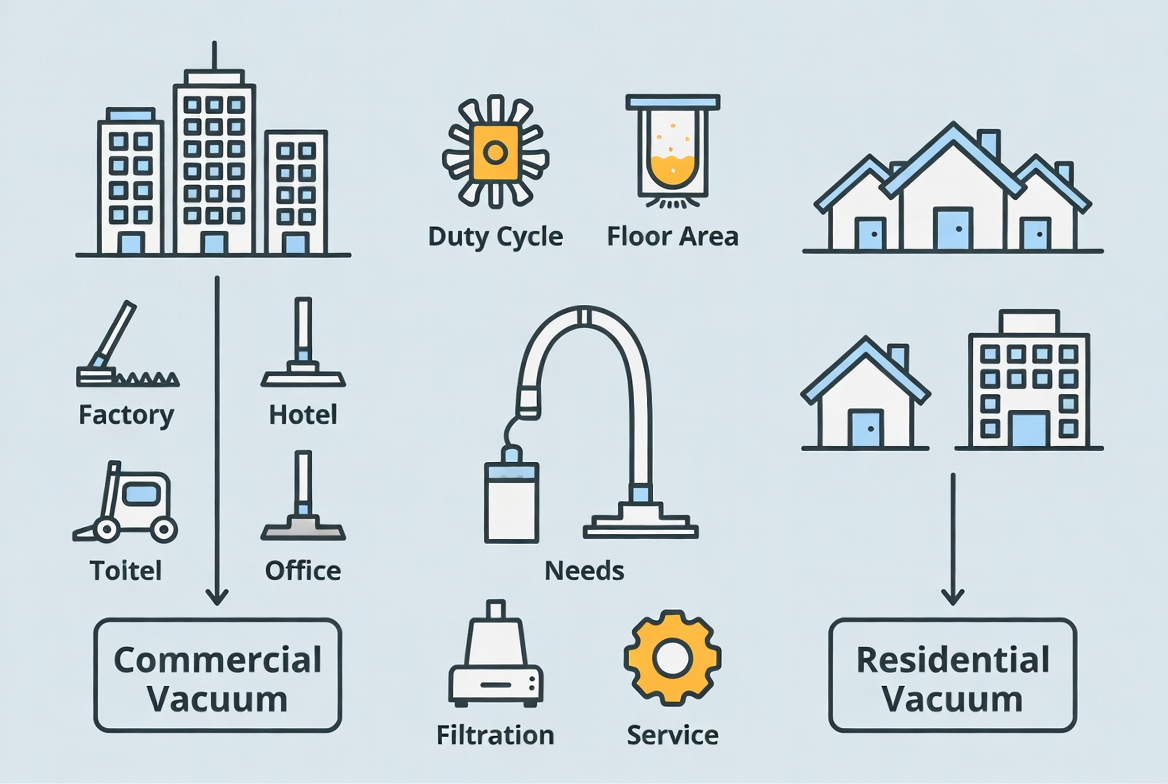
For manufacturers and private-label buyers, the product strategy should reflect market segmentation, not just visual styling. A model intended for commercial buyers should emphasize durability testing, cord management, filtration performance, and easy maintenance. A residential product should emphasize weight, compact form factor, quiet operation, and user-friendly design.
The market is also evolving toward cordless convenience. Recent market reporting points to continued growth in cordless vacuum cleaner demand, driven by longer battery life, lighter designs, and convenience-focused use cases. At the same time, commercial buyers still care deeply about runtime consistency, power stability, and service life, which means corded and cordless portfolios should be developed differently rather than treated as one interchangeable category. [industryresearch]
For a company like Ningbo Eyunhome Electric Technology Co.,Ltd., this creates a strong OEM/ODM opportunity: build separate product lines for household convenience and commercial productivity, while aligning each model with the buyer's actual cleaning scenario.
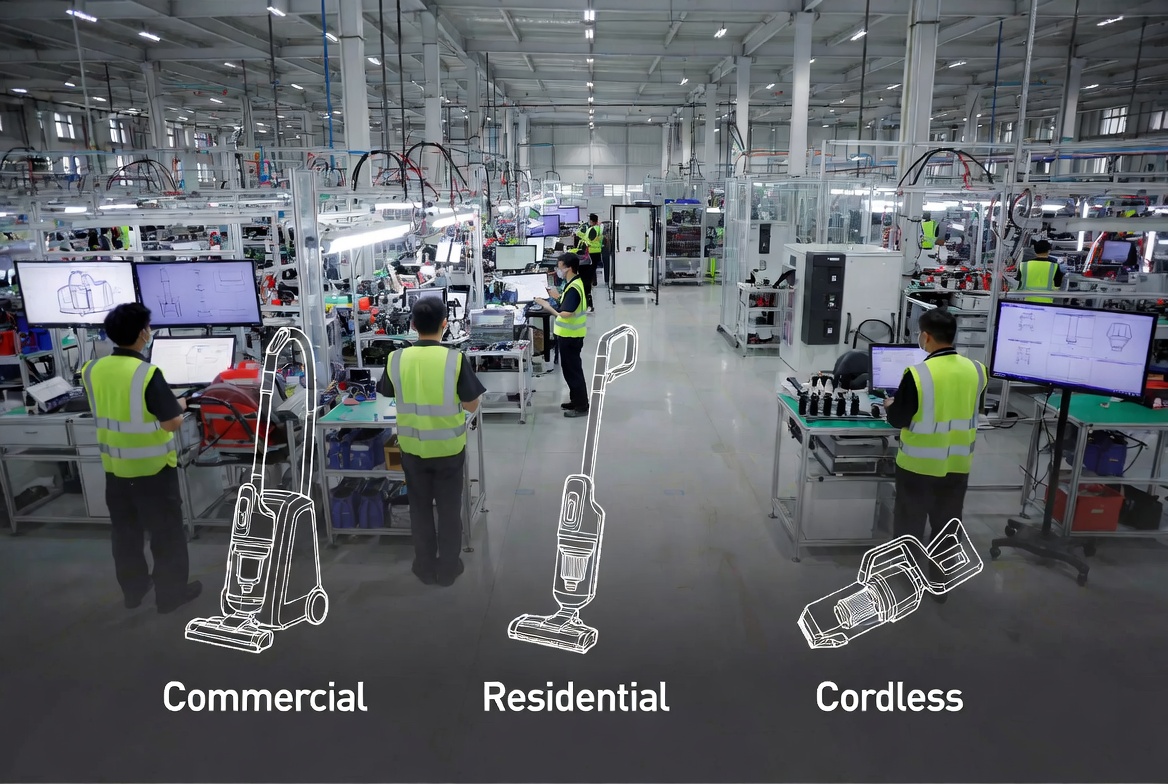
Before placing an order or starting an OEM project, confirm these points:
- Cleaning environment, home, office, hotel, retail, or mixed use.
- Frequency of use, occasional, daily, or multiple times per day.
- Surface type, hard floor, carpet, mixed flooring, or stairs.
- Power preference, corded, cordless, or both.
- Filtration target, standard filtration or HEPA-performance expectation. [store.astm]
- Service expectations, consumer replacement or business repairability.
- Accessory needs, basic tools or expanded attachments.
- Brand positioning, value, premium, or professional-grade.
If your customer buys the wrong vacuum category, they may think the product failed, even when the product simply matched the wrong use case. That is why clear category education improves conversion, reduces returns, and protects brand reputation.
For exporters, distributors, and OEM partners, the strongest selling point is not just suction power. It is fit-for-purpose engineering backed by reliable manufacturing, stable output, and after-sales support.
Commercial and residential vacuum cleaners solve different problems, and the best choice depends on where the product will be used, how often it will run, and how long it must last. Commercial vacuums prioritize durability, uptime, and large-area efficiency, while residential vacuums prioritize comfort, weight, and everyday convenience. [bissellcommercial]
For buyers who need tailored vacuum cleaner solutions, the smartest approach is to match design to use case from the start. That is how you create better user experience, stronger SEO content, and a more persuasive product story for global markets.
Commercial vacuums are built for heavier use, longer duty cycles, and easier maintenance, while residential vacuums are designed for lighter, more convenient household cleaning. [youtube]
Yes, but only for very light cleaning in small spaces. For daily or large-scale business use, a commercial vacuum is usually the better choice. [cleanhire.co]
They are usually built for stronger output and faster coverage, but the best machine still depends on the floor type, cleaning frequency, and facility size. [nettoyeurdelacite]
They can, and many buyers now expect it. ASTM F3150-18 covers filtration performance testing for both residential and commercial vacuums used in non-critical applications. [store.astm]
Both can work well, but they serve different markets. Residential products usually sell on convenience and comfort, while commercial products sell on durability, uptime, and serviceability.
1. Vacuum Wars, "Commercial vs. Residential Vacuum Cleaners: Key Differences" — [https://vacuumwars.com/commercial-vs-residential-vacuum-cleaners-key-differences/] [vacuumwars]
2. Bissell Commercial, "Differences Between Commercial & Residential Vacuums" — [https://www.bissellcommercial.com/blogs/blog/differences-between-commercial-residential-vacuums] [bissellcommercial]
3. Nettoyeur De la Cité, "5 Differences Between a Commercial and Residential Vacuum Cleaner" — [https://nettoyeurdelacite.com/en/5-differences-between-a-commercial-and-residential-vacuum-cleaner/] [nettoyeurdelacite]
4. LX Vacuum, "Commercial vs Household Vacuum Cleaner Comparison" — [https://lxvacuum.com/article-details/Commercial_vs_Household_Vacuum_Cleaner_Performance_A_ValueforMoney_Guide_1754876305224.html] [lxvacuum]
5. ThinkVacuums, "Commercial Vacuum vs. Residential Vacuums" — [https://www.thinkvacuums.com/commercial-vacuum-vs-residential-vacuums] [thinkvacuums]
6. Cleanhire, "What Are The Differences Between Commercial & Residential Vacuums" — [https://cleanhire.co.uk/what-are-the-differences-between-commercial-residential-vacuums/] [cleanhire.co]
7. Centaur Machines, "Why Commercial Rather than Residential Vacuum Machines" — [https://centaurmachines.com/blog/commercial-rather-residential-vacuum-machines/] [centaurmachines]
8. Bissell Commercial, "Differences Between Commercial & Residential Vacuums" — [https://www.bissellcommercial.com/differences-between-commercial-residential-vacuums/] [https://www.bissellcommercial.com/differences-between-commercial-residential-vacuums/] [bissellcommercial]
9. Industry Research, "Cordless Vacuum Cleaner Market Size, Share" — [https://www.industryresearch.biz/market-reports/cordless-vacuum-cleaner-market-101531] [industryresearch]
10. ASTM International, "ASTM F3150-18 Standard Specification for HEPA Filtration System Performance of Residential and Commercial Vacuum Cleaners" — [https://store.astm.org/f3150-18.html] [store.astm]
11. Vacuum Wars, "The 2025 Clean Up: Navigating the Next Wave of Vacuum Innovation Market Shifts" — [https://vacuumwars.com/the-2025-clean-up-navigating-the-next-wave-of-vacuum-innovation-market-shifts/] [vacuumwars]
12. Data Insights Market, "Cordless Vacuum Cleaner in North America: Market Dynamics and Forecasts 2025-2033" — [https://www.datainsightsmarket.com/reports/cordless-vacuum-cleaner-1356814] [datainsightsmarket]


