
Views: 299 Author: Eyunhome Vacuum Publish Time: 2026-11-17 Origin: Site


Content Menu
● Private Label vs Generic Cordless Vacuums: What Are You Buying?
● Compare Cordless Vacuum Performance Before You Compare Prices
>> Measure Runtime With the Floor Head Attached
>> Check Daily Use, Not Just the Suction Number
● Model Private Label and Generic Costs Beyond the Factory Quote
>> Illustrative Case: How Many Units Must a Branded Model Sell?
● Choose the Level of Customization That Solves a Buyer Problem
● Use a Five-Step Approval Plan Before Placing a Bulk Order
>> Market Compliance and Battery Transport Are Separate Checks
● Which Option Fits Your Business?
● Request a Side-by-Side Cordless Vacuum Quote
>> Is a private label cordless vacuum better than a generic vacuum?
>> Can I start with branding and customize the hardware later?
>> What MOQ should I expect for a private label cordless vacuum?
>> Is a generic vacuum always faster to launch?
>> Can I get exclusivity for my private label model?
>> Which spare parts should I ask about before ordering?
>> What should a cordless vacuum supplier include in its performance report?
A private label cordless vacuum is the better choice when your brand can offer a difference customers will notice and your business can support after the sale. Generic products are often a better starting point when demand is uncertain, the launch window is short, or buyers mainly compare price. For retailers, distributors, and importers, the real decision is not whether to put a logo on the vacuum. It is whether more control over the product, packaging, and spare parts will earn back the extra investment.
My first question as a buyer would be: What can the customer do better with this model? A floor head that picks up crumbs from tile grooves, a battery that lasts through a typical cleaning session, or a replacement filter customers can actually reorder can justify a branded offer. A new carton alone may not.

A private label cordless vacuum is manufactured by a supplier and sold under the buyer's brand. The buyer might personalize an existing model or commission changes to the floor head, battery, accessories, or housing. The extent of customization depends on the agreement, not the label.
A generic cordless vacuum, as used here, is a standard catalog model purchased without meaningful buyer-specific product changes. It may ship unbranded or under the supplier's brand. A distributor can still offer good service and replacement parts for that model. Likewise, a private label vacuum can use the same motor, filter, and battery as a generic model.
| Buying factor | Private label cordless vacuum | Generic cordless vacuum |
|---|---|---|
| Product specification | Buyer can negotiate changes and record approved components | Usually follows the supplier's catalog specification |
| Brand presentation | Buyer controls the branding, packaging, manuals, and product content within the agreed scope | Usually uses neutral packaging or supplier materials |
| Minimum order quantity (MOQ) | May rise with custom colors, tooling, or components | Stocked models may support smaller trial orders |
| Lead time | Add time for artwork, sample approval, and any required retesting | Can be shorter if the exact configuration is in stock |
| Price comparison | A distinctive bundle or configuration can make direct comparisons harder | Comparable catalog models may compete mainly on price |
| Spare parts and service | Buyer can negotiate part numbers, stock commitments, and escalation procedures | Depends on supplier availability and the service agreement |
| Exclusivity | Applies only if the contract defines what is exclusive and where | Typically no buyer-specific exclusivity |
Private labeling does not improve suction, filtration, or runtime by itself. Compare both options using the configuration customers will receive: the battery, filter, floor head, and attachments included in the box.
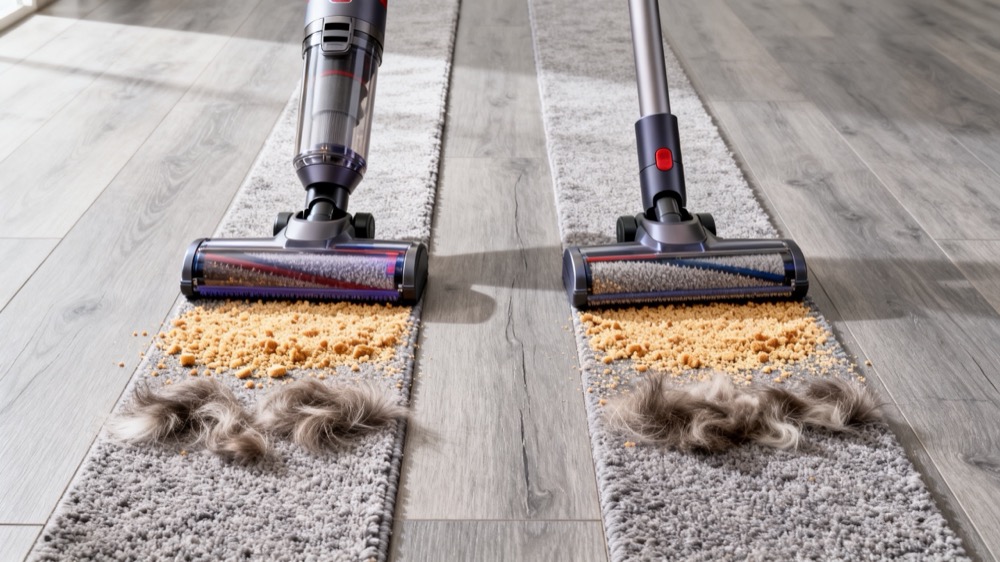
Ask the supplier to state the power setting, surface, attachment, and test endpoint for each runtime claim. A maximum-runtime figure from a low-power test with an unpowered tool does not tell you how long a cordless stick vacuum will clean carpet with the motorized head attached. It answers a different question.
For a hard-floor model, test the standard floor head on the surfaces your customers actually have. For a pet-oriented bundle, also test the upholstery tool and check how easily users can clear wrapped hair. For formal comparisons, ask the lab to identify the edition and method used. The 2026 edition of IEC 62885-2 covers performance measurement for household or similar dry vacuums, including cordless models.
A suction-pressure figure does not show whether a floor head scatters crumbs, picks up debris near baseboards, or moves easily on rugs. If the supplier makes a filtration claim, ask whether the evidence covers the filter material alone or the assembled vacuum. Those are different claims.
During sample review, empty the dust cup, remove the brush roll, reinstall the filter, and put the unit back on charge. Record any step a first-time user gets wrong. If the filter can be reinstalled incorrectly or the charging connection is easy to miss, address it before printing the manual or approving the first order.
A generic vacuum can cost less to buy yet produce a lower contribution per sale. A branded vacuum can sell for more yet tie up enough cash in tooling, packaging, and stock to make the launch unattractive. Compare both at the same sales volume and over the same period.
Start with net selling revenue, then subtract landed cost, channel fees, fulfillment, and expected returns and warranty costs. List one-time launch costs separately so you can see what the order must recover. Include spare batteries and filters in the budget if your business will stock them.
Suppose a private label launch costs $12,000 upfront. After variable costs, the branded model contributes $17 per sale versus $11 for the generic model. The extra $6 per unit means the branded option needs to sell 2,000 units to recover its additional launch cost. At 1,500 units sold, it is still $3,000 short relative to the generic option. These are hypothetical figures, not supplier quotes or market averages.
Run the calculation again with a lower selling price, a higher return allowance, and slower sell-through. If those changes erase the advantage, a catalog pilot or a smaller branded run may be the better next step. Use units sold, not units ordered, to calculate payback.
If customers want an affordable vacuum for small apartments, start with a proven platform and review storage, weight, and everyday runtime. If your channel serves pet owners, compare a better upholstery tool and a brush roll that is easier to clean before spending money on a custom housing mold.
In this guide, OEM refers to manufacturing against a buyer-defined specification, while ODM refers to adapting a supplier-developed design. Suppliers do not always use these terms consistently. Ask the factory to state who owns the tooling, who controls the drawings, which changes require approval, and whether another buyer can purchase the same configuration.
A useful sourcing rule: customize the part of the product that solves a customer problem first. Add cosmetic changes when they support a clear merchandising need and the order volume can justify them.
1. Define the use case. Specify the target market, sales channel, floor surfaces, included accessories, and expected retail price. Turn the most important feature into a pass/fail requirement rather than a phrase such as "strong suction."
2. Compare samples side by side. Test the generic and branded candidates under the same conditions. Record the mode, floor head, surface, and battery used so the comparison can be repeated.
3. Approve a production reference sample. Record the battery and charger model numbers, floor head, filter, labels, packaging, and manual revision. Keep a signed reference sample and specify which substitutions require written approval.
4. Check documentation against the actual configuration. Confirm which model each report covers and whether changes to the battery, charger, or other components require further review. Keep product safety, performance claims, and transport documentation separate.
5. Agree on service before shipment. Set the inspection criteria, defect reporting process, warranty handling, and spare-parts commitments. Ask who pays for a replacement and its freight, who investigates repeat failures, and how you will reorder compatible parts.
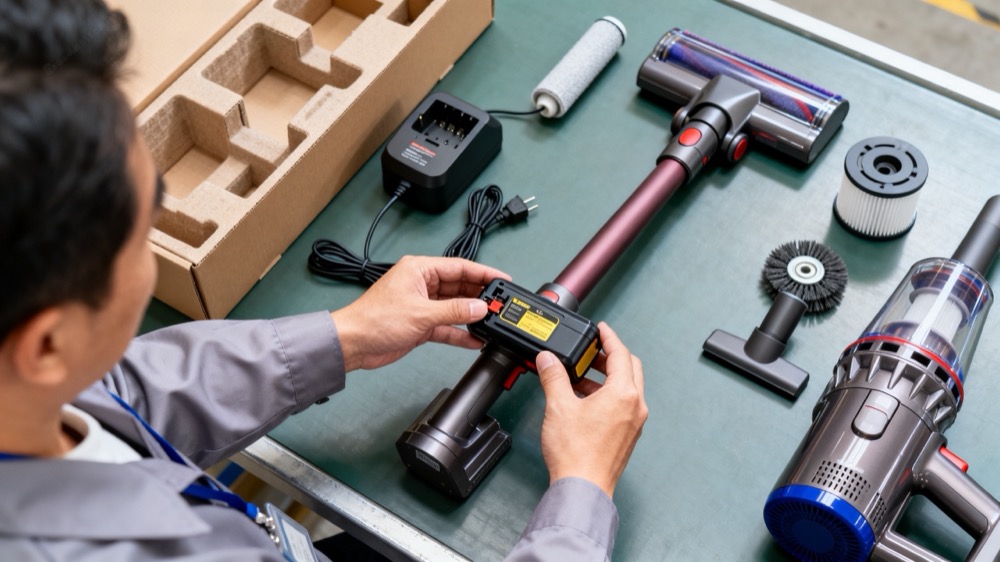
For EU consumer sales, a business that places a product on the market under its own name or trademark is treated as a manufacturer under the General Product Safety Regulation. A factory agreement does not remove those responsibilities. Before approving artwork, establish who maintains the safety documentation, how finished units are traced, and who handles safety complaints or corrective action.
For lithium-battery transport, request the UN 38.3 test summary for the battery type in the quoted model. Give your freight forwarder the actual shipping configuration. A battery installed in the vacuum and a spare battery packaged alongside it may be subject to different air-shipping requirements. The test summary does not, by itself, establish that the finished vacuum complies with product safety rules in the destination market.
- Choose generic products when you need to test a price point, launch from stock, or learn which accessories customers use before committing to custom inventory. Confirm that reorders will match the tested specification.
- Choose private label when you have a defined customer segment, a measurable product or service difference, and enough expected sales to recover launch costs. Confirm that your team can keep replacement parts available and manage the warranty.
- Use a staged launch when demand looks promising but remains unproven. Start with an existing platform, track returns and customer questions, then customize the part customers actually complain about or ask for. That might be the floor head, charging dock, or tool bundle rather than the vacuum itself.
Ningbo Eyunhome Electric Technology Co., Ltd. manufactures upright, handheld, corded, and cordless vacuums in China and offers OEM/ODM and after-sales support for international buyers.
Send us your destination market, sales channel, expected order volume, target landed cost, and top three performance requirements. Ask for two quotations: an existing cordless vacuum platform and a private label configuration. Request that each quote list the included accessories, sample and production lead times, MOQ, available test documentation, and spare-parts terms. That gives your team a comparable basis for deciding what to sample and what to customize.
Not automatically. It is better for your business if the agreed specification or service package meets a customer need and justifies the added cost. Compare production-representative samples rather than treating the brand name as evidence of quality.
Yes, if your supplier supports that route. Start with a catalog platform and approved artwork. Before changing a battery, charger, floor head, or housing, check how the change affects compatibility, documentation, and claims already printed on the packaging.
There is no single MOQ. Ask for separate minimums for neutral stock, branded cartons, custom colors, and hardware modifications. Request reorder minimums as well; they matter if you plan to replenish inventory in smaller batches.
No. A catalog model is only a faster option if the right configuration is available and the documentation, charger, labeling, and instructions suit the destination market. Confirm the actual dispatch date rather than relying on a catalog lead time.
Only if the agreement defines it. Specify whether it covers the whole model or just a color, accessory bundle, or design feature. State the territory, sales channels, term, and any order-volume conditions. Your own logo does not make the underlying platform exclusive.
Start with filters, brush rolls, chargers, and replacement batteries where applicable. Ask for part numbers, compatibility across model revisions, prices, replenishment lead times, and how long the supplier will continue to offer them. Confirm any battery transport requirements separately.
Ask for the tested model and configuration, measurement method and edition, attachments, power settings, surfaces, and test endpoints. Match those conditions to the claims you plan to make on the carton, product page, and sales materials.
- International Electrotechnical Commission, [IEC 62885-2:2026 — Dry vacuum cleaners for household or similar use: Methods for measuring performance]. Basis for the performance measurement discussion and the treatment of cordless dry vacuums. [webstore.iec]
- European Commission, [EU General Product Safety Regulation overview], and European Union, [Regulation (EU) 2023/988, Article 13]. Basis for the EU product safety and own-brand manufacturer discussion. [trade.ec.europa]
- International Air Transport Association, [Battery Guidance Document]. Basis for the UN 38.3 test summary and air transport discussion. [iata]


