
Views: 288 Author: Eyunhome Vacuum Publish Time: 2026-10-15 Origin: Site


Content Menu
● Cordless Vacuum Suction Power vs Battery Runtime: A Quick Comparison
● What Cordless Vacuum Suction Power Actually Means
>> Air Watts, Pressure, Airflow, and Motor Wattage
>> Why Higher Suction Does Not Automatically Mean Better Cleaning
● What Cordless Vacuum Battery Runtime Actually Means
>> Maximum Runtime Is Not Typical Cleaning Runtime
>> Compare Runtime at the Setting You Will Actually Use
● Which Matters More for Different Cleaning Scenarios?
>> Carpets and Embedded Dirt: Start With Pickup Performance
>> Large Hard-Floor Areas: Emphasize Useful Runtime
>> Pet Hair and Mixed Surfaces: Evaluate the Complete System
>> Cars, Stairs, and Quick Cleanups: Match the Tool to the Task
● A Real-World Example: Peak Suction and Maximum Runtime Are Different Claims
● A Better Comparison Metric: Cleaning Completed per Charge
>> Measure Successful Coverage, Not Just Operating Minutes
● How to Test Cordless Vacuum Suction Power and Battery Runtime Together
>> Step 1: Define the Intended Cleaning Job
>> Step 2: Standardize the Conditions
>> Step 3: Test Every Relevant Mode
>> Step 4: Measure Pickup Separately
>> Step 5: Report Results as a Performance Matrix
● What OEM/ODM Buyers Should Prioritize
>> Turn Customer Needs Into Verifiable Requirements
>> Discuss the Product Balance With Eyunhome
● Build a Cordless Vacuum Around Your Customers' Cleaning Needs
>> Is Suction Power More Important Than Battery Runtime?
>> Does Higher kPa Always Mean Better Cleaning?
>> Are Air Watts the Same as Motor Watts?
>> Why Is Actual Runtime Shorter Than the Advertised Maximum?
>> Should Buyers Compare Runtime With a Motorized Floorhead?
>> What Evidence Should an OEM/ODM Buyer Request?
When comparing cordless vacuum suction power vs battery runtime, prioritize cleaning performance first, then choose enough runtime to finish the intended job. Strong suction is valuable only when the vacuum removes debris effectively. Long battery life matters only when that performance remains useful throughout the cleaning session.
For homes with carpets, pets, or embedded dirt, cleaning capability usually deserves greater attention. For larger spaces with mostly hard floors, usable battery runtime becomes more important once satisfactory pickup is established.
From a product-selection perspective, I would focus on one question: how much cleaning can this vacuum complete before it needs recharging? That connects both specifications to usable performance, rather than treating them as competing headline numbers.

| Comparison factor | Suction power | Battery runtime |
|---|---|---|
| Main purpose | Supports debris removal | Determines uninterrupted operating time |
| Common measurements | Air watts, pressure, and airflow | Minutes under specified operating conditions |
| Main limitation | Does not independently establish floor-cleaning performance | Does not establish how effectively the vacuum cleans |
| Critical buying question | Can it clean the intended surfaces effectively? | Can it finish the intended task at that setting? |
| Best comparison method | Matched pickup tests and measurement conditions | Matched modes, attachments, and operating conditions |
Neither specification should be evaluated alone. Independent performance testing measures actual debris pickup because advertised power, settings, and accessories cannot individually establish cleaning effectiveness. Battery testing likewise distinguishes minimum and maximum runtime rather than relying on one figure.
"Suction power" can refer to different measurements. Understanding those distinctions helps buyers avoid comparisons that look precise but are technically misleading.
Air watts describe the power carried by an air stream under specified resistance conditions. Pressure, commonly expressed in pascals or kilopascals, describes the pressure difference generated by the vacuum. Airflow describes the volume of air moving through it. Motor wattage describes electrical input—not the same thing as cleaning output. ASTM air-performance testing distinguishes suction, airflow, air power, and input power.
These measurements are related, but they are not interchangeable.
A high sealed-suction measurement can occur when airflow is restricted. Conversely, airflow increases as the opening becomes less restrictive. This is why a pressure figure alone cannot describe the complete operating performance of a vacuum.
When comparing cordless vacuum suction specifications, ask:
- Where was the measurement taken?
- Which operating mode was used?
- Were the same attachments fitted?
- Which test method was followed?
- Was the figure a peak measurement or representative operating value?
A vacuum's floorhead, brush system, airflow path, and interaction with the surface affect how its available power translates into pickup.
ASTM explicitly cautions that laboratory air-performance results do not indicate the actual air power present during cleaning, because tools and surfaces change operating conditions. Independent testing therefore evaluates debris removal directly across different surfaces and debris types.
For buyers, this creates an important distinction: suction is a capability measurement; debris pickup is an outcome measurement.
A convincing comparison should show both.
Battery runtime describes how long a vacuum operates under stated conditions. It is different from battery lifespan, which concerns how the battery performs over its service life.
An advertised "up to" runtime may describe low-power operation with a particular attachment or configuration.
For example, Dyson lists up to 60 minutes for its V8 Cyclone in Eco mode and handheld configuration. It separately states that actual runtime varies with power mode, floor type, and attachments. Its suction comparison uses a different operating condition: Boost mode at the inlet.
The lesson is not that maximum-runtime claims are inherently unreliable. It is that buyers must read the conditions.
A maximum suction figure and maximum runtime figure may not be achievable simultaneously.
Independent battery testing illustrates the importance of mode-specific reporting. RTINGS measures minimum battery life at maximum power with a motorized head where applicable, and maximum battery life at minimum power. Consumer Reports tests all speed settings twice and averages the results.
For purchasing decisions, request:
1. Runtime in Eco mode.
2. Runtime in normal or medium mode.
3. Runtime in maximum-power mode.
4. The attachment used for each result.
5. Recharge time and battery configuration.
For routine floor cleaning, normal-mode runtime with the intended floorhead is often the more decision-relevant figure—not the longest possible handheld runtime.
The practical answer depends on the surface, debris, and size of the task. The following priorities are a selection framework, not universal performance guarantees.
For carpet-focused products, I would begin with controlled carpet pickup tests rather than a minimum air-watt target.
The vacuum must remove the intended debris effectively with its supplied floorhead. Only then should the buyer judge whether runtime at that effective setting is sufficient.
Independent testing uses repeated passes and measured debris removal to evaluate cleaning performance. That provides stronger evidence than assuming a larger suction number guarantees a better result.
For extensive hard-floor cleaning, prioritize runtime once the product demonstrates satisfactory pickup of the relevant dust and debris.
The key question becomes whether the vacuum can maintain that result throughout the planned session. Request operating time with the supplied floorhead—not just a lightweight handheld attachment.
This distinction matters because manufacturer runtime qualifications can depend on configuration and attachment choice.
For pet-owning households, assess hair pickup, brush maintenance, maneuverability, and battery runtime together.
A strong peak-suction claim does not answer whether the floorhead handles hair effectively or whether the user must repeatedly stop to clear it. Surface-specific cleaning tests are more informative than suction specifications alone.
For mixed-floor homes, compare performance and runtime on the combination of surfaces users actually clean.
For short, localized jobs, the longest advertised runtime may have limited practical value.
Instead, evaluate cleaning access, handheld configuration, attachment suitability, and performance at the required setting. Battery testing and manufacturer qualifications show that operating mode and configuration can materially change runtime.
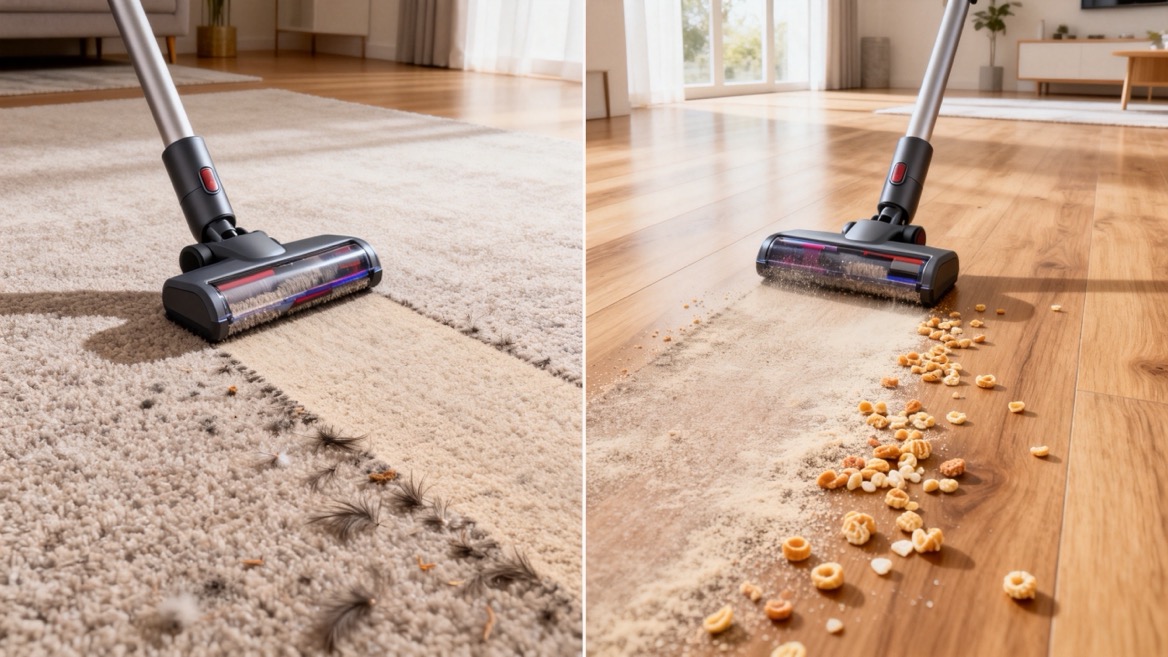
Dyson's V8 Cyclone provides a useful example of specification reading.
The product page advertises 150 air watts and up to 60 minutes of runtime. However, the runtime qualification applies to Eco mode in handheld configuration, while the cited suction comparison is tested in Boost mode at the inlet.
| Published claim | Condition to examine |
|---|---|
| Maximum suction | Power mode, measurement location, and test method |
| Maximum runtime | Power mode, attachment, and configuration |
| Whole-home suitability | Actual cleaning time at an effective setting |
| Cleaning capability | Surface-specific pickup results |
This example is not a ranking or endorsement. It demonstrates why two impressive numbers should not be combined into an unsupported promise.
For importers and private-label brands, the same discipline should apply to packaging, specification sheets, and sales presentations.
My preferred evaluation framework is cleaning completed per charge.
This is a proposed procurement metric, not a standardized laboratory measurement. Its purpose is to connect cleaning quality with operating duration.
Consider two hypothetical cordless vacuums:
- Model A runs longer but needs repeated passes to reach the target result.
- Model B runs for less time but reaches that result faster.
The longer-running product does not necessarily complete more useful work.
For a meaningful comparison, define a cleaning threshold, then measure how much representative area each vacuum cleans to that threshold before recharging.
Record:
- Surface and debris type.
- Initial debris quantity.
- Operating mode and attachment.
- Number of passes.
- Percentage of debris removed.
- Active cleaning time and interruptions.
This extends the logic of independent pickup testing, which measures debris collected after controlled passes, into a practical whole-task assessment.
Useful coverage should also account for interruptions.
Record time spent emptying the bin, removing tangled material, changing attachments, and repeating unsatisfactory sections. These are proposed evaluation criteria, not claims about any specific product.
For product development, this approach helps reveal whether a larger battery genuinely improves the experience—or merely compensates for inefficient cleaning.
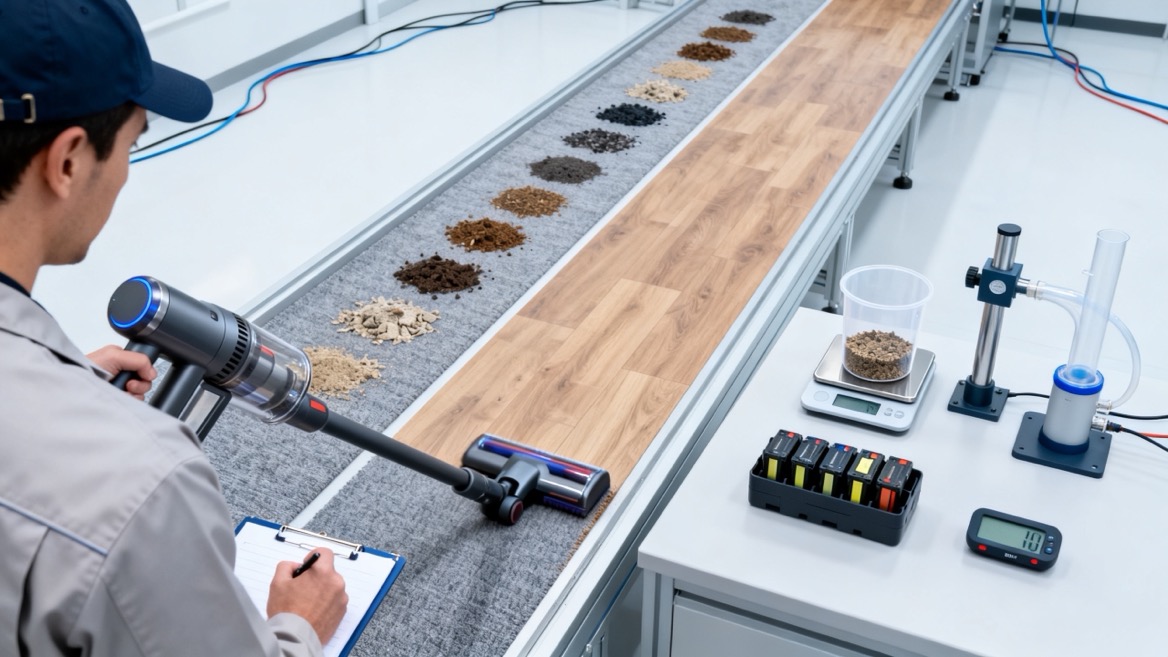
A structured sample evaluation can prevent misleading comparisons and improve purchasing decisions.
Specify the target customer, surfaces, debris, and expected session length.
An apartment-focused vacuum and a carpet-focused family-home vacuum should not automatically share the same performance priorities.
Use comparable battery preparation, maintenance condition, attachments, surfaces, and debris quantities.
Document the operating mode and ambient conditions. Consistency makes differences between samples easier to interpret.
IEC 62885-2:2026 covers performance measurements for mains-operated and cordless dry vacuum cleaners, including additional requirements for cordless measurements in Annex D. Use an appropriate documented method when commissioning formal testing.
Measure Eco, normal, and maximum-power runtime separately.
Where useful, distinguish motorized-floorhead operation from handheld operation. Independent testing already separates maximum- and minimum-power battery performance, demonstrating why one runtime number is insufficient.
Use a known quantity of representative debris and a consistent number of passes.
Repeat the test to check consistency. RTINGS, for example, repeats its debris pickup process three times for each debris type and surface.
| Evaluation item | What to document |
|---|---|
| Suction and airflow | Method, mode, and measurement location |
| Debris pickup | Surface, debris, passes, and removal result |
| Battery runtime | Mode, attachment, and configuration |
| Charging | Recharge conditions and elapsed time |
| Practical usability | Weight, handling, interruptions, and maintenance access |
The result is a clearer product profile than a comparison built around peak suction and maximum runtime alone.
For a brand or distributor, the right balance must fit the intended market position.
A procurement brief should explain the cleaning task before specifying motor power or battery size.
Useful requirements include:
- Effective pickup on target surfaces.
- Runtime at the intended everyday setting.
- Acceptable handling and product weight.
- Clear battery and attachment information.
- Accessible maintenance instructions.
- Agreed testing and claim-verification procedures.
- Defined after-sales responsibilities.
Avoid treating a suction figure as a complete engineering brief. ASTM's stated limitations show why laboratory air-performance results require context before becoming consumer-facing cleaning claims.
Ningbo Eyunhome Electric Technology Co., Ltd.. offers upright, handheld, corded, and cordless vacuum solutions, together with OEM/ODM services, stable production, and after-sales support, according to the company information supplied for this article.
For a cordless project, the initial discussion should identify target surfaces, expected cleaning duration, price positioning, and the evidence needed to support product claims.
Specific suction, runtime, battery, and testing capabilities should be confirmed for the selected model. They should not be assumed from general manufacturing capabilities.
Contact Ningbo Eyunhome Electric Technology Co., Ltd. to discuss your target market, floor types, expected cleaning duration, and OEM/ODM requirements.
Request a model-specific comparison of suction performance, everyday-mode runtime, and sample-testing conditions. Build your product proposition around cleaning customers can complete—not specifications they cannot reproduce.
Effective cleaning comes first. After a vacuum demonstrates satisfactory pickup, assess whether it runs long enough to complete the intended task. Suction specifications alone do not establish cleaning performance.
No. Pressure and airflow describe different aspects of air performance. A pressure measurement alone cannot establish debris pickup across different tools and surfaces.
No. Air watts concern power in the airflow under specified conditions. Motor input wattage concerns electrical power consumed. ASTM treats air power and input power as separate measurements.
Maximum runtime may use a low-power mode or a particular configuration. Different modes, surfaces, and attachments can change operating duration. Always check the qualification attached to the claim.
Yes, when powered-floorhead cleaning represents the intended use. A handheld maximum-runtime figure should not substitute for floor-cleaning runtime. Independent minimum-runtime testing includes a motorized head where applicable.
Request mode-specific runtime, documented air-performance conditions, and surface-specific pickup results. Together, these address the limitations of judging a vacuum from one suction number or one maximum-runtime claim.
1. ASTM International. *ASTM F558-21: Standard Test Method for Measuring Air Performance Characteristics of Vacuum Cleaners.* Covers suction, airflow, air power, and electrical input measurements, including limitations when interpreting laboratory results as actual cleaning performance. [astm]
[https://www.astm.org/f0558-21.html]
2. International Electrotechnical Commission. *IEC 62885-2:2026: Surface Cleaning Appliances — Part 2: Dry Vacuum Cleaners for Household or Similar Use — Methods for Measuring the Performance.* Provides a performance-measurement framework for mains-operated and cordless dry vacuum cleaners. [webstore.iec]
[https://webstore.iec.ch/en/publication/82454]
3. RTINGS.com. *Our Vacuum Design Tests: Battery.* Explains testing of minimum and maximum battery runtime, operating configurations, and recharge time. [rtings]
[https://www.rtings.com/vacuum/tests/design/battery]
4. RTINGS.com. *Our Vacuum Performance Tests.* Describes surface-specific debris pickup testing and explains how cleaning modes, attachments, and other product characteristics inform performance comparisons. [rtings]
[https://www.rtings.com/vacuum/tests/performance]
5. RTINGS.com. *Test Bench 1.2 — Airflow: R&D Article.* Explains airflow measurement and its relationship to suction testing when evaluating vacuum performance. [rtings]
[https://www.rtings.com/vacuum/learn/research/airflow]
6. Consumer Reports. *4 Cordless Stick Vacuums With the Best Battery Life, Lab-Tested.* Describes runtime testing at different speed settings, with repeated measurements averaged for comparison. [consumerreports]
7. Dyson. *Dyson V8 Cyclone Cordless Vacuum.* Provides manufacturer specifications and qualifications illustrating why maximum suction and maximum runtime must be interpreted under their respective operating conditions. [dyson]


