
Views: 264 Author: Eyunhome Vacuum Publish Time: 2026-10-17 Origin: Site


Content Menu
● Removable vs Built-In Battery Cordless Vacuum: Quick Comparison
● What Is the Difference Between Removable and Built-In Vacuum Batteries?
>> Removable Battery Cordless Vacuum
>> Built-In Battery Cordless Vacuum
● Runtime and Suction: Does a Removable Battery Perform Better?
>> Battery Capacity Matters More Than Detachability
>> Swappable Batteries Extend Sessions, Not Individual Pack Runtime
● Charging Convenience, Weight, and Everyday Usability
>> Removable Batteries Offer More Charging Flexibility
>> Built-In Batteries Can Simplify the User Routine
● Battery Lifespan, Replacement Costs, and Safety
>> Battery Architecture Does Not Determine Battery Lifespan
>> Replacement Access Changes the Cost of Ownership
>> Neither Design Is Automatically Safer
● Three Deeper Checks That Improve a Battery Decision
>> 1. Compare Total Ownership Cost, Not Just Purchase Price
>> 2. Test the Battery Interface, Not Just the Runtime
>> 3. Plan for European Battery Replaceability Requirements
● Which Battery Design Should Buyers Choose?
>> Choose a Removable Battery Cordless Vacuum When:
>> Consider a Serviceable Built-In Battery Cordless Vacuum When:
● Developing Your OEM/ODM Cordless Vacuum Range
>> 1. Is a removable battery better than a built-in battery for a cordless vacuum?
>> 2. Do removable batteries provide stronger suction?
>> 3. Can a built-in cordless vacuum battery be replaced?
>> 4. Can I use any battery with the same voltage?
>> 5. Does buying a spare battery double runtime?
>> 6. How should an old vacuum battery be recycled?
Choosing a removable battery vs built-in battery cordless vacuum affects more than charging convenience. It shapes cleaning continuity, repair costs, product design, and the after-sales experience. For importers and private-label brands, it also influences spare-parts planning and long-term product positioning.
My recommendation is to start with replaceability, not battery location. A detachable pack offers practical advantages, but only when compatible replacements remain available. A built-in battery can support a streamlined product, yet buyers must understand how it can be serviced.
This guide compares both designs from household and procurement perspectives. It draws on published technical guidance rather than claiming hands-on testing of specific models.
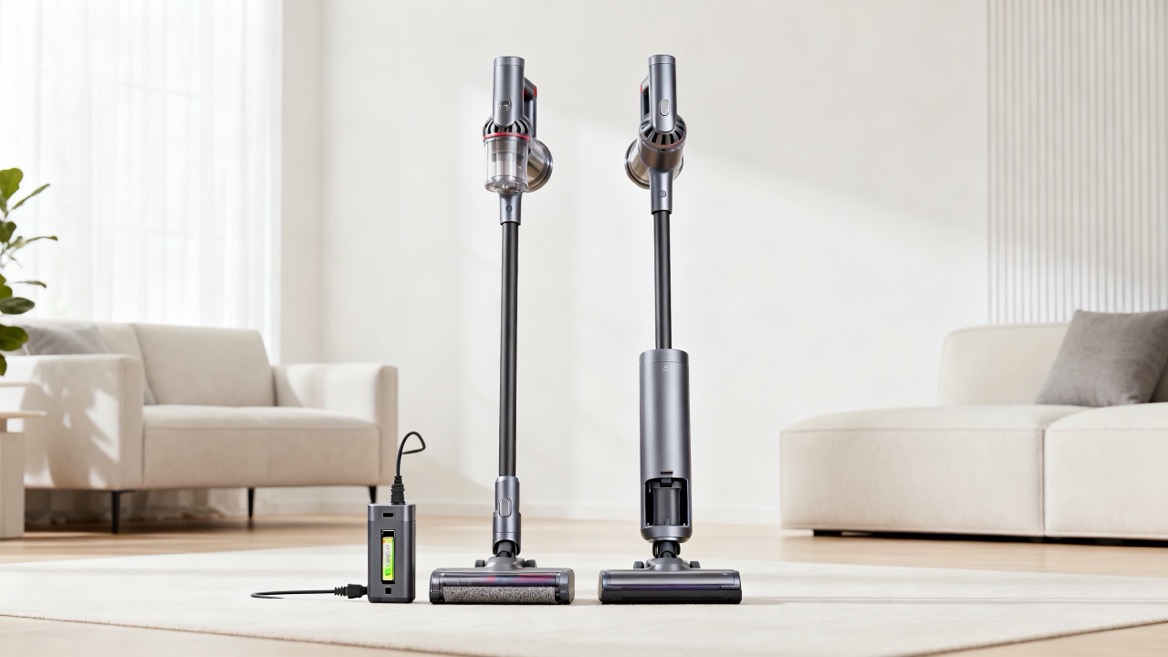
For extended cleaning and convenient battery replacement, a removable battery is generally the stronger choice. For compact products used in short sessions, a serviceable built-in design may be appropriate.
Neither architecture automatically delivers better suction, longer battery life, or greater safety.
| Comparison factor | Removable battery cordless vacuum | Built-in battery cordless vacuum |
|---|---|---|
| Battery access | Pack detaches through a release mechanism | Access may require tools or servicing |
| Extended cleaning | A charged spare can extend the session | Usually requires recharging before continuing |
| Charging options | Off-machine charging may be available | Usually charges through the appliance or dock |
| Replacement process | Often straightforward with a compatible pack | Depends on access, instructions, and service policy |
| Design considerations | Requires a secure release system and contacts | Can offer more packaging freedom |
| Long-term ownership | Depends on replacement-pack availability | Depends on repair access and service costs |
| Best-fit applications | Larger homes, frequent cleaning, repair-focused ranges | Short cleaning sessions, compact handheld products |
These are design tendencies, not guarantees. Individual models need separate evaluation.
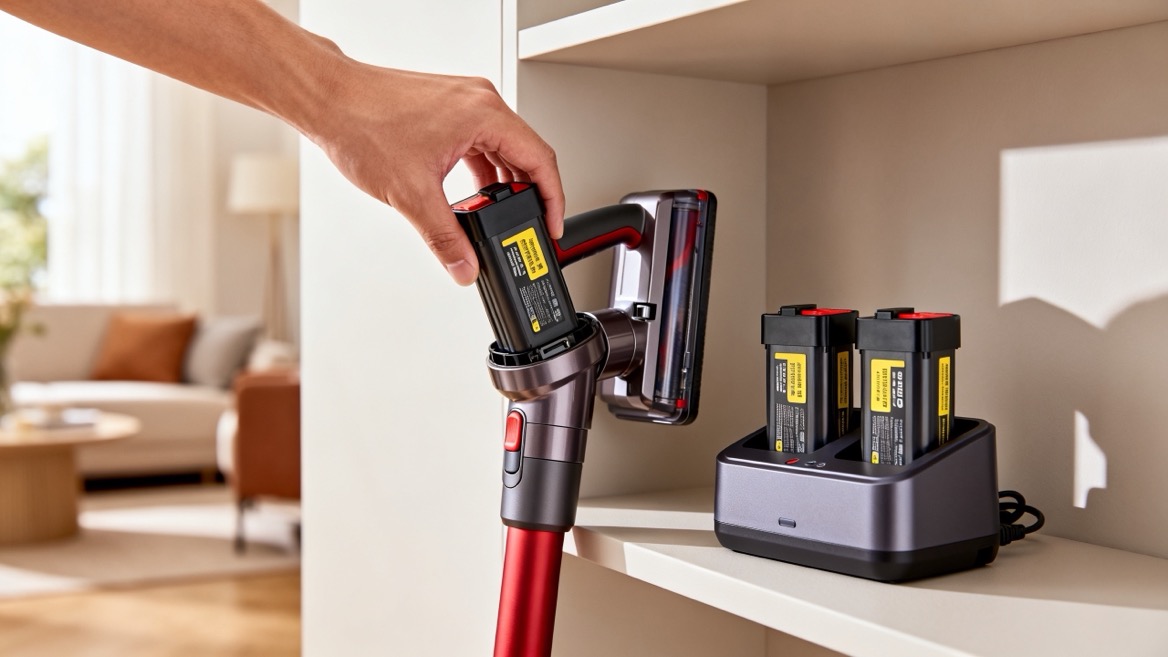
A removable battery cordless vacuum uses a pack designed to detach from the appliance. Depending on the model, users can replace an aging pack, swap in a charged spare, or charge the battery separately.
However, detachable does not necessarily mean externally chargeable. Some packs still require the vacuum or a dedicated charging accessory.
A useful product description should explain:
- Whether removal requires tools.
- Whether a spare battery is included.
- Whether off-machine charging is supported.
- Which replacement-pack part number is compatible.
A built-in battery remains inside the appliance during normal use. Replacement may involve removing screws, opening a service panel, or contacting a repair provider.
Importantly, built-in does not always mean permanently sealed or nonreplaceable.
I would separate this category into user-serviceable, technician-serviceable, and effectively nonserviceable designs. That distinction tells buyers much more than the phrase "integrated battery."
A removable pack does not inherently provide stronger suction. Cleaning performance depends on the complete system: motor, airflow path, floor head, filtration, power controls, and battery capability.
For stored energy, compare watt-hours rather than milliamp-hours alone:
Watt-hours=Nominal voltage×Amp-hours
For illustration, a 22.2 V, 2.5 Ah pack stores approximately 55.5 Wh. This is a calculated example, not an Eyunhome product specification.
Even equal watt-hour ratings do not guarantee equal runtime. Motor demand, attachments, operating mode, and control settings affect consumption.
A cordless vacuum with a swappable battery can continue cleaning after the first pack runs down, provided a compatible charged spare is ready.
That does not make each pack last longer. Nor does it guarantee continuous all-day operation: charging time, cooling requirements, and spare-pack quantity still matter.
Published manufacturer guidance also shows that runtime varies with power mode, floor type, dust level, and attachments. Treat maximum-runtime claims as conditional.
For comparisons, request:
- Runtime with the powered floor head attached.
- Normal-mode and maximum-mode results.
- The tested floor surface.
- Charging time under stated conditions.
- Whether runtime was measured continuously.
Off-machine charging can be valuable when the nearest outlet is far from the storage location. A spare pack can also reduce interruptions during a larger cleaning job.
But the charging system must support that workflow. Confirm whether buyers need an additional charger and whether one charger can charge only one pack at a time.
For users who clean briefly and return the vacuum to its dock, an integrated charging routine may be entirely sufficient.
Removing the need to handle a separate pack can also simplify daily operation. The tradeoff appears when the battery ages or a longer session exceeds available runtime.
Neither design is automatically lighter. Compare complete appliance weight and balance, especially during above-floor cleaning. A comfortable handle and well-positioned center of gravity may matter more than a small difference in total weight.
Battery aging depends on operating conditions, cell quality, charging controls, and use patterns—not simply whether the pack detaches.
Manufacturer battery-care guidance identifies heat and frequent high-power use as factors that can accelerate degradation. Users should follow their model's instructions rather than apply one universal charging rule.
For either design:
- Avoid storage in hot vehicles or direct sunlight.
- Follow specified charging-temperature limits.
- Maintain filters and clear airflow blockages.
- Use the specified battery and charging equipment.
A removable battery can reduce replacement inconvenience. A built-in battery may require labor, shipping, or service-center handling.
However, an easily detachable pack has limited long-term value if replacements disappear from sale.
Before purchasing, ask for replacement pricing, warranty conditions, compatibility information, and expected availability. Avoid treating a general appliance warranty as proof that normal battery-capacity loss is covered.
Safety requires model-level assessment. Important questions include battery protection, charger compatibility, mechanical retention, and clear operating instructions.
For removable packs, assess exposed-contact protection and latch security. For integrated designs, assess safe replacement access and service procedures.
Stop using a damaged or swollen battery and contact the manufacturer for handling instructions. Do not open a pack or attempt to replace individual cells.
A useful planning model is:
Ownership cost=Purchase price+Battery replacements+Service and delivery costs
Consider this hypothetical comparison:
| Cost item | Removable design | Serviceable built-in design |
|---|---|---|
| Initial purchase | $160 | $140 |
| One replacement battery | $45 | $40 |
| Replacement labor and delivery | $0 | $35 |
| Illustrative total | $205 | $215 |
These figures are assumptions, not quotations or market averages. Both examples assume one replacement and exclude electricity and other repairs.
The lesson is not that removable batteries always cost less. It is that a lower shelf price can conceal later service costs.
For OEM/ODM buyers, the battery connection deserves its own acceptance checklist.
Request agreed testing for:
1. Repeated insertion and removal.
2. Secure retention during normal movement.
3. Electrical-contact condition after repeated use.
4. Charging behavior after sustained operation.
5. Clear identification of compatible replacement packs.
6. Usability when the buyer has limited hand strength.
For a built-in design, add a documented replacement demonstration. Record required tools, disassembly steps, and whether replacement damages the enclosure.
These are proposed evaluation steps, not claims that every supplier performs identical tests.
For brands selling into the European Union, battery access is also a product-development issue.
Article 11 requirements under Regulation (EU) 2023/1542 apply from 18 February 2027. The general rule requires portable batteries incorporated into products to be readily removable and replaceable by end users, subject to applicable exceptions.
This does not mean every product must have a tool-free, click-out battery. Replacement using commercially available tools can meet the general framework when the relevant conditions are satisfied.
The European Commission announced additional proposed exemption categories through a delegated act adopted in July 2026. Buyers should verify the final applicable text and current guidance rather than assume that a particular vacuum qualifies for an exception.
For procurement, resolve battery access before tooling approval—not after packaging is printed.
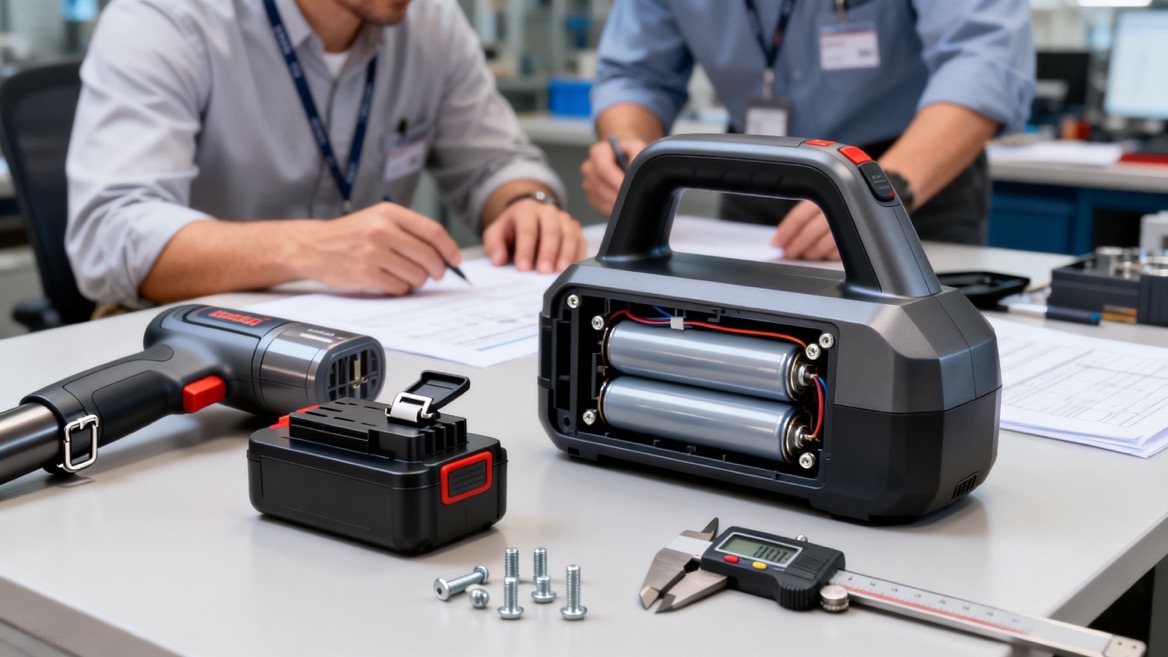
- Cleaning sessions regularly exceed one pack's practical runtime.
- Customers value straightforward battery replacement.
- Off-machine charging solves a genuine storage problem.
- Your brand can maintain compatible spare-pack supply.
- Repairability is central to the product proposition.
- The product targets short, occasional cleaning tasks.
- Compact packaging is an important design requirement.
- Customers have convenient charging access.
- Replacement procedures and service costs are clearly documented.
- The design meets the destination market's requirements.
For a long-term cordless stick vacuum range, I would generally prioritize accessible replacement and dependable spare-parts support. For a compact handheld range, I would assess actual runtime needs before adding a detachable-pack mechanism.
That is a product-positioning judgment, not a universal performance ranking.
Ningbo Eyunhome Electric Technology Co., Ltd. provides upright, handheld, corded, and cordless vacuum cleaner solutions, alongside OEM/ODM services, production support, and after-sales assistance.
For a battery-focused project, turn the comparison into a clear development brief:
- Target market and intended user.
- Required runtime with specified attachments.
- Preferred battery-access method.
- Charging arrangement and accessory package.
- Replacement-pack supply expectations.
- Warranty and service responsibilities.
Battery architecture should be evaluated alongside cleaning performance, ergonomics, manufacturing feasibility, and applicable requirements.
Send Eyunhome your target market, expected order volume, cleaning application, and battery-service requirements to request a model-specific OEM/ODM proposal. Ask for sample specifications and supporting documentation before approving production.
It is usually better for battery swapping and convenient replacement. A serviceable built-in design can still suit shorter cleaning tasks. Compare the complete product and support plan.
No. Detachability does not determine suction. Motor performance, airflow, battery output capability, and the floor head all contribute to cleaning results.
Sometimes. Some models provide user-accessible replacement; others require professional servicing. Check the instructions, replacement part number, and service price before purchasing.
No. Matching voltage alone does not establish compatibility. Physical fit, electrical connections, charging requirements, and protection systems must also be appropriate for the appliance.
Two equally performing, fully charged packs may provide roughly twice the available cleaning time under comparable conditions. Swapping, temperature limits, and operating conditions can affect the practical result.
Use an appropriate battery collection or electronics-recycling service. Do not place lithium-ion batteries in household trash or ordinary recycling bins. Follow local instructions and seek specific guidance for damaged packs.
1. [Dyson — Vacuum Battery Care]. Manufacturer guidance supporting the discussion of temperature, power modes, battery aging, and care. Model-specific instructions take precedence. [dyson]
2. [Dyson — Cordless Vacuum Cleaners]. Product information explaining that runtime varies with operating mode, floor type, dust level, and attachments. Not used as evidence of Eyunhome product performance. [dyson]
3. [Intertek — Navigating 2027 Requirements for Removability and Replaceability of Batteries in Electrical Products]. Andreas Nyman, Senior Battery Specialist, 27 June 2025. Technical interpretation supporting the February 2027 date, tool-access distinction, and replacement requirements. [intertek]
4. [European Commission — Batteries]. Official overview of Regulation (EU) 2023/1542, battery categories, implementation, and related guidance. [environment.ec.europa]
5. [European Commission — Commission Adds Exemptions to Rules on Removability of Portable Batteries]. Directorate-General for Environment, 14 July 2026. Explains the adopted delegated act, additional exemption categories, and subsequent scrutiny process. [environment.ec.europa]
6. [United States Environmental Protection Agency — Used Lithium-Ion Batteries]. Official guidance supporting separate collection, terminal protection, and the prohibition on disposal in household trash or ordinary recycling bins. [epa]


