
Views: 238 Author: Eyunhome Vacuum Publish Time: 2026-09-17 Origin: Site


Content Menu
● Portable Vacuum vs Shop Vacuum: Quick Comparison
● What Is a Portable Vacuum for Vehicle Cleaning?
● What Is a Shop Vacuum for Vehicle Cleaning?
● Portable Vacuum vs Shop Vacuum: Cleaning Performance
>> Dust, Crumbs, and Fine Interior Debris
>> Heavy Dirt, Mud, and Large Debris
>> Pet Hair and Fabric Upholstery
● Power Supply and Runtime: A Major Buying Decision
>> 12V Vehicle-Powered Portable Vacuum
● Wet-and-Dry Vehicle Cleaning Capability
● Practical Selection Guide by User Type
● The Total Cost of Ownership for Commercial Buyers
>> Portable Vacuum Cost Factors
● Expert Checklist: How to Test a Vehicle Vacuum Before Ordering
● When a Portable Vacuum Is the Better Choice
● When a Shop Vacuum Is the Better Choice
● Product Development Opportunities for Vacuum Brands
● FAQ
>> 1. Is a portable vacuum powerful enough for car cleaning?
>> 2. Is a shop vacuum better than a portable vacuum for pet hair in cars?
>> 3. Can a portable car vacuum pick up liquids?
>> 4. What is the best vacuum type for a mobile car-detailing business?
>> 5. Should I choose a cordless or 12V portable car vacuum?
>> 6. What should importers check before ordering a car vacuum cleaner from a manufacturer?
>> 7. Can a vacuum cleaner manufacturer customize portable and shop vacuums?
When comparing a portable vacuum vs shop vacuum for vehicle cleaning, the right choice depends on the cleaning environment, dirt type, power availability, operator workflow, and the expectations of end users. A portable vacuum is typically the better option for quick interior touch-ups, mobile detailing, private-car owners, and compact storage. A shop vacuum is usually better for high-volume workshops, wet-and-dry debris, deep carpet extraction support, and demanding commercial cleaning tasks.
For importers, distributors, private-label brands, and automotive-accessory buyers, the decision is not simply about choosing the strongest machine. It is about selecting a product category that matches the target customer, price point, local regulations, retail channel, and after-sales strategy. As a China vacuum cleaner manufacturer, Ningbo Eyunhome Electric Technology Co., Ltd. supports buyers with upright, handheld, corded, and cordless vacuum cleaner solutions, including flexible OEM/ODM development for different market requirements.

The following table provides a practical overview of the main differences between a portable vacuum cleaner and a shop vacuum for car cleaning.
| Comparison Factor | Portable Vacuum for Vehicle Cleaning | Shop Vacuum for Vehicle Cleaning |
|---|---|---|
| Typical use | Fast interior cleaning and light maintenance | Deep cleaning, workshop cleaning, wet-and-dry jobs |
| Size and weight | Compact, lightweight, easy to carry | Larger, heavier, often mounted on wheels |
| Power source | Rechargeable battery, 12V vehicle socket, or household power | Usually corded AC power |
| Best for | Car owners, mobile detailers, small apartments, retail users | Garages, detailing shops, car washes, repair centers |
| Suction capacity | Suitable for dust, crumbs, hair, sand, and light debris | Better for heavier debris, wet dirt, and large cleaning areas |
| Noise level | Often lower or moderate | Frequently louder due to higher motor output |
| Storage | Easy to keep in a vehicle, cabinet, or small retail package | Requires more storage space |
| Runtime | Limited for cordless models | Continuous operation when connected to power |
| Wet cleaning | Available only on selected models | Common in wet-and-dry shop vacuum designs |
| Product positioning | Convenience, mobility, daily maintenance | Performance, durability, professional cleaning |
The best-selling product may not be the most powerful product. In many consumer markets, convenience and portability drive repeat usage. In professional settings, however, operators may prioritize tank capacity, continuous runtime, hose length, wet pickup capability, and filter durability.
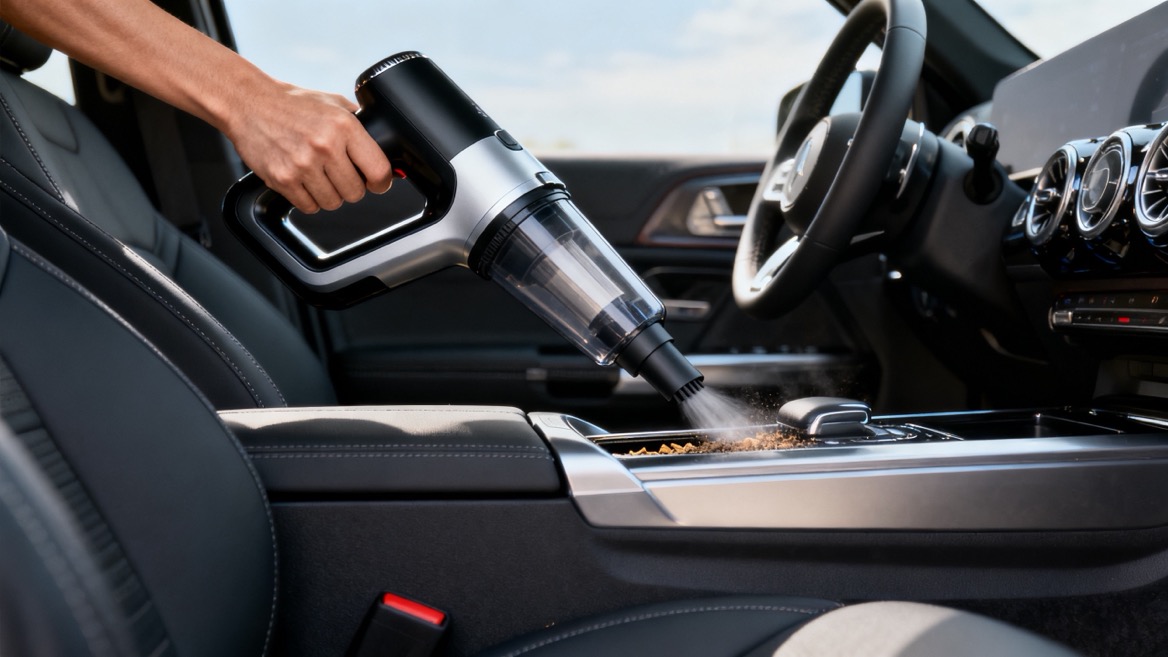
A portable vacuum is a compact cleaning machine designed for easy handling in limited spaces. For vehicle cleaning, it is normally used on seats, floor mats, dashboards, trunk areas, door pockets, and narrow gaps between seats.
Portable models can include:
- Cordless handheld vacuums
- 12V car vacuum cleaners
- Rechargeable portable vacuum cleaners
- Small corded handheld models
- Compact wet-and-dry portable vacuums
- Mini vacuums with crevice tools and brush attachments
The major appeal is simple: users can clean their cars whenever they notice dust, pet hair, snack crumbs, sand, or small debris. They do not need to bring a large machine from a garage, connect a long hose, or find a commercial power outlet.
From a product-development perspective, a good portable car vacuum should balance several factors:
- Suction efficiency
- Battery runtime or vehicle-power compatibility
- Dust cup capacity
- Noise control
- Ergonomic grip design
- Filter washability
- Easy emptying
- Useful accessories
- Compact packaging
For example, a handheld cordless vacuum with a crevice nozzle, motorized brush, washable HEPA-style filter, and USB-C charging may appeal to consumers who want quick daily vehicle maintenance. A 12V plug-in car vacuum may be more suitable for price-sensitive markets where drivers prefer continuous power directly from the vehicle outlet.
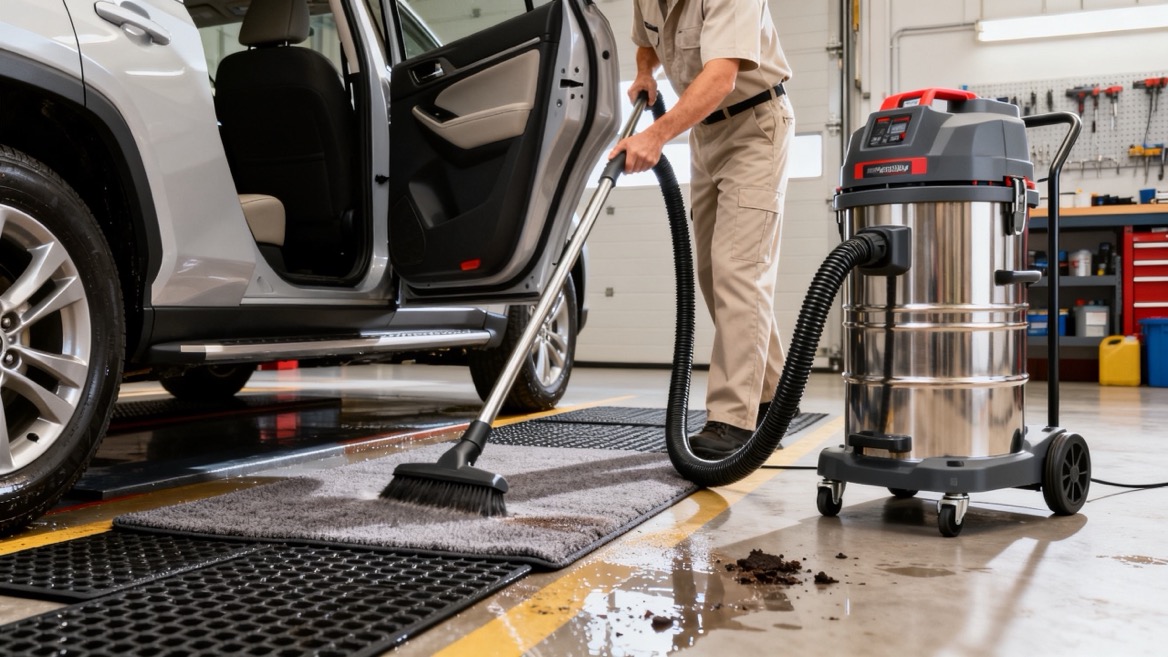
A shop vacuum is a larger, more robust vacuum cleaner designed for workshops, garages, construction areas, warehouses, repair facilities, and commercial cleaning environments. In automotive cleaning, it is commonly used by professional detailers, repair shops, car washes, fleet-management companies, and service centers.
Many shop vacuums are designed as wet-and-dry vacuum cleaners. This means they can collect dry dust, loose dirt, sawdust, larger debris, and—in suitable configurations—small amounts of liquid. For vehicle cleaning, this can be useful when dealing with muddy floor mats, wet carpet areas, spilled beverages, or debris brought in from outdoor worksites.
A typical shop vacuum may include:
- A large collection tank
- A powerful corded motor
- Flexible long hose
- Wide floor nozzle
- Crevice tool
- Wet pickup accessory
- Blower function
- Wheels or casters
- Reusable or replaceable filters
The larger tank and continuous power supply make a shop vacuum especially useful for operators who clean several vehicles per day. A detailing shop cannot afford to stop every 15 to 20 minutes to recharge a battery. In that environment, a corded shop vacuum can support a faster and more predictable workflow.
However, more power is not always better. Shop vacuums can be bulky, noisy, and less convenient for ordinary consumers. A customer living in an apartment, driving a compact vehicle, or cleaning a car once per week may find a shop vacuum unnecessarily large.
Cleaning performance should be evaluated by the actual debris found inside a vehicle—not only by advertised motor wattage or vacuum pressure.
For common car-cleaning tasks such as dust on seats, food crumbs, dry leaves, hair, and fine sand, a portable vacuum can be highly effective when it uses the right nozzle and filter system.
A narrow crevice tool is often more important than a wide floor head when cleaning:
- Gaps between front seats
- Seat rails
- Door storage pockets
- Dashboard edges
- Center-console compartments
- Air-vent surroundings
- Child-seat areas
For these tasks, a handheld portable vacuum can be faster because the user can move directly from one area to another without pulling a long hose or repositioning a large tank.
Shop vacuums generally perform better when vehicle interiors contain heavy debris. This includes dried mud, workshop dust, gravel, metal shavings, wood chips, construction residue, and large amounts of sand.
A professional garage may clean vehicles used by construction workers, outdoor sports teams, delivery fleets, or agricultural businesses. These interiors require stronger airflow, larger collection capacity, and a more durable hose system.
A shop vacuum is also more suitable when the operator must clean several cars continuously. The ability to run from a mains power source avoids battery downtime and allows longer cleaning sessions.
Pet hair is one of the most difficult vehicle-cleaning challenges. Hair can become tightly embedded in fabric seats and carpets, especially when mixed with static electricity or moisture.
Both product types can work well, but the accessory determines the result:
- A motorized brush can loosen embedded hair from fabric.
- A rubberized nozzle can pull hair from carpets and upholstery.
- A crevice tool can reach around seat edges.
- A fabric brush can clean delicate surfaces with less risk of scratching.
For private users, a portable vacuum with a motorized mini brush can provide a premium user experience. For professional detailers, a shop vacuum with strong airflow plus a dedicated pet-hair tool is more appropriate for repeated commercial use.
Power source is one of the biggest differences in the portable vacuum vs shop vacuum decision.
A cordless portable vacuum gives users maximum mobility. It can be used in parking areas, apartment garages, roadside situations, or locations without easy access to a wall outlet.
This format is ideal when customers value:
- Fast spot cleaning
- Cable-free movement
- Small storage footprint
- Easy use inside a vehicle
- Modern lifestyle design
- Travel-friendly portability
The limitation is runtime. Battery-powered models should be designed with realistic cleaning expectations. If the product is intended for quick interior maintenance, a shorter runtime may be acceptable. If it is marketed as a complete car-cleaning solution, the battery system, airflow performance, and charging time must be carefully balanced.
For private-label buyers, the battery platform matters. Lithium-ion battery quality, protection systems, charging interface, certification requirements, and replacement policies all influence long-term product performance.
A 12V car vacuum plugs into the vehicle's power outlet. It avoids battery charging concerns and can offer continuous use while the vehicle is powered.
This design may work well for:
- Budget-oriented retail markets
- Promotional automotive products
- Drivers who prefer in-car storage
- Basic dust and crumb cleaning
- Markets where simple functionality is prioritized
The main limitation is power output. A 12V system may not deliver the same performance as a larger AC-powered shop vacuum. Product messaging should therefore focus on everyday maintenance, not industrial-level cleaning.
A corded shop vacuum is the practical choice for commercial users who need stable operation. It is suitable for fixed garages, detailing bays, automotive workshops, and car wash facilities.
Its advantages include:
- No battery interruption
- Higher sustained cleaning power
- Larger dust and liquid capacity
- Better support for professional attachments
- Stronger suitability for frequent use
For B2B buyers, cord length, plug type, voltage options, hose durability, tank material, caster quality, and noise performance should be evaluated before placing a production order.
One major reason buyers choose a shop vacuum is wet pickup capability. Vehicles often contain more than dry dust. Rainwater, snow, muddy shoes, spilled coffee, leaking bottles, and wet floor mats can create cleaning problems that a basic dry vacuum is not designed to handle.
A wet-and-dry shop vacuum can help remove standing water or damp debris from:
- Rubber floor mats
- Cargo areas
- Workshop service vehicles
- Car-wash interiors
- Fleet vehicles
- Boat trailers and recreational vehicles
However, wet pickup should never be treated as an automatic feature. Buyers should verify whether the product is specifically designed for liquid collection, whether a float mechanism is included, whether the filter needs to be removed or changed, and what volume of liquid the machine can safely handle.
For portable vacuum development, compact wet-and-dry designs can create a valuable product niche. A small portable model with controlled liquid pickup can appeal to drivers who need emergency spill cleanup without purchasing a full-size shop vacuum.
Different customers need different products. The most effective product range is often not one machine, but a tiered portfolio.
| Target User | Recommended Vacuum Type | Why It Fits |
|---|---|---|
| Private car owner | Cordless portable vacuum | Easy for weekly cleaning, storage, and quick touch-ups |
| Apartment resident | Compact handheld vacuum | Small footprint and easier transport |
| Budget automotive retailer | 12V portable car vacuum | Accessible price point and simple product positioning |
| Mobile detailing professional | High-performance cordless portable vacuum | Flexible use at customer locations without relying on outlets |
| Auto repair shop | Corded shop vacuum | Better for frequent use and heavy debris |
| Car wash business | Wet-and-dry shop vacuum | Suitable for high volume and occasional liquid pickup |
| Fleet-management company | Shop vacuum plus handheld units | Supports deep cleaning and daily spot cleaning |
| Premium private-label brand | Portable vacuum with accessories | Creates a differentiated, giftable, lifestyle-oriented product |
This table highlights an important commercial reality: the product category should match the customer journey.
A car owner may purchase a portable vacuum because they want convenience. A detailing company may purchase a shop vacuum because every minute of labor affects profitability. A retailer may choose a 12V car vacuum because it has a clear price advantage and fits well into automotive-accessory displays.
Purchase price is important, but it is not the full cost. Importers and professional buyers should consider the total cost of ownership over the product's expected lifecycle.
A portable vacuum may have a lower shipping volume and easier retail packaging, but buyers should also review:
- Battery replacement availability
- Charging cable durability
- Filter replacement frequency
- Motor life
- Dust cup latch strength
- Accessory loss or breakage
- Warranty claim rate
- Product-return risk caused by unrealistic suction expectations
A well-designed portable vacuum can create strong value if it is marketed honestly. If a compact model is promoted as a substitute for a commercial workshop vacuum, customer dissatisfaction may increase.
For shop vacuums, commercial buyers should assess:
- Tank capacity
- Hose length and thickness
- Motor reliability
- Wet-pickup system design
- Filter availability
- Wheel durability
- Noise level
- Power-cord length
- Spare-part supply
- Service requirements
In professional use, downtime is costly. A machine with a slightly higher initial cost may be the better investment if it has more durable components, easier maintenance, and consistent replacement-part support.
Before committing to volume production, buyers should request samples and test them in realistic vehicle-cleaning conditions. Laboratory specifications are useful, but actual user testing reveals whether the design works in daily operation.
Use this practical evaluation process:
1. Test on multiple vehicle materials. Clean fabric seats, rubber mats, carpet, leather surfaces, plastic trim, and trunk linings.
2. Use realistic debris. Test fine dust, crumbs, sand, hair, dried leaves, pet hair, and light gravel.
3. Check difficult access points. Evaluate the crevice tool around seat rails, under seats, between cushions, and inside door pockets.
4. Measure usable cleaning time. For cordless units, test runtime under real suction conditions rather than relying only on no-load battery claims.
5. Evaluate emptying and cleaning. Users should be able to remove the dust cup, clean the filter, and reinstall components without confusion.
6. Inspect heat and noise. Run the product for an extended period to identify overheating, unpleasant vibration, or excessive sound.
7. Test accessory value. A useful brush or crevice nozzle can improve cleaning outcomes more than a minor increase in motor power.
8. Review packaging protection. Check whether the vacuum, battery, charger, hose, and accessories arrive securely after transport testing.
For OEM/ODM projects, this sample-testing stage is where product positioning becomes more accurate. A manufacturer can modify accessory combinations, color options, logo placement, packaging, battery capacity, filtration design, and user instructions to suit the destination market.
Choose a portable vacuum for vehicle cleaning when the product must be easy to use, easy to store, and easy to sell to everyday consumers.
A portable vacuum is usually the stronger option when:
- The customer needs fast cleanup rather than deep restoration.
- Storage space is limited.
- The user cleans one vehicle at a time.
- The product will be sold online, in automotive-accessory stores, or as a gift item.
- Mobility is more valuable than extended runtime.
- The vehicle is cleaned frequently but lightly.
- The target user values a sleek, lightweight design.
For many consumer brands, the most competitive offering is a portable vacuum with a thoughtful accessory kit. A combination of crevice nozzle, brush head, flexible hose, washable filter, charging cable, and storage bag can make the product more practical and more premium.
Choose a shop vacuum for vehicle cleaning when the work is frequent, heavy-duty, wet-and-dry, or performed in a fixed commercial location.
A shop vacuum is usually the better solution when:
- Operators clean multiple vehicles each day.
- Vehicles carry mud, sand, workshop debris, or large particles.
- A large collection tank is necessary.
- Wet pickup is required.
- Continuous power is available.
- The buyer needs a machine for cars, garages, workshops, and general facility cleaning.
- Long-term durability matters more than compact size.
A professional detailing business can also combine both products. A shop vacuum can handle the deep-cleaning stage, while a portable vacuum can be used for final touch-ups, dashboard areas, tight gaps, and mobile services.
The portable vacuum vs shop vacuum category creates a useful opportunity for brand differentiation. Instead of competing only on motor power or price, buyers can develop products around specific cleaning scenarios.
Potential product concepts include:
- Pet-owner car vacuum kits with a motorized brush and anti-tangle accessories.
- Family vehicle cleaning kits with long crevice tools for child-seat areas and snack debris.
- Mobile-detailing cordless vacuums with removable battery packs and high-capacity filtration.
- Workshop wet-and-dry shop vacuums with durable tanks, blower functions, and long hoses.
- Premium automotive gift sets with branded carrying cases, charging docks, and refined packaging.
- Fleet-cleaning vacuum systems that combine heavy-duty shop vacuums with portable maintenance units.
For private-label buyers, differentiation also comes from product details. Handle comfort, nozzle storage, transparent dust cups, LED indicators, charging convenience, visual branding, and packaging quality can strongly influence buyer perception.
The answer to portable vacuum vs shop vacuum for vehicle cleaning is straightforward: choose a portable vacuum for mobility, everyday vehicle maintenance, and consumer convenience; choose a shop vacuum for intensive cleaning, wet-and-dry capability, and professional use.
The most effective product strategy is to match vacuum performance to the actual cleaning job. A compact cordless car vacuum should deliver fast, accessible cleaning for dust, crumbs, hair, and tight spaces. A shop vacuum should deliver reliable continuous operation for large debris, demanding interiors, workshop use, and higher cleaning volume.
If you are developing a vacuum cleaner range for retail, e-commerce, automotive accessories, professional detailing, or commercial distribution, Ningbo Eyunhome Electric Technology Co., Ltd. can help turn your product idea into a market-ready solution. From portable handheld models to corded and cordless vacuum cleaner programs, our team can support product customization, OEM/ODM development, stable production planning, packaging, and after-sales coordination.
Contact Eyunhome today to discuss your target market, product positioning, sample requirements, and private-label vacuum cleaner project.
Yes, a portable vacuum can be effective for regular car cleaning, including dust, crumbs, hair, light sand, and debris in narrow areas. For heavily soiled carpets, wet messes, or commercial cleaning workloads, a shop vacuum is usually more suitable.
A shop vacuum can offer stronger sustained airflow and longer operating time, which helps in professional settings. However, a portable vacuum with a motorized brush or rubberized pet-hair attachment can also perform very well for private vehicles.
Only selected models are designed for wet pickup. Buyers should confirm the product specification, liquid capacity, filter requirements, and safety instructions before using any portable vacuum to collect liquids.
A high-performance cordless portable vacuum is useful for mobile flexibility, while a shop vacuum is better when the detailing team has access to reliable mains power. Many professional operators use both types for different stages of cleaning.
Choose a cordless model if your customers value freedom of movement, rechargeable convenience, and modern product design. Choose a 12V model if your target market prefers a lower-cost solution that can operate directly from a vehicle power outlet.
Importers should test suction performance, runtime, battery quality, filter design, accessory usefulness, noise, heat control, packaging protection, safety documentation, warranty terms, and spare-part availability. Sample testing in real vehicle interiors is essential.
Yes. Depending on the project, OEM/ODM customization may include logo printing, colors, packaging, battery capacity, attachments, filtration options, cord length, plug type, tank size, user manuals, and market-specific product configuration.
- [Eyunhome Vacuum — China Upright, Handheld, Corded & Cordless Vacuum Cleaner Manufacturer & Supplier]
- [Eyunhome Vacuum — Company Introduction]
- [Eyunhome Vacuum — Household Vacuum Cleaner Solutions]
- [HKTDC Sourcing — Ningbo Eyunhome Electric Technology Co., Ltd. Company Profile]
- [HKTDC Sourcing — Ningbo Eyunhome Electric Technology Co., Ltd. Catalogue]
- [HKTDC Sourcing — Rechargeable Vacuum Cleaner Product Listing]


