
Views: 269 Author: Eyunhome Vacuum Publish Time: 2026-09-18 Origin: Site


Content Menu
● Why Vacuum Mop Combos Are Growing in Importance
● The Features That Matter Most to Users
>> Strong Suction Is Important—but It Is Not Everything
>> Water Management Defines the Cleaning Result
● Cordless, Corded, Upright, or Handheld: Which Format Fits Your Market?
>> Upright and Stick Vacuum Platforms
>> Handheld Cleaning Solutions
● The Most Common Product Gaps in Vacuum Mop Combos
>> Poor Dirty-Water Tank Hygiene
>> Self-Cleaning That Is Not Truly Complete
>> Too Much Weight During Real Use
>> Weak Serviceability and Spare-Part Planning
● A Practical Development Process for Private-Label Buyers
>> Step 1: Define the Target User and Cleaning Scenario
>> Step 2: Choose a Feature Tier
>> Step 3: Validate the Critical Systems
>> Step 4: Prepare Packaging and After-Sales Materials
● How Eyunhome Supports Vacuum Cleaner Programs
● Build a Better Hard-Floor Cleaning Range
>> 1. What floors can a vacuum mop combo clean?
>> 2. Can a wet-dry vacuum replace a regular vacuum cleaner?
>> 3. Is a cordless vacuum mop combo suitable for large homes?
>> 4. Why is heated roller drying useful?
>> 5. What should buyers check before choosing an OEM vacuum cleaner manufacturer?
>> 6. How often should users clean a vacuum mop combo?
>> 7. What makes a vacuum mop combo easier to use?
A vacuum mop combo for hard floors is no longer a niche appliance. It has become a major product category for brands that want to offer faster, more convenient daily cleaning. By vacuuming dry debris and washing sealed hard floors in one pass, a well-designed wet-dry vacuum can help users reduce cleaning time, control water residue, and maintain a more presentable home.
For product managers, importers, retailers, and private-label brands, however, choosing or developing a vacuum mop combo involves more than adding a water tank to a cordless vacuum. The best hard floor cleaner must balance pickup performance, water control, battery runtime, hygiene, maneuverability, serviceability, and production consistency.
At Ningbo Eyunhome Electric Technology Co., Ltd., we work with global buyers looking for upright, handheld, corded, and cordless cleaning appliances. From our manufacturing perspective, the most successful wet-dry vacuum programs begin with a clear understanding of the end user's cleaning habits and a disciplined product-development process.
This guide explains how modern vacuum mop combos work, which features matter most, where product programs often fail, and how buyers can develop a more reliable hard-floor cleaning solution for their market.

A vacuum mop combo is a hard-floor cleaning appliance designed to pick up dry debris, collect liquid messes, and wash sealed floor surfaces during the same cleaning pass. It may also be described as a wet-dry vacuum, floor washer, or hard floor cleaner.
Most modern designs use a rotating soft roller, a clean-water tank, a dirty-water tank, a suction system, and a recovery channel. Clean water or cleaning solution is delivered onto the roller or floor surface. The roller loosens soil and stains. Then, suction and a scraper system remove the used liquid and debris into a separate dirty-water tank.
This cleaning architecture offers a clear user benefit: the user does not need to sweep first and mop afterward for many everyday messes.
A well-engineered vacuum mop combo typically performs five functions at once:
1. Dispenses clean water or diluted solution in a controlled amount
2. Rotates a soft roller to lift dust, dried food residue, and light stains
3. Uses suction to collect debris and wastewater
4. Separates clean and dirty water to avoid reusing contaminated liquid
5. Leaves the floor only lightly damp rather than visibly wet
The fifth point is often underestimated. A machine that removes stains but leaves excessive water behind can create streaks, longer drying times, and user dissatisfaction. Strong cleaning performance is not simply about adding more water. It is about delivering the right amount of water and recovering it effectively.
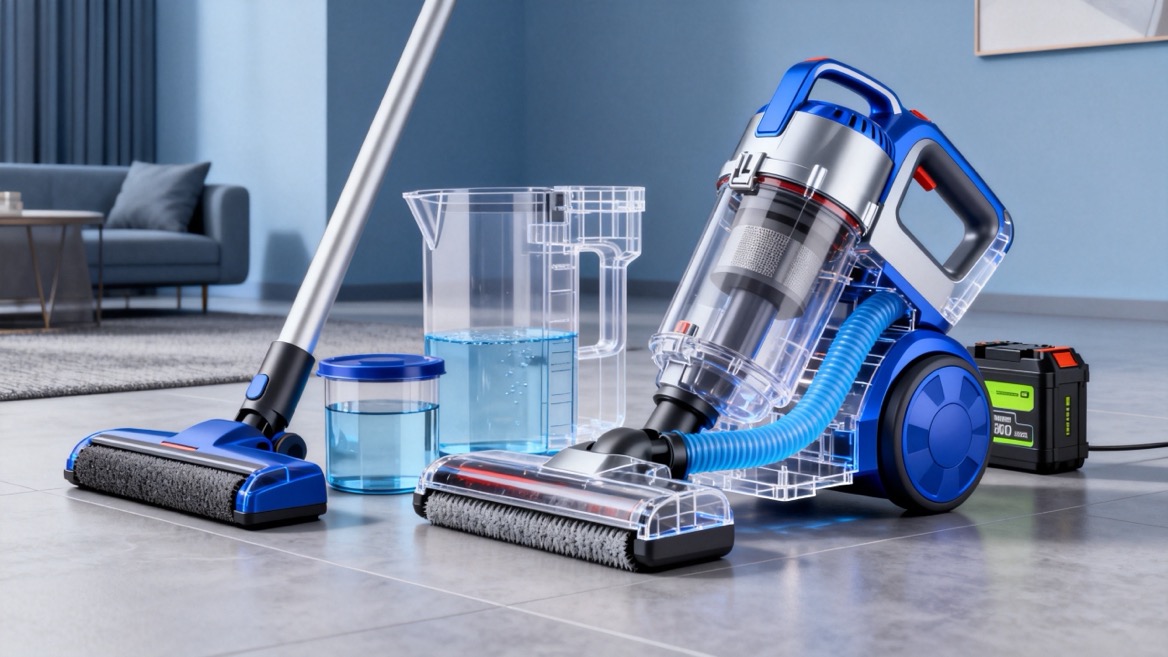
Hard flooring is common in apartments, family homes, rental properties, offices, and hospitality spaces. Tile, sealed wood, laminate, vinyl, stone, and other hard surfaces are easier to maintain when a cleaner can remove dust and wet residue in one workflow.
The category has also evolved quickly. Current premium models increasingly include features such as dirt sensing, automatic water adjustment, edge cleaning, self-propulsion, lay-flat operation, roller washing, and heated roller drying.
Independent testing published in 2026 showed that leading hard-floor cleaners are increasingly evaluated not only by stain removal, but also by residual water, usable suction at the floorhead, edge reach, runtime, weight, and long-term reliability signals. This is a useful direction for any brand because it reflects the user's real experience after the appliance leaves the retail shelf.
For buyers, the opportunity is clear: a vacuum mop combo can become a high-value addition to a home-cleaning product range. But the product must be designed around the target market rather than copied from a feature list.
Not every market needs the most expensive configuration. The right specification depends on floor type, home size, retail price target, customer expectations, and after-sales capability.
| Feature Area | Why It Matters | Product Development Consideration |
|---|---|---|
| Separate water tanks | Keeps dirty water away from the cleaning solution | Tank shape should be easy to remove, fill, empty, and rinse |
| Roller and scraper system | Determines debris pickup and wastewater recovery | Roller material, scraper angle, and sealing require repeated testing |
| Controlled water flow | Helps reduce streaks and unnecessary moisture | Use calibrated flow control rather than relying only on manual spraying |
| Battery system | Affects runtime, charging time, weight, and cost | Match battery capacity to cleaning mode and expected floor area |
| Edge cleaning | Helps users clean near walls and baseboards | Brush housing geometry is as important as roller width |
| Lay-flat design | Makes under-furniture cleaning easier | Tank sealing and airflow must remain stable when the unit reclines |
| Self-cleaning cycle | Reduces the burden of daily maintenance | The cycle must rinse internal water paths, not only the roller |
| Heated drying | Helps reduce roller odor after storage | Heat protection, energy use, noise, and drying duration need validation |
| Anti-tangle system | Improves usability in homes with long hair or pets | Blade geometry and roller material must avoid damaging the brush roll |
| Filtration and seals | Supports cleaner exhaust air and consistent suction | Confirm filter access, gasket durability, and replacement-part availability |
Many buyers focus first on motor wattage or maximum vacuum figures. These specifications can be useful, but they do not tell the complete story.
In a wet-dry floor cleaner, the more relevant question is whether suction remains effective at the floorhead while the roller is wet, debris is moving through the recovery channel, and the machine is turning around furniture. Airflow design, nozzle sealing, scraper contact, tank layout, and blockage resistance all influence real pickup performance.
A product can have a powerful motor on paper and still perform poorly if wastewater recovery is weak or the brush head does not maintain proper contact with the floor.
Water management is one of the biggest differences between an average floor washer and a product users recommend to others.
A good system should:
- Deliver enough liquid to loosen everyday stains
- Avoid oversaturating sealed hard floors
- Recover dirty water efficiently
- Minimize visible streaking after one or two passes
- Keep clean water and dirty water physically separated
- Make the dirty-water tank quick to empty and rinse
For a private-label project, this means testing should include more than dry debris pickup. Evaluate the appliance with common household messes such as coffee residue, sauce, fine dust, hair, cereal fragments, and small wet spills. Test it on several relevant sealed surfaces, not only on one smooth laboratory panel.
A complete cleaning range does not need to rely on a single product type. Different formats solve different customer problems.
Cordless wet-dry vacuums are ideal for users who value quick access and room-to-room freedom. They are especially suitable for apartments, family homes, and frequent maintenance cleaning.
Their key strengths include:
- Easy grab-and-go cleaning
- No cable management during use
- Convenient movement around furniture
- Strong appeal in premium and mid-range retail channels
- Compatibility with self-cleaning charging docks
Their trade-offs include battery cost, charging time, runtime limitations, and the need for robust battery safety controls.
A cordless product should be specified around actual use conditions. A claimed runtime measured in an ultra-low mode may not represent how customers clean sticky kitchen stains or pet-related messes. Buyers should define runtime targets by operating mode, water flow level, and roller condition.
Corded floor cleaners can be attractive for users who prioritize uninterrupted cleaning time and stable high-power operation. They are particularly relevant for larger spaces, certain commercial applications, and price-sensitive markets where battery replacement is a concern.
The key design challenge is user comfort. Cable storage, cord length, strain relief, handle ergonomics, and safe cable routing can determine whether a corded model feels practical or outdated.
An upright format can support larger tanks, a wider cleaning head, and a more substantial motor system. A stick-style platform can be lighter and easier to store. The correct choice depends on whether the buyer prioritizes coverage area, compact storage, portability, or a premium visual identity.
For brands that already sell dry stick vacuums, using compatible accessories, battery platforms, charging systems, or visual design language may simplify range development. However, wet-cleaning products have different sealing, corrosion, water-path, and hygiene requirements. A dry vacuum platform should not simply be converted without dedicated engineering validation.
Handheld vacuums are not a direct substitute for a floor washer, but they can strengthen a broader cleaning portfolio. They are useful for car interiors, furniture, stairs, crumbs, narrow gaps, and fast localized cleanup.
For retailers, combining a cordless stick vacuum, a wet-dry hard-floor cleaner, and a compact handheld vacuum can create a more complete cleaning category. For manufacturers, it also allows brand partners to develop a coherent product family across multiple price points.
Many products look competitive in photographs and specification sheets. Problems often appear only after repeated use. In our experience, the following issues should receive early attention during development.
The dirty-water tank is one of the most important ownership touchpoints. If it has narrow corners, an inaccessible filter, a weak lid seal, or a difficult-to-remove debris separator, users may delay cleaning it. That can lead to odor, residue buildup, and negative product feedback.
A better design uses a wide opening, simple removal steps, accessible filters, and a clear separation method for larger debris where appropriate.
A self-cleaning function should not be treated as a marketing label alone. A proper cycle needs to flush the roller chamber and internal liquid pathways sufficiently, while allowing the user to empty the dirty-water tank afterward.
Heated roller drying can add value, especially for users concerned about a damp brush roll sitting on a dock. Yet it must be validated for drying consistency, noise, energy consumption, thermal protection, and long-term reliability.
Product weight should be considered with water in the tank, not only when the appliance is empty. A larger tank may reduce refill frequency, but it can also make the machine less comfortable on stairs or in multi-room homes.
Balance matters. Self-propelled assistance, swivel steering, handle angle, wheel design, and center of gravity can make a heavier product feel more manageable. Conversely, a lightweight product can still feel tiring if the brush head drags or turning resistance is high.
A product is only as strong as its ownership experience. Buyers should plan for parts that may need replacement over time, including rollers, filters, tank seals, chargers, batteries, and brush components.
Before launch, define:
- Which consumables will be sold separately
- How frequently key parts are expected to be replaced
- Whether the user can remove parts without tools
- How service teams will diagnose common water-flow and charging issues
- Which spare parts should be stocked locally
This preparation can reduce warranty friction and protect the brand's reputation.
A successful OEM or ODM project starts with a detailed product brief. The brief should describe the intended user, retail channel, floor types, target selling price, desired performance level, and required compliance markets.
Start with real customer situations rather than generic claims.
For example, a pet-owning household with sealed vinyl floors may prioritize hair handling, edge cleaning, odor control, and a quick self-cleaning cycle. A compact-city apartment may prioritize storage size, low weight, and a short charging dock footprint. A large suburban home may require greater tank capacity and longer runtime.
A clear feature tier helps prevent over-specification and cost surprises.
| Product Tier | Suitable Positioning | Recommended Focus |
|---|---|---|
| Entry level | Value retail and basic daily cleaning | Reliable pickup, simple tanks, straightforward maintenance |
| Mid-range | Mainstream households | Better water control, stronger maneuverability, self-cleaning dock |
| Premium | Feature-led retail and brand differentiation | Dirt sensing, lay-flat cleaning, heated drying, advanced displays, refined ergonomics |
The best product is not always the one with the most functions. It is the one whose features match its intended price and user expectations.
Prioritize the systems that most affect ownership satisfaction:
- Motor and airflow performance
- Water delivery consistency
- Dirty-water recovery
- Roller durability
- Tank sealing
- Battery endurance and charging behavior
- Noise level
- Brush head maneuverability
- Self-cleaning effectiveness
- Long-term part replacement
Testing should be repeated across multiple production samples. A prototype that performs well once is not enough. Consistency matters in mass production.
Good product development includes the full customer journey. The packaging should protect the appliance and communicate the correct use case. The user manual should explain floor compatibility, cleaning solution guidance, daily tank emptying, roller care, charging, and troubleshooting.
Clear instructions can prevent avoidable returns. For example, users should understand that wet-dry floor cleaners are intended for sealed hard floors and are not designed to deep-clean carpets. They should also know that even a self-cleaning cycle does not remove the need to empty dirty water after use.
Ningbo Eyunhome Electric Technology Co., Ltd. develops and manufactures a range of cleaning appliances, including cordless vacuums, corded vacuums, upright formats, handheld models, and portable cleaning products. Our product approach combines practical cleaning performance with manufacturability, customization options, and quality control for international buyers.
Our stated manufacturing capability includes a 15,000-square-meter production base, annual output of 720,000 units, and business coverage across more than 30 countries and regions. The company also presents certifications and quality-management practices relevant to global appliance programs, including ISO 9001-based quality control and multiple product compliance certifications.
For OEM and ODM partners, our support can include:
- Product appearance and functional customization
- Motor, battery, accessory, and filtration configuration
- Brand identity, color, packaging, and instruction customization
- Product sampling and performance verification
- Manufacturing coordination for stable volume production
- Technical and after-sales support planning
- Development support for corded, cordless, handheld, stick, and upright vacuum categories
A strong manufacturing partnership should be transparent. Buyers should be able to discuss their market positioning, expected sales channels, compliance needs, packaging requirements, target price range, and service expectations before committing to mass production.

The vacuum mop combo category rewards products that solve everyday cleaning problems without creating new maintenance burdens. Strong stain removal, controlled water output, efficient dirty-water recovery, accessible maintenance, and stable production quality matter more than a long list of features.
For brands and importers, the opportunity is to create a hard-floor cleaner that feels practical on day one and remains dependable after months of ownership. That requires careful product positioning, disciplined testing, and a manufacturing partner that understands both performance and production realities.
Looking for a customized vacuum cleaner solution? Contact Ningbo Eyunhome Electric Technology Co., Ltd. to discuss your OEM or ODM requirements for cordless, corded, upright, handheld, and wet-dry cleaning appliances. Our team can help turn your target market requirements into a practical, manufacturable product program.
A vacuum mop combo is generally designed for sealed hard floors, including tile, sealed hardwood, laminate, vinyl, and some stone surfaces. Always confirm the flooring manufacturer's care guidance before using water, cleaning solution, or steam.
It can replace a regular vacuum for many hard-floor cleaning tasks, especially when users need to collect dust and wash the floor in one pass. However, it is not a complete replacement for carpet deep cleaning, above-floor cleaning, upholstery cleaning, or tight crevice cleaning.
Yes, if its battery runtime and water-tank capacity match the home size. For larger homes, buyers should assess runtime in real cleaning modes, charging time, clean-water capacity, dirty-water capacity, and whether an additional battery option is available.
Heated roller drying helps reduce the time a cleaned roller remains damp after use. This can help limit unpleasant odors and improve readiness for the next cleaning session. It should be paired with proper dirty-water tank emptying and routine maintenance.
Buyers should review product-development capability, quality-control procedures, production capacity, compliance support, sample performance, documentation quality, spare-parts planning, communication efficiency, and after-sales support. Factory audits and sample validation are also important before mass production.
Users should empty and rinse the dirty-water tank after every use. The roller, filter, tank lid, and internal cleaning system should be maintained according to the product manual. Even models with self-cleaning functions need regular user care.
The most helpful usability features are low turning resistance, balanced weight, swivel steering, easy tank removal, clear controls, practical runtime, effective edge cleaning, simple self-cleaning, and accessible replacement parts.
1. [Vacuum Wars: Best Hard Floor Cleaners (Vacuum Mop Combos) in 2026]
2. [Vacuum Wars: How Vacuum Wars Tests Hard Floor Cleaners]
3. [Ningbo Eyunhome Electric Technology Co., Ltd.: Vacuum Cleaner Manufacturing and OEM/ODM Solutions]
4. [Eyunhome: Household Vacuum Cleaner Manufacturing, Quality Control, and Custom Solutions]
5. [HKTDC Sourcing: Ningbo Eyunhome Electric Technology Co., Ltd. Supplier Profile]


