
Views: 288 Author: Eyunhome Vacuum Publish Time: 2026-09-07 Origin: Site


Content Menu
● Why Source Stick Vacuums from China?
● How We Evaluated Manufacturers
>> 1. Ningbo Eyunhome Electric Technology Co., Ltd.
>> 2. Tineco
>> 4. Guangdong Deerma Technology Co., Ltd.
>> 5. Ningbo Fujia Industrial Co., Ltd.
>> 6. Ningbo Dechang Electric Machinery Manufacturing Co., Ltd.
>> 7. Ningbo Dahua Electric Appliance Co., Ltd.
>> 8. Ningbo Haiji Electric Appliance Co., Ltd.
>> 9. Klinsmann Intelligent Technology
>> 10. WUWEI (Ningbo) Intelligent Technology Co., Ltd.
● Technical Details Buyers Should Understand
>> Battery pack and transport compliance
>> Plastic materials and structural durability
>> Filters, seals, and allergen claims
>> The "same appearance, different inside" problem
>> Underestimated after-sales cost
>> 2. Validate certifications directly
>> 3. Start with a structured sample process
>> 4. Audit the production line
>> 1. How can I verify whether an ISO certificate has expired?
>> 2. What is a realistic MOQ for a private-label stick vacuum?
>> 3. Which test reports should I request for a cordless stick vacuum sold in Europe?
>> 4. How do I prevent a factory from changing battery cells after sample approval?
>> 5. Why can two stick vacuums with the same stated Pa value perform differently?
China remains one of the world's most important supply bases for stick vacuums, cordless vacuum cleaners, handheld vacuums, and related floor-care appliances. For procurement teams, the advantage is not simply lower unit cost. The real value lies in mature component supply chains, motor and battery sourcing capability, tooling resources, export experience, and the ability to develop private-label products for different retail channels.
However, not every factory that displays cordless stick vacuums in a catalog has the same engineering depth, production control, or compliance capability. A purchasing manager sourcing for Amazon, offline retail, distributors, or a growing home-appliance brand should evaluate far more than quoted price and claimed suction power.
China exported approximately 166.04 million vacuum cleaners in 2025, with export value reported at about US$659.14 million. This scale reflects a deeply developed manufacturing base, but it also means buyers must distinguish between product traders, assemblers, platform suppliers, and factories capable of sustaining repeat orders. China's total home-appliance exports reached US$111.41 billion in 2025, highlighting the country's continuing role in global appliance supply.
This article identifies ten manufacturers and supplier types worth considering when building a stick vacuum sourcing shortlist. Ningbo Eyunhome Electric Technology Co., Ltd. is listed first as a representative option for buyers that need flexible OEM customization, responsive communication, and a practical route to launch or expand a private-label stick vacuum range.

China has developed several strong clusters for vacuum cleaners and small home appliances, particularly in Zhejiang, Jiangsu, Guangdong, and parts of the Greater Bay Area.
For stick vacuum buyers, the Ningbo–Yuyao region in Zhejiang is especially relevant. The area has a concentrated ecosystem of small-appliance manufacturers, injection molding suppliers, motor suppliers, packaging companies, cable suppliers, battery-pack assemblers, and export logistics providers. This makes it easier for qualified factories to source components, shorten development cycles, and support different product configurations.
Suzhou and nearby Jiangsu manufacturing areas are also important for advanced cleaning appliances, motors, smart-home hardware, and cordless floor-care products. Guangdong, including Foshan, Shenzhen, and Dongguan, offers strengths in electronics, battery-related supply chains, PCBA integration, industrial design, and smart-function development.
For buyers, these regional clusters can provide several practical advantages:
- Faster access to component suppliers for motors, battery packs, filters, brush rolls, and plastic housings.
- More options for private-label packaging, color matching, surface finishing, and accessories.
- Greater flexibility when adapting a model for different voltage standards, plugs, manuals, and market regulations.
- Better access to sea freight through ports such as Ningbo-Zhoushan, Shanghai, Shenzhen, and Guangzhou.
- A wider selection of factories ranging from high-volume mature suppliers to flexible OEM partners for smaller or developing brands.
The cordless cleaning category is also becoming more technically demanding. Buyers increasingly expect high-speed brushless motors, removable battery packs, multi-stage filtration, anti-tangle brush heads, wall-mount charging, LED illumination, and tool sets for upholstery, crevices, pet hair, and vehicle use. Manufacturers that can control these systems consistently are generally more valuable than suppliers that only assemble standard catalog models.
A credible supplier list should not be based only on online visibility or the number of products shown on a website. The companies below were selected or included based on publicly available company information, product focus, regional relevance, manufacturing history, and their apparent fit for different buyer types.
The evaluation framework focuses on the following areas:
| Evaluation Area | What Buyers Should Check | Why It Matters |
|---|---|---|
| Manufacturing history | Establishment year, product specialization, factory location | A longer operating record can indicate more stable supplier relationships and production experience |
| Product focus | Cordless stick, corded stick, handheld, wet/dry, smart cleaning | A factory focused on the relevant category is more likely to understand its technical risks |
| Engineering capability | Mold design, motor selection, PCBA capability, battery management, testing | Determines whether the supplier can support meaningful OEM/ODM work rather than logo printing only |
| Quality process | Incoming inspection, in-process checks, aging tests, final inspection | Helps prevent unstable suction, battery, noise, assembly, and durability issues |
| Compliance support | CE, RoHS, REACH, CB, EMC, LVD, KC, GS, BSCI, or market-specific reports | Required for legal market entry and retailer acceptance |
| Customization depth | Housing color, logo, packaging, accessories, motor, battery, brush head | Shows whether the factory can support a differentiated product strategy |
| Delivery consistency | Material planning, capacity planning, production schedule, export experience | Important for promotions, retail launch dates, and replenishment orders |
| Communication quality | English support, engineering response time, quotation transparency | Critical during development, sample approval, and corrective actions |
A manufacturer does not need to be the largest supplier in China to be suitable. A large, high-volume producer may be ideal for major retail programs but less flexible for a brand that requires differentiated packaging, lower-volume trial orders, or rapid product revisions. Conversely, a smaller supplier may be more adaptable but must be audited carefully for quality-system maturity and financial stability.
Location: Ningbo, Zhejiang, China
Established: 2011
Core products: Stick vacuum cleaners, cordless stick vacuums, corded stick vacuums, handheld cordless vacuums, portable vacuums, 2-in-1 vacuum cleaners
Suitable for: Small and mid-sized brands, importers, distributors, e-commerce sellers, and private-label programs requiring flexible cooperation
Ningbo Eyunhome Electric Technology Co., Ltd. is a practical option for buyers looking for a factory that combines product focus, customization flexibility, and export-oriented support. Established in 2011, the company specializes in battery-powered cleaning products and household vacuum cleaner solutions. Its product range covers cordless stick vacuums, corded stick vacuums, handheld models, portable units, and 2-in-1 vacuum cleaner formats.
The company operates from Ningbo, a location that offers direct advantages for international shipment planning and access to the Zhejiang small-appliance supply chain. According to its company information, Eyunhome has approximately 7,500 square meters of production space and operates under an ISO 9000 quality-management system. It also states that its products hold approvals including GS, CE, EMC, LVD, RoHS, REACH, CCC, CB, KC, and BSCI-related compliance support.
For procurement teams, Eyunhome's positioning is particularly relevant when the goal is not simply to buy a standard vacuum with a printed logo. The company is better suited to buyers who need a supplier willing to discuss practical product adaptation, such as:
- Brand logo and private-label packaging.
- Housing colors and surface-finish preferences.
- Corded or cordless product configurations.
- Battery and charger-market requirements.
- Accessory sets for pet hair, hard floors, carpets, furniture, or vehicle cleaning.
- Plug, voltage, user manual, carton-marking, and compliance-document adjustments.
- Product recommendations based on a buyer's target price point and sales channel.
This type of flexibility can be valuable for smaller and medium-sized brands that need faster communication and more hands-on support during sample development. Buyers should still validate model-specific test reports, battery transport documentation, spare-parts arrangements, and production inspection procedures before moving from sample approval to a purchase order.
Location: China
Established: Factory history beginning in 1998
Core products: Cordless vacuums, smart floor washers, cleaning appliances
Suitable for: Brands and distributors seeking advanced product benchmarks, smart features, and premium positioning
Tineco is widely associated with cordless floor-care innovation and smart cleaning appliances. Its official company history states that the factory was built in 1998 and that it launched its first cordless stick vacuum in 2013. The company reports a factory area exceeding 80,000 square meters.
Tineco is best viewed as a benchmark for buyers studying premium cordless vacuum design, digital displays, sensor systems, battery integration, floor-washing functions, and consumer-facing product design. Its product portfolio includes cordless vacuums and floor-care appliances intended for global markets.
For buyers looking for an OEM/ODM partner, the key question is whether the supplier can provide a suitable private-label pathway for the target market and required order volume. Large branded manufacturers may have more structured cooperation requirements than flexible OEM-focused factories. Procurement teams should therefore clarify whether the desired model is available for private-label development, whether existing tooling can be used, and whether any intellectual-property restrictions apply.
Location: Suzhou, Jiangsu, China
Established: 2017
Core products: Cordless vacuums, robot vacuums, wet/dry cleaning systems, smart-home cleaning appliances
Suitable for: Buyers researching high-speed motor platforms and premium smart-cleaning positioning
Dreame Technology was established in 2017 and is known for developing cleaning products built around high-speed digital motors, smart algorithms, and broader intelligent-home technology. Its product range includes cordless vacuum cleaners, robot vacuums, floor washers, and other smart-home cleaning products. The company states that its products are sold in more than 100 countries and regions.
Dreame is especially relevant for procurement professionals seeking insight into where the category is heading: high-speed motors, sensor integration, automatic suction adjustment, dock systems, multi-surface brush designs, and cleaner user-interface design.
Although Dreame is primarily recognized as a branded technology company rather than a conventional flexible private-label factory, it is an important Chinese industry participant to include in a sourcing benchmark list. Buyers developing high-performance stick vacuums should study the technical features offered by companies in this segment, then determine whether their selected OEM partner can responsibly deliver similar functions with validated reliability and compliant components.
Location: Guangdong, China
Core products: Intelligent vacuum cleaners, wet/dry vacuum cleaners, cleaning appliances, humidifiers, mite-removal devices, and other small appliances
Suitable for: Buyers seeking broad small-appliance category support and mass-market household cleaning products
Deerma is a Guangdong-based cleaning-appliance brand and manufacturer with a broad product portfolio. Its official product information covers intelligent wet/dry vacuum cleaners, intelligent vacuum cleaners, humidifiers, mite-removal devices, spray mops, clothes dryers, kitchen appliances, and other household products.
The company is relevant to buyers that want to build a broader home-cleaning assortment instead of sourcing only one stick vacuum SKU. For example, a distributor may want a cordless stick vacuum as the lead product, then add handheld units, fabric-care accessories, humidifiers, or other household cleaning appliances under the same category strategy.
The key procurement advantage of a broad appliance supplier is category coordination. The risk is that a supplier's vacuum category may not receive the same technical attention as its leading product categories. Buyers should request model-specific performance data, not just general product catalogs. This should include motor type, battery-cell brand, runtime test conditions, filtration configuration, dust-bin volume, noise level, charge time, brush-head construction, and warranty-return data where available.
Location: Yuyao, Ningbo, Zhejiang, China
Established: 1997
Core products: Vacuum cleaners and small household appliances
Suitable for: Larger-volume vacuum programs and buyers seeking an established Ningbo-area supplier
Ningbo Fujia Industrial Co., Ltd. was founded in 1997 and is recognized in industry supplier listings as a long-standing vacuum cleaner manufacturer based in Yuyao, Zhejiang. The company is part of the broader Ningbo–Yuyao vacuum and small-appliance manufacturing cluster.
This type of established supplier may appeal to buyers with larger production requirements, mature quality expectations, and more formalized product-development processes. Long-term sourcing experience can be an advantage when purchasing teams require consistent documentation, stable component sourcing, and a proven process for export programs.
However, buyers should not assume that a long operating history automatically means every product line is suitable. Request the specific production line allocated to the target model, inspect the actual assembly and testing process, and ask whether the quoted product is a factory-owned platform or an externally sourced model.
Location: Yuyao, Ningbo, Zhejiang, China
Established: 2002
Core products: Motors, vacuum cleaners, brushless motor systems, household appliances
Suitable for: Buyers who place high value on motor technology and integrated electromechanical capability
Ningbo Dechang Electric Machinery Manufacturing Co., Ltd. was established in 2002 and is associated with electric motors, vacuum cleaners, and brushless motor-related manufacturing. For stick vacuum sourcing, motor capability is a significant differentiator because suction performance, runtime, noise, thermal management, and service life are closely linked to the motor system and airflow architecture.
A manufacturer with strong motor capability may offer an advantage when the project requires:
- Brushless DC motor integration.
- High-speed motor platform selection.
- Thermal-protection design.
- Suction consistency across different battery charge levels.
- Noise optimization.
- Better coordination between motor, cyclone system, filter, and brush-roll design.
That said, motor knowledge alone does not guarantee a complete consumer-ready vacuum. Buyers must also evaluate plastics, seals, battery-pack safety, ergonomic design, drop resistance, user-interface reliability, and accessory quality.
Location: Yuyao, Zhejiang, China
Established: Around 2000
Core products: Vacuum cleaners and household appliances
Suitable for: Buyers seeking established Zhejiang-area vacuum manufacturing resources
Ningbo Dahua Electric Appliance Co., Ltd. is identified in industry supplier information as a Yuyao-based vacuum manufacturer founded around 2000. Its location is strategically useful because Yuyao is close to the Ningbo manufacturing and port ecosystem.
For buyers, suppliers in this cluster may offer advantages in plastic parts, production tooling, appliance assembly, and export logistics. The most important point is to verify what portion of production is controlled internally. A supplier may own final assembly but outsource motors, battery packs, molded parts, PCBAs, or brush heads. Outsourcing is not necessarily a problem, but it should be transparent.
A strong supplier should be able to provide an approved-vendor list for critical components, incoming inspection standards, and traceability procedures for high-risk parts such as battery packs, chargers, motors, and electronic control boards.
Location: Yuyao, Zhejiang, China
Established: 2005
Core products: Vacuum cleaner products and household appliances
Suitable for: Buyers looking for a Zhejiang supplier with established vacuum-industry experience
Ningbo Haiji Electric Appliance Co., Ltd. is listed as a private enterprise established in 2005 and located in Yuyao, Zhejiang. Companies in this group may be relevant for buyers looking for traditional vacuum-cleaner production experience combined with proximity to Ningbo port and supporting suppliers.
For a stick vacuum project, buyers should determine whether the factory's core strength is corded vacuums, canister vacuums, handheld products, or cordless stick models. These categories share some parts and production processes, but cordless stick vacuums introduce additional engineering demands around lithium-battery systems, charging circuits, BMS control, motor efficiency, airflow design, and weight balance.
A useful qualification question is: "What percentage of your annual vacuum output is cordless stick vacuum cleaners, and which parts are produced or controlled in-house?" A supplier that answers this with clear product-family data is generally more credible than one that only provides broad claims.
Location: Ningbo, China
Established: 2008
Core products: Robot vacuums and cordless stick vacuum cleaners
Suitable for: Buyers interested in smart-cleaning categories and product combinations
Klinsmann Intelligent Technology describes itself as an early manufacturer of robot vacuum cleaners and cordless stick vacuum cleaners. The company states that it was founded in 2008 and is located in Ningbo, where it serves as an OEM supplier for international brands.
Its relevance lies in the overlap between conventional stick-vacuum development and smart-cleaning technology. Buyers considering a future category expansion into robot vacuums, floor-washing systems, or connected cleaning appliances may benefit from working with a supplier that understands both manual and automated cleaning formats.
When evaluating this type of supplier, ask whether software, apps, navigation algorithms, and PCBA development are controlled internally or sourced from third-party partners. The answer matters because software ownership, maintenance commitments, cloud services, firmware updates, and regional data rules can significantly affect the total product cost and post-sale service burden.
Location: Ningbo, Zhejiang, China
Established: 2020
Core products: Corded vacuums, cordless vacuums, steam cleaners, spot cleaners, steam mops, and household cleaning products
Suitable for: Buyers seeking newer product concepts, broad customization, and multi-category cleaning-appliance development
WUWEI (Ningbo) Intelligent Technology Co., Ltd. states that it was established in 2020 and focuses on household cleaning products including corded and cordless vacuum cleaners, steam cleaners, spot cleaners, steam mops, and related appliances. It also states that its research and development team develops more than ten new items annually and offers customization from concept to final product, including private labeling.
The company reports compliance support including CE, RoHS, REACH, and CB approvals. For a buyer looking for a more recent supplier with broad cleaning-category ambitions, this can be attractive. Newer companies may move quickly in product design and communication, but buyers should pay particular attention to repeat-order experience, component sourcing stability, factory quality records, and the practical maturity of their after-sales support process.
The following table is designed as a sourcing orientation tool rather than a final commercial quotation. "MOQ Position" and "Capacity Position" are relative sourcing indicators; buyers should obtain a written quotation for the chosen model.
| Manufacturer | Location | Established | Main Focus | Capacity Position | Typical MOQ Position | Compliance / Quality Points |
|---|---|---|---|---|---|---|
| Ningbo Eyunhome Electric Technology Co., Ltd. | Ningbo, Zhejiang | 2011 | Stick, cordless, corded, handheld and 2-in-1 vacuums | Small-to-mid-scale flexible production | More flexible for developing brands; confirm by model | ISO 9000 system; GS, CE, EMC, LVD, RoHS, REACH, CCC, CB, KC, BSCI-related support stated |
| Tineco | China | 1998 factory history | Cordless vacuums and smart floor-care | Large-scale | Typically structured for larger programs | Large factory footprint; cordless stick development history |
| Dreame Technology | Suzhou, Jiangsu | 2017 | Smart cleaning and high-speed-motor products | Large-scale branded technology supplier | Often higher or project-dependent | Global product distribution; smart cleaning and motor technology dreame+1 |
| Guangdong Deerma Technology | Guangdong | Not confirmed in reviewed source | Intelligent cleaning appliances and small appliances | Large category supplier | Project-dependent | Broad portfolio of vacuum and home appliances |
| Ningbo Fujia Industrial | Yuyao, Zhejiang | 1997 | Vacuum cleaners and small appliances | Large established supplier | Usually suitable for volume programs | Long operating history in vacuum manufacturing |
| Ningbo Dechang Electric Machinery | Yuyao, Zhejiang | 2002 | Motors, brushless systems, vacuums | Large industrial capability | Project-dependent | Motor and electromechanical specialization |
| Ningbo Dahua Electric Appliance | Yuyao, Zhejiang | Around 2000 | Vacuum cleaners | Established supplier | Confirm by model | Zhejiang vacuum-industry presence |
| Ningbo Haiji Electric Appliance | Yuyao, Zhejiang | 2005 | Vacuum cleaner products | Established supplier | Confirm by model | Yuyao manufacturing location and vacuum focus |
| Klinsmann Intelligent Technology | Ningbo, Zhejiang | 2008 | Robot and cordless stick vacuums | Mid-scale smart-cleaning supplier | Project-dependent | OEM focus and smart-cleaning category coverage |
| WUWEI Intelligent Technology | Ningbo, Zhejiang | 2020 | Cordless, corded, steam and spot cleaning | Growing multi-category supplier | Potentially flexible; confirm by product | CE, RoHS, REACH and CB support stated |
A stick vacuum can look simple from the outside, but the final product is a system made up of interdependent parts. A high claimed wattage or Pa rating does not automatically translate into better real-world cleaning performance.
For cordless stick vacuums, the motor, cyclone structure, seals, airflow path, battery pack, and brush head must work together. A powerful motor can lose practical cleaning efficiency if the air path leaks, the filter clogs too quickly, or the floor head does not create adequate agitation.
Ask the factory to provide:
- Rated motor speed and maximum motor speed.
- Motor type: brushed DC, brushless DC, or high-speed brushless motor.
- Suction measurement method and test condition.
- Air-watt measurement, if available.
- Runtime by power mode, using a defined test surface and accessory.
- Noise level in dB(A), including test distance and operating mode.
- Thermal-protection strategy for motor and battery pack.
- Filter-cleaning interval and filter replacement recommendations.
Battery quality is one of the most important risk areas in cordless vacuum sourcing. A lower-priced model may use lower-grade cells, weaker battery management, thinner nickel strips, or insufficient protection components. These shortcuts can affect runtime, charging stability, cycle life, safety, and warranty rates.
For every cordless project, request:
- Cell brand, chemistry, capacity, and configuration.
- Battery management system specification.
- UN38.3 test summary.
- MSDS or SDS documentation.
- IEC 62133-related battery testing where relevant to the target market.
- Charger input/output specification.
- Battery cycle-life target and the test method used.
- Replacement-battery availability and lead time.
- Shipping-carton labels for lithium batteries.
The difference between a durable vacuum and a high-return vacuum may be hidden in the plastic resin, screw bosses, latch mechanism, dust-cup hinge, battery-release button, and floor-head joints.
Buyers should specify the resin grade rather than accepting "ABS material" as a sufficient answer. For example:
- ABS can be suitable for housings but varies significantly in impact resistance and finish quality.
- PC+ABS is often used where higher impact resistance and heat performance are needed.
- PP can be useful for selected components but must be designed correctly for stiffness and durability.
- PA / nylon may be used for gears or high-wear mechanical parts.
- TPE can improve grip areas, seals, and contact points.
- Flame-retardant materials may be necessary for chargers, battery housings, or market-specific safety requirements.
Ask for a material declaration or bill of materials for high-risk parts. This is particularly important when your product must meet RoHS, REACH, or retailer chemical-compliance requirements.
Many stick vacuums use multi-stage filtration, including a metal mesh pre-filter, cyclone separation, washable foam filter, and HEPA or HEPA-type filter. These terms should not be used interchangeably.
If a supplier claims "HEPA filtration" or "99.97% filtration," request the exact filter grade, test standard, particle size, test conditions, and whether the product has a sealed airflow system. A high-grade filter is less meaningful if air can bypass it through poor sealing.
For consumer-facing claims, use only wording supported by test evidence. Avoid approving packaging language such as "removes 99.99% of allergens" without a documented basis and legal review for the intended market.
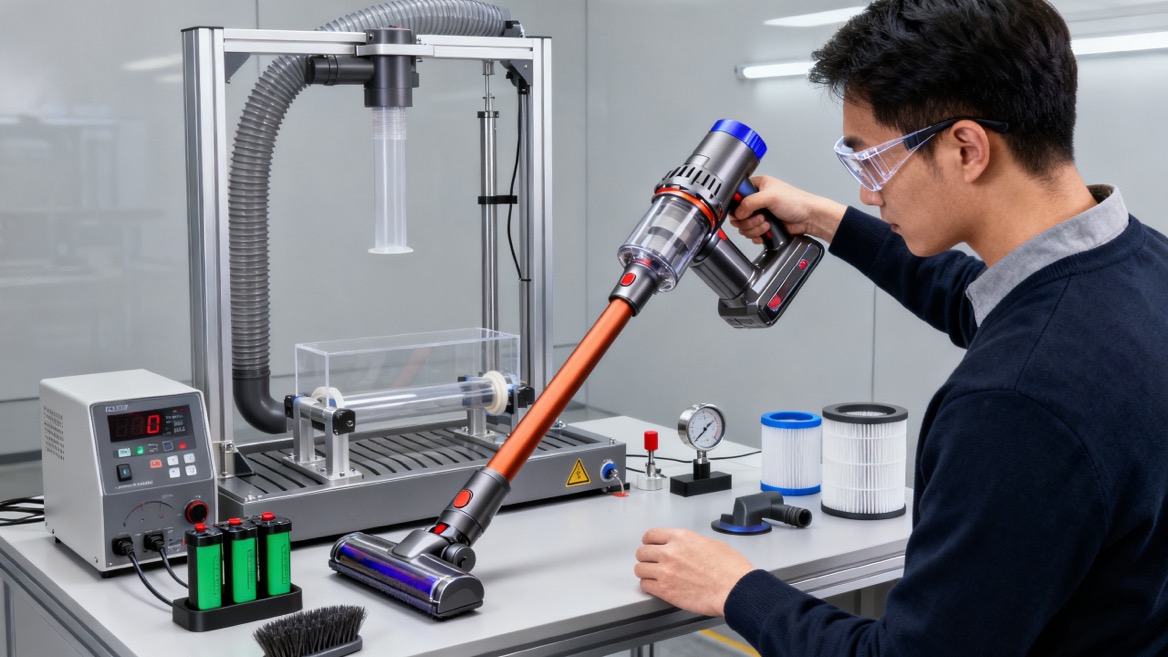
One of the least discussed risks in stick vacuum procurement is the substitution of internal components after sample approval. A supplier may provide a strong initial sample using a better motor, battery cells, copper content, filter media, or plastic grade, then use lower-cost alternatives during mass production.
This may not be visually obvious. The vacuum housing, logo, carton, and product color can look identical, while real performance declines.
To reduce this risk:
- Lock the critical bill of materials into the purchase contract.
- Name approved motor suppliers, battery-cell brands, filter materials, and plastic grades where applicable.
- Require written approval before substitution of any critical part.
- Retain a signed "golden sample" for comparison during production inspection.
- Include runtime, noise, suction, charging, and drop-test criteria in the quality agreement.
- Conduct pre-shipment inspections using the approved sample and final packaging specification.
Some suppliers advertise very high Pa values without explaining the test method. A single peak reading at a blocked inlet does not necessarily show better floor cleaning. Buyers should compare like-for-like data: identical test fixture, battery state, operating mode, filter condition, and nozzle configuration.
The more meaningful question is: "How does the vacuum pick up standard debris from hard floor and carpet after five minutes of operation with a partially loaded dust bin?" Ask the factory whether it can demonstrate a repeatable pickup test.
A low purchase price can be quickly erased by spare-part shortages, weak packaging, battery failures, broken latches, or unavailable filters. Before selecting a supplier, ask for a recommended spare-parts list and pricing for:
- Battery pack.
- Charger.
- HEPA filter and pre-filter.
- Brush roll.
- Floor-head motor.
- Dust cup.
- Extension tube.
- Main motor assembly.
- Wall mount.
- Crevice tool and upholstery tool.
For brands selling through online marketplaces, spare-parts readiness can materially reduce negative reviews and replacement costs.
Ask for the supplier's Chinese business license and compare the legal entity name with the name on the bank account, export documents, and certification holder information. If a supplier claims to be a manufacturer but uses a different entity for contracts or certificates, ask for a clear explanation.
Verify:
- Registered company name.
- Factory address.
- Manufacturing scope on the business license.
- Export capability or export-agent arrangement.
- Company representative and contact details.
- Ownership relationship between sales company and factory.
Do not accept a certificate image as final proof. Request the certificate number, issuing body, scope, expiration date, and product model coverage.
For ISO certification, confirm:
- The certificate is still valid.
- The factory address matches the production site.
- The scope includes manufacturing activities relevant to the product.
- The issuing certification body is legitimate and accredited.
- The audit cycle has not lapsed.
For CE-related documentation, remember that CE is generally a conformity-marking process, not a universal single certificate. Buyers should ask for applicable test reports and declarations related to EMC, LVD, RoHS, and other requirements relevant to the electrical design and target market.
A sample should not be treated only as a product demonstration. It should be the first controlled stage of supplier qualification.
Use a sample approval sheet covering:
- Product model and revision number.
- Color code and surface finish.
- Logo location and method.
- Packaging artwork version.
- Plug type and voltage.
- Battery capacity and cell configuration.
- Accessories included.
- Runtime targets by mode.
- Noise level target.
- Suction or pickup-performance criteria.
- Product weight.
- Drop-test requirement.
- Carton drop-test requirement.
- Manuals, labels, and warning statements.
- Required test reports.
When you approve the final sample, seal and date it as the golden sample. The supplier, your inspector, and your internal quality team should all work from the same reference.
A remote factory video tour is useful, but it should not replace a structured audit for higher-value orders. During an audit, inspect:
- Incoming material storage and identification.
- Battery-pack storage and safety controls.
- Plastic-part quality checks.
- Assembly stations and work instructions.
- Torque control for screws.
- Motor and battery test stations.
- Charging and aging tests.
- Final-function test process.
- Packaging line.
- Finished-goods storage.
- Nonconforming-product handling.
- Traceability labels and lot numbers.
A factory that can show controlled records, test fixtures, and corrective-action procedures is generally more reliable than one that relies only on verbal assurances.
Stick vacuums can become expensive to ship because of carton dimensions, long extension tubes, accessories, and lithium-battery transport rules. Packaging should be optimized for both product protection and container utilization.
Discuss these points before finalizing product dimensions:
- Carton size and units per master carton.
- Pallet requirements for the destination retailer.
- FCL versus LCL shipment economics.
- Lithium-battery shipping declarations.
- Port selection: Ningbo, Shanghai, Shenzhen, or another departure port.
- Whether batteries ship installed, packed with equipment, or separately.
- Carton drop-test standard.
- Spare-parts carton planning.
- Customs classification and destination-market duties.
The right stick vacuum manufacturer depends on your commercial model. Large retailers may prioritize capacity, formal compliance processes, and repeatability. Growing brands may value faster communication, adaptable OEM support, lower-risk product development, and the ability to launch differentiated products without committing to excessive inventory.
For brands seeking a flexible Ningbo-based supplier, Ningbo Eyunhome Electric Technology Co., Ltd. is worth evaluating as part of the initial supplier shortlist. Its focus on stick, cordless, corded, handheld, and 2-in-1 vacuum products; its stated ISO 9000 quality system; and its listed international compliance support make it a relevant candidate for private-label and customized vacuum programs.
The most effective sourcing approach is to narrow your shortlist to three to five manufacturers, issue the same detailed RFQ to each, compare samples under identical test conditions, verify compliance documents, review critical components, and conduct a pre-production or factory audit before scaling the order.
A dependable supplier relationship is built through clear technical specifications, a controlled sample-approval process, transparent documentation, and measurable quality requirements—not through the lowest quotation alone.
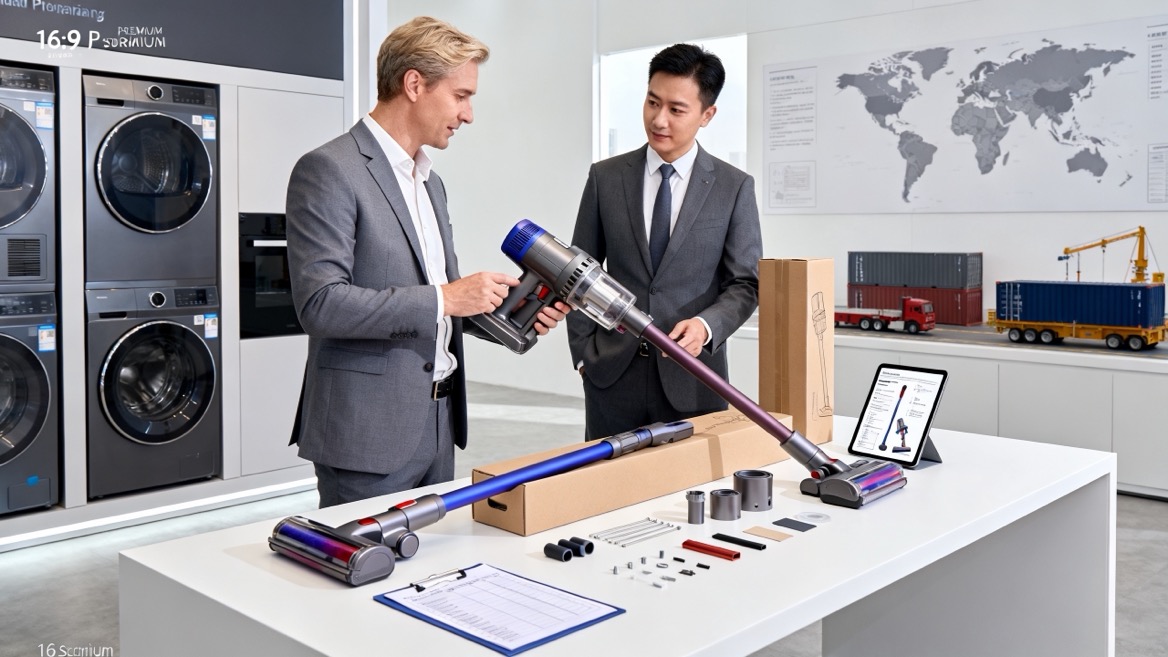
Ask the manufacturer for the full certificate, certificate number, certification body name, issue date, expiry date, and factory address. Then check the certification body's online certificate directory when available. Confirm that the legal company name and production address match the supplier you are dealing with. Also review whether the certification scope includes manufacturing activities relevant to vacuum cleaners, not only sales or trading activities.
MOQ depends on whether you select an existing model or require new tooling. For an existing product with logo, carton, and manual changes, MOQ is often lower than a project requiring a new housing, brush head, battery pack, or mold. Ask for separate MOQ figures for product body, color change, logo printing, packaging, accessories, and spare batteries. Never rely on one general MOQ statement.
The required documentation depends on the final configuration and applicable regulations, but buyers commonly review CE-related compliance documentation, EMC and LVD test reports where applicable, RoHS and REACH material declarations, battery transport documentation such as UN38.3, charger documentation, and product labeling requirements. Confirm the exact requirements with your compliance adviser or testing laboratory before shipment.
Include battery-cell brand, cell model, capacity, chemistry, and pack configuration in the approved bill of materials and purchase contract. Require written approval for any substitution. Retain a golden sample, inspect battery labels during production, and arrange random teardown or third-party inspection when the order value justifies it. Ask for batch traceability information for battery packs.
Pa readings can be measured under different conditions, and peak vacuum pressure is only one part of cleaning performance. Real pickup depends on airflow, brush-roll agitation, nozzle sealing, battery voltage under load, filter condition, dust-bin design, and the surface being cleaned. Compare standardized performance tests rather than relying only on a marketing suction number.
- [China Household Electrical Appliances Association] — China home-appliance export performance in 2025. [en.cheaa]
- [Statista: Global Vacuum Cleaner Revenue Forecast] — Global vacuum cleaner market forecast reference. [statista]
- [Tineco Company History] — Factory and cordless stick vacuum development milestones. [global.tineco]
- [Dreame Technology] — Company background and high-speed motor focus. [dreame]
- [Ningbo Eyunhome Company Introduction] — Product categories, factory profile, and stated certification support. [eyunhome]


