
Views: 218 Author: Eyunhome Vacuum Publish Time: 2026-11-19 Origin: Site


Content Menu
● Custom, Private-Label, and Ready-to-Ship Vacuum Cleaners: What Changes?
>> Ready-to-Ship Models: An Existing Product With Inventory to Verify
>> Private-Label Vacuum Cleaners: An Existing Platform Under Your Brand
>> Custom OEM/ODM Vacuum Cleaners: A Product Built to an Agreed Specification
● Custom Vacuum Cleaner vs Ready-to-Ship Models: B2B Comparison
● Choose the Vacuum Format Before You Choose the Sourcing Route
>> Upright and Handheld Vacuums: Test the Job Customers Buy Them For
>> Corded and Cordless Vacuums: Compare the Configuration You Will Sell
● Three Procurement Checks That Make the Decision Clearer
>> 1. Calculate the Break-Even Volume Before Paying for Custom Tooling
>> 2. Compare Samples Using the Same Tasks and Test Conditions
>> 3. Match Safety Evidence and Spare Parts to the Exact SKU
● How to Request a Quote From Ningbo Eyunhome
>> Are ready-to-ship vacuum cleaners always cheaper?
>> Can I put my logo on a ready-to-ship vacuum cleaner?
>> What is the minimum order quantity for a custom vacuum cleaner?
>> How long does custom vacuum cleaner development take?
>> Can I start with a stock model and customize it later?
>> Does a custom vacuum cleaner need new testing?
A custom vacuum cleaner is the better choice when the models already available cannot meet a requirement that matters to your customers, such as carpet pickup, accessory compatibility, or a specific size and weight. A ready-to-ship model is the better starting point when an existing configuration meets your requirements and you need to validate demand quickly. The deciding factor is not how many features you can customize. It is whether those changes justify the added cost, approval time, and inventory commitment.
My first question when reviewing a vacuum cleaner sourcing brief would be: "What would make us reject the best stock model?" If the answer is only branding or packaging, ask for a private-label quote before commissioning a new design. If the answer is that the stock model cannot do the job your product listing promises, ask for performance samples and a development plan.

A ready-to-ship vacuum cleaner is an existing configuration offered from finished inventory. Before using that inventory to plan a launch, ask for the available quantity, exact model revision, plug or charger, included accessories, packaging language, and earliest dispatch date. A catalog listing or an available sample does not show that enough finished units are available for your order. Dispatch also does not mean delivery to your warehouse.
Private labeling starts with an existing product and may include your logo, carton artwork, manual, or a selection of existing attachments. It can be a useful middle ground when the machine already meets your performance requirements. Ask which changes can be made to finished stock and which require a new production run. A branded carton is a smaller change than a new housing, but printing and packing can still put it on a different schedule from the stock model.
In an OEM arrangement, the supplier may manufacture to a buyer's design or specification. In an ODM arrangement, the supplier may adapt a design it developed. Those labels do not, by themselves, settle who owns the design, tooling, or right to sell the configuration. Put those terms in the agreement. Also define the scope: changing an attachment bundle is a different project from changing the motor, battery pack, floor head, or enclosure.
| Buying factor | Ready-to-ship model | Custom vacuum cleaner |
|---|---|---|
| Best fit | Trial orders, assortment gaps, or urgent replenishment | A defined performance, design, or compatibility requirement |
| Configuration | Confirm the exact finished units available | Agree on the specification and approve a representative sample |
| Minimum order quantity | Ask for the minimum per SKU and the available stock balance | Check separate minimums for components, colors, packaging, and assembly |
| Lead time | Confirm stock allocation, dispatch, and transit separately | Allow time for samples, revisions, testing, materials, and production |
| Upfront cost | Quote samples, preparation, and any relabeling | Quote engineering, tooling, validation, and artwork separately |
| Reorder risk | The same version may not be in stock next time | A custom component may have its own minimum order or longer replenishment time |
| After-sales support | Verify parts compatibility and availability for the stock revision | Agree on spare parts, change notices, and support for the approved revision |
Ask for a firm dispatch date for the stock order and a milestone schedule for the custom project. A single "lead time" figure makes the two offers look comparable when they may start and end at different points.
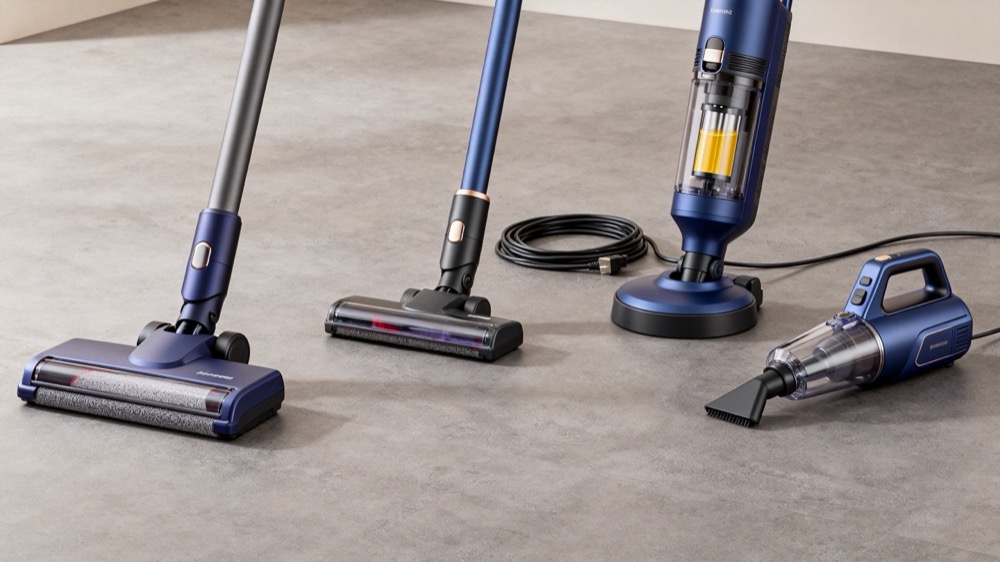
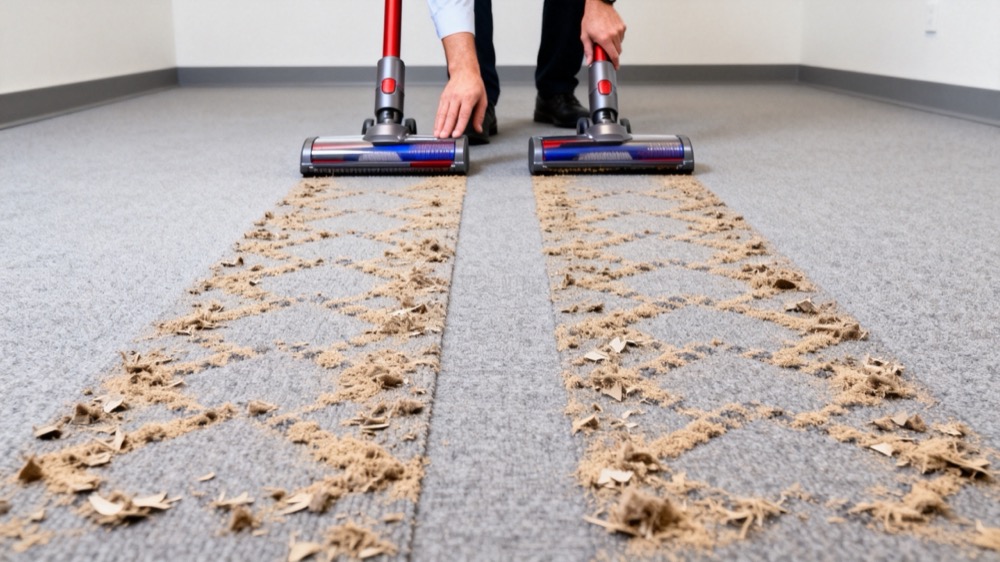
For an upright vacuum cleaner intended for carpet, compare debris pickup on the carpet type you sell into. Also check steering effort, edge cleaning, and how easily users can clear the brush roll. A stock upright may be enough if it performs well in those checks. If it leaves debris along skirting boards and edge cleaning is central to your offer, ask whether a different floor head solves the problem before paying to redesign the body.
For a handheld vacuum cleaner, test the full task: reach into a vehicle footwell or between seat cushions, collect debris, then empty the bin. Check balance with the nozzle attached, not just the weight of the bare unit. An existing crevice tool may solve the access problem. A new housing makes more sense when grip, balance, or storage dimensions are the reason buyers would reject the stock design.
For a corded vacuum cleaner, confirm the destination voltage, plug, cord length, and storage method. Test whether the cord reaches the intended cleaning area without frequent outlet changes. A supplier may already offer the configuration you need; ask for its exact model identifier rather than assuming every plug variant is stocked.
For a cordless vacuum cleaner, request runtime with the intended attachment and power mode. A figure measured without a powered floor head is not a sound basis for promising how long a customer can clean carpet with that head fitted. Compare charging time, battery replacement options, and spare charger availability alongside runtime. A different battery or charger should prompt a review of the applicable testing and documentation, not just a price adjustment.
Use the landed cost per unit: the cost of getting the product to your warehouse. Compare quotes on the same delivery basis, with the same accessories and packaging scope. Account for freight, duties, and handling where relevant, then keep one-time development costs separate.
Suppose a ready-to-ship model costs US$24 per unit landed. A custom alternative costs US$21 per unit landed but needs US$9,000 in one-time development, tooling, and validation. The US$3 saving offsets that investment at 3,000 units. At 1,000 units, the custom option effectively costs US$30 per unit before financing, storage, returns, or after-sales costs. These numbers are illustrative, not supplier quotes or market averages.
The result only answers whether unit savings recover the upfront cost. If customization raises your selling price or helps reduce returns, model those benefits separately and label your assumptions. If the business case relies on a large first order, check what happens if sales fall short and you have to carry the remaining stock.
Write acceptance criteria before samples arrive. For a retailer choosing a cordless stick vacuum for apartments, the shortlist might prioritize hard-floor pickup, maneuverability under furniture, and runtime with the powered head fitted. A buyer sourcing a handheld vacuum for vehicle interiors would use a different shortlist.
1. Test the same debris on the same surfaces, using the same number of passes.
2. Record the nozzle, mode, battery charge, and filter condition for each comparison.
3. Include usability checks such as emptying the bin, refitting the filter, and clearing the brush.
4. Request the test method and conditions behind any performance claim you plan to publish. Use a method suited to the model and the claim.
5. Retain an approved sample and record its model revision, accessories, and packaging so you can compare later shipments against it.
A suction reading describes one aspect of air performance. It cannot tell you on its own how well the complete machine collects debris through a particular floor head. For a buying decision, pair measurements with tests that reflect what customers actually clean.
Start with the destination market and intended use. Household and similar-use vacuum cleaners and commercial wet-and-dry machines can fall under different safety standards. Ask the supplier which requirements and editions apply to your product and market. A test report for a related model is not enough to establish that a different battery, charger, or configuration is covered.
Check the identifiers on the product label, reports, manual, and purchase specification. For a custom project, agree in writing which component substitutions require your approval before production. For stock, ask whether the quoted batch matches the version shown in the documents and sample.
Finally, request part numbers, reorder minimums, and estimated availability for filters, brush rolls, chargers, and battery packs as applicable. Ask how warranty claims are assessed and who supplies replacements. If a pilot sells well but replacement filters cannot be sourced reliably, the fast launch can become an expensive support problem.
Ningbo Eyunhome Electric Technology Co., Ltd. is a Chinese vacuum cleaner manufacturer offering upright, handheld, corded, and cordless solutions, with OEM/ODM services, production, and after-sales support for B2B buyers.
Send Ningbo Eyunhome your destination market, intended cleaning tasks, target landed cost, first-order quantity, estimated annual demand, and required delivery date. List mandatory requirements separately from preferences. If branding is the priority, include the logo, carton, and manual changes you need. If performance is the priority, describe the task the product must pass and how you will measure it.
Request two quotes against the same brief: the closest available stock model and the smallest customization that closes any remaining gap. Ask for sample options, itemized costs, available quantities or production minimums, dispatch milestones, model-specific documents, and spare-parts terms. That gives your team a fair comparison without committing to development before seeing what the stock model can do.
No. A stock order may avoid development and tooling charges, but the total cost depends on volume, freight, packaging, accessories, and service needs. Compare landed cost and one-time charges separately. Then check whether both models meet the same requirements.
Possibly. Ask whether the vacuum, carton, and manual can each be branded from existing stock. If the factory needs to print new cartons or schedule another assembly run, request a separate price and dispatch date for the private-label order.
There is no universal minimum. Ask for a breakdown by finished product, color, packaging, and custom component. A factory may be able to assemble your first order at one quantity while a packaging printer or component supplier requires a larger commitment.
It depends on what changes and what needs to be validated. Ask for milestone dates for specification approval, samples, applicable testing, pilot production, final inspection, and dispatch. For a stock alternative, ask for the earliest dispatch date after inventory is reserved.
Yes, provided the platform supports the changes you want. Use the first order to learn which features customers value and why units are returned. Confirm which changes would affect parts compatibility, documentation, or the accuracy of existing product listings.
Not every change has the same effect. New artwork and a new battery pack raise different questions. Ask the supplier and a qualified testing provider to review the final configuration, intended use, and destination before relying on existing reports or publishing performance claims.
1. [International Electrotechnical Commission — IEC 60335-2-2:2026, safety requirements for household and similar-use vacuum cleaners and water-suction cleaning appliances]. Supports the discussion of household vacuum safety scope. [webstore.iec]
2. [International Electrotechnical Commission — IEC 60335-2-69:2021, safety requirements for commercial wet and dry vacuum cleaners]. Supports the distinction between household and commercial equipment. [webstore.iec]
3. [SGS — Vacuum Cleaner Testing]. Describes separate air-performance and vacuum-cleaner performance test methods, including ASTM F558 and the IEC 62885 series. [sgs]


