
Views: 231 Author: Eyunhome Vacuum Publish Time: 2026-11-20 Origin: Site


Content Menu
● Introduction: How to Identify a Reliable Mini Cordless Handheld Vacuum Manufacturer
>> Why China Is a Practical Sourcing Base
● Selection Criteria: What Buyers Should Verify Before Shortlisting a Factory
● The 2026 Shortlist: 10 Chinese Manufacturers to Evaluate
>> 1. Ningbo Eyunhome Electric Technology Co.,Ltd. — Compact Handheld OEM/ODM for Growing Brands
>> 2. Suzhou Dibea Electrical Technology Co., Ltd. — Mini Car Vacuums and Broader Cordless Platforms
>> 3. Suzhou Royal Cleanland Electric Co., Ltd. — Portable Car-Vacuum OEM
>> 4. Hangzhou Chunjie Electrical Manufacture Co., Ltd. — Private Label and Buyer-Owned Tooling
>> 5. Ningbo Jinlong Electric Appliance Co., Ltd. — Handheld OEM/ODM Within a Wider Vacuum Portfolio
>> 6. Suzhou Best Clean Electrical Co., Ltd. — Multi-Category Floor-Care Manufacturing
>> 7. Klinsmann Intelligent Technology — Branding and Accessory Customization
>> 8. KingClean Electric Co., Ltd. — Motor Engineering and Larger ODM Programs
>> 9. Midea Cleaning Appliances — A Group-Scale Candidate for Retail Programs
>> 10. Minfu Group — Shenzhen-Based Cordless Development Candidate
● Comparison Table: Capacity, MOQ and Compliance Evidence
● Buyer's Guide: How to Qualify a Mini Cordless Handheld Vacuum Factory
>> 1. Write the Specification Around the Cleaning Job
>> 2. Specify Material Grades and the Checks That Protect Them
>> 3. Approve an Engineering Sample, Then Pull a Line Sample
>> 4. Use a Three-Way Check to Catch Unauthorized Substitutions
>> 5. Separate Factory Credentials, Product Conformity and Freight Documents
● Conclusion: Request Comparable Quotes Before Committing to Tooling
>> 1. How do I verify whether a factory's ISO 9001 certificate has expired?
>> 2. Can I reuse a supplier's CE documentation after changing the logo or battery?
>> 3. How can I tell whether the quoted factory capacity is credible?
>> 4. What should I do if a supplier quotes a different MOQ for each color?
>> 5. How should I handle warranty claims involving lithium batteries after delivery?
Start by asking whether the factory can reproduce the sample you approve. A strong supplier can identify the battery cells, motor, filter and housing resin in that sample; show how those components are checked on the production line; and explain what happens if a supplier or material changes. A polished demo and a low unit price tell you much less about the shipment you will receive.
This 2026 shortlist is designed for importers, distributors and private-label brands evaluating long-term manufacturing partners. It gives priority to compact handheld and car-vacuum candidates, while also identifying broader floor-care manufacturers worth approaching for higher-volume or custom projects. The numbering is editorial, not a market-share or factory-audit ranking. Ningbo Eyunhome Electric Technology Co., Ltd., the publisher of this guide, is featured first. Factory claims are attributed, and unavailable figures are marked rather than estimated.
The supplier base spans several manufacturing clusters. Suzhou, Jiangsu, brings together floor-care specialists such as KingClean, Dibea, Royal Cleanland and Best Clean. Ningbo, Zhejiang, gives buyers another group of candidates, including Eyunhome, Jinlong and Klinsmann, while Hangzhou adds custom tooling and appliance assembly options. Shenzhen offers an additional route for projects that need electronics and cordless-system development. The practical advantage is the ability to compare different production models: an existing handheld platform, a private-label adaptation, or a custom design with dedicated tooling.
The China Household Electrical Appliances Association's 2025 industry overview, published in April 2026, reported cleaning-appliance sales of 35.5 million units, up 17% year over year, and revenue of RMB 47.1 billion, up 11.3%. It also reported USD 111.41 billion in total Chinese home-appliance exports, down 0.9%. These are broad industry figures, not estimates for mini cordless handheld vacuums. Likewise, the customs heading HS 8508.11 covers a broader class of motorized vacuum cleaners rated at up to 1,500 W with a receptacle of up to 20 L. Use it to research trade flows, not to calculate the size of the mini handheld segment.
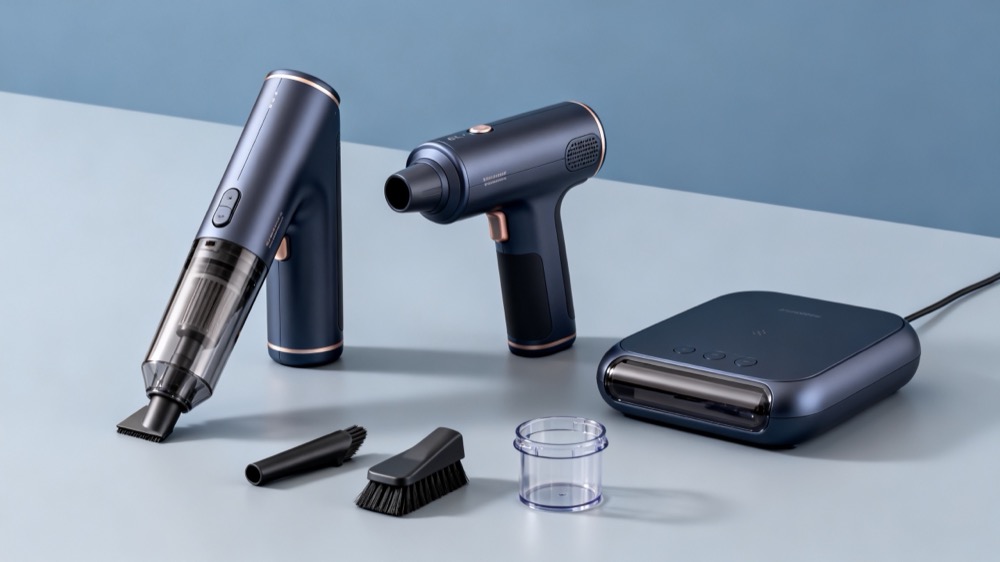
For this list, the strongest evidence of category fit was a published compact handheld or car-vacuum product. A cordless stick vacuum that converts to handheld mode is not equivalent to a purpose-built mini vacuum. Broader manufacturers are included where their floor-care engineering or contract manufacturing makes them plausible candidates, but they should clear an additional product-fit check before receiving a sample order.
| Screening dimension | Evidence to request | What it tells you |
|---|---|---|
| Factory identity and certification | Chinese business license, production-site address, management-system certificate and current scope | Whether the contracting company, audited site and actual assembly location match |
| Product fit and development | Current model drawing, unit weight with battery, teardown sample and responsibility for tooling and electronics | Whether the factory has a true mini platform or is proposing a new engineering project |
| Quality control and traceability | Incoming inspection records, end-of-line test limits and an example of a traced production lot | Whether the factory can detect defects and contain affected units |
| Capacity and delivery | Recent output for comparable units, committed orders, bottleneck test capacity and a dated production schedule | How many units the factory can allocate to your order, not how many it can theoretically build |
| Compliance and after-sales | Exact-model documents, battery transport summary, spare-parts price list and warranty procedure | Whether you can import, support and reorder the same configuration without surprises |
Founded in 2011 in Ningbo, Zhejiang, Eyunhome describes itself as a handheld-vacuum manufacturer focused on battery-powered cleaning products. It reports a 7,500 m² facility, investment in product development and a quality process operating under what it calls an "ISO 9000 system." Its company profile targets international customers but does not identify its largest destination markets. The stated floor area is not a production-capacity figure, and the quality-system wording should not be read as evidence of a current ISO 9001 certificate.
Eyunhome is a candidate for small and midsize brands that want to balance cost with meaningful customization. Rather than assuming the lowest price, compare the cost of adapting an existing cordless platform with the cost of new tooling. Ask Eyunhome to quote three options: branding and packaging only; a revised accessory set and finish; and an engineering-led version with a defined runtime, filter or ergonomics target. The company describes its approach as responsive and tailored. Buyers can test that claim during sampling by asking for one engineering contact, a written change log and an explanation of which modifications can be made without creating a new mold.
Founded in 2007, Dibea is a Suzhou-based manufacturer with listings for mini wireless car vacuums and cordless handheld wet/dry units. Its company site offers private-label and distribution partnerships and reports customers in more than 80 countries and regions, without a breakdown of its largest markets. Dibea is a practical candidate if a mini vacuum is the first product in a wider cordless range. Request the dimensions and weight of the standalone handheld unit rather than relying on specifications from its stick-vacuum range. If you intend to market a wet-pickup version, request documentation for that exact use and configuration.
Royal Cleanland says it was established in June 2016 in Suzhou and markets OEM and wholesale portable car vacuums. Major export destinations are not identified in the cited product profile. The company is most relevant when the product brief calls for a compact nozzle that can reach seat rails, door pockets and other tight interior spaces. Confirm first that the SKU is rechargeable: a portable vacuum that runs from a vehicle's 12 V socket is not a cordless model. Then ask which nozzle, housing, branding and packaging options are available without new tooling.
Chunjie lists handheld and car-vacuum models on its cordless OEM page and advertises private label starting at 500 units. It also describes custom development and customer-owned mold manufacturing. The cited page targets global brands and importers but does not establish the company's founding year or principal export destinations. Chunjie is worth evaluating if you want to compare an existing platform with a proprietary enclosure or accessory. Request separate quotations for each route. A published entry MOQ does not necessarily apply to a custom housing, exclusive resin color or different battery pack.
Jinlong publishes a dedicated cordless handheld OEM/ODM offering and markets cleaning appliances internationally. A trade-directory profile lists 1985 as its establishment year and "worldwide" as its market; verify the registered entity's date and request references for your destination market. Jinlong's value in a tender is the opportunity to compare a compact handheld SKU with other vacuum products under one sourcing program. Ask which mini platforms are in current production, who assembles the battery pack, and whether the factory can support a proprietary nozzle or dust-cup design.
Best Clean's factory profile lists October 2005 as its founding date and includes handheld, cordless, upright and canister vacuums. It advertises OEM/ODM services, cites ISO 9001 and lists BSCI and Sedex in its profile, but does not substantiate a destination-market breakdown in the cited material. Consider Best Clean if your import program spans multiple vacuum formats. Require a dedicated mini cordless sample, however, and ask the factory to separate production capacity and test capability for that model from numbers reported for the wider facility.
Klinsmann says it has supplied cordless vacuums since 2008 and reports more than 80 business partners worldwide, without naming principal destination markets on its cordless product page. The Ningbo supplier advertises logo printing, packaging, color, appearance and selected accessory customization, and reports ISO 9001 certification and BSCI verification. It is an option for importers looking to adapt an existing cordless design. Ask whether the quotation covers a purpose-built mini handheld or a stick vacuum's detachable motor unit. The distinction affects weight, nozzle geometry and carton dimensions.
Founded in 1994 and headquartered in Suzhou, KingClean serves global markets through OEM/ODM and component businesses. Its published strengths include high-speed motors, intelligent controls, precision molds and related components. These capabilities make it a development candidate where the challenge is balancing airflow, battery draw, noise and enclosure size. They do not establish that KingClean offers a stock mini platform or accepts small pilot orders. Ask first about engineering fees, minimum annual commitments, program ownership and whether a direct handheld project is commercially viable for both sides.
Midea's group history is dated to 1968 in industry coverage, but that date should not be used as the incorporation year of the entity that would sign your purchase order. Trade records identify Jiangsu Midea Cleaning Appliances in U.S. imports under the broader HS 8508.11 category. That supports U.S. shipment activity for vacuum cleaners, not mini handheld sales or an open private-label program for the exact product. Approach Midea when your order forecast and distribution footprint justify a larger program, and verify who will contract, design, assemble and provide the model-level compliance file.
Minfu says it has offered OEM/ODM smart-cleaning solutions since 2021 and identifies Shenzhen as its base. Treat 2021 as its stated start of operations, not a verified legal incorporation date. Its public positioning targets brands worldwide, but the cited material does not disclose priority export destinations or establish a current standalone mini handheld line. Minfu is therefore a development lead rather than a stock-model recommendation. Ask for a working prototype, a plan for motor and battery integration, and a clear breakdown of in-house work versus subcontracted production.
MOQ means minimum order quantity. Here, "not confirmed" means the cited materials do not establish a usable figure for the exact mini cordless SKU. It does not mean the factory lacks capacity or documentation. Group output, facility area and catalog-wide figures are not substitutes for monthly units allocated to your order.
| Manufacturer | Procurement focus | Capacity for mini cordless SKU | Published MOQ | Certification or compliance evidence to check |
|---|---|---|---|---|
| Eyunhome | Compact handheld customization | Not confirmed; 7,500 m² site reported | Not confirmed | Company lists CE, RoHS, GS and CB among its claims; request exact-model documents and current site certification. |
| Dibea | Mini car vacuums and cordless range expansion | Not confirmed | Not confirmed | Request reports for the selected mini model, battery and charger configuration. szdibea.made-in-china+1 |
| Royal Cleanland | Portable car-vacuum OEM | Not confirmed | Not confirmed | Verify rechargeable model identity before reviewing compliance documents. |
| Chunjie | Private label and custom tooling | Not confirmed | From 500 units advertised; confirm SKU and options | Ask what existing evidence covers and what must be tested after customization. |
| Jinlong | Handheld OEM/ODM and broader vacuum portfolio | Not confirmed | Not confirmed | Request declarations and reports tied to the quoted model and assembly site. |
| Best Clean | Multi-category floor care | Not confirmed | Not confirmed | Supplier lists ISO 9001, BSCI and Sedex; verify scope, site and current status separately. |
| Klinsmann | Appearance, branding and accessory changes | Not confirmed | Not confirmed | Supplier reports ISO 9001 and BSCI; request the certificate or audit evidence and the separate product file. |
| KingClean | Motor engineering and higher-volume ODM | Not confirmed | Not confirmed | Request the plant's certificate scope and the proposed platform's test records. |
| Midea Cleaning Appliances | Larger retail and appliance programs | Not confirmed | Not confirmed | Verify the contracting entity, plant and SKU-specific file; trade records do not prove conformity. |
| Minfu | Cordless engineering development | Not confirmed | Not confirmed | Ask for site documentation, battery traceability and a test plan for the mini design. |
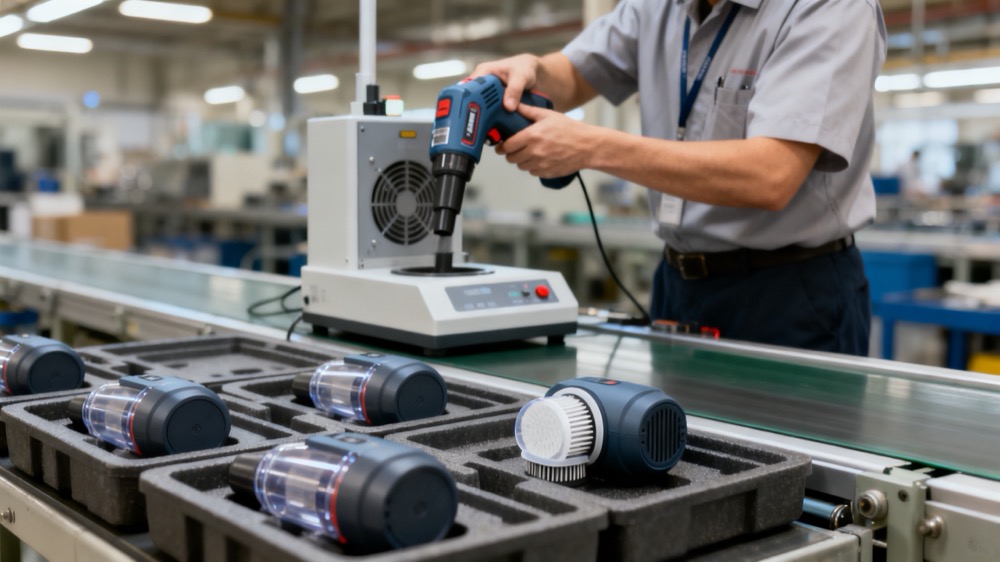
A desktop vacuum for crumbs, a car vacuum for sand in mats and a handheld unit for pet hair are different products, even when their advertised suction figures are similar. Specify debris, surface, nozzle, acceptable weight and usable runtime. Ask for sealed suction in kilopascals and airflow under a stated setup, but make a repeatable pickup test the deciding measure. For example, use the same mass of dry sand, the same car-mat sample and the same number of passes for every vendor. Run the test with both a clean and a partially loaded filter. That exposes the difference between an attractive specification and useful performance.
Treat filtration claims the same way. If the supplier advertises a HEPA filter, ask whether the evidence applies to filter media, the finished filter cartridge or the assembled vacuum. A report on filter material alone does not demonstrate how much air bypasses the cartridge through a poor seal. For a USB-C charging claim, test the actual cable and power-source combinations customers will use; document which are supported instead of assuming the connector establishes charging behavior.
Do not approve a housing described only as "premium ABS." Name the resin grade or agreed material specification, the permitted recycled or regrind content, and the color and finish requirements. Define acceptance checks for the parts most likely to fail: the dust-cup latch, nozzle fit, screw bosses, seals and charging-port surround. Use an appropriate impact-resistant grade for the housing and specify a flame rating where the design or applicable safety assessment requires it. Request molding controls, supplier declarations and lot identification for critical materials.
For the cordless system, record the cell manufacturer and model, pack identifier, rated watt-hours, protection-board revision and charger configuration in a controlled bill of materials (BOM). Ask the factory how it checks incoming packs and traces them to finished serial numbers. Where a brushless DC motor is proposed, evaluate it on the complete vacuum: usable runtime, debris pickup, sound and temperature are more informative than motor type alone.
1. Use the engineering sample to settle ergonomics, accessories, controls and cleaning performance. Record each unresolved issue with an owner and due date.
2. Approve a pre-production sample made with the intended vendors, tooling and materials. Retain one signed reference unit and have the factory keep a matching unit. Record the BOM revision, labels and packaging artwork alongside it.
3. Run a pilot lot and have the buyer or inspector select units from production cartons. Repeat pickup, runtime, charging, latch and packaging checks; review traceability and end-of-line records.
4. Before shipment, use a written sampling plan with agreed defect categories and acceptance rules. Keep periodic performance and durability tests separate from the routine visual and functional inspection so that neither is mistaken for the other.
One useful check is to compare three things before releasing the first production lot: the approved sample's BOM, the lab file's component and model identifiers, and parts taken from randomly selected production units. A battery pack can retain the same external label after an internal cell change. A filter can look identical while using a different media insert or gasket. A housing molded with a different resin blend can also pass a brief visual inspection. Comparing the box to the golden sample is not enough.
Write the change process into the purchase agreement. Require prior written approval for changes to the cell, pack, motor, filter, resin, charger or protection firmware. Make the factory identify the affected serial-number range and provide an assessment of which tests or declarations need updating. Ask a qualified inspector or laboratory to verify internal components where needed; do not ask warehouse staff to open battery packs. This check helps catch a specific risk: the production unit still has the approved model number, but no longer matches the configuration you tested.
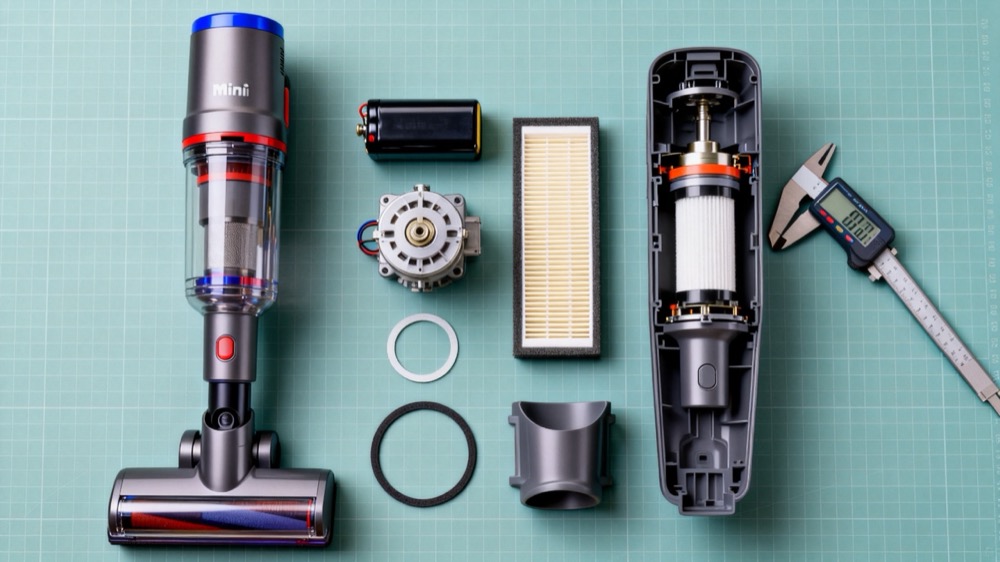
ISO 9001 concerns a quality management system. A social-audit record is a separate type of evidence. Neither establishes that your vacuum complies with the rules of the destination market. For EU sales, request a signed EU Declaration of Conformity, supporting reports and traceable model identifiers. CE marking is the manufacturer's declaration of conformity with applicable requirements; it is not a blanket factory approval. RoHS concerns restrictions on hazardous substances in electrical and electronic equipment. Have the responsible compliance team determine which requirements apply to the vacuum, supplied adapter and any optional features.
For lithium-battery freight, obtain the UN 38.3 test summary for the pack that will actually ship. Ask the forwarder to review the configuration before booking: a battery installed in the vacuum, a spare packed alongside it and a standalone replacement pack can require different transport handling. Confirm routing, packaging, markings and carrier acceptance, then compare quotes on the same delivery terms. Include inspection, freight, customs charges, spare filters and warranty support in your landed-cost comparison. Agree on a separate delivery schedule for replacement packs and filters rather than assuming they will travel with repeat vacuum orders.
Start with three suppliers that fit your project, not three that happen to quote the lowest price. Give each the same target market, use case, initial volume, annual forecast, test protocol and customization brief. Compare the exact configuration they will supply, the documentation they can produce and the capacity they will reserve. Move to a pilot only after the supplier agrees to component traceability and written change control.
For a compact handheld program that needs more than a stock logo change, contact Ningbo Eyunhome Electric Technology Co.,Ltd. with your intended sales market, target order volume, unit weight and runtime requirements, and desired accessories. Ask for an existing-platform proposal and a separate custom-development option, each with its own MOQ, tooling cost, sample schedule and list of model-specific compliance documents. That gives you a concrete basis for comparing Eyunhome with the other factories on the shortlist.
Request the certificate number, issuing certification body, legal entity, site address, scope and expiry date. Verify the record through the issuer or an accredited-certificate directory where available. Check active status as well as the printed expiry date, and confirm that the scope and address cover the actual assembly site. If the address differs from the purchase contract, obtain the relationship between the entities in writing and verify where the order will be built.
Do not assume either change is automatically covered. Check whether rebranding changes who is considered the manufacturer for EU purposes and whether the model identifiers, labels and declaration still align. A battery change requires a technical review of its impact on the conformity evidence and the transport file. Ask the responsible compliance party to document what remains valid, what needs updating and whether new testing is required before shipment.
Ask for recent output and rejection rates on a comparable SKU, then calculate capacity at the slowest process after allowing for other orders. For example, if a test station handles 90 units per hour for six productive hours a day over 22 days, it can process 11,880 units per month before rejects or downtime. An assembly line that can build 20,000 units does not remove that test bottleneck. Ask for a dated capacity allocation and separate commitments for first orders and reorders.
Request an MOQ breakdown by platform, molded color, packaging artwork and battery option. A supplier may be able to run one shared housing color and split the order across two print variants, even when two resin colors would require separate minimums. Compare the extra inventory and component commitments before changing the design. Put the confirmed MOQ for each variant in the quotation and purchase order.
Agree in advance on what evidence the supplier needs, such as a serial number, batch code, photos and a description of the failure. Set response and remedy terms, including credits, replacement units or approved local handling. Do not plan on sending damaged or suspect packs through ordinary parcel channels. Have a qualified logistics or disposal provider give instructions for your market, and keep sales-batch records so you can identify other units if a fault repeats.
- China Household Electrical Appliances Association — 2025 Home Appliance Industry Performance Overview, published in 2026. [en.cheaa]
- European Commission TARIC — official tariff classification lookup for motorized vacuum cleaners under code 8508.11. [ec.europa]
- Your Europe — CE marking responsibilities and the EU Declaration of Conformity. [europa]
- European Commission — Restriction of Hazardous Substances in Electrical and Electronic Equipment. [environment.ec.europa]
- International Air Transport Association — battery transport guidance and UN 38.3 test-summary requirements. [iata]


