
Views: 268 Author: Eyunhome Vacuum Publish Time: 2026-11-15 Origin: Site


Content Menu
● Entry-Level vs Premium Cordless Vacuums: What Retailers Are Really Buying
● Cleaning Performance: Compare Pickup, Not Just Peak Suction
>> Hard Floors, Carpet, and Pet Hair Need Different Tests
>> Battery Runtime: Compare the Setup Customers Will Use
● Handling, Filtration, and Maintenance: Where Premium Features Earn Their Price
>> Judge Comfort With the Vacuum Fully Assembled
>> Separate Filter Claims From Whole-Machine Results
● Retail Margin: Compare Contribution After Returns and Warranty Costs
● A Five-Step Sample Review Before You Place a Purchase Order
● OEM vs ODM: Build Two Price Tiers Without Duplicating the Range
● Choose the Right Cordless Vacuum Range for Your Retail Channel
>> 1. Is an entry-level cordless vacuum suitable for a private-label launch?
>> 2. What makes a premium cordless vacuum worth stocking?
>> 3. How should retailers compare cordless vacuum runtime claims?
>> 4. Should retailers require a removable battery?
>> 5. What should retailers request before ordering private-label cordless vacuums?
>> 6. Can a single cordless vacuum platform serve both price tiers?
An entry-level cordless vacuum earns its shelf space by making everyday cleaning convenient at an accessible price. A premium cordless vacuum earns its price by solving a problem shoppers can see or feel: better pickup on carpet, less effort when cleaning up pet hair, or enough usable runtime to finish a larger area. For retailers, the best choice is not the model with the longest feature list. It is the one that delivers a clear benefit at its price while leaving enough margin to cover returns, warranty claims, and replacement parts.
At Ningbo Eyunhome Electric Technology Co., Ltd., we approach this comparison from an OEM/ODM manufacturing perspective. Our recommendation: define the cleaning job for each price tier, compare samples under the same conditions, and check the economics after the sale before committing to a range.

"Entry-level" and "premium" are retail positions, not performance grades. An affordable model can outperform a more expensive one at a specific task. Likewise, a premium model may justify its price through better handling or easier maintenance rather than higher peak suction. Use the table below to define what each tier should deliver, not to assume what every model includes.
| Buying factor | Entry-level cordless vacuum | Premium cordless vacuum | What to verify before ordering |
|---|---|---|---|
| Primary cleaning job | Daily crumbs, surface dust, and quick hard-floor cleanup | Mixed flooring, pet hair, or longer cleaning sessions | Pickup on the surfaces your customers actually clean |
| Floor head | One versatile head with straightforward controls | A specialized roller, adjustable head, or hair-removal design | Debris pickup, hair wrap, and roller removal |
| Battery and charging | Enough usable runtime for short sessions | Longer usable runtime, faster charging, or a spare-pack option | Runtime with the supplied floor head in a named mode |
| Handling | Easy to grab, carry, and store | Better balance, steering, or handheld conversion | Wrist comfort with the wand and floor head attached |
| Filtration and emptying | Accessible filters and simple bin emptying | Documented whole-machine filtration or cleaner bin emptying | Whether the test covers the filter or the assembled vacuum |
| Accessories | A floor head and a tool for tight spaces | Tools tied to specific jobs, such as upholstery or pet-hair cleanup | Whether shoppers will use the tools and can replace them |
| After-sales support | Parts availability without excessive inventory complexity | A service plan that supports the higher purchase price | Parts pricing, warranty responsibilities, and fulfillment lead times |
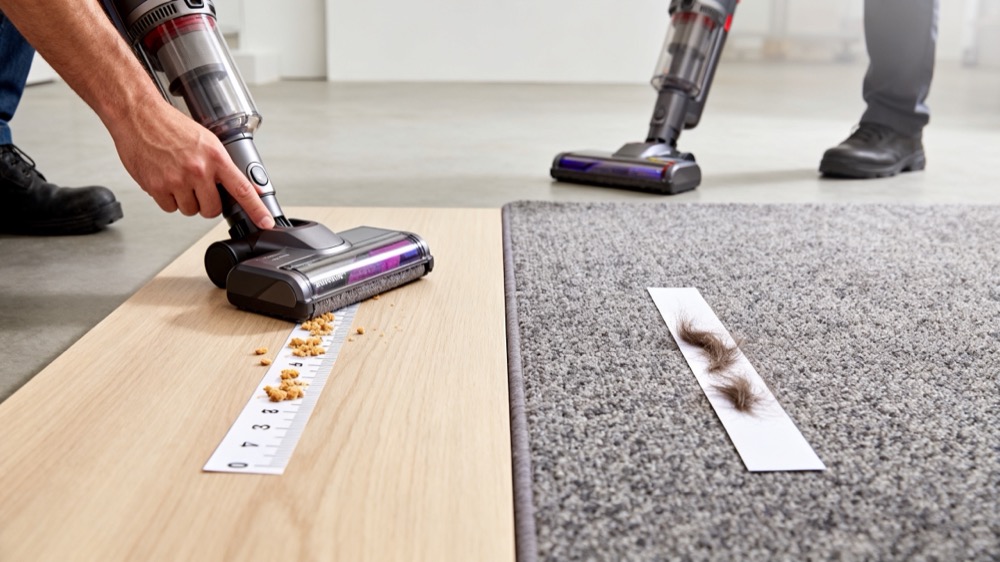
For an affordable cordless stick vacuum aimed at apartments and quick cleanups, start with hard-floor pickup. Run the machine over fine dust and larger crumbs, then check what it leaves along skirting boards and in floor gaps. Watch whether the head collects larger particles or pushes them forward. A simple model that handles these tasks consistently can be a better fit than a higher-priced machine designed around carpet.
For premium cordless vacuum models, ask what the upgrade delivers on low-pile carpet, rugs, or upholstery. If pet hair is the selling point, compare both how much hair the head picks up and how much remains wrapped around the roller. Then time how long it takes to clear the roller. A model that picks up hair well but is tedious to clean may be difficult to position as a convenience upgrade.
Suction and airflow describe air performance. Floor pickup measures what the machine actually removes from a surface. Request separate results for the surfaces you plan to mention on the carton or product page. For any side-by-side claim, check that both machines were evaluated with comparable debris, passes, flooring, and operating modes.
An "up to" runtime is hard to interpret without the test configuration. Ask for the power mode, attachment, floor surface, starting charge, and cutoff criterion. For example, 45 minutes with a small unpowered attachment is not directly comparable with 30 minutes using a powered floor head on carpet. The shorter figure may tell your shopper more about a typical cleaning session.
For the opening-price model, verify that its everyday mode lasts long enough for the quick-clean tasks you advertise. For the premium model, compare everyday and high-power runtime, recharge time, and the cost of a spare battery. If the battery is removable, verify that customers can actually buy a compatible replacement. A removable pack has limited after-sales value if it is unavailable in the destination market.
Compare the machine with the battery, wand, and floor head fitted. A bare handheld weight does not tell buyers how the vacuum feels when steering under a table or lifting the head over a threshold. Test the assembled machine during turns and the handheld unit on stairs or upholstery. If the premium model weighs more, check whether its balance or steering makes the extra weight acceptable.
Pay equal attention to the jobs shoppers repeat after cleaning: emptying the bin, removing the roller, and storing the unit. Ask someone unfamiliar with the product to do these tasks using only the supplied instructions. If they struggle to open the dustbin or reinstall a filter, revise the design or instructions before launch.
A filter test tells you how the filter performed under its test conditions. It does not, by itself, show how much particulate matter the assembled vacuum emits during use. If filtration is part of the premium sales pitch, ask whether the report covers the filter media, the filter assembly, or the complete machine. Match the packaging claim to the scope of the evidence.
For both tiers, check how often filters need attention, which parts are washable, and whether a shopper can reinstall them without guessing which way they fit. Confirm replacement part numbers before printing the instruction manual or building product listings.
Use unit contribution to compare the two models. Start with net selling price, then subtract landed product cost, variable selling and fulfillment costs, and an allowance for returns and warranty service. Landed cost is what it costs to bring the product into stock, not just the price quoted by the factory. Use the same costing basis for both models.
| Illustrative cost per unit | Entry-level model | Premium model |
|---|---|---|
| Net selling price | $89 | $149 |
| Landed product cost | $42 | $78 |
| Variable selling and fulfillment costs | $15 | $21 |
| Returns and warranty allowance | $5 | $12 |
| Estimated unit contribution | $27 | $38 |
These figures are hypothetical, not supplier quotes or market averages. In this example, the premium unit contributes $11 more before fixed overhead. If deeper promotions reduce its realized selling price by another $8 and warranty costs run $4 above the allowance, that advantage disappears.
Compare contribution alongside expected sales volume and inventory exposure. A premium SKU can generate more per sale but still deliver less total contribution if it sells slowly. Conversely, an entry model that needs constant discounting may do little for the category even if it sells in volume. Review both scenarios before agreeing to minimum order quantities or committing to extra colors and accessory bundles.
1. Write one shopper promise per tier. For entry-level, try "quick daily cleanup on hard floors." For premium, choose one benefit that matters to your assortment, such as "picks up pet hair on rugs with less roller maintenance." Identify the evidence needed to support each promise.
2. Compare the exact configurations you plan to sell. Keep the floor surface, debris amount, pass count, and starting charge consistent. Record the mode and attachment for every run. Repeat promising results on another sample before relying on them for a purchase decision.
3. Check what shoppers experience after pickup. Time bin emptying and roller cleaning. Check filter access and storage with the supplied accessories. If a feature requires explanation, decide whether the manual, product images, or a short demonstration needs to show it.
4. Verify documentation and spare parts. Match the sample and proposed production order to model identifiers and relevant test reports. For lithium battery transport, request the applicable UN 38.3 test summary and have your logistics partner confirm the requirements for the shipping configuration. Verify product compliance for the destination market separately.
5. Pilot the range and track return reasons by SKU. Distinguish battery complaints, weak pickup, missing accessories, and unclear assembly instructions. A high return rate tells you there is a problem; the reason codes tell you whether to improve the product, the packaging, or the listing.
This review is a buying tool, not a substitute for formal testing. Use it to narrow the shortlist, then obtain appropriate reports for the final production configuration and the claims you intend to make.
With OEM production, the retailer can specify a product for manufacture under its own brand. With ODM, the project can start from a manufacturer's existing design and adapt agreed features, finishes, accessories, or packaging. The scope varies by agreement, so specify what can change, who approves revisions, and which changes require new documentation or testing.
For a two-tier range, consider sharing parts that shoppers do not buy the upgrade for. A common crevice tool or filter may simplify spare-parts inventory if fit, performance, and part identification are verified. Invest in the differences shoppers can demonstrate: a better floor head, a useful upholstery tool, or longer measured runtime with the powered head. Avoid relying on cosmetic changes alone to explain a functional price increase.
Before ordering, agree on the approved sample, pack contents, inspection criteria, and how the supplier will notify you of component substitutions. Confirm who handles customer troubleshooting, spare-parts fulfillment, and warranty claims. Those decisions matter just as much for an opening-price model as they do for a flagship.
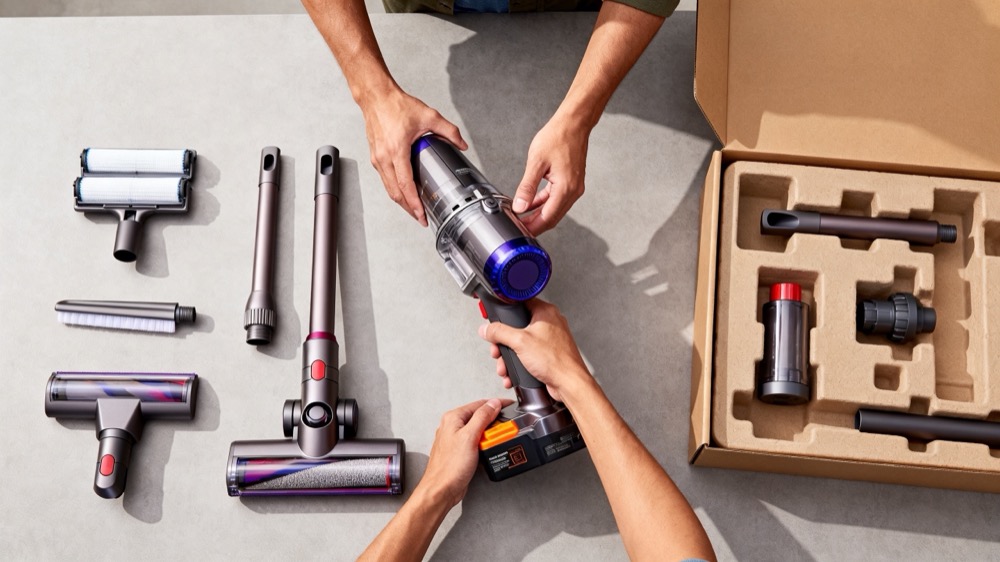
Lead with an entry-level model when customers mainly want a lightweight vacuum for quick jobs and compare prices closely. Add a premium model when your customers have a specific need—pet hair, mixed flooring, or longer sessions—and you can show exactly what they get for the extra spend. If you stock both, put the same measurements side by side on the shelf or product page so shoppers can compare them without decoding two different sets of claims.
Contact Ningbo Eyunhome Electric with your target retail price, sales market, expected order volume, and the cleaning job each model must handle. Ask for an OEM/ODM shortlist from Ningbo Eyunhome Electric Technology Co., Ltd., with sample configurations, proposed test documentation, packaging options, and an after-sales parts plan. The company also offers upright, handheld, corded, and cordless vacuum solutions for broader assortment planning.
Yes, when it has a narrow, credible job and the price leaves room for support. For a hard-floor quick-clean model, prioritize consistent pickup, simple handling, and available filters over a larger accessory bundle.
A benefit your customers can verify. That could mean better carpet pickup, easier upholstery cleaning, or longer runtime with the floor head attached. Compare the upgrade against the entry model and check that the contribution still makes sense after promotions and warranty costs.
Compare the same attachment, mode, surface, starting charge, and cutoff. Keep maximum runtime separate from runtime in a typical floor-cleaning setup. Publish the conditions next to the figure so shoppers know what the claim means.
Not necessarily. It is useful when shoppers need to swap packs during cleaning or replace a worn battery. Before specifying it, confirm the replacement price, availability, and fulfillment arrangements.
Request an approved sample, a final specification, reports supporting advertised claims, market-specific compliance documentation, and applicable battery transport records. Also confirm the packaging contents, compatible spare parts, and warranty responsibilities in writing.
Yes, if the upgrade solves a different or more demanding cleaning job. Shared parts can simplify service, but the premium version needs a measurable improvement that shoppers can understand and that the retailer can support.
- [BSI — BS EN IEC 62885-4:2020+A1:2023: Methods for Measuring the Performance of Cordless Dry Vacuum Cleaners]. Basis for the discussion of standardized cordless vacuum performance measurement. [knowledge.bsigroup]
- [ASTM International — Consumer Product Evaluation Standards]. Lists separate methods for air performance (F558), hard-surface cleaning (F2607), and carpet embedded dirt removal (F608). [store.astm]
- [ASTM International — Collecting Dust: Standards for Vacuum Cleaners]. Explains the distinction between carpet pickup and particulate emissions during vacuuming. [astm]
- [International Air Transport Association — Battery Guidance Document]. Supports the discussion of UN 38.3 test summaries and battery shipping configurations. [iata]


