
Views: 298 Author: Eyunhome Vacuum Publish Time: 2026-11-16 Origin: Site


Content Menu
● Introduction: Where to Source Vacuum Cleaners for Saudi Arabia and the Gulf
● How the Five Suppliers Were Selected
● Five Vacuum Cleaner Manufacturers and Suppliers Serving Arabia
>> 1. Ningbo Eyunhome Electric Technology Co., Ltd. — China-Based OEM/ODM Candidate for Smaller Brands
>> 2. Kärcher Middle East — Branded Equipment With a Regional Dealer Network
>> 3. Nilfisk Middle East — Professional and Industrial Vacuum Solutions
>> 4. Cleantech Gulf / Cleantech Global — UAE and Saudi Multi-Brand Distribution
>> 5. ALBARIQ Equipment — Gulf Sales, Rental, and Fleet Service
● Supplier Comparison: Capacity, MOQ, and Compliance Evidence
● Buyer's Guide: From RFQ to Shipment
>> Write an RFQ That Makes Performance Comparable
>> Qualify Materials, Assembly, and Model-Level Compliance
>> Use Three Sample Gates Before Approving Volume
>> Compare Landed Cost and Assign Warranty Responsibility
● Inside Procurement: Audit the Second Lot, Not Just the Golden Sample
● Conclusion: Choose for the Commercial Model, Then Verify the SKU
>> 1. How do I verify that a factory's ISO 9001 certificate is still valid?
>> 2. Can I use the factory's existing test report for a new private-label SKU?
>> 3. How can I tell whether a vacuum with a HEPA filter actually controls emissions?
>> 4. What if a supplier quotes one MOQ for the vacuum and a higher MOQ for my color or carton?
>> 5. How can I verify capacity when a factory will not share its full order book?
For a private-label vacuum cleaner, start with a factory that can document what it builds and control what changes between orders. For a hotel, cleaning contractor, or industrial site, start with a regional supplier that can demonstrate the machine, stock the right spares, and restore it to service when it fails. Those are different sourcing decisions. The lowest factory quote will not fix a weak service network, and a distributor with excellent local support may not offer the design control a growing appliance brand needs.
This guide uses "Arabia" to mean Saudi Arabia and the wider Gulf markets, with particular attention to Saudi Arabia and the UAE. It profiles five businesses: one China-based OEM/ODM candidate, two international manufacturers with regional operations, and two Gulf distributors. It does not present the overseas companies as Saudi factories or treat a local sales office as evidence of local manufacturing.
Saudi Arabia is a significant import market for the category. World Bank WITS, using UN Comtrade data, reports US$45.72 million in Saudi imports of domestic vacuum cleaners in 2024, of which US$31.29 million came from China—about 68% by reported value. The figures use the historical HS 1988/92 classification, code 850910. They show the importance of imported supply in that specific trade category; they are not total Saudi vacuum cleaner sales, a measure of local output, or a tariff classification to copy onto a current shipment.
The regional cluster advantage visible in this shortlist is distribution and service, not a verified concentration of vacuum cleaner factories. Dubai's Jebel Ali Free Zone hosts Kärcher's Middle East headquarters, while Cleantech lists operations in Dubai and sales or showroom coverage in Riyadh, Jeddah, and Dammam. A Gulf partner can therefore be worth selecting even when the machine is made overseas: ask what is actually held in local stock, where repairs take place, and who owns the warranty obligation in the destination country.
For broader context, Grand View Research's 2026 commercial vacuum cleaner report estimates the global category at US$1.3 billion in 2025 and US$1.4 billion in 2026. It puts corded machines at 74.4% of global commercial revenue in 2025. That is a useful reminder not to default to cordless for shifts with sustained cleaning demand, but it is not a Saudi market-share estimate. Evaluate the daily duty cycle, access to outlets, charging time, and availability of replacement packs before choosing a power source.

The shortlist gives each company a defined procurement role rather than ranking unlike businesses by size. Eyunhome is listed first as the featured private-label factory option. Its company profile is supplier-provided information, not an independent factory audit. The same distinction applies to the other entries: a public catalog or office listing can establish what a business offers, but it does not establish the performance of your model or the capacity promised for your order.
Use these five criteria at the quotation and qualification stages:
1. Factory identity and quality oversight. Confirm which legal entity will sign the contract, where assembly and final testing occur, and which processes are subcontracted. Request the current management-system certificate if one is claimed, then match the site and scope to the work you are buying.
2. Engineering and customization capability. Ask who owns the drawings and tooling, who approves component substitutions, and whether an engineer can explain the effects of a proposed motor, filter, charger, or enclosure change. Verify whether "custom" means branding an existing model or paying for product development.
3. Quality control and traceability. Review incoming component checks, in-process controls, final electrical and functional tests, and defect records. Ask the supplier to demonstrate how it can trace a finished serial number back to a production lot and to critical components.
4. Capacity and delivery reliability. Request monthly output for the quoted platform, not the whole factory. Ask for lead times split into materials, assembly, inspection, and dispatch. Compare those commitments against recent production or dispatch records where the supplier can share them.
5. Compliance and support in the destination market. Assess documents for the exact model, rating, charger, and brand. For local equipment purchases, ask for a spare-parts price list, repair turnaround, and the location and coverage of the service team. A country office is not a service-level agreement.
Founded in 2011, Ningbo Eyunhome Electric Technology Co., Ltd. is based in Ningbo, Zhejiang, China. Its company profile reports a 7,500-square-meter facility and emphasizes handheld and battery-powered cleaning products, engineering, and customer-specific proposals. The company presents its business as export-oriented, but its profile does not identify its largest national markets, verify Saudi sales volumes, or establish a Gulf service network. Its strongest documented starting point is handheld and battery-powered products. For a corded or upright inquiry, request the current platform list and model-specific evidence rather than assuming that every configuration is available for customization.
Eyunhome is a candidate for small and midsize brands looking for a cost-conscious alternative to funding a new platform from scratch. In the RFQ, ask the company to price three levels separately: existing-platform branding and packaging; accessory, filter, or configuration changes; and deeper development that requires engineering, tooling, or further testing. That breakdown lets you identify where the factory can be flexible without treating an unquoted MOQ or proposed customization as a commitment. Test communication efficiency early: ask for one written response that identifies what can change, who approves it, how long it takes, and what needs to be retested.
The company reports operating under an ISO 9000 system and lists product approvals or compliance claims that include CE, GS, CB, and RoHS. Treat these as document requests, not blanket coverage. In particular, operating under an ISO 9000 system is not proof of current accredited ISO 9001 certification. Ask for the bill of materials revision, test-report identifiers, and the exact model and factory shown on any document the company submits. The value case is established when that evidence, the pilot results, and the landed cost all support the quote.
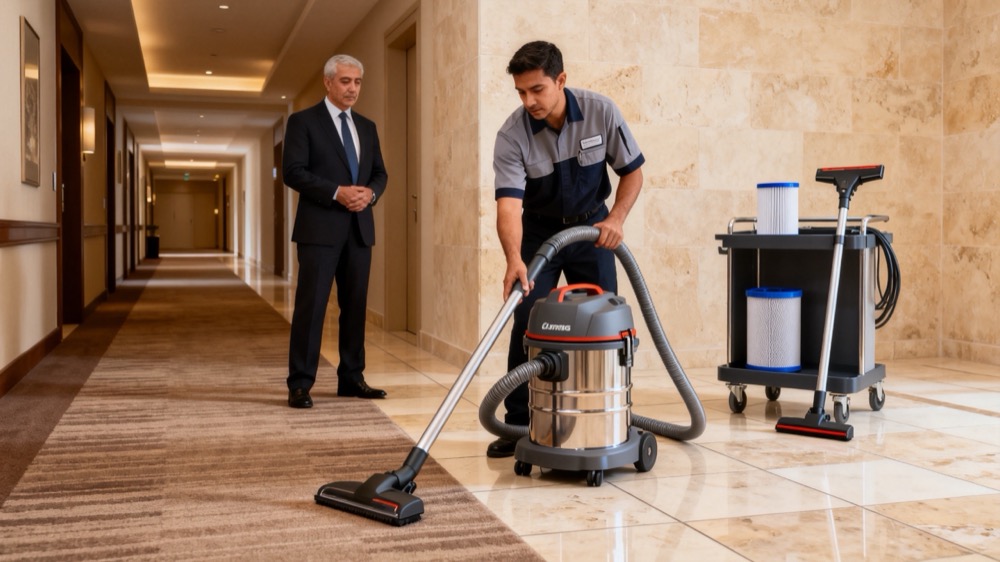
Kärcher was founded in Germany in 1935. Its Middle East headquarters are in Jebel Ali Free Zone, Dubai, and its regional dealer directory covers purchasing, accessories, and service inquiries. The company's history documents its expansion into wet and dry vacuums and other professional cleaning equipment. Its regional operation is a practical lead for contractors and facility managers who want branded equipment and a named service contact, not proof that the machines are made in the UAE.
The public regional offer is for Kärcher-branded products; private-label OEM/ODM terms are not established by the cited pages. If you are buying for several countries, ask which dealer will service each site, whether parts and labor are included in warranty, and whether the quoted accessories can be replenished locally. For a fleet purchase, request a demonstration with the surfaces, debris, and working conditions your staff will encounter.
Nilfisk was founded in Denmark in 1906 and serves customers in more than 100 countries. Its Middle East operation lists a Dubai office and authorized regional partners. Its offering spans commercial wet and dry vacuums, carpet care, and industrial equipment for defined applications such as oil and metal chip recovery or hazardous dust. That specialization makes it a relevant candidate when the material being collected matters more than the headline suction figure.
Nilfisk's regional site markets its own professional equipment and support, not a public private-label OEM/ODM program. For a specification-led tender, send the application details and ask for the exact model, approved accessories, filtration and containment documentation, and the service contact for the installation site. Do not infer that a regular wet and dry vacuum or a model with a high-efficiency filter is suitable for a hazardous application simply because it appears in the same catalog.
Cleantech's company profile lists 2007 as its founding year; its own site separately describes more than 30 years of industry experience. These are different claims, so confirm the registration date of the exact entity on the quotation if it matters to vendor onboarding. Its core markets in this guide are the UAE and Saudi Arabia, where it supplies cleaning contractors, hospitality, healthcare, manufacturing, and other professional buyers. Its range includes wet and dry vacuum cleaners, industrial vacuums, and carpet and upholstery extractors.
Cleantech's public offer is sourced equipment, spare parts, and regional support rather than factory OEM/ODM. The procurement advantage is the ability to compare multiple lines with one supplier. Ask which units and consumables are locally stocked, which must be imported, and who is responsible for authorized warranty work on each brand. If you are ordering for several Saudi sites, request separate delivery and service commitments for each city.
Founded in 1995, ALBARIQ supplies, rents, and services professional cleaning and floor-preparation equipment in the UAE, Saudi Arabia, and Qatar. Its catalog includes industrial and commercial vacuum cleaners, and its customers include cleaning contractors, warehouses, factories, hotels, and hospitals. Its rental and service model is especially relevant when downtime or short-term project mobilization matters more than owning the machine outright.
ALBARIQ is a distributor and service provider, not a verified private-label vacuum cleaner factory. Its public offering does not establish OEM/ODM services. Request comparable purchase and rental quotes for the same model, then check whether accessories, consumables, maintenance visits, transport, and a temporary replacement unit are included. A rental quote is more useful when it spells out what happens if the machine fails midway through your contract.
Unpublished figures are marked as such. A facility's floor area is not monthly output; local inventory is not factory capacity; and a declaration for one model cannot be treated as coverage for a whole catalog.
| Supplier | Best-fit purchase | Production capacity or availability | MOQ or minimum commitment | Certification and conformity checks |
|---|---|---|---|---|
| Ningbo Eyunhome | Export OEM/ODM inquiry, especially handheld and battery-powered ranges | Reports 7,500 m²; monthly model-level output not published in the cited profile | Not published; request separate pilot, custom-color, packaging, and repeat-order minimums | Company lists CE, GS, CB, RoHS and other claims; verify model-level evidence and any claimed ISO 9001 certificate. |
| Kärcher Middle East | Branded commercial or professional equipment with dealer support | Gulf office and dealer network; request availability and replenishment time for the SKU | Not published in cited sources; request unit and fleet pricing | Ask the dealer for destination-specific documents for the quoted SKU and electrical configuration. |
| Nilfisk Middle East | Commercial cleaning and application-specific industrial vacuuming | Regional office and partner network; request local inventory or made-to-order lead time | Not published in cited sources; confirm by model and configuration | Request machine- and application-specific documents, including any relevant hazardous-duty approvals. |
| Cleantech Gulf / Global | Multi-brand project supply in the UAE and Saudi Arabia | Advertises stock and spare-parts support; verify quantity by SKU and city | Not published in cited sources; ask about project minimums and consumable packs | Verify the original manufacturer's documents for the model and named importer. |
| ALBARIQ Equipment | Fleet purchase, rental, and regional service | Ask for available units, service coverage, and replacement fleet availability | Not published in cited sources; request purchase minimums and rental term | Request OEM documents and written confirmation of the supplied configuration. |
Motor wattage measures electrical input, not pickup performance. Ask suppliers to state where and how they measure air pressure and airflow. A sealed-suction figure at the motor inlet does not describe performance through a hose, a floor head, and a partly loaded filter. Require the complete configured machine to meet an agreed pickup test on your priority surfaces. If noise is part of the tender, specify the mode, surface, measurement method, and distance rather than comparing bare decibel claims.
For cordless vacuum cleaners, ask for runtime with the power head attached in normal and high modes, not just a best-case figure in low mode. Record the charger model, battery pack capacity in watt-hours, pack replacement price, and the availability of the pack over the warranty period. For a corded upright, focus on working reach, cord and strain-relief durability, restart behavior after thermal protection operates, and access to belts, rollers, or filters. For commercial wet and dry machines, specify the debris or liquid, daily operating hours, tank capacity, filter cleaning method, and how an operator empties and services the unit.
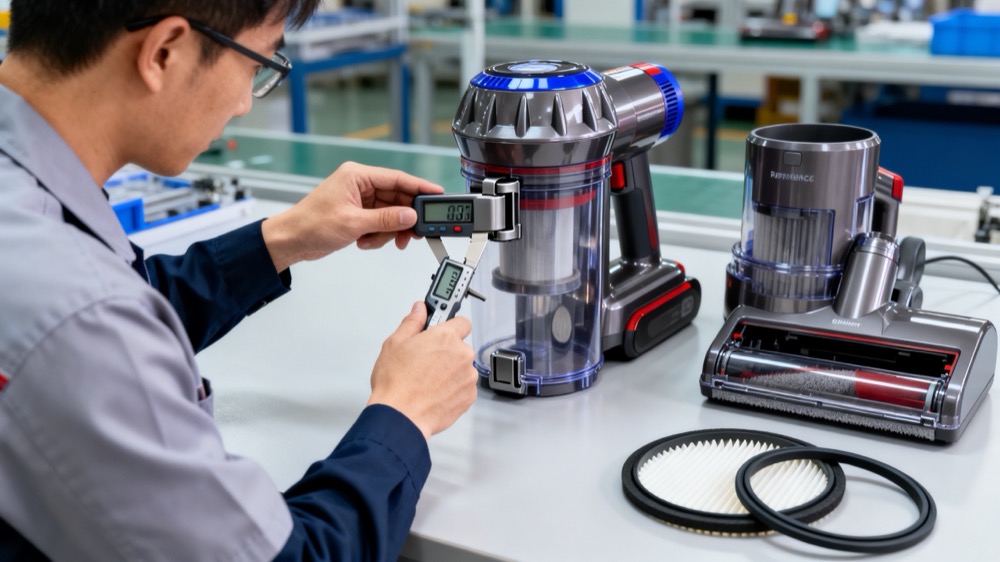
"ABS housing" is not a complete material specification. Identify the approved resin grade and supplier for critical parts such as the main housing, dust cup, latch, and charger enclosure. Agree where recycled material or regrind is acceptable, if anywhere, and document any relevant flammability requirements. Then connect each part to a practical acceptance check: latch cycling, drop resistance, fit after conditioning, or dust cup sealing. A cosmetic approval should not substitute for a durability test.
For a Saudi launch, have the importer and its conformity assessment provider map the exact product to the current SABER route before finalizing artwork or ordering production. Check whether the applicable Gulf low-voltage conformity requirements and product and shipment certificates apply. IEC 60335-1 and the applicable vacuum-specific Part 2 standard are useful starting points for the safety-document review; have the assessment provider confirm the relevant editions and whether a household, commercial, or industrial configuration needs a different scope. EU CE marking and RoHS documentation serve different purposes and do not establish Saudi clearance.
Ask for a model-to-document matrix covering the marketed SKU, factory model, factory site, electrical rating, plug, cord set or charger, battery pack where applicable, and the reports or declarations that cover them. Confirm the country-of-origin marking, Arabic labeling and instructions as applicable, and consistency between the rating plate and shipping documents. Resolve any mismatch before the packaging goes to print.
1. Engineering sample. Confirm form, ergonomics, pickup, airflow, filtration, thermal behavior, charging, and accessory fit. Keep a dated list of issues and agree measurable acceptance limits before approving revisions.
2. Pre-production sample. Approve a reference unit built to the agreed component list, using the production-intent charger or cord set, nameplate, accessories, and packaging. Combine the sample approval with a signed specification and photos so the reference is not just "the white unit we received in May."
3. Pilot lot and pre-shipment inspection. Pull units from normal production, not from the showroom. Check serial traceability, carton markings, critical components, and the agreed functional tests. Define what triggers a shipment hold and who signs any release. Use sampling for agreed inspection items, but specify separately which critical safety checks must be performed as routine factory tests.
Request quotes under a named Incoterms rule and location, then normalize the offers. A lower price at a Chinese port may become more expensive after freight, certification, inspection, customs clearance, inland delivery, and warranty stock. For battery-powered products, confirm battery transport documentation, packaging, and carrier acceptance with the forwarder before booking. Record carton dimensions, pallet configuration, shipment readiness, and who pays if a documentation error delays release.
For stocked Gulf equipment, ask for the price and lead time of filters, brush rolls, hose assemblies, batteries, and chargers—not merely a general promise that spares are available. For an OEM order, agree how failures will be identified by lot, how replacement parts or credits will be authorized, and who pays to move defective goods. For a fleet, compare cost per usable operating hour rather than unit price alone.
The first lot can pass inspection and still leave the buyer exposed. Consider a factory that replaces a filter gasket with a cheaper part of similar appearance on the second order. The housing, label, and even the filter media may remain unchanged. Yet a poor fit can allow air to bypass the filter. A visual check or a certificate for the filter media will not tell you whether the assembled vacuum still meets its filtration claim.
Put a change-control clause in the purchase agreement. Freeze the controlled bill of materials for the motor, impeller, filter media and seals, plastics, battery cells, protection electronics, and charger. Require written notice and buyer approval before substitution, with a documented review of whether verification or retesting is needed. Keep a retention sample from the approved lot. On the first repeat order, have an inspector select a unit from packed stock and compare it against the approved configuration and performance checks. This makes it harder for a cost-saving substitution to reach retail shelves before anyone notices.
For a private-label launch, shortlist the factory that can put customization boundaries, critical components, pilot commitments, and conformity evidence in writing. For a commercial fleet, favor the regional supplier that can demonstrate the application, name the service team, and commit to parts and repair terms for each site. Verify the exact model before comparing final prices: a cheaper quote for a different configuration is not a like-for-like saving.
To request an OEM/ODM assessment from Ningbo Eyunhome Electric Technology Co., Ltd., send your target Gulf market, product format, electrical configuration, estimated order and annual volumes, performance targets, packaging requirements, and launch date. Ask for an existing-platform option and a customized option, each with a separate MOQ, sample lead time, tooling estimate, document list, and spare-parts proposal. The company lists vivian@eyunhome.net for inquiries.
Ask for the complete certificate, including any multi-site annex. Match the legal entity, manufacturing address, certificate number, standard, scope, and expiration date to your purchase. Check current status with the issuing certification body or in IAF CertSearch if the record is listed; verify the issuer's accreditation separately where necessary. If the certificate cannot be found, ask the issuer to confirm its status rather than assuming the certificate is fake or active. An ISO 9001 certificate concerns the management system, not the conformity of a particular vacuum cleaner.
Only after the conformity assessment provider accepts the model mapping and confirms coverage. Start by comparing the factory model and retail SKU, brand, rating, charger, battery, safety-critical parts, factory site, and intended use. A brand or packaging change may call for different documentation than a motor, charger, or enclosure change. Ask for that determination in writing before printing the carton or issuing a production order.
Ask whether the claim applies to the filter element or the fully assembled vacuum. Request the test method, report, tested configuration, and acceptance limit. For whole-machine claims, make sure the production unit uses the same filter, gaskets, housing, and assembly arrangement as the tested unit. If the supplier can document only the filter element, do not turn that evidence into a whole-machine emissions claim.
Ask for separate minimums for the base model, resin color, logo application, printed carton, charger, and accessory kit. Price an existing color with custom labeling as an alternative, then compare the cost of buying or storing excess custom materials. Put ownership, storage time, reorder rights, and disposal charges in writing. An attractive assembly MOQ is not useful if it leaves you financing unusable packaging.
Ask for anonymized output records for the quoted platform, the planned production line, and a pilot schedule. Compare effective output—not theoretical line speed—with your required shipment cadence. Request the supplier's assumptions for shared lines, key component supply, rework, and peak-season allocation. Put milestones for material readiness, assembly, inspection, and dispatch in the purchase order and define what happens if a milestone slips.
- World Bank WITS / UN Comtrade — Saudi Arabia's 2024 domestic vacuum cleaner import table under the historical HS 850910 classification. [wits.worldbank]
- Gulf Standardization Organization — official notification scope under the Gulf low-voltage technical regulation; use it to check the scope of the conformity assessment body relevant to the product. [gso.org]
- TÜV SÜD — overview of Saudi SASO/SABER product certification and conformity assessment. [tuvsud]
- Grand View Research — 2026–2033 commercial vacuum cleaner market report, with the 2025 baseline and 2026 forecast discussed above. [grandviewresearch]


