
Views: 217 Author: Eyunhome Vacuum Publish Time: 2026-09-12 Origin: Site


Content Menu
● Handheld Vacuum vs Portable Vacuum: Quick Comparison
● What Is a Handheld Vacuum for Car Detailing?
>> Strengths of Handheld Vacuums
>> Limitations of Handheld Vacuums
● What Is a Portable Vacuum for Car Detailing?
>> Strengths of Portable Vacuums
>> Limitations of Portable Vacuums
● The Most Important Performance Factors for Car Detailing
>> Suction Is More Than a Single Number
>> Battery Runtime Must Match the Cleaning Scenario
>> Filtration Affects Cleaning Confidence
● Handheld Vacuum vs Portable Vacuum by User Type
>> For Professional Detailing Businesses
● A Practical Vehicle-Interior Cleaning Workflow
>> Step 1: Remove Large Loose Items
>> Step 3: Use the Right Attachment
>> Step 4: Treat Hair and Embedded Debris Separately
>> Step 5: Empty and Maintain the Vacuum
● Product Development Insight: Build a Two-Tier Car Vacuum Range
● Which Vacuum Is Better for Car Detailing?
● Build Your Car Vacuum Program With Eyunhome
● FAQ
>> 1. Is a handheld vacuum powerful enough for car detailing?
>> 2. What is the difference between a handheld vacuum and a portable vacuum?
>> 3. Should I choose a corded or cordless car vacuum?
>> 4. Which accessories are essential for a car vacuum?
>> 5. How long should a cordless car vacuum run?
>> 6. Is HEPA filtration necessary in a car vacuum?
>> 7. Can portable vacuums clean wet spills in cars?
>> 8. What should importers ask a car vacuum manufacturer before ordering?
When buyers compare a handheld vacuum vs portable vacuum for car detailing, they are often comparing more than two product names. They are assessing cleaning reach, suction stability, runtime, storage, attachments, user comfort, and the final cost of ownership.
For brands, distributors, automotive-accessory retailers, and professional detailing operators, the best choice depends on the intended cleaning task. A compact handheld vacuum can be highly convenient for quick spot cleaning, while a more fully featured portable vacuum may offer greater capacity, stronger sustained pickup, and more versatile accessory options for deeper vehicle-interior work.
At Ningbo Eyunhome Electric Technology Co., Ltd., we support global customers with upright, handheld, corded, and cordless vacuum cleaner solutions. Through flexible OEM/ODM development, stable manufacturing, product customization, and responsive after-sales support, we help businesses create car-cleaning vacuum ranges that match their target market, price position, and performance requirements.
This guide explains the practical differences between handheld vacuums and portable vacuums for car detailing, so buyers can build a more competitive and user-friendly product portfolio.

The terms "handheld vacuum" and "portable vacuum" are sometimes used interchangeably. However, for product development and purchasing, they should be separated more carefully.
A handheld vacuum is usually designed to be held directly in one hand. It is compact, lightweight, and convenient for fast cleanup jobs. A portable vacuum is a broader category. It can include handheld models, but it may also refer to compact canister-style, shoulder-carry, wheeled, corded, cordless, wet-and-dry, or hose-equipped vacuum cleaners that are easy to move between locations.
| Feature | Handheld Vacuum for Car Detailing | Portable Vacuum for Car Detailing |
|---|---|---|
| Main design | Small, one-hand operation | Compact but may include hose, larger body, strap, or wheels |
| Best use | Fast daily cleaning and spot pickup | Full vehicle cleaning and more demanding detailing |
| Weight | Usually lighter | Varies from light to medium-duty |
| Dust-bin capacity | Usually smaller | Often larger |
| Cleaning reach | Good with crevice tool, limited by body size | Better with hose and extended tools |
| Runtime | Often limited in cordless models | May offer larger battery, dual battery, or corded operation |
| Suction endurance | Suitable for light debris | Better potential for longer cleaning cycles |
| Storage | Very easy | Still manageable, but requires more space |
| Typical buyer | Consumer, car owner, gift buyer | Detailer, retailer, workshop, fleet operator |
| Product-positioning potential | Entry and mid-range | Mid-range to professional-use category |
The right answer is not always one product or the other. Many successful brands offer both: a lightweight cordless handheld vacuum for convenience and a stronger portable vacuum for deep cleaning.
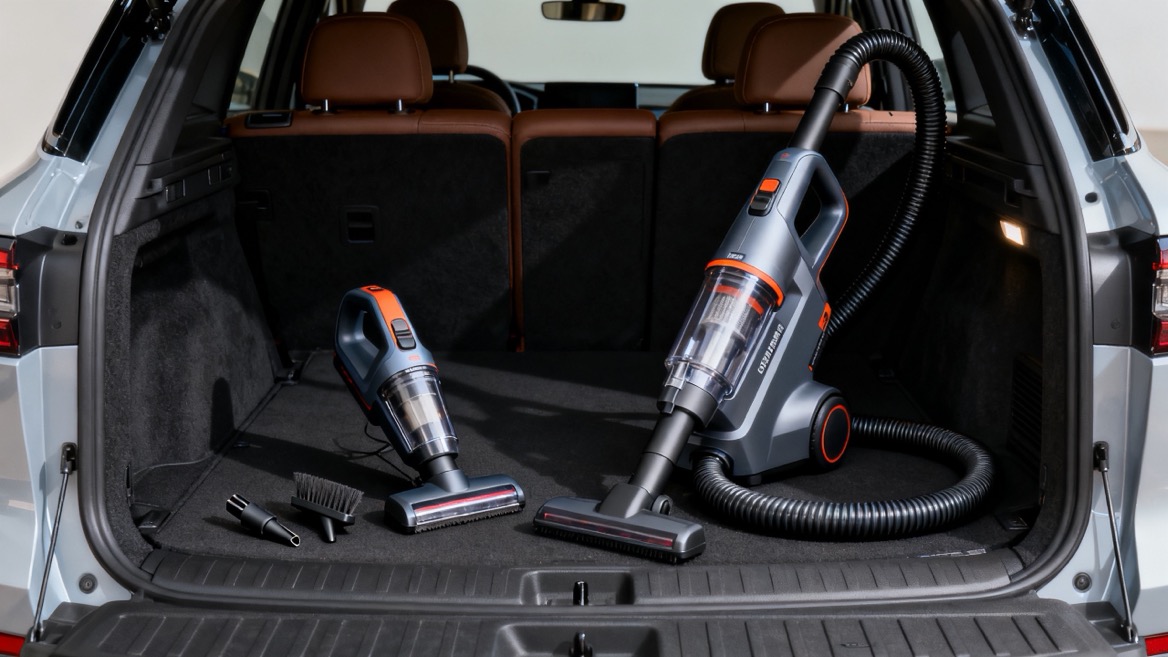
A handheld vacuum cleaner for car detailing is a small vacuum that users can carry around the vehicle without dragging a large machine or power cord. Most models are cordless and rechargeable, although corded 12V vehicle-powered versions also exist.
For everyday users, the biggest attraction is simple: pick it up, clean the mess, put it away.
A handheld car vacuum is especially useful for cleaning:
- Loose dust on dashboards and center consoles
- Crumbs on seats and floor mats
- Hair around seat edges
- Dust inside door pockets
- Small debris around cup holders
- Dirt under child safety seats
- Pet hair in limited areas
- Light dry debris in trunks
From a product-planning perspective, handheld vacuums are ideal when a customer needs a compact, accessible, and impulse-friendly item. Their smaller format also gives brands more flexibility in packaging, shipping, and retail display.
Fast deployment is the primary advantage. A user does not need to assemble a large unit, find a wall socket, or move a bulky machine around the vehicle.
Compact storage also matters. Many consumers keep a handheld vacuum in a garage cabinet, apartment storage area, RV, office, or vehicle trunk.
One-hand control makes it easier to clean narrow parts of the vehicle interior. With the right crevice nozzle, the user can reach gaps between seat rails, under pedals, and along seat seams.
Strong consumer appeal makes handheld models suitable for online retail, promotional bundles, automotive-accessory stores, and gift-oriented campaigns.
The compact format creates trade-offs. A smaller dust cup means more frequent emptying. A smaller battery may limit high-power cleaning time. A lightweight motor system may also struggle with deeply embedded sand, thick pet hair, or heavily soiled commercial vehicles.
In independent product testing, cordless car vacuums have shown meaningful differences in usable runtime. Some compact handheld models run for roughly 12 minutes, while stronger battery-platform models can provide approximately 18 to 25 minutes depending on the mode and load. This is why a product specification should clearly distinguish maximum runtime, high-power runtime, and charging time rather than relying on a single broad claim.
For quick household use, 10 to 15 minutes may be acceptable. For deep car detailing, buyers should consider longer runtime, replaceable batteries, or a corded alternative.
A portable vacuum for car detailing is a transportable cleaning system designed for more complete interior maintenance. It may be cordless or corded. It may also include a flexible hose, a larger dust container, several nozzles, shoulder straps, or wet-and-dry pickup capability.
Compared with a basic handheld vacuum, a portable vacuum is often designed around versatility and sustained cleaning performance.
A portable vacuum can be a practical option for:
- Professional car detailing studios
- Car-wash businesses
- Rental-car cleaning teams
- Taxi and ride-hailing fleets
- Automotive dealerships
- Mobile detailing operators
- Workshop environments
- Large household vehicles such as SUVs, vans, and RVs
The larger design can support a longer hose, a more stable motor platform, a larger bin, and more accessories. It can also improve ergonomics because the user does not need to carry the full motor and dust container in the hand while reaching under every seat.
Deeper-cleaning capability is the key reason to choose a portable vacuum. A hose-equipped design can reach under seats, around rails, into footwells, and behind center consoles without forcing the user to hold a heavy body in an awkward position.
Larger dust capacity is important for professional users. A detailer cleaning multiple vehicles should not need to stop after every few minutes to empty the bin.
Accessory flexibility improves cleaning results. Useful accessories can include:
- Narrow crevice nozzle for seams and gaps
- Flexible crevice nozzle for seat rails and console areas
- Upholstery brush for fabric seats
- Dusting brush for vents and dashboards
- Wide floor nozzle for mats and trunk carpet
- Rubber nozzle for hair pickup
- Extension hose for hard-to-reach spaces
Power-source choice gives buyers more options. Corded portable vacuums can support longer continuous cleaning. Cordless models offer mobility. Dual-battery systems can reduce downtime in commercial use.
A portable vacuum is not always the best solution for every user. It may be larger, heavier, more expensive, and less convenient for a two-minute cleanup.
For a compact-car owner who only needs to remove crumbs once a week, a more powerful portable system may feel excessive. The best product is the one that users will actually reach for regularly.
Choosing between a handheld vacuum and a portable vacuum should not be based only on the product shape. The following performance factors have a much greater effect on real-world cleaning satisfaction.
Many vacuum listings focus heavily on suction figures such as Pa, kPa, air watts, wattage, or motor speed. These figures can be useful, but they should never be evaluated alone.
A vacuum's real pickup performance depends on several connected factors:
- Motor and fan efficiency
- Airflow pathway design
- Sealed suction performance
- Nozzle design
- Hose diameter and length
- Filter condition
- Battery voltage and discharge performance
- Debris type and surface material
- Whether the bin is nearly full
For example, a narrow crevice tool can increase local pickup in a seat gap, but it may reduce airflow if the opening becomes blocked by hair or large debris. A high motor-speed claim does not automatically guarantee better cleaning if airflow, nozzle design, and filtration are poorly balanced.
For a car-detailing vacuum, buyers should request repeatable testing with common debris such as sand, cereal, pet hair, dust, paper fragments, and fine particles on carpet, fabric, rubber mats, and hard plastic surfaces.
Runtime is one of the most common causes of customer dissatisfaction in cordless car vacuums.
A low-power setting can deliver an attractive runtime number, but users often switch to a higher setting when cleaning carpets, sand, pet hair, or embedded debris. That means actual high-power runtime may be much shorter.
For product planning, consider these use cases:
| Use Case | Recommended Battery Strategy |
|---|---|
| Quick consumer cleanup | Integrated battery with simple charging |
| Family car weekly cleaning | 15–25 minutes of practical working time |
| SUV, van, or pet-hair cleaning | High-capacity pack or removable battery |
| Professional detailing | Dual battery, fast charging, or corded model |
| Fleet and workshop use | Corded or commercial battery platform |
A removable battery can create extra value because the customer can charge one pack while using another. For professional users, this can matter more than a small improvement in peak suction.
Vehicle interiors collect fine dust, pollen, fibers, pet dander, and particles carried in from outside. A well-designed filtration system helps prevent fine debris from being released back into the cleaned area.
A true HEPA filter is commonly defined as a filter capable of capturing at least 99.97% of particles at 0.3 microns under the applicable test conditions. However, filter material alone is not enough. The complete vacuum system must be designed so that airflow passes through the filter rather than leaking around it.
For product developers and sourcing teams, it is important to ask:
- Is the filter washable, replaceable, or both?
- Is the filter grade clearly specified?
- Does the filter fit securely within the product?
- Can consumers easily purchase replacement filters?
- Does the product include a pre-filter for larger debris?
- Is the dust bin easy to empty without creating a dust cloud?
A washable pre-filter can reduce running costs, while a replaceable fine filter can support better long-term hygiene and performance.
The best product category changes according to the buyer's workflow.
A cordless handheld vacuum is usually the most practical choice. It is simple, compact, and quick to use after school runs, road trips, pet transport, or food spills.
Recommended features include:
- Lightweight body
- USB-C, wall, or vehicle charging option
- Crevice tool and brush nozzle
- Transparent dust bin
- Easy one-button emptying
- Washable filter
- LED light for footwells and seat gaps
- Low-noise operating profile
The goal is convenience, not industrial-level capacity.
A high-performance handheld vacuum or compact portable vacuum can work well, depending on the vehicle size and cleaning frequency.
Detailing enthusiasts often care about:
- Strong pickup from carpet fibers
- Long crevice tools
- Pet-hair brush tools
- Battery runtime in max mode
- Better filtration
- Durable attachments
- Easy cleaning after use
For this group, a removable battery and flexible hose can be strong selling points.
A portable vacuum with sustained power and a larger capacity is generally the more suitable choice. Professional teams need consistency over many cleaning cycles, not only a small and attractive form factor.
Important commercial requirements include:
- Longer continuous working time
- Larger dust container
- Robust hose and connection points
- Multiple accessory kits
- Replaceable filters
- Reliable motor protection
- Easy serviceability
- Stable supply of spare parts
- Clear safety and compliance documentation
A mobile detailer may prefer a battery-powered portable vacuum with two interchangeable packs. A fixed detailing bay may prefer a corded model to avoid charging interruptions.
A good vacuum will not compensate for an inefficient cleaning process. The order of work can reduce repeated cleaning and improve customer results.
Take out bottles, paper, toys, bags, removable mats, and other objects. This exposes the actual dirty areas and prevents accessories from becoming blocked.
Clean dashboard vents, seat surfaces, door pockets, and console areas before moving down. Dust falls downward, so this method avoids re-cleaning lower surfaces.
Use a brush tool for vents and textured plastic. Use a narrow crevice tool for seat seams, handbrake areas, and rail gaps. Use a wider nozzle for floor mats and trunk carpet.
Pet hair and sand often need more than standard vacuum passes. Agitate the surface with a detailing brush first, then vacuum slowly with a focused nozzle. This helps loosen debris trapped in carpet fibers.
Do not wait until the bin is completely packed. A full bin and clogged filter can reduce airflow and make a good vacuum feel weak. Clean the filter according to product instructions and allow washable filters to dry fully before reinstalling them.
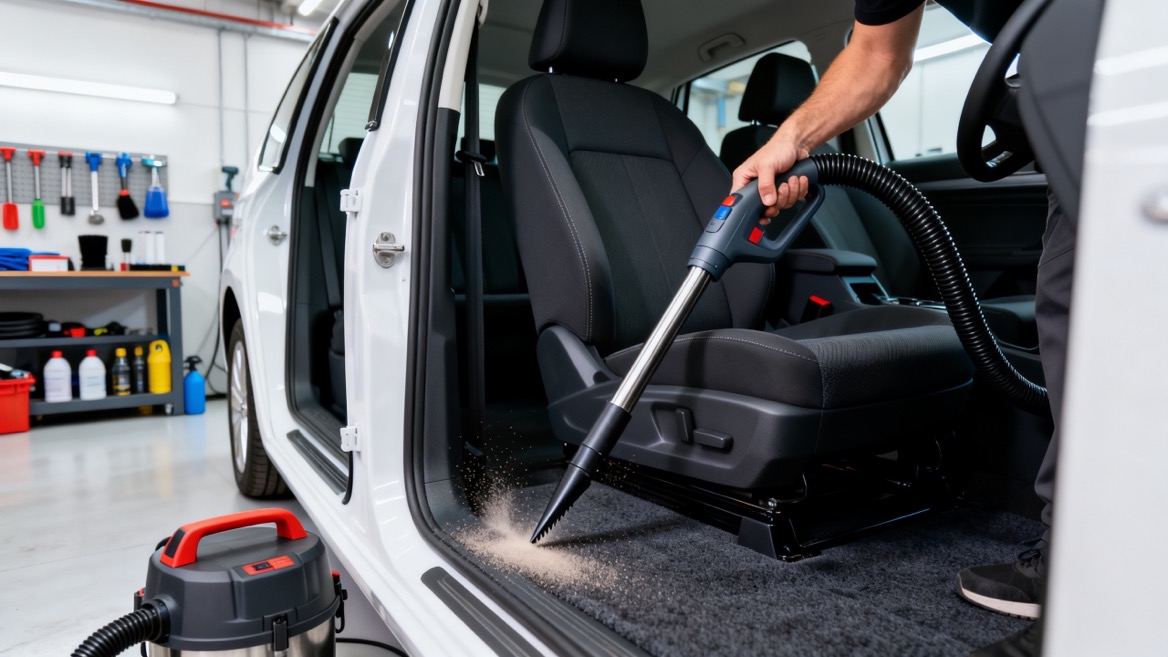
For private-label buyers, one of the most effective portfolio strategies is not choosing between handheld and portable formats. It is creating a clear two-tier range.
| Product Tier | Suggested Format | Target Buyer | Core Selling Message |
|---|---|---|---|
| Convenience Series | Compact cordless handheld vacuum | Daily car owner, online shopper, gift buyer | Quick, compact, ready for everyday messes |
| Performance Series | Hose-equipped portable vacuum | Detailer, enthusiast, workshop, fleet | Deeper reach, stronger endurance, complete interior care |
This approach allows a brand to cover different budgets without confusing the customer.
The entry model should emphasize portability, easy charging, compact storage, and essential accessories. The premium model should focus on sustained performance, larger capacity, accessory completeness, replaceable filters, upgraded battery configuration, and durable construction.
For OEM/ODM projects, customization opportunities can include:
- Product color and finish
- Logo placement and packaging
- Battery capacity options
- Filter configuration
- Accessory combinations
- Corded or cordless platform selection
- Retail-ready gift-box design
- Instruction manual localization
- Spare-parts and replacement-filter programs
- Market-specific compliance requirements
A handheld vacuum is better for fast, lightweight, everyday car cleaning. It is ideal for crumbs, dust, seat seams, small spills of dry debris, and quick maintenance.
A portable vacuum is better for deeper, longer, and more professional car detailing work. It provides more flexibility when cleaning large vehicles, heavily soiled carpets, pet hair, multiple vehicles, and difficult areas beneath seats.
The final decision should be based on the cleaning frequency, vehicle type, debris profile, power-source preference, and buyer segment.
Do not select a model only because it has the largest suction figure on the packaging. Instead, evaluate the complete cleaning system: airflow, attachment design, runtime, filtration, bin capacity, ergonomics, noise, serviceability, and replacement-part availability.
For a competitive car-cleaning product range, the strongest solution may be a compact handheld vacuum for daily convenience plus a portable vacuum for deeper detailing performance.
Ningbo Eyunhome Electric Technology Co., Ltd. can support your business with vacuum cleaner development and manufacturing options for global markets. Whether you need a cordless handheld car vacuum, a corded portable model, a customized accessory set, private-label packaging, or a full OEM/ODM project, our team can help turn your product concept into a scalable market-ready solution.
Contact Eyunhome today to discuss your target market, product specifications, customization needs, and sourcing plan for handheld and portable car-detailing vacuums.
Yes, a handheld vacuum can be effective for routine cleaning, especially for crumbs, dust, hair, and loose dirt. For deeply embedded sand, heavy pet hair, or multiple vehicles, a more powerful portable vacuum with a hose and larger capacity is usually more efficient.
A handheld vacuum is usually a compact unit held directly in the hand. A portable vacuum is a wider category that may include handheld models, compact canister units, hose-equipped designs, shoulder-carry machines, and other movable vacuum systems.
Choose cordless for flexibility and fast cleaning without a nearby power outlet. Choose corded for longer uninterrupted use, especially in workshops, detailing studios, and fixed cleaning locations. A removable battery system offers a useful middle option for mobile professionals.
The most useful accessories are a crevice nozzle, flexible hose or extension tool, upholstery brush, dusting brush, and wide floor nozzle. A rubber hair-removal tool can also improve pet-hair pickup from carpet and fabric seats.
For quick consumer use, practical runtime of 10 to 15 minutes can be sufficient. For a complete family-car clean, 15 to 25 minutes is often more suitable. Professional users should consider dual batteries, fast charging, or corded equipment for longer cleaning sessions.
HEPA filtration can be valuable for users who want better fine-dust control, especially in vehicles that carry pets, children, or allergy-sensitive passengers. The complete air path should be properly sealed for the filter system to perform as intended.
Only a vacuum specifically designed and rated for wet pickup should be used for wet spills. A dry-only handheld or portable vacuum should not be used to collect liquids, because this can damage the motor, filtration system, or electrical components.
Ask about motor performance, practical runtime, charging time, battery type, filter specification, dust-bin capacity, included accessories, noise level, quality-control process, spare-part availability, packaging options, compliance documents, lead time, and after-sales support.
1. [Eyunhome Vacuum — China upright, handheld, corded and cordless vacuum manufacturer]
2. [Ningbo Eyunhome Electric Technology Co., Ltd. — HKTDC supplier profile]
3. [U.S. Environmental Protection Agency — What is a HEPA filter?]
4. [U.S. Environmental Protection Agency — HEPA vacuum definition and performance requirements]
5. [Wirecutter — Car vacuum testing, runtime, attachments, and interior-cleaning performance]
7. [People — Car vacuum testing and cordless runtime observations]


