
Views: 217 Author: Eyunhome Vacuum Publish Time: 2026-09-05 Origin: Site


Content Menu
● Quick Answer: Handheld or Stick Vacuum for Pet Hair?
● Handheld Vacuum vs Stick Vacuum Comparison Table
● What Pet Owners Actually Need From a Vacuum
>> The Difference Between Visible Fur and Fine Debris
● Handheld Vacuum for Pet Owners
>> Where Handheld Vacuums Perform Best
>> Benefits of a Handheld Vacuum
>> Limitations of a Handheld Vacuum
>> Features That Make a Handheld Vacuum Better for Pet Hair
>> Where Stick Vacuums Perform Best
>> Limitations of a Stick Vacuum
>> Features That Make a Stick Vacuum Better for Pet Owners
● Which Vacuum Wins by Cleaning Task?
● The Best Choice by Household Type
>> Small Apartment With One Cat
>> Family Home With One or Two Dogs
>> Multi-Pet Home With Carpets
>> Frequent Car Travel With Pets
● Expert Buying Framework: Look Beyond "High Suction"
>> 1. Check the Floorhead First
>> 3. Examine Filtration Claims Carefully
>> 4. Calculate the Cleaning Routine
● Product Development Insights for Vacuum Brands
>> Build a Clear Product Ladder
>> Turn Maintenance Into a Selling Point
>> Use Claims That Match Product Evidence
● Practical Pet-Hair Cleaning Routine
● Handheld Vacuum vs Stick Vacuum: Final Verdict
>> Is a handheld vacuum good enough for pet hair?
>> Are stick vacuums good for dog hair?
>> What is the best vacuum type for pet hair on furniture?
>> Should pet owners choose corded or cordless vacuums?
>> Do I need a HEPA filter in a pet vacuum?
>> How do I stop pet hair from tangling around a vacuum brush roll?
>> Is a 2-in-1 stick vacuum better than buying separate appliances?
>> What vacuum features should a private-label pet vacuum include?
For pet owners, the choice between a handheld vacuum and a stick vacuum is not simply about size. It affects how quickly hair is removed from sofas, how well embedded fur is lifted from carpets, how often people clean, and whether the vacuum remains convenient enough for daily use. A handheld vacuum is ideal for fast, targeted cleanups, while a stick vacuum is usually the stronger all-around solution for floors and larger pet-hair workloads.
For retailers, private-label brands, importers, and distributors, this distinction is equally important. A product range that includes both handheld and stick vacuum cleaners can address different household cleaning routines, pet types, floor plans, and price expectations. Ningbo Eyunhome Electric Technology Co., Ltd. supports this market with upright, handheld, corded, and cordless vacuum cleaner solutions, along with professional OEM/ODM development, stable manufacturing, and dependable after-sales support.

Choose a handheld vacuum for pet hair when customers need a lightweight machine for sofas, car seats, stairs, pet beds, curtains, and other small areas.
Choose a stick vacuum for pet owners when customers need regular whole-home cleaning across hard floors, rugs, carpet, and under-furniture spaces.
For many multi-pet households, the strongest product strategy is not "handheld vacuum vs stick vacuum" as an either-or decision. It is a two-product cleaning system:
- A cordless stick vacuum for frequent floor cleaning
- A handheld vacuum for quick fur removal from furniture and vehicles
- Motorized pet tools for upholstery and fabric surfaces
- Effective filtration for fine dust and pet-related debris
- Easy-empty dust cups that encourage regular maintenance
This combination matters because pet hair does not stay in one place. It gathers on flooring, wraps around brush rolls, clings to woven upholstery, accumulates on stairs, and becomes trapped in car-seat seams.
3333
The best choice depends on the cleaning task—not only on suction power. In practical pet-hair cleaning, floorhead design, brush-roll contact, airflow control, filtration, and tool selection often have more influence on the user's experience than a single motor specification.
Pet owners do not clean in the same way as households without animals. Hair shedding can be daily, seasonal, or constant. Short pet hair may work into carpet fibers. Long hair may wrap around rollers. Fine dander and dust can become airborne during cleaning if filtration and sealing are weak.
The U.S. pet market remains substantial: 95 million U.S. households owned at least one pet in 2025, while dog ownership reached 71 million households in the same period. That scale helps explain why pet-hair cleaning features have become a meaningful product category rather than a minor accessory claim.
A well-designed vacuum for pet households should solve five practical problems:
- Fast pickup: Remove visible fur without repeated passes
- Hair management: Reduce brush-roll tangling and manual cutting
- Surface flexibility: Work on floors, carpets, upholstery, stairs, and vehicles
- Dust containment: Capture fine debris rather than releasing it through leakage or poor filtration
- Low-effort maintenance: Make it simple to empty the bin, wash filters, and clean tools
Visible pet hair is only one part of the cleaning job. Pet households also deal with fine dust, tracked-in soil, food crumbs, litter particles, and dander-like debris. That is why a strong cleaning product should be evaluated as a system: intake path, cyclone or dust separation, filters, seals, brush roll, accessories, and bin-emptying design all matter.
For products marketed with true HEPA filtration, the terminology should be used carefully. The U.S. Environmental Protection Agency describes HEPA filtration as capable of capturing at least 99.97% of particles at 0.3 microns, and its guidance also emphasizes that a HEPA vacuum must direct all drawn air through the final filter without bypass leakage.
For brands and buyers, this means a "HEPA-style" label should not be treated as identical to a verified, sealed HEPA filtration claim.
A handheld vacuum offers convenience that a full-size floor cleaner cannot always match. It is small, accessible, and ready for immediate cleaning. When a dog jumps onto the sofa after a walk or a cat leaves fur on a blanket, many users will reach for the compact tool first.
A handheld pet vacuum is particularly useful for:
- Fabric sofas and armchairs
- Pet beds and blankets
- Car seats, footwells, and cargo areas
- Carpeted stairs
- Window ledges and tight corners
- Cushions and mattress edges
- Cat trees and scratching furniture
- Quick cleaning after grooming sessions
The main advantage is speed of response. A compact product stored near the living area can make a 30-second cleaning task feel realistic. A larger appliance stored in a closet may turn that same job into something users postpone.
Excellent portability. Handheld models are normally easier to carry upstairs, use in vehicles, and maneuver around furniture.
Better close-range control. The user can guide the nozzle directly over hair-covered surfaces, seams, cushions, and stairs.
Strong accessory potential. A mini motorized brush, crevice tool, fabric nozzle, and flexible hose can turn a basic handheld unit into a focused pet-cleaning product.
Compact retail positioning. For distributors and private-label brands, handheld vacuums can serve as entry-level products, bundled accessories, seasonal promotions, or add-on products alongside stick vacuum lines.
Useful for frequent touch-ups. They fit the reality of pet care: small messes happen often.
The same compact design also creates trade-offs.
A handheld vacuum generally has a smaller dust cup, a narrower cleaning path, and a limited battery capacity. It may clean a sofa beautifully but feel inefficient across a living-room floor. Users with multiple shedding pets may need to empty the bin often, especially when cleaning rugs, upholstery, and pet bedding.
Handheld models can also fatigue the wrist when used for long sessions. The user must support the full weight in one hand rather than allowing a floorhead and extension tube to carry part of the load.
When sourcing or developing a handheld vacuum for pet owners, prioritize these features:
- Motorized mini brush: Helps lift fur from upholstery and stairs
- Anti-tangle brush design: Reduces manual removal of wrapped hair
- Wide-mouth intake: Improves pickup of hair clumps and crumbs
- Crevice tool: Reaches car-seat gaps, sofa seams, and baseboards
- Washable filter system: Supports lower long-term maintenance costs
- Clear dust cup: Lets users see when the unit needs emptying
- Easy-release bin: Reduces direct contact with dust and debris
- Comfortable grip: Important for repeated, one-handed cleaning
- Battery indicator: Helps users avoid interrupted cleaning sessions
A useful product-development lesson is that a handheld vacuum should not merely be a smaller version of a standard vacuum. It should be designed around the surfaces where pets create the most concentrated mess.
A stick vacuum is usually the more complete choice for everyday pet-hair management. It combines a long cleaning path with a motorized floorhead, extension tube, and upright operating position. For homes with open floor plans, multiple rooms, rugs, or mixed surfaces, a stick vacuum can make daily cleaning much faster.
A stick vacuum for pet hair is most effective for:
- Hardwood, laminate, tile, and vinyl floors
- Low-pile and medium-pile rugs
- Carpeted rooms
- Hallways and open living areas
- Under beds, sofas, and cabinets
- Daily or near-daily whole-home cleaning
- Larger apartments and family homes
- Multi-pet households
In independent cleaning-lab coverage, cordless stick models designed for pet hair have shown the value of anti-tangle pickup and floorhead details. For example, recent testing highlighted a model that removed long test strands from carpet without tangling and used headlights to reveal debris near baseboards and under furniture.
That result reflects an important design principle: a floorhead must do more than create suction. It needs to maintain contact with the surface, guide debris into the intake, manage wrapped hair, and help users see missed dirt.
Faster floor coverage. A wider floorhead allows users to clean larger spaces more efficiently than a compact handheld unit.
Better for routine habits. A cordless stick vacuum stored on a wall mount or freestanding dock can encourage quick daily passes.
More capable on mixed floors. A motorized brush roll can lift hair from rugs and carpet, while a soft roller or adjustable setting can improve hard-floor pickup.
Improved reach. The extension tube helps users clean under furniture, along ceiling edges, and behind appliances without crouching.
Higher perceived value. Stick vacuums can support premium features such as LED lighting, removable batteries, touch displays, multi-stage filtration, self-standing designs, and convertible handheld functionality.
Cordless stick vacuums depend on battery strategy. Maximum-power modes can reduce runtime, especially when used with motorized floor tools. For buyers, rated runtime should be assessed alongside real operating conditions:
- Which power mode was used?
- Was the motorized floorhead active?
- Was the test on hard floor or carpet?
- Is the battery removable?
- How long does a full recharge take?
- Can users purchase a spare battery?
A stick vacuum may also be less convenient for car interiors, narrow stairs, and upholstery unless it converts into a handheld unit or includes targeted accessories.
For a pet-focused stick vacuum program, consider:
- Motorized anti-tangle floorhead
- Soft roller for hard floors
- Carpet-capable brush roll
- Mini motorized pet tool
- Detachable handheld configuration
- LED floorhead lights
- Multi-stage filtration
- Sealed airflow path where applicable
- Removable battery option
- Wall dock or charging stand
- One-click dust-bin emptying
- Washable components where appropriate
- Long crevice tool for under-furniture cleaning
The answer becomes clearer when the decision is based on actual pet-owner routines.
| Cleaning task | Better choice | Why |
|---|---|---|
| Daily fur on hard floors | Stick vacuum | Covers larger areas quickly and reaches under furniture |
| Embedded fur in rugs | Stick vacuum | Motorized floorhead provides more consistent agitation and coverage |
| Sofa cushions and upholstery | Handheld vacuum | Closer control and mini motorized tools are easier to use |
| Pet beds | Handheld vacuum | Compact size makes targeted cleaning faster |
| Car interiors | Handheld vacuum | Better maneuverability in confined spaces |
| Carpeted stairs | Handheld vacuum | Safer and easier to carry than a full stick configuration |
| Quick crumbs near feeding areas | Handheld vacuum | Immediate access for small, localized messes |
| Whole-home weekly cleaning | Stick vacuum | Larger bin and broad cleaning path reduce total cleaning time |
| Under beds and sofas | Stick vacuum | Long tube and low-profile floorhead improve reach |
| Homes with multiple pets | Stick vacuum plus handheld | The stick vacuum handles volume; handheld supports touch-ups |
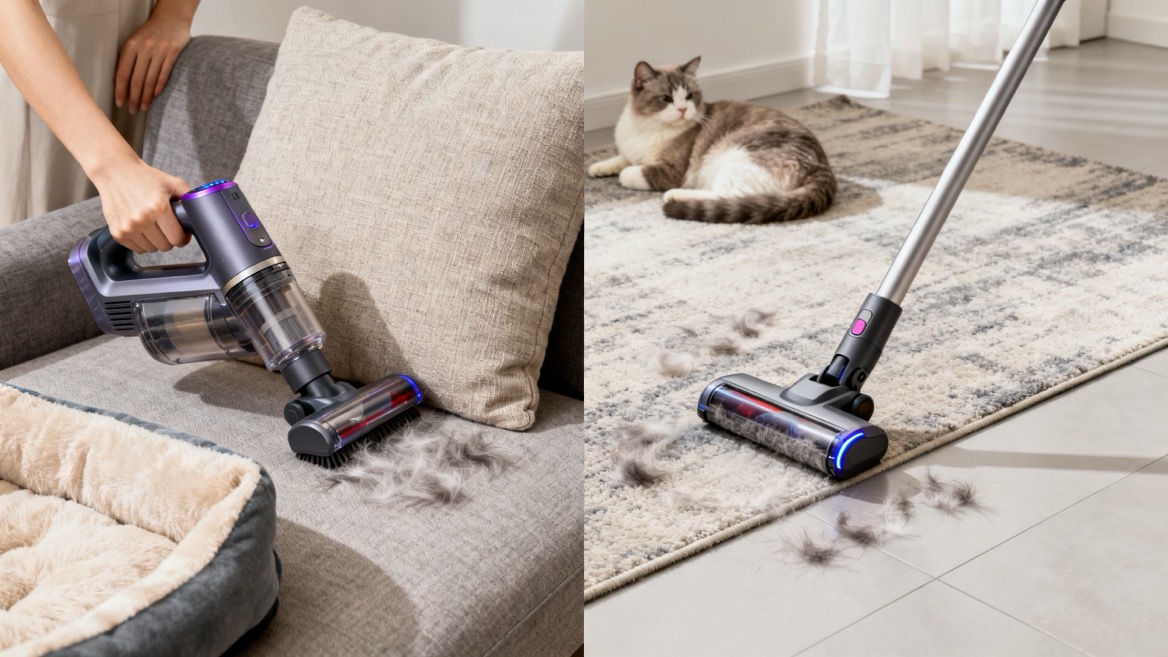
A compact handheld vacuum may be enough if the home has mostly hard flooring, minimal carpet, and the owner needs to clean furniture and bedding often. However, a lightweight cordless stick vacuum becomes more practical if the cat sheds across several rooms.
A stick vacuum is usually the stronger primary appliance. Dogs bring in outdoor debris, shed on floors, and leave hair on rugs and furniture. Select a unit with a motorized floorhead, a substantial dust cup, and a mini pet tool.
A stick vacuum should be the foundation. Look for anti-tangle brush technology, strong carpet pickup, sealed filtration options, and removable batteries. A companion handheld vacuum is valuable for stairs, car interiors, cat trees, and sofas.
A handheld vacuum becomes essential. Choose a model with a crevice tool, flexible hose or extension, powered upholstery brush, and sufficient runtime for vehicle seats, mats, and trunk areas.
Many vacuum listings emphasize suction wattage, motor speed, or maximum pressure. These figures can be useful, but they do not independently predict real pet-hair performance.
A more practical buying framework evaluates the complete system.
For stick vacuums, the floorhead has a major influence on results. Ask:
- Is it motorized?
- Does it resist hair wrapping?
- Is it intended for hard floors, carpets, or both?
- Does it have an adjustable gate or suction channel?
- Can it maintain contact at floor edges?
- Are LEDs included for low-light cleaning?
A high-powered motor paired with a poor floorhead may still leave hair in carpet fibers or scatter debris on hard floors.
A mini motorized brush can be one of the most meaningful accessories for pet owners. It is especially important for upholstery, pet beds, stairs, and fabric-lined vehicle interiors.
For OEM/ODM projects, brands should consider whether the pet tool is included as standard, sold as an upgrade, or bundled with premium models. This accessory can materially change the product's usefulness and perceived value.
Filtration should be described accurately. True HEPA performance refers to the ability to capture at least 99.97% of 0.3-micron particles, while system sealing is important because air leakage can reduce the practical benefit of the final filter.
For allergy-sensitive households, buyers may also look for products assessed by independent certification programs. The asthma & allergy friendly certification criteria for vacuum cleaners include surface-allergen removal, limits on airborne allergen release during vacuuming, filtration-system integrity, and low dust exposure during bin or bag maintenance.
A vacuum is only effective when people use it. Ask customers to estimate:
1. How often does pet hair become visible?
2. How much carpet or upholstery is in the home?
3. Are there stairs?
4. Does the pet travel in a car?
5. Is the user comfortable holding a vacuum for 10 to 20 minutes?
6. Is a charging dock or storage wall available?
7. Will the product be used for fast cleanups or full-home sessions?
This process often reveals that the ideal purchase is a stick vacuum with a convertible handheld design—or a coordinated pair of products.
For distributors and brands building a pet-cleaning range, the strongest opportunity is to design for real behavior, not only headline specifications.
A practical lineup may include:
| Product tier | Customer need | Recommended product direction |
|---|---|---|
| Entry level | Quick furniture and car cleaning | Compact cordless handheld vacuum with crevice tool |
| Mid-range | Small-home daily cleaning | Cordless stick vacuum with floorhead and handheld conversion |
| Pet-focused | Fur, rugs, upholstery, multi-surface cleaning | Stick vacuum with anti-tangle brush and mini motorized pet tool |
| Premium | Larger homes and multi-pet households | Higher-capacity stick vacuum with removable battery, advanced filtration, and accessory set |
| Commercial or high-traffic use | Continuous cleaning and dependable power | Corded upright or corded stick vacuum solution |
Pet hair exposes weak maintenance design quickly. If a brush roll tangles after two uses, a user may lose confidence in the product. If the dust bin is difficult to empty, users may delay cleaning. If a filter is expensive or hard to access, repeat satisfaction can decline.
Useful product details include:
- Tool-free brush-roll access
- Clear instructions for hair removal
- Washable pre-filter designs
- Accessible filter replacement paths
- Large, easy-empty dust bins
- Stable storage docks
- Spare-part availability
- Clear battery and warranty support
Avoid vague claims such as "best pet vacuum" unless they are backed by defined testing. Instead, build product descriptions around specific, supportable features:
- "Designed with a motorized mini brush for upholstery."
- "Anti-tangle floor brush helps reduce hair wrapping."
- "Convertible handheld design for sofas, stairs, and cars."
- "Multi-stage filtration system."
- "Removable battery option for extended cleaning routines."
- "Cordless design for quick daily pet-hair pickup."
Clear claims create stronger buyer confidence than exaggerated language.
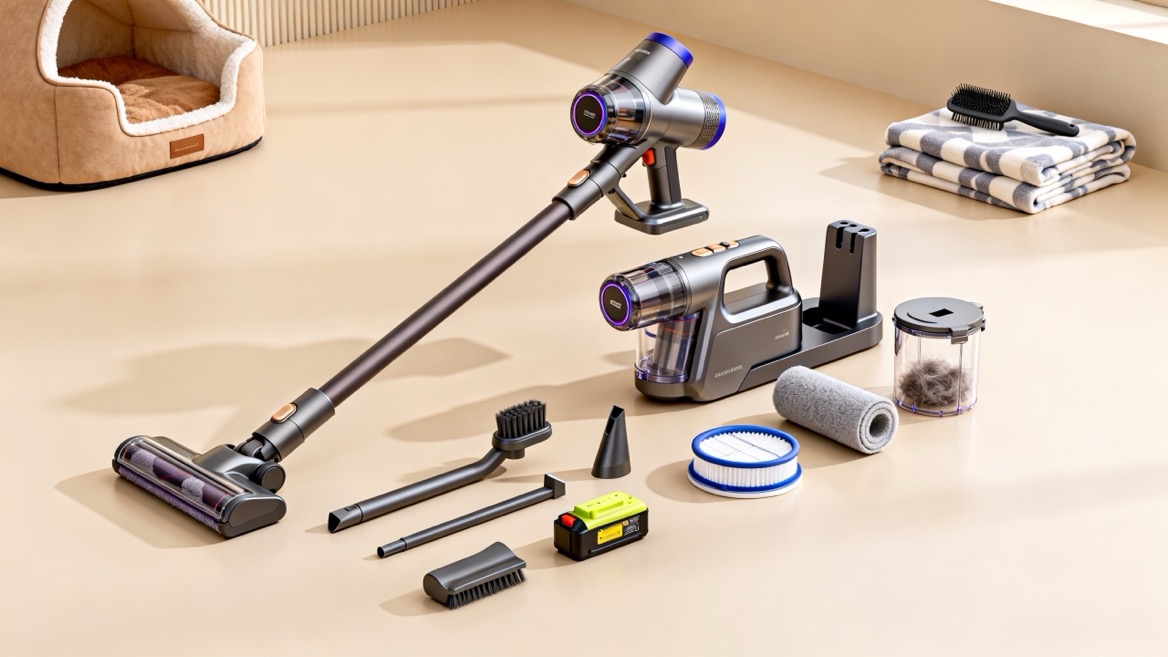
The vacuum category becomes more useful when customers understand how to use it efficiently. A simple routine can reduce buildup and make each cleaning session easier.
1. Vacuum hard floors every one to three days in high-shedding areas, especially near pet beds, feeding stations, doorways, and sofas.
2. Use a motorized floorhead on rugs and carpet at least weekly, making slow, overlapping passes in more than one direction when hair is embedded.
3. Clean upholstery with a mini motorized tool once or twice a week, paying attention to seams, cushion edges, and areas where pets rest.
4. Empty the dust cup before it becomes overfilled. A heavily packed bin can affect airflow and make disposal messier.
5. Remove wrapped hair from the brush roll regularly. Do not wait until the roller stops spinning effectively.
6. Wash or replace filters according to the product manual. A poorly maintained filter can reduce airflow and compromise performance.
7. Keep the vacuum visible and accessible. A dock near the most-used living area makes daily spot cleaning much more likely.
For most pet owners, a stick vacuum is the better primary vacuum because it handles frequent floor cleaning, wider spaces, rugs, and under-furniture fur more efficiently. It is the best solution for households where pet hair appears across multiple rooms every day.
A handheld vacuum is the better specialist tool for sofas, stairs, pet beds, cars, and quick messes. It offers flexibility that a floor-focused vacuum cannot fully replace.
The most complete pet-hair cleaning strategy combines both formats. A cordless stick vacuum maintains floors, while a handheld vacuum handles the high-contact areas where animals sleep, sit, and travel. For vacuum brands, this creates a clear opportunity to develop coordinated products that meet real household behavior—from a fast sofa cleanup to full-home floor care.
Ningbo Eyunhome Electric Technology Co., Ltd. can support importers, distributors, retailers, and brand owners seeking dependable upright, handheld, corded, and cordless vacuum cleaner programs. With OEM/ODM capabilities, stable production planning, customizable product configurations, and reliable after-sales support, we help businesses build vacuum solutions tailored to their target pet-owner market.
Contact Ningbo Eyunhome Electric Technology Co., Ltd. to discuss your pet-hair vacuum cleaner project, product customization requirements, target market needs, and OEM/ODM development plan.
A handheld vacuum can be very effective for pet hair on sofas, pet beds, car seats, stairs, and cushions. It is less efficient as the only cleaning appliance for larger homes, multiple rooms, or carpeted floors because its dust capacity and cleaning width are usually smaller.
Yes. A stick vacuum is often a strong option for dog hair, especially when it has a motorized floorhead, an anti-tangle brush roll, and a mini motorized upholstery attachment. It is especially useful for routine cleaning across hard floors, rugs, and carpet.
A handheld vacuum with a mini motorized brush is often the most convenient choice for furniture. It gives the user direct control over cushions, seams, armrests, pet beds, and fabric surfaces where hair becomes embedded.
Cordless vacuums are convenient for quick and frequent cleaning, which suits many pet households. Corded vacuums can be preferable for larger homes, extended cleaning sessions, or situations where uninterrupted operation is more important than portability.
A true HEPA filter can be useful for households concerned about fine dust and particles. However, filtration performance also depends on the full airflow path and product sealing. Buyers should review the manufacturer's stated test standard, filter specification, and maintenance instructions rather than relying only on broad marketing terms.
Choose a vacuum with an anti-tangle brush design, clean the roller regularly, and remove long hair before it builds up heavily. A tool-free brush-roll release can make this maintenance faster and easier.
A 2-in-1 stick vacuum with a detachable handheld unit can be a practical option for users who want one appliance for floors, furniture, stairs, and cars. Separate appliances may still be better for multi-pet homes that need longer floor-cleaning runtime and a dedicated, always-ready handheld unit.
A strong private-label pet vacuum should consider a motorized anti-tangle floorhead, mini pet brush, multi-stage filtration, easy-empty dust bin, washable components, ergonomic grip, storage dock, clear battery indication, and dependable spare-part support.
1. American Pet Products Association. [U.S. Pet Industry Reaches $158 Billion in 2025, Poised for Continued Growth in 2026]
2. American Pet Products Association. [America's Dog Owners Are Becoming Smarter Spenders]
3. U.S. Environmental Protection Agency. [What Is a HEPA Filter?]
4. U.S. Environmental Protection Agency. [The RRP Rule Requires HEPA Vacuums: What Should I Look For?]
5. Good Housekeeping Institute. [5 Best Cordless Stick Vacuums of 2026, Tested by Experts]
6. Asthma & Allergy Friendly Certification Program. [Certified Vacuum Cleaners and Certification Standards]
7. American Lung Association. [Not All Vacuums Are Created Equal: Pick the Best One for Indoor Air Quality]


