
Views: 258 Author: Eyunhome Vacuum Publish Time: 2026-10-08 Origin: Site


Content Menu
● High Suction Cordless Vacuum vs Standard Cordless Vacuum at a Glance
● What Makes a Cordless Vacuum "High Suction"?
>> Suction Pressure, Airflow, and Air Watts
>> Maximum Suction Is Not Everyday Suction
● Cleaning Performance: Where Does Stronger Suction Help?
>> Hard Floors and Larger Debris
● Battery Runtime: Compare the Cleaning Mode, Not Just the Label
>> Why "Up to" Runtime Needs Context
● Filtration, Noise, and Handling: The Often-Missed Differences
>> Filtration Is a Whole-Machine Question
>> Handling Must Be Evaluated Separately
● A Five-Step Sample Test for Importers and Private-Label Brands
>> Step 1: Define the Target Cleaning Scenario
>> Step 2: Compare Equivalent Configurations
>> Step 3: Measure Pickup Consistently
>> Step 4: Record the Entire Cleaning Session
>> Step 5: Check Maintenance and Replacement Support
● Industry Insight: Why Motor Power Can Mislead Buyers
● OEM/ODM Selection: Turn the Comparison into a Product Brief
● Which Cordless Vacuum Should You Choose?
>> Choose High Suction When the Task Justifies It
>> Choose Standard When It Meets the Requirement
● Discuss Your Cordless Vacuum Project
>> Is a high suction cordless vacuum always better?
>> What suction number should I require?
>> Does stronger suction reduce battery runtime?
>> Can a standard cordless vacuum clean pet hair?
>> Does a HEPA filter prove excellent whole-machine filtration?
>> What should I request before placing an OEM/ODM order?
A high suction cordless vacuum vs standard cordless vacuum comparison should begin with one question: what cleaning problem does the product need to solve? Stronger suction can help with demanding tasks, but it does not automatically deliver better cleaning on every surface. Floorhead design, airflow, battery performance, filtration, and handling all influence the result. Independent testing evaluates cordless vacuums across these factors rather than ranking them by suction alone.
For homeowners, the right choice depends on flooring, cleaning habits, and comfort. For importers, distributors, and private-label brands, it also depends on customer expectations, product positioning, and support requirements.
At Ningbo Eyunhome Electric Technology Co.,Ltd., our approach to product selection starts with the application—not simply the largest advertised number. This guide explains how to compare both categories and build a more useful purchasing specification.
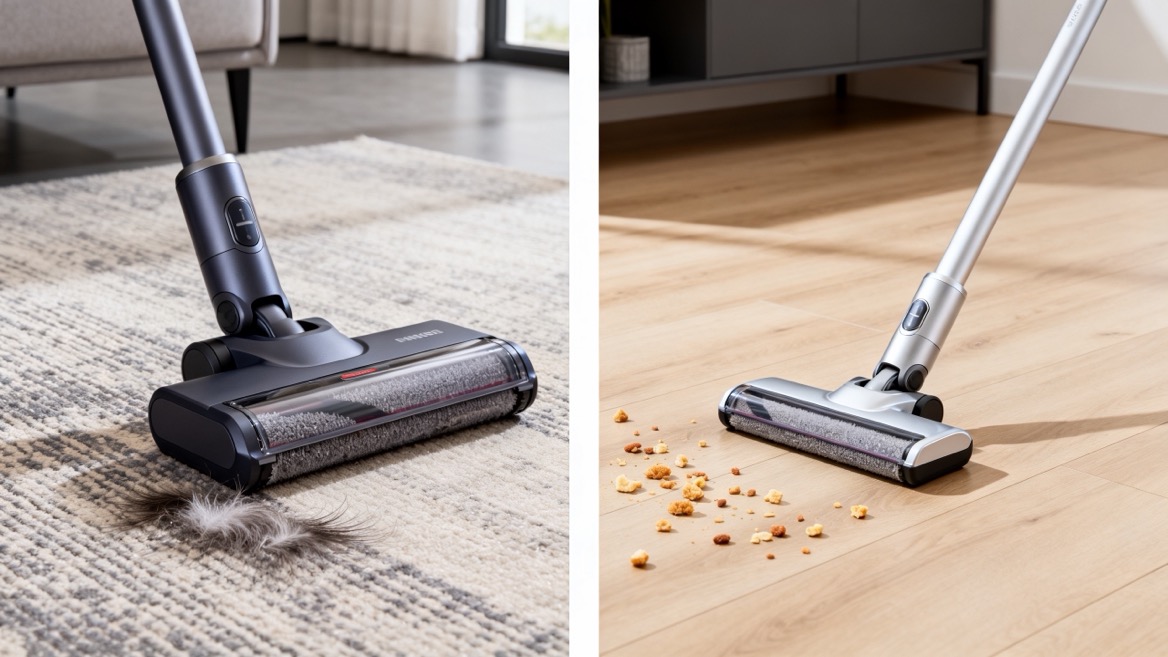
"High suction" and "standard" are comparative product descriptions in this guide, not fixed performance classifications. Buyers should compare measured specifications and test conditions rather than assume that either label guarantees a particular result.
| Comparison factor | High suction cordless vacuum | Standard cordless vacuum |
|---|---|---|
| Main positioning | Demanding cleaning and premium performance | Everyday cleaning and accessible value |
| Potential advantage | More suction available for difficult debris | Sufficient performance without unnecessary complexity |
| Best-fit applications | Carpet, embedded dirt, demanding mixed-floor tasks | Routine hard-floor cleaning and quick pickups |
| Battery consideration | Highest-power operation can shorten runtime | Lower-power operation may support longer sessions |
| Floorhead requirement | Must translate suction into effective pickup | Equally important for compensating for modest suction |
| Purchasing priority | Verify sustained performance and usable runtime | Verify pickup quality and overall value |
These are purchasing considerations, not guaranteed differences. Testing shows that floorhead architecture can limit usable suction even when a vacuum has a more powerful motor. Product-level evaluation remains essential.
Buyers commonly encounter several different specifications:
- Suction pressure, often expressed in pascals or kilopascals.
- Airflow, expressed as the volume of air moving through the system.
- Air watts, used to describe suction power.
- Electrical motor wattage, describing power consumption rather than cleaning performance.
These figures should not be treated as interchangeable. A purchasing specification should identify the measurement method, location, operating mode, and attachment configuration. The cordless-vacuum performance standard IEC 62885-4 provides methods for measuring characteristics relevant to users, including suction and cleaning performance.
My first recommendation when reviewing a supplier quotation is to ask: "Where was this figure measured, and under what conditions?" A bare-inlet measurement and a complete-machine cleaning test answer different questions.
A headline specification may describe the highest available setting rather than the mode customers normally use.
For example, Dyson distinguishes between Eco mode for longer cleaning sessions and Boost mode for short, intensive cleaning. Its published maximum suction and maximum runtime should therefore not be interpreted as simultaneous operating conditions.
A useful specification sheet separates:
1. Maximum suction.
2. Suction in the normal cleaning mode.
3. Runtime in each mode.
4. The attachment used during testing.
5. Pickup performance on the intended surface.
The most valuable comparison is usable performance: what the vacuum delivers while completing the customer's actual cleaning task.
A high suction cordless vacuum is worth investigating when carpet cleaning is a priority. However, carpet performance still needs direct testing. Independent evaluations assess actual debris pickup, and results can differ between carpet types and cleaning heads.
For a private-label carpet-focused product, I would request demonstrations using consistent debris quantities, surfaces, and pass counts.
Record both pickup and handling. A model that removes more debris but requires excessive pushing force may not deliver the experience your customers expect.
On hard floors, floorhead design can matter as much as headline power. Independent testing has identified vacuums that scatter larger debris because of their brushroll behavior, while suitable soft-roller heads can deliver strong bare-floor pickup.
This makes a standard cordless vacuum a credible option for routine hard-floor cleaning—but only after checking its actual performance.
Test several debris types separately:
- Fine dust.
- Crumbs.
- Rice-sized particles.
- Larger dry debris.
- Material lodged in floor crevices.
Do not assume that one successful demonstration proves suitability for all of them.
For pet-focused products, evaluate hair pickup and hair handling as separate requirements.
A machine may collect hair effectively yet require frequent brush cleaning. Conversely, an anti-tangle feature does not prove strong carpet pickup. Manufacturer documentation identifies anti-tangle performance under specific test conditions, while independent reviews separately evaluate pet-hair removal.
For this application, compare the main floorhead, upholstery attachment, brush access, and maintenance instructions—not suction alone.
Maximum runtime is not a dependable estimate for every household. Power setting, cleaning task, and attachment configuration need to accompany the claim.
Independent reviews note that cordless vacuums may provide sufficient runtime for smaller homes at low or medium settings but run out during larger, carpet-heavy cleaning sessions. They also identify short battery life at the highest power setting as a limitation of some premium models.
For buyers, the practical question is not "Which vacuum has the longest advertised runtime?" It is "Which vacuum finishes the target cleaning routine without an inconvenient interruption?"
Ask suppliers to complete a table like this:
| Test condition | Information to request |
|---|---|
| Low mode, motorized floorhead | Measured runtime and test surface |
| Normal mode, motorized floorhead | Measured runtime and pickup result |
| Highest mode, motorized floorhead | Measured runtime and operating limitations |
| Handheld configuration | Attachment and measured runtime |
| Recharge | Charging time under stated conditions |
IEC-based comparisons are particularly useful because related cleaning tests should use the same settings and cleaning-head configuration. This helps prevent comparisons between strong pickup in one mode and long runtime in another.
Removable batteries may add flexibility, but confirm replacement availability and compatibility rather than treating removability alone as a complete solution.
Do not equate a filter component with verified whole-machine filtration.
Manufacturer documentation distinguishes fully sealed filtration systems from individual filters and specifies particle size, capture percentage, and test conditions. Independent testing also shows that machines sharing the same filter can differ in how much dust they release during use.
For procurement, request evidence covering the complete product configuration. Avoid presenting an unverified filter specification as proof of the vacuum's total filtration performance.
A more powerful vacuum is not automatically heavier, and a standard model is not automatically quieter. These characteristics should be measured rather than inferred from positioning.
Your evaluation checklist should include:
- Complete-machine weight.
- Comfort in handheld use.
- Steering and furniture access.
- Floorhead resistance.
- Control placement.
- Noise under matched operating conditions.
IEC performance testing includes noise-related comparisons alongside cleaning and runtime measurements, reinforcing the importance of testing the same cleaning configuration.
From a product-selection perspective, I would give handling its own score. Otherwise, an impressive power specification can overshadow the experience customers notice every day.
The following workflow is a proposed procurement method, not a claim that either product category will achieve a particular result.
Choose the intended customer before choosing the motor specification.
Examples include apartment residents with hard floors, pet owners with mixed flooring, or customers replacing a corded vacuum.
Specify the surfaces, debris, cleaning duration, and preferred price position.
Fully charge both samples and document their filters, floorheads, settings, and bin condition.
Do not compare one vacuum in Boost mode with another in its everyday mode without clearly identifying the difference.
Use a known starting quantity of debris, a defined test area, and a fixed number of passes.
A simple internal comparison is:
Pickup percentage = collected debris mass ÷ starting debris mass × 100.
Repeat the procedure rather than relying on one demonstration. This is an internal screening method, not a substitute for formal laboratory testing.
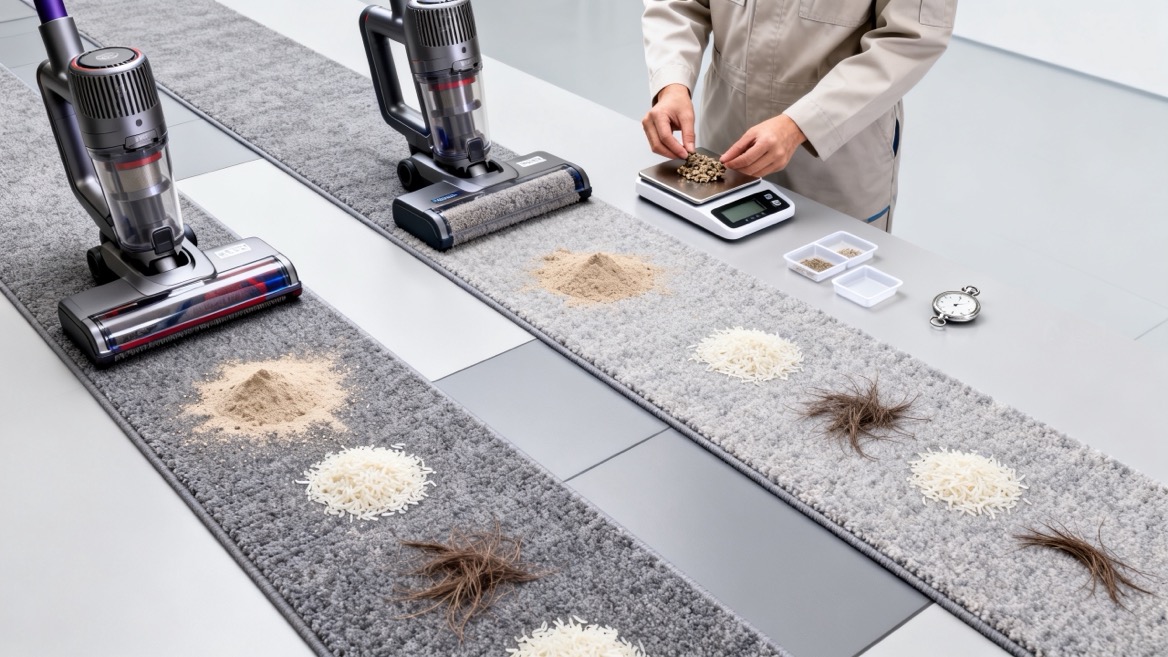
Alongside pickup, record runtime, interruptions, push effort, tangling, and emptying difficulty.
The purpose is to identify trade-offs that a headline suction number cannot explain.
Review filter access, brush removal, battery replacement, spare-part identification, and troubleshooting documentation.
For commercial buyers, these items belong in the purchasing discussion before the order is finalized.
A useful real-world example comes from RTINGS' review of the Shark PowerDetect Cordless IP1251. The review reports that, despite a higher-powered motor than an older comparison model, suction at the floorhead was disappointing. Its twin-roller design spread suction over a larger area. Nevertheless, the product performed well on bare floors.
This illustrates two important relationships:
1. More motor power does not necessarily produce more effective suction at the cleaning interface.
2. Lower floorhead suction does not automatically mean poor pickup on every surface.
For product development, this is a reason to evaluate the motor, airflow path, and floorhead as a system. For purchasing, it is a reason to prioritize task-specific results over isolated numbers.
For an importer or brand owner, the choice between high suction and standard cordless models is also a positioning decision.
Before discussing customization, prepare a brief covering:
- Target users and flooring.
- Required cleaning tasks.
- Desired runtime by mode.
- Weight and handling expectations.
- Filtration claims requiring verification.
- Attachment package.
- Packaging, manuals, and spare-part needs.
- Destination-market documentation requirements.
Ningbo Eyunhome Electric Technology Co.,Ltd. offers upright, handheld, corded, and cordless vacuum solutions, together with OEM/ODM services, production support, and after-sales assistance.
Rather than selecting a model solely by its advertised suction, use this brief to discuss the most suitable configuration. Any performance, filtration, or compliance claim intended for your packaging should be supported by documentation for the selected model—not assumed from the broader product range.
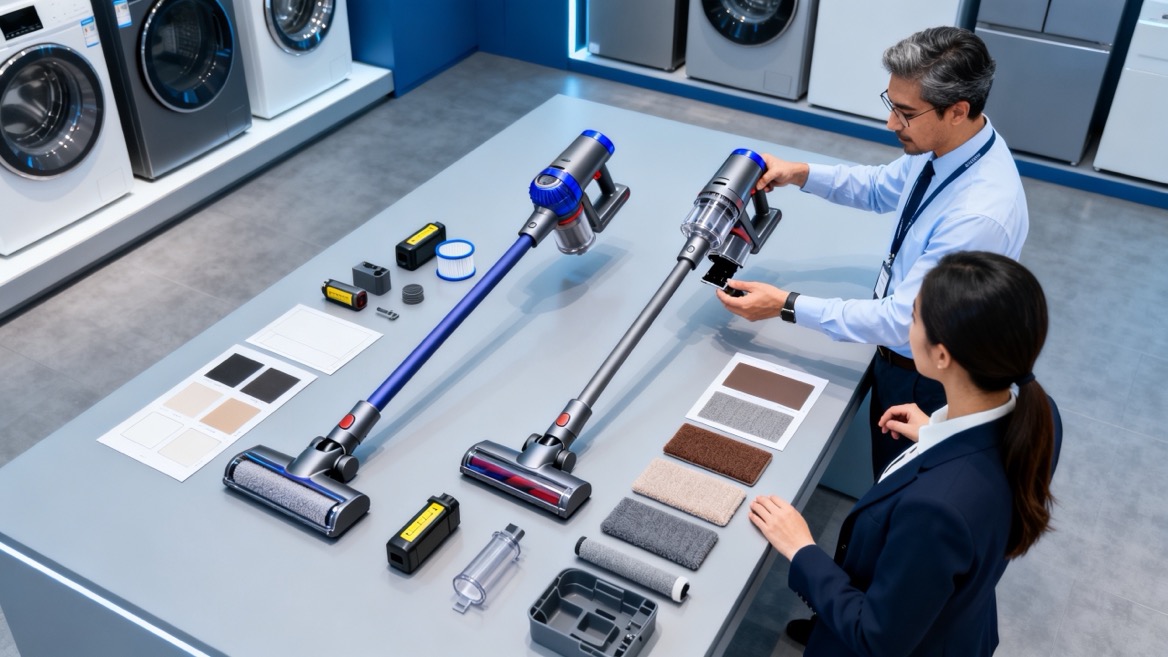
Prioritize a high suction cordless vacuum when demanding carpet cleaning, embedded debris, or premium performance positioning drives the purchase.
Still require acceptable normal-mode pickup, runtime, handling, and maintenance. Strong maximum suction should support the cleaning task, not substitute for evidence that the product completes it. Independent recommendations similarly consider cleaning performance, battery life, air quality, and portability together.
A standard cordless vacuum can be the better commercial fit when routine hard-floor pickup and accessible pricing define the target application.
The decision should follow sample results. A well-matched floorhead can be more relevant to bare-floor performance than a stronger motor specification, as independent testing demonstrates.
For a product portfolio, evaluate whether customers genuinely need two performance tiers before introducing both.
Contact Ningbo Eyunhome Electric Technology Co.,Ltd. with your target market, preferred format, flooring requirements, expected runtime, and order requirements. Ask for a model-specific quotation and sample-evaluation plan so your team can compare high suction and standard cordless vacuum solutions against the same purchasing criteria.
No. Cleaning performance also depends on the floorhead, surface, filtration, battery behavior, and handling. Higher motor power does not guarantee stronger effective suction at the floorhead.
Do not set a universal threshold without defining the cleaning task and measurement method. Request comparable suction data and actual pickup results under documented conditions.
Highest-power operation can shorten usable cleaning time. Compare runtime in the mode customers will actually use rather than relying on the maximum advertised figure.
Potentially, but verify the model and attachment. Pet-hair pickup, carpet performance, and brush maintenance should be assessed separately rather than inferred from the product category.
No. Ask for complete-machine evidence. System sealing and leakage matter, and machines using the same filter can produce different dust-emission results.
Request a confirmed model specification, sample evaluation, documented performance claims, agreed accessories, packaging requirements, and replacement-part arrangements. Use matched test conditions when comparing cleaning performance and runtime.
- [IEC — IEC 62885-4:2020/AMD1:2023]
Cordless dry vacuum cleaner performance measurement standard and its 2023 amendment.
- [RTINGS — The Best Cordless Vacuums]
Independent comparisons of cleaning performance, battery life, filtration, and usability.
- [RTINGS — Our Vacuum Design Tests: Battery]
Battery testing methodology and explanations of cordless vacuum runtime evaluation.
- [RTINGS — The Best Stick Vacuums]
Comparisons of floorhead design, surface suitability, handling, and cleaning performance.
- [RTINGS — Shark PowerDetect Cordless Vacuum Review]
A product-specific evaluation illustrating the relationship between motor power, floorhead design, suction, and debris pickup.
- [Dyson — V15 Detect Absolute Cordless Vacuum]
Manufacturer specifications and operating-mode information relevant to suction power, maximum runtime, and filtration.
- [Dyson — New Technology for Healthier Homes]
Manufacturer explanations of filtration systems, particle capture claims, and associated testing conditions.


