
Views: 243 Author: Eyunhome Vacuum Publish Time: 2026-10-04 Origin: Site


Content Menu
● How Often Should You Replace Vacuum Filters?
>> Cleaning and Replacement Are Different Tasks
● Understand Your Vacuum's Filter Before Maintaining It
>> Foam and Felt Pre-Motor Filters
>> HEPA and Pleated Post-Motor Filters
● What Changes Your Vacuum Filter Maintenance Needs?
>> Establish a Routine, Then Adjust Inspection Frequency
● Signs Your Vacuum Filter May Need Attention
>> Appearance Cannot Confirm Filtration Performance
● How to Clean a Washable Vacuum Filter Safely
>> Twenty-Four Hours Is Not a Guarantee of Dryness
>> Avoid Unapproved Cleaning Shortcuts
● Weak Suction After Filter Cleaning: What to Check Next
>> Keep a Simple Maintenance Record
● Why Sealed Filtration Matters Beyond the HEPA Label
● A Practical Filter Checklist for Vacuum Buyers and Distributors
>> Request Clear Maintenance Documentation
>> Discuss Validation Before Making Performance Claims
>> Compare Maintenance Costs Transparently
● Vacuum Solutions from Ningbo Eyunhome Electric Technology Co., Ltd.
>> How Often Should You Replace Cordless Vacuum Filters?
>> Can You Wash a HEPA Vacuum Filter?
>> How Often Should You Replace Robot Vacuum Filters?
>> Can You Reinstall a Filter After Twenty-Four Hours?
>> Does Weak Suction Always Mean You Need a New Filter?
>> Can You Judge a Filter Only by Its Color?
How often should you replace vacuum filters? The answer depends on the filter, the vacuum model, and how you clean—not simply whether your vacuum is upright, handheld, corded, or cordless. Some filters need regular washing rather than scheduled replacement. Others must stay dry and be replaced according to the manufacturer's instructions.
My starting point is straightforward: identify the filter before choosing a maintenance schedule. A monthly cleaning reminder can help, but it cannot tell you whether a particular filter is washable.
This guide explains how to separate cleaning from replacement, recognize warning signs, troubleshoot weak suction, and evaluate filter maintenance when sourcing vacuums for your business.

There is no universal replacement interval. Use your model's manual as the primary reference, then inspect filters between scheduled maintenance dates.
The examples below show why model-specific instructions matter.
| Vacuum or filter example | Cleaning guidance | Replacement guidance |
|---|---|---|
| Dyson cordless filters covered by its filter-care guidance | Wash at least monthly; dry completely for at least 24 hours | Follow the individual model’s instructions rather than assuming monthly replacement |
| Roomba models covered by iRobot’s care chart | Clean weekly, or twice weekly in homes with pets | Replace every two months |
| Shark Vertex AZ2000 post-motor HEPA filter | Rinse every 12 months, or as needed | Do not confuse its rinsing interval with a replacement interval |
| BISSELL CleanView post-motor filter | Do not wash | Replace when dirty |
These are manufacturer examples, not interchangeable rules for every product in each brand's range.
Cleaning removes accumulated debris using an approved method. Replacement installs a new filter when the existing one reaches its prescribed interval, becomes damaged, or no longer performs adequately.
A washable filter is not necessarily permanent. Equally, a dirty-looking filter does not automatically require replacement if its approved cleaning procedure restores it.
Never decide washability from appearance alone. Similar-looking pleated filters can have different maintenance requirements.
Pre-motor filters sit upstream of the motor. Foam filters commonly capture debris before it reaches later filtration stages, and many are washable.
However, approved cleaning methods differ. Some instructions permit mild detergent; others specify water only. Follow the exact model's guidance instead of applying one brand's procedure to another.
Check the filter's condition whenever you clean it. Tears, deterioration, and poor fit are reasons to investigate replacement rather than continue washing.
HEPA means high-efficiency particulate air. The U.S. Environmental Protection Agency describes this filter type as capable of theoretically removing at least 99.97% of airborne particles measuring 0.3 microns. That size represents a particularly challenging filtration point, not a boundary below which particles cannot be captured.
HEPA performance does not establish washability.
Some vacuum filters can be rinsed. Others cannot. BISSELL specifically states that the CleanView post-motor filter is not washable and must be replaced when dirty.
Robot vacuums require their own maintenance schedules.
For models covered by iRobot's general care chart, the recommendation is weekly filter cleaning, twice-weekly cleaning in homes with pets, and replacement every two months. Its Roomba Combo 10 Max instructions also explicitly prohibit washing the filter.
Do not apply those instructions automatically to another robot brand—or even another model without checking its documentation.
A calendar is useful, but inspection adds context. The same model can encounter very different cleaning conditions.
Consider these practical questions:
- Does the vacuum run daily or occasionally?
- Does the household have pets?
- Is the collected debris mostly hair, crumbs, or fine dust?
- Does the dustbin fill quickly?
- Has pickup performance changed since the last cleaning?
- Does the manual specify additional care for demanding use?
Manufacturer guidance already recognizes some differences. Dyson recommends monthly washing at minimum, while iRobot increases cleaning frequency for homes with pets.
Start with the prescribed schedule. After several cleaning sessions, inspect the filter and record what you find.
If it loads quickly, check it more frequently and use the approved cleaning method. Do not extend a stated replacement interval merely because the filter still looks acceptable.
For households with several vacuums, label reminders by model and filter location. "Clean pre-motor filter" is more useful than "service vacuum."
Reduced pickup is an important warning, but it does not prove that the filter alone is responsible. BISSELL identifies dirty filters as a potential cause of lost suction and emphasizes checking the correct maintenance procedure.
Inspect the filter when you notice:
- Weaker pickup than usual.
- Heavy debris accumulation.
- A filter-care warning.
- Visible damage or distorted pleats.
- A filter that no longer seats correctly.
Odor also deserves investigation, but it is not a reliable filter-replacement test by itself. Check the collected debris and other accessible components rather than assuming a new filter will solve everything.
A filter can look intact after improper washing while suffering damage that reduces particle capture. BISSELL warns that water can damage non-washable media, including through changes not readily visible to the user.
The practical lesson is simple: cleanliness and filtration integrity are different questions.
The following sequence is a planning guide. Your model's instructions take precedence.
1. Switch off the vacuum and disconnect its power supply as instructed.
2. Remove the filter using the documented procedure.
3. Confirm that the specific filter is washable.
4. Remove loose dust using the approved method.
5. Rinse at the specified water temperature.
6. Use detergent only if expressly permitted.
7. Remove excess water without damaging the filter.
8. Allow it to dry completely.
9. Reinstall it correctly before using the vacuum.
Dyson advises washing its covered filters at least monthly, avoiding detergent, and allowing at least 24 hours of drying with good airflow. It also requires the filter to be completely dry before reinstallation because moisture could damage the motor.
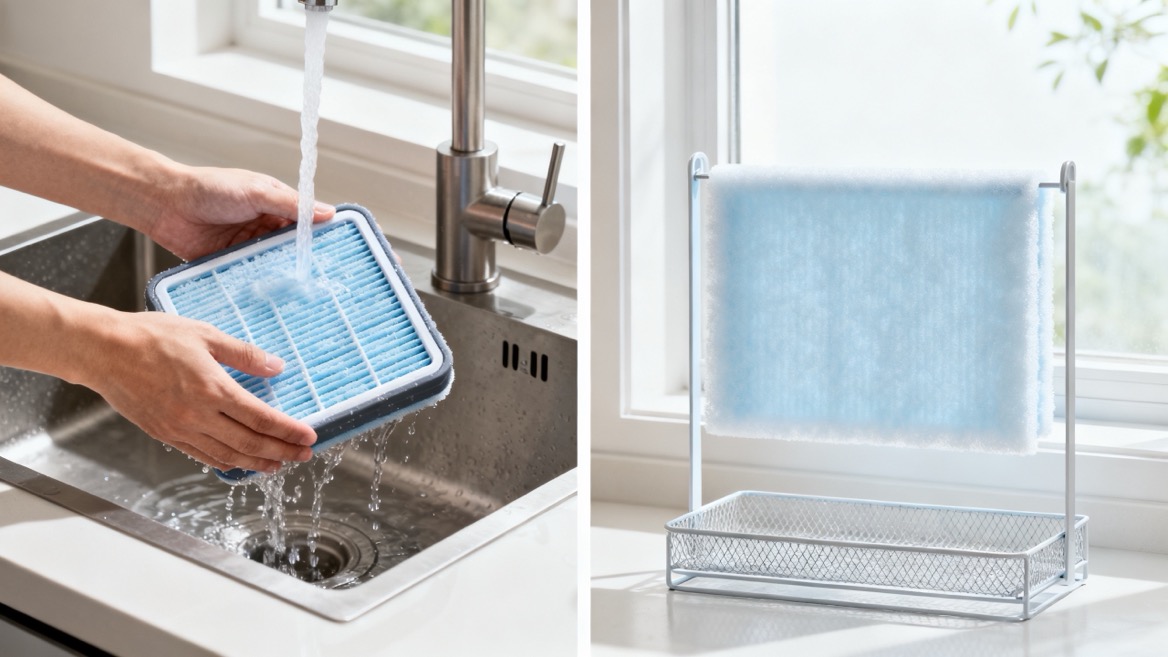
Treat a stated drying period as a minimum, not permission to reinstall a damp filter. Dyson advises physically checking for remaining moisture before refitting.
A compatible spare filter may make maintenance easier: one can dry while another is available for use. Confirm compatibility and installation instructions before adopting this approach.
Do not assume that compressed air, aggressive brushing, soap, or machine washing is safe.
The key question is not whether a technique removes visible dust. It is whether the manufacturer approves it for that filter. Water on a non-washable filter can permanently reduce performance.
Replacing a filter without checking the rest of the vacuum can leave the underlying problem unresolved.
Use this practical troubleshooting sequence:
1. Empty the dustbin.
2. Confirm the filter is completely dry.
3. Check that the filter and bin are correctly installed.
4. Inspect accessible air passages for obstructions.
5. Check the brush roll and cleaning head.
6. Review warnings and troubleshooting instructions.
7. Contact support if the problem persists.
This sequence is intended to organize inspection, not diagnose every fault. Avoid dismantling sealed assemblies or continuing to operate a malfunctioning machine.
Record the date, cleaning method, filter condition, and whether performance improved afterward.
For a household, a phone note may be enough. For a distributor or service team, a standardized record can help distinguish recurring maintenance questions from possible product faults.
This also makes support conversations more specific: "pickup remained weak after approved cleaning and full drying" is more actionable than "the vacuum does not work."
A high-performance filter cannot capture air that bypasses it.
In its definition of a HEPA vacuum for lead-related renovation work, the EPA requires all air drawn into the machine to pass through the HEPA filter without leaking around it. This illustrates why filter media and complete-machine construction must be considered together.
For product evaluation, distinguish between:
- The filter's stated efficiency.
- The filter's fit within its housing.
- Air leakage around seals and joints.
- Complete-machine performance.
A filter specification alone should not be presented as proof of whole-vacuum performance. The EPA also recommends asking whether the machine has been tested to achieve the required efficiency in its intended application.
For business buyers, maintenance should be part of product evaluation—not an afterthought.
The following checklist is a proposed procurement framework, not a claim about tests already completed by any supplier.
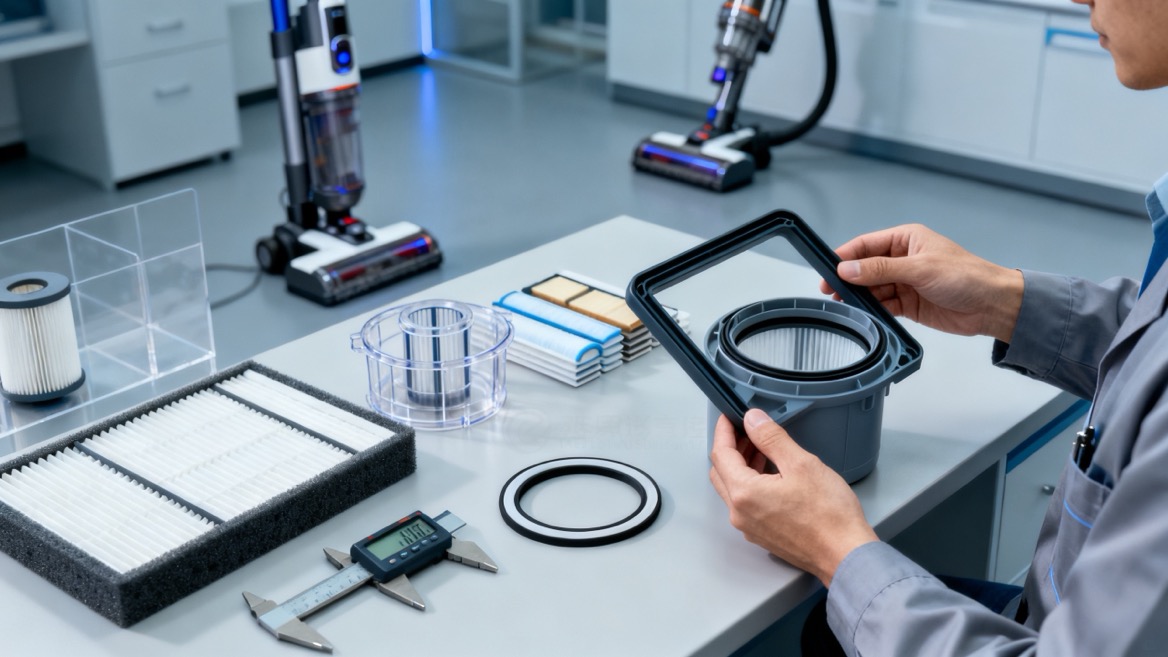
Ask for:
- Filter identification and part numbers.
- Separate cleaning and replacement instructions.
- Approved washing methods.
- Minimum drying requirements.
- Installation diagrams.
- Replacement-part availability.
Precise instructions can prevent the confusion seen across manufacturer examples, where one post-motor filter is washable and another is not.
Ask the supplier what evidence supports filtration statements. Clarify whether results concern filter media or the complete vacuum, and whether performance after maintenance has been evaluated.
For washable designs, discuss an agreed validation plan covering repeated cleaning, fit, and post-cleaning performance. Do not assume that "washable" establishes an unlimited service life.
Use quoted replacement-part prices rather than generic market estimates.
A basic planning calculation is:
Annual filter cost = replacement filters used per year × delivered cost per filter.
Evaluate spare-filter inventory and service requirements separately. This keeps comparisons meaningful when products use different filter combinations and replacement schedules.
Ningbo Eyunhome Electric Technology Co., Ltd. is a China-based vacuum manufacturer offering upright, handheld, corded, and cordless vacuum solutions.
According to the company information supplied for this article, its offering includes professional OEM/ODM services, stable production, and reliable after-sales support for global business customers.
For brands, importers, and distributors, filter maintenance is a useful starting point for development discussions. Agree on the intended user, cleaning environment, maintenance instructions, and spare-parts requirements before finalizing a product brief.
Contact Ningbo Eyunhome Electric Technology Co., Ltd. to discuss your target market, preferred vacuum format, filtration requirements, and OEM/ODM project. Request model-specific documentation and supporting evidence for any performance claims relevant to your purchasing decision.
Follow the model's replacement instructions. Some cordless filters primarily require washing rather than frequent replacement. Dyson's general guidance recommends washing covered filters at least monthly, not replacing them monthly.
Only when the manufacturer explicitly permits it. HEPA describes filtration performance, not washability. Non-washable media can lose effectiveness after contact with water.
For Roomba models covered by iRobot's care chart, replace the filter every two months. Clean weekly, or twice weekly with pets. Other models may have different schedules.
Only if it is completely dry. Dyson specifies at least 24 hours and recommends checking for moisture before reinstallation.
No. A dirty filter may contribute, but cleaning requirements vary. Check the manual and inspect other accessible components before assuming replacement is the complete solution.
No. A filter may look intact despite damage from improper cleaning. Follow its prescribed maintenance method rather than relying on appearance alone.
1. [Vacuum Wars — "How Often Should You Replace Vacuum Filters (Bagless, Cordless, Robot Vacuums)"]
Original article reviewed for topic coverage, maintenance comparisons, and opportunities for deeper restructuring. [vacuumwars]
2. [Dyson — "Vacuum Filter Care"]
Primary source for monthly washing, detergent restrictions, complete drying, and the minimum 24-hour drying period. [dyson]
3. [iRobot — "Roomba Care Procedure Frequency"]
Primary source for weekly cleaning, increased cleaning with pets, and two-month replacement guidance for covered models. [homesupport.irobot]
4. [iRobot — "Roomba Combo 10 Max Care Procedure Frequency"]
Model-specific source confirming that the filter must not be washed. [homesupport.irobot]
5. [Shark — "AZ2000 Series Shark Vertex Upright Vacuum FAQs"]
Primary source distinguishing a 12-month HEPA rinsing interval from filter replacement. [support.sharkninja]
6. [BISSELL — "Changing/Cleaning Filters: CleanView Vacuum"]
Primary source stating that the post-motor filter is non-washable and should be replaced when dirty. [support.bissell]
7. [BISSELL — "Lost Suction? The Fix Is Probably Your Vacuum Filter"]
Manufacturer guidance on filter types, approved cleaning, moisture precautions, and potential damage to non-washable media. [bissell]
8. [U.S. Environmental Protection Agency — "What Is a HEPA Filter?"]
Authoritative explanation of the 99.97% efficiency benchmark at 0.3 microns. [epa]
9. [U.S. Environmental Protection Agency — HEPA Vacuum Requirements for Renovation, Repair, and Painting]
Archived regulatory explanation supporting the distinction between filter efficiency and complete-machine sealing. [19january2021snapshot.epa]


