
Views: 272 Author: Eyunhome Vacuum Publish Time: 2026-06-30 Origin: Site


Content Menu
● Kenmore DS1030 vs Bissell Featherweight: Ultra-Lightweight Cordless Vacuum Showdown
● Core Specifications and Design Overview
● Power and Performance: Which Cleans Better?
>> Kenmore DS1030: Power-Focused Design
>> Bissell Featherweight: Strong Enough for Its Target Use
● Debris Pickup and Floor-Type Versatility
>> Kenmore's Strength: Carpets and General Use
>> Bissell's Strength: Large Debris on Hard Floors
● Battery Life, Charging, and Filtration
>> Kenmore DS1030: Longer Runtime, Better Fog-Test Performance
>> Bissell Featherweight: Adequate Battery, But Non-Removable
● Features, Attachments, and Everyday Usability
>> Kenmore DS1030: Feature-Rich for the Price
>> Bissell Featherweight: Small-Space Champion
● Expert Perspective: Matching Vacuum to Use Case
● How Ningbo Eyunhome Electric Supports Similar Solutions
● Unique Insight: Design Lessons for Future Cordless Vacuums
>> 1. Battery Strategy: Removable vs Integrated
>> 2. Floorhead Engineering: Gates, Squeegees, and Brushrolls
>> 3. Maintenance UX: Dustbin and Filter Access
● Practical Buying Guide: Which One Should You Choose?
● How Ningbo Eyunhome OEM/ODM Services Add Value
● Call to Action: Build Your Next Cordless Vacuum with Us
● Frequently Asked Questions (FAQ)
The Kenmore DS1030 and Bissell Featherweight cordless stick vacuums are both ultra-lightweight, budget-friendly options, but they shine in slightly different use cases: the Kenmore favors power, runtime, and carpet performance, while the Bissell emphasizes compact storage, large-debris pickup, and small-space convenience. From a manufacturer's and expert user's perspective, understanding these trade-offs is essential if you want to define your own product roadmap or select the right OEM/ODM partner for similar cordless vacuum projects. [vacuumwars]
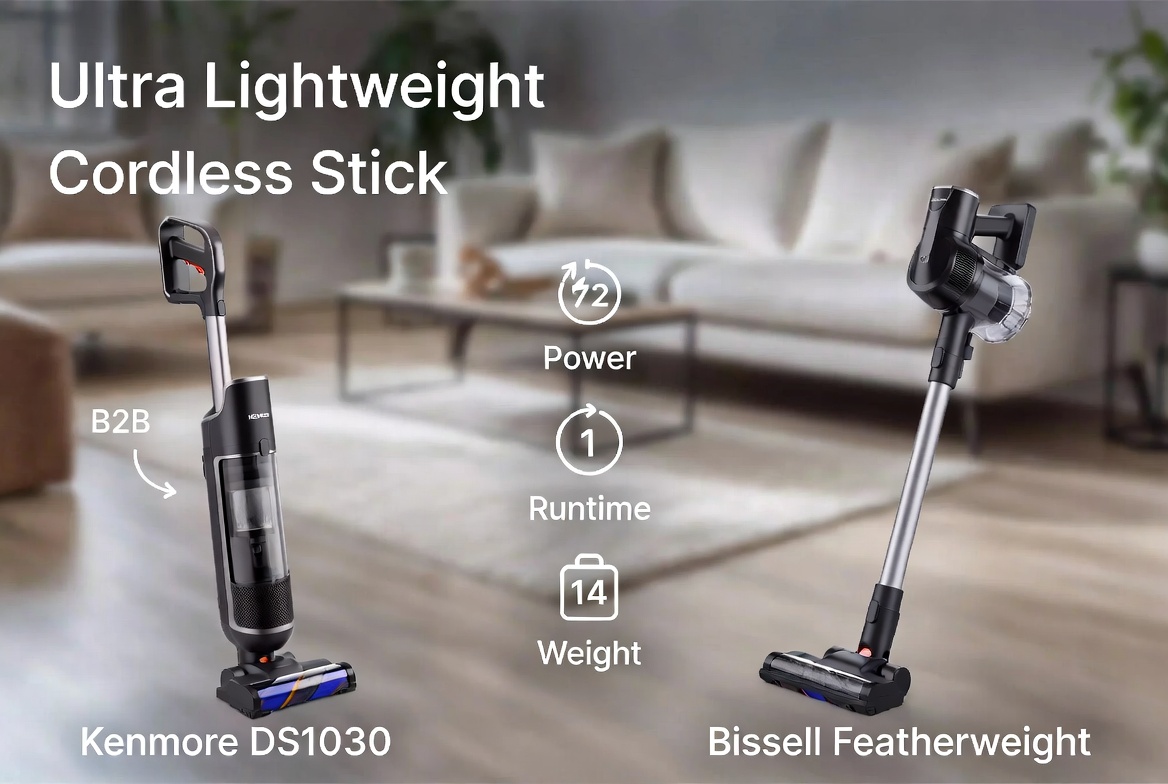
When you compare ultra-lightweight cordless vacuums, weight distribution, suction performance, runtime, and usability in small spaces should be your first checkpoints. In this showdown, both the Kenmore DS1030 and Bissell Featherweight 3061 have been independently tested on debris pickup, carpet deep cleaning, battery life, and everyday ergonomics, giving us a solid data-backed foundation for evaluation. [vacuumwars]
From my experience working with cordless vacuum OEMs in China, including teams like Ningbo Eyunhome Electric Technology Co.,Ltd., these dimensions are also exactly what buyers focus on when defining new product specifications for private-label or custom solutions. A well-designed ultra-lightweight cordless stick vacuum must balance cost, battery efficiency, floor-type versatility, and real-world user scenarios such as small apartments, dorms, or multi-story homes. [vacuumwars]
Both vacuums fall into the budget ultra-lightweight cordless segment, but their design philosophies diverge around power vs compactness. The table below summarizes the most important attributes for quick comparison (values and features based on independent testing and manufacturer descriptions). [vacuumwars]
| Feature / Aspect | Kenmore DS1030 | Bissell Featherweight Cordless 3061 |
|---|---|---|
| Product type | Ultra-lightweight cordless stick with removable handheld | Ultra-lightweight cordless stick with removable handheld |
| Weight profile | Evenly distributed, upright-style body to reduce arm fatigue | Very light (around 5.8 lbs), optimized for small spaces and easy storage |
| Power modes | 2 modes: low and max | 1 fixed power mode |
| Runtime | Up to about 45 minutes on low, 15–20 minutes on max | Around 20 minutes of cleaning time per charge |
| Debris handling on carpet | Strong deep-clean performance, especially for embedded debris | Better-than-expected carpet deep clean due to spinning brushroll |
| Debris handling on hard floors | Excellent on fine and medium debris, struggles with larger pieces due to shallow gates | Very good on fine, medium, and large debris thanks to larger gate and squeegee |
| Special features | Easy Cut nozzle for hair removal, LED lights, active hair removal design | Pivoting/folding handle, compact storage, responsive swivel steering |
| Filtration | Not sealed HEPA, but stronger fog test performance vs Bissell | Non-sealed filtration; filters need frequent maintenance |
| Ideal use case | Mixed flooring, users focusing on power and runtime | Small spaces like RVs, dorms, studios, and tight storage environments |
From a manufacturing perspective, the Kenmore DS1030's spec sheet points to a slightly more complex motor and battery configuration, while the Bissell Featherweight prioritizes mechanical simplicity and compact packaging, which has direct implications on BOM cost and assembly complexity. [vacuumwars]
Independent tests show the Kenmore DS1030 consistently outperforms the Bissell in sealed suction, airflow, and practical power tests, especially when switching to its max mode. It offers two power levels, which allows users to match suction to surface type, preserving battery life on hard floors and boosting performance on carpets when needed. [vacuumwars]
In carpet deep clean tests, the Kenmore slightly edges out the Bissell, especially for deeply embedded debris such as sand in medium-pile carpets. For OEM/ODM buyers, this points to a motor and airflow design that can serve as a reference baseline if your brand wants to position itself as a high-performance yet lightweight cordless solution. [vacuumwars]
The Bissell Featherweight, while lacking multiple power modes, still delivers surprisingly strong performance on both hard floors and carpets for its class. Its spinning brushroll (which can be turned on or off) contributes to better agitation and deep cleaning on rugs and low-pile carpets compared with older corded Featherweight designs that relied purely on suction. [vacuumwars]
In small apartments or RVs—where floor area is limited and clean-up sessions are shorter—the Bissell's single-mode power and ~20-minute runtime provide adequate performance without over-engineering the motor or battery pack. [vacuumwars]
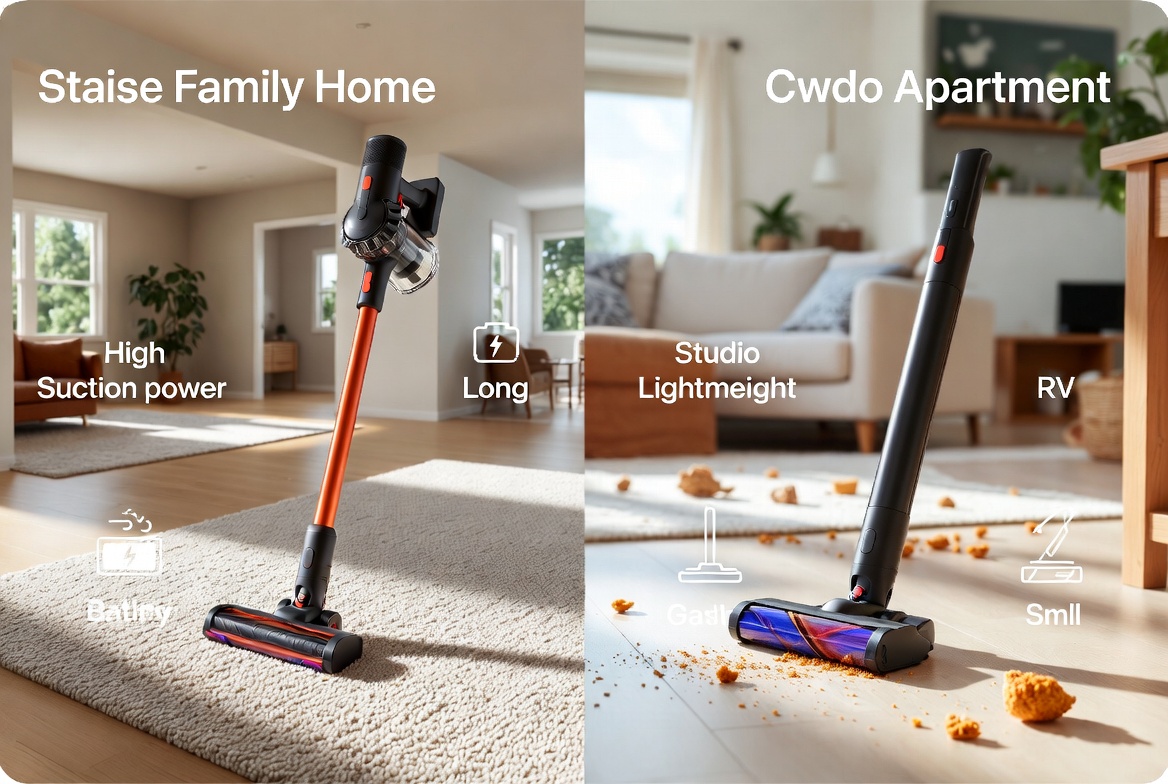
In testing, both vacuums handled fine to extra-large debris on carpets well, but the Kenmore's overall suction advantage gave it a slight edge in comprehensive carpet performance. It excels at deeply embedded debris, making it attractive for users who frequently clean bedrooms, living rooms, or high-traffic carpeted areas. [vacuumwars]
However, the Kenmore's shallower floorhead gates, optimized for carpet performance, cause some difficulties when picking up larger debris on hard floors (for example, cereal pieces like Cheerios). From a design perspective, this shows the classic trade-off: narrow gates improve suction concentration and carpet pickup but reduce clearance for larger particles. [vacuumwars]
The Bissell Featherweight uses a larger gate opening and a squeegee at the bottom to reduce scattering and allow bigger debris to enter the floorhead. This makes it particularly effective for kitchen or dining areas, where crumbs and larger pieces of dry debris are common. [vacuumwars]
For small-space users, this versatility is critical: a single compact cordless vacuum needs to transition seamlessly from hard floors to area rugs, from kitchen crumbs to living-room dust without frequent tool changes. OEM/ODM engineers can learn from this: a well-tuned combination of gate height and squeegee design offers a cost-effective way to improve real-world usability without significantly changing motor specs. [vacuumwars]
The Kenmore DS1030 delivers up to about 45 minutes of runtime on low power and 15–20 minutes on max, clearly surpassing the Bissell Featherweight's 20-minute battery window. This makes it more suitable for larger dwellings or multi-level homes, where longer continuous cleaning is needed. [vacuumwars]
Even though neither model features sealed HEPA filtration, fog tests show that the Kenmore performs better in overall air containment, suggesting tighter seals and better internal airflow management. For buyers and product managers targeting international markets with rising indoor air quality expectations, this kind of filtration performance can be a competitive differentiator without fully adopting HEPA systems. [vacuumwars]
The Bissell Featherweight's battery provides around 20 minutes of runtime, which is acceptable for small spaces but much less forgiving for larger homes. Charging time is around 4.5 hours, and the battery is non-removable, limiting extended run sessions or quick swaps. [vacuumwars]
In addition, the dustbin design requires manual filter removal, and filters tend to get dirty faster than in more sophisticated systems. While filter replacements are inexpensive, this highlights a key UX challenge: maintenance friction can impact long-term satisfaction and review scores. For OEM/ODM manufacturers like Ningbo Eyunhome, designing a more user-friendly dustbin and filter system is one of the easiest ways to add perceived value to a private-label cordless vacuum line. [vacuumwars]
The Kenmore DS1030 offers a dual-use handheld module, LED floorhead lights, and a distinctive Easy Cut nozzle, which simplifies removal of tangled hair from the brush roll. In real households—especially those with pets or long hair—this kind of feature can significantly reduce maintenance time and improve long-term usability. [vacuumwars]
The even weight distribution—more similar to an upright vacuum than a traditional stick—reduces strain on the wrist and shoulder during longer sessions, making it a comfortable choice for older users or those with joint issues. [vacuumwars]
The Bissell Featherweight focuses on compact storage and maneuverability. Its folding handle allows the vacuum to be stored in tight closets or under furniture, and that same hinge lets users clean under low furniture without bending. [vacuumwars]
The swivel steering is responsive and intuitive, which is especially valuable in cramped layouts like studio apartments, dorm rooms, or RV interiors. While its attachments are fairly basic and not a core selling point, the ability to convert into a handheld still adds above-floor flexibility. [vacuumwars]
From a UX standpoint, this product shows that mechanical ingenuity and space-efficiency can be as powerful a differentiator as raw suction. For Chinese OEMs serving European or Japanese urban markets, compactness and folding mechanisms are often key selling points.
From an industry expert perspective, choosing between the Kenmore DS1030 and Bissell Featherweight is less about which is "better" in absolute terms and more about matching the vacuum's strengths to the user's environment. [vacuumwars]
- For larger homes with mixed flooring, the Kenmore DS1030's stronger suction, dual power modes, and longer runtime make it the more balanced option. [vacuumwars]
- For small spaces with limited storage, the Bissell Featherweight's ultra-compact design, large-debris handling on hard floors, and lightweight build are more compelling. [vacuumwars]
This decision framework mirrors how professional buyers in retail chains or B2B distributors define their portfolios: they often carry both a "performance" model and a "space-saving" model to cover different customer personas.
As a trusted Chinese vacuum cleaner manufacturer, Ningbo Eyunhome Electric Technology Co.,Ltd. can help brands and distributors develop products that combine the strengths seen in both the Kenmore DS1030 and Bissell Featherweight, while tailoring them to local market needs. [vacuumwars]
In OEM and ODM engagements, we typically work with partners to:
- Define target user profiles (e.g., small apartments, large homes, pet owners) and align powertrain, battery capacity, and floorhead design accordingly.
- Customize weight distribution and handle geometry to achieve comfortable ergonomics for specific markets (e.g., taller users in Europe vs more compact designs for Asia).
- Integrate value-adding features such as LED headlights, easy hair-removal nozzles, removable batteries, and enhanced filtration without overshooting target price points.
By benchmarking products like the Kenmore DS1030 and Bissell Featherweight, our engineering and product teams can propose competitive, differentiated cordless stick vacuums that balance price, performance, and user experience for your brand's positioning.
Both reviewed vacuums rely on internal batteries, but market data and field feedback increasingly favor removable battery packs, especially for prosumers and larger homes. For OEM/ODM projects, adopting a removable battery architecture can: [vacuumwars]
- Extend product life cycles by allowing battery replacement.
- Enable extended runtime through spare packs.
- Create upsell opportunities for accessories and battery bundles.
Chinese manufacturers that invest in modular battery platforms can leverage economies of scale across multiple models—handheld, stick, and upright—while enhancing UX.
The Kenmore and Bissell models highlight how gate size, brushroll design, and squeegee placement shape real-world debris handling. An ideal next-generation product could: [vacuumwars]
- Use adjustable or variable-height gates for mixed debris environments.
- Integrate a dual-row brushroll (soft + stiff bristles) to balance hard-floor gentleness and carpet agitation.
- Optimize squeegee geometry to minimize scatter while preserving airflow.
Manufacturers like Ningbo Eyunhome can simulate these designs, then validate them through instrumented test rigs for airflow, suction, and debris pickup metrics.
Both the Kenmore DS1030 and Bissell Featherweight could still improve on dustbin ergonomics and filter access, which are frequent sources of user frustration. Based on user feedback, future designs should emphasize: [vacuumwars]
- One-touch bin release and easy reattachment.
- Minimizing direct contact with dust and debris.
- Clear visual cues (icons, color-coding) to guide filter cleaning or replacement intervals.
In the long run, these details drive higher customer satisfaction, better reviews, and lower return rates, which are crucial for global retailers and online marketplaces.
If you are a consumer or a buyer for a retail chain, use this simple decision path:
1. How big is your cleaning area?
- Mostly small spaces (studio, RV, dorm): Bissell Featherweight is often sufficient.
- Larger homes or multi-level houses: Kenmore DS1030 offers more runtime.
2. What's your dominant floor type?
- Primarily carpets and rugs: Kenmore's stronger deep cleaning and dual power modes give it the edge. [vacuumwars]
- Mainly hard floors with frequent large debris (crumbs, cereal): Bissell's larger gate and squeegee design work better. [vacuumwars]
3. How important is storage footprint?
- Very limited storage: the Bissell's folding handle and compact body win. [vacuumwars]
- Standard closets or garages: Kenmore's slightly larger body is still manageable. [vacuumwars]
4. Do you prioritize advanced features?
- Yes (LED lights, hair-removal nozzle, more powerful suction): Kenmore. [vacuumwars]
- No, you just want a simple, affordable, lightweight tool for quick clean-ups: Bissell. [vacuumwars]
For distributors or brands planning an OEM project with Ningbo Eyunhome, this same framework can be used to define multiple SKUs—for example, a "Performance" line inspired by the Kenmore profile and a "Compact" line reflecting Bissell-like ergonomics.
Ningbo Eyunhome Electric Technology Co.,Ltd. provides end-to-end OEM and ODM services for upright, handheld, corded, and cordless vacuum cleaners, helping international partners translate market insights into manufacturable products. [vacuumwars]
Key benefits include:
- Flexible customization of powertrains, battery packs, and floorhead modules (e.g., adapting between Kenmore-like high-performance configurations and Bissell-like compact layouts).
- Stable mass production with quality controls aligned to international safety and performance standards, ensuring consistent batches for long-term retail programs.
- Reliable after-sales support, including spare parts, technical documentation, and co-branded service solutions that help partners maintain high customer satisfaction.
By combining data-driven benchmarks from independent testing and our own engineering expertise, we can co-create cordless vacuum solutions that compete directly in the ultra-lightweight, budget-friendly segment while offering unique differentiators aligned with your brand strategy. [vacuumwars]
If you are a brand, retailer, or distributor looking to launch or upgrade an ultra-lightweight cordless vacuum line, you can leverage Ningbo Eyunhome's OEM/ODM capabilities to:
- Develop a Kenmore-style performance model with strong suction, dual power modes, and extended runtime.
- Launch a Bissell-style compact model optimized for small spaces, large-debris handling, and ultra-lightweight ergonomics.
- Create a hybrid design that blends the best of both worlds, customized to your target market and price positioning.
Contact our team to share your specifications, target price, and regional requirements, and we will help you define a tailored cordless vacuum roadmap that aligns with your growth strategy.
Q1: Are the Kenmore DS1030 and Bissell Featherweight suitable as primary vacuums for large homes?
A1: The Kenmore DS1030, with up to around 45 minutes of runtime on low and stronger suction, can serve as a primary vacuum in many medium-size homes, especially those with mixed flooring. The Bissell Featherweight, with approximately 20 minutes of runtime and a focus on small-space ergonomics, is better suited as a secondary or small-space vacuum rather than the main cleaner in large residences. [vacuumwars]
Q2: Which vacuum is better for users with pets?
A2: The Kenmore DS1030's stronger suction, dual power modes, and Easy Cut nozzle for hair removal give it a clear advantage in homes with pets, particularly on carpets and rugs. While the Bissell Featherweight can handle daily pet hair in small spaces, its focus is more on compactness than heavy-duty pet cleaning. [vacuumwars]
Q3: How important is sealed HEPA filtration in ultra-lightweight cordless vacuums?
A3: Sealed HEPA systems are ideal for users with allergies or asthma, but they are rare in this price category, and neither the Kenmore DS1030 nor the Bissell Featherweight includes sealed HEPA filtration. However, better fog-test performance and tighter seals, as seen in the Kenmore, still improve air quality compared to looser designs; OEM/ODM buyers should decide whether to invest in full HEPA systems based on their target market's health and regulatory expectations. [vacuumwars]
Q4: What are the main UX improvements OEMs should prioritize beyond raw suction?
A4: Beyond suction, OEMs should focus on dustbin ergonomics, filter access, battery modularity, and intuitive handle design, all of which directly influence perceived quality and long-term satisfaction. Features like easy hair removal, LED lighting, and compact storage mechanisms can also significantly differentiate a product in crowded online marketplaces. [vacuumwars]
Q5: How can Ningbo Eyunhome support a brand that wants both performance and compactness?
A5: Ningbo Eyunhome can co-develop a multi-SKU product line that combines a performance-oriented model similar in spirit to the Kenmore DS1030 with a compact, small-space model inspired by the Bissell Featherweight's ergonomics. Through OEM/ODM collaboration, we can adjust motor power, battery capacity, floorhead design, and structural engineering to meet specific performance targets while staying within your cost and branding constraints. [vacuumwars]
1. Vacuum Wars. "Kenmore DS1030 vs. Bissell Featherweight – Ultra-Lightweight Cordless Vacuum Showdown." Available at: https://vacuumwars.com/ultra-lightweight-cordless-vacuum-showdown-kenmore-ds1030-vs-bissell-featherweight/
2. Vacuum Wars. "Bissell Featherweight Cordless Review: The Best Stick Vacuum for Small Spaces?" Available at: https://vacuumwars.com/bissell-featherweight-cordless-the-best-stick-vacuum-for-small-spaces/


