
Views: 282 Author: Eyunhome Vacuum Publish Time: 2026-08-15 Origin: Site


Content Menu
● What Is the Difference Between Portable and Canister Vacuums?
● Portable Vacuum Growth Potential
>> Why portable vacuums are gaining demand
>> 2. Cordless technology supports premium positioning
>> 3. Compact homes create a natural use case
>> 4. Portable vacuums fit more sales channels
● Canister Vacuum Growth Potential
>> Where canister vacuums remain strong
>> Filtration is a major value driver
>> Canister models can support stable B2B demand
● Portable Vacuum vs Canister Vacuum: Business Comparison
● Market Data and Category Outlook
● How Buyers Should Choose a Category
>> Choose portable vacuums when you want:
>> Choose canister vacuums when you want:
>> Consider a dual-category strategy when:
● Product Development Priorities for Manufacturers
>> Portable vacuum development checklist
>> Canister vacuum development checklist
● FAQ
>> 1. Are portable vacuums powerful enough for whole-home cleaning?
>> 2. What is the best portable vacuum type for online sales?
>> 3. Why do some consumers still prefer canister vacuums?
>> 4. What features matter most in a cordless portable vacuum?
>> 5. Can a canister vacuum be cordless?
>> 6. Which vacuum category is better for pet hair?
>> 7. What should an OEM vacuum buyer prepare before starting a project?
For vacuum cleaner brands, importers, and retailers, the choice between a portable vacuum and a canister vacuum is no longer only about product shape. It is a decision about target consumers, retail positioning, pricing power, supply-chain capability, and long-term category growth.
Based on current market direction, portable vacuum cleaners—especially cordless stick and handheld models—offer stronger growth potential because they match the rising demand for convenience, compact storage, fast daily cleaning, and flexible multi-scenario use. However, canister vacuums remain a valuable category for markets and buyers that prioritize continuous runtime, deep cleaning, large dust capacity, hard-floor performance, and professional-grade accessories.
For Ningbo Eyunhome Electric Technology Co., Ltd., the strongest opportunity is not simply choosing one category over the other. It is building a focused portfolio: fast-moving portable vacuum models for volume growth, supported by differentiated canister vacuum solutions for selected customer groups and regional markets.

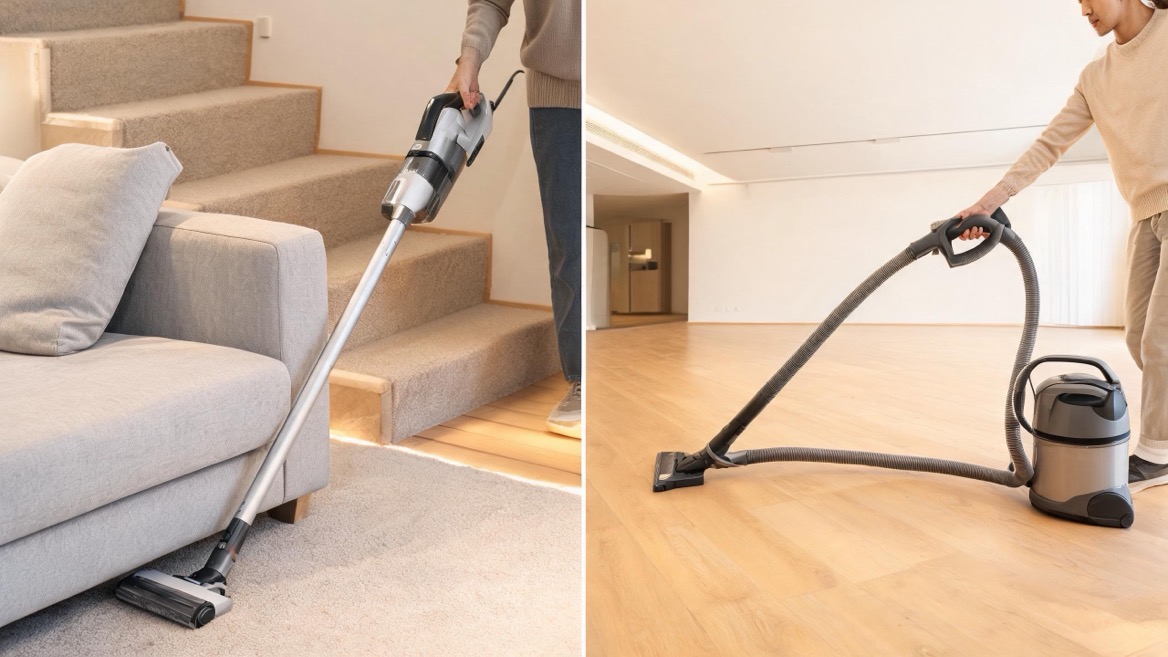
A portable vacuum cleaner is designed for mobility, quick access, and compact storage. This category commonly includes handheld vacuums, cordless stick vacuums, compact corded models, car vacuums, and lightweight multi-purpose cleaners.
A canister vacuum cleaner separates the motor and dust container from the cleaning head. The main unit rolls behind the user and connects to a hose, wand, and floor nozzle. This structure can improve reach and reduce the weight held in the hand during extended cleaning.
| Feature | Portable Vacuum | Canister Vacuum |
|---|---|---|
| Typical format | Handheld, stick, compact upright, car vacuum | Separate body, hose, wand, and floor head |
| Main consumer benefit | Fast, lightweight, convenient cleaning | Deep cleaning, reach, continuous power |
| Best use cases | Daily spills, stairs, cars, sofas, small homes | Whole-home cleaning, hard floors, curtains, large spaces |
| Power source | Mainly rechargeable battery; also corded options | Mostly corded; cordless canister models are emerging |
| Storage requirement | Usually compact and wall-mountable | Requires more floor or cabinet space |
| Dust capacity | Usually smaller | Usually larger |
| Runtime | Battery-dependent for cordless models | Continuous power for corded models |
| Product-development priority | Battery, weight, charging, compact design | Suction stability, hose system, filtration, accessories |
The key commercial distinction is simple: portable vacuums sell convenience, while canister vacuums sell cleaning endurance and versatility.
Portable vacuum cleaners have substantial momentum because consumers increasingly want cleaning tools that are ready immediately, rather than appliances that require setup, assembly, and storage planning.
The worldwide cordless vacuum cleaner market was estimated at US$6.5 billion in 2024 and is projected to reach US$8.4 billion by 2030. Within this category, upright cordless products are forecast to grow, while canister products also retain a meaningful role.
1. Faster daily-cleaning habits
Many households now clean in shorter, more frequent sessions. A consumer may use a lightweight cordless stick vacuum after cooking, before guests arrive, after children play indoors, or after a pet sheds on the sofa.
This behavior favors products that are:
- Ready to use in seconds
- Easy to carry upstairs
- Easy to store in apartments
- Suitable for quick spot cleaning
- Practical for car interiors and upholstery
- Simple to empty and maintain
A portable vacuum turns cleaning from a scheduled task into an on-demand habit.
Battery performance remains one of the most important competitive factors in portable vacuum development. Buyers increasingly compare:
- Runtime per charge
- Recharge time
- Battery removability
- Motor efficiency
- Suction consistency
- Battery safety protection
- Availability of replacement batteries
A removable battery can create a stronger product proposition for distributors and brand owners. It extends practical cleaning time and can support accessory sales or premium bundles.
For an OEM/ODM buyer, the most commercially attractive portable vacuum is often not the lowest-cost model. It is a product with a clear feature story, such as 45-minute runtime, detachable battery, LED floor brush, anti-tangle roller, washable filter, and wall-mounted charging dock.
Portable vacuums work especially well in apartments, rental homes, dormitories, small offices, and urban households. Their value is not only cleaning performance. It is also storage efficiency.
A slim stick vacuum can be mounted on a wall, placed beside a refrigerator, stored in a narrow closet, or kept near a frequently used area. This gives portable models a clear advantage in space-constrained markets.
Portable vacuum cleaners are well suited to:
- Online marketplaces
- Social-commerce promotions
- Consumer electronics retailers
- Home-improvement stores
- Car accessory channels
- Pet-product retailers
- Gift and seasonal campaigns
Their lighter shipping weight and easier product demonstration can also improve their suitability for direct-to-consumer and marketplace-based brands.
Canister vacuums may not generate the same excitement as cordless stick vacuums, but they remain commercially relevant. In 2025, canister vacuum cleaners held the largest product-category revenue share in the broader market, at 25.7%.
That leadership reflects a continuing need for dependable whole-home cleaning equipment, particularly in homes with mixed flooring, larger rooms, frequent deep-cleaning needs, or allergy-related filtration expectations.
Continuous runtime is a major advantage. A corded canister vacuum does not lose performance because a battery is depleted. This matters for consumers who clean larger homes, hospitality spaces, offices, or multiple rooms in one session.
Canister vacuums also offer practical benefits for:
- Hard floors and tile
- Area rugs and low-pile carpets
- Stairs
- Curtains and blinds
- Under-furniture cleaning
- Upholstery and mattresses
- Large homes
- Users who prefer a lighter handle weight
The body remains on the floor while the user works with the hose and wand. This can make above-floor cleaning easier than using a full-size upright vacuum.
For canister vacuum buyers, filtration is often a major decision factor. A well-designed system can include:
- Sealed air pathways
- Multi-stage filtration
- Washable filters
- High-efficiency particulate filtration
- Dust bags for cleaner disposal
- Large dust-bin capacity for bagless versions
A product should not rely on vague claims such as "strong filtration." Instead, manufacturers and brand owners should clearly define the filtration structure, replacement cycle, maintenance method, and relevant test standards.
Canister vacuums are attractive for buyers looking for a more established, practical, and less trend-dependent product category. They may be especially suitable for:
- Regional appliance brands
- Offline retail chains
- Professional cleaning suppliers
- Hospitality procurement programs
- Markets with stronger demand for corded appliances
- Buyers seeking larger dust capacity and lower battery-related complexity
The U.S. canister segment is described as mature, with growth expected in the low-to-mid single digits in value terms. Within that segment, cordless canister models are gaining faster momentum, while conventional corded bagged models face greater pressure.
| Decision Factor | Portable Vacuum | Canister Vacuum |
|---|---|---|
| Overall category momentum | Higher, led by cordless convenience | Steadier, with selective growth niches |
| Main growth engine | Cordless stick, handheld, compact multi-use models | Cordless hybrids, bagless systems, filtration upgrades |
| Ideal buyer | E-commerce brands, young consumer brands, lifestyle retailers | Appliance distributors, offline retailers, professional channels |
| Development complexity | High battery, motor, weight, and thermal-management requirements | High airflow, hose, accessory, and filtration-design requirements |
| Shipping efficiency | Often favorable due to compact design | Can require larger packaging volume |
| Price competition | Intense at entry level | Strong competition but more room for feature-based differentiation |
| Product life-cycle risk | Faster trend changes | More stable but slower innovation cycle |
| Best product strategy | Multiple price tiers and accessory bundles | Specialized models for deep cleaning and multi-surface use |
Portable vacuum cleaners have greater growth potential overall. But canister vacuums may offer better opportunities where buyers value reliability, continuous operation, and deep-cleaning capability over extreme portability.
Different market reports use different category definitions, so figures should be treated as directional rather than perfectly comparable. Still, the broader pattern is consistent: cordless and compact vacuum formats are expanding faster than conventional corded categories.
One market assessment projects the cordless vacuum category to grow from US$14.2 billion in 2025 to US$27.3 billion by 2034, representing a 7.8% compound annual growth rate. Stick vacuums accounted for 42.5% of that category in 2025.
Another market source estimates the handheld cordless vacuum segment at US$7.33 billion in 2025, with projected annual growth of 10.9% through 2033.
For canister products, the growth picture is more nuanced. The category remains significant, and a global market forecast estimates canister vacuum cleaners could grow from US$3.4 billion to US$5.3 billion, at a 7.9% compound annual growth rate. The dry-canister segment is forecast to expand more quickly than wet-dry canister products in that assessment.
The commercial takeaway is clear:
- Portable vacuum growth is broader and faster
- Canister vacuum demand remains resilient in specific use cases
- Cordless technology is influencing both categories
- Battery, filtration, and accessory systems will shape product differentiation
The best category depends on the buyer's customer profile, sales channel, and brand strategy.
- High-volume online sales potential
- Compact products for apartment living
- Products for quick daily cleaning
- A strong lifestyle-oriented brand image
- Car, pet, sofa, and desktop cleaning applications
- Opportunities for cordless upgrades and accessory bundles
- More frequent product refreshes
- Continuous runtime
- Larger dust capacity
- Strong hard-floor and whole-home performance
- A product for mature appliance retail channels
- More accessories for specialized cleaning
- Stronger relevance for large homes and commercial-light use
- Filtration-focused positioning
A distributor or brand wants to serve both quick-cleaning and deep-cleaning needs. For example, a brand could offer:
1. An entry-level handheld vacuum for cars and desktop cleaning
2. A mid-range cordless stick vacuum for everyday home cleaning
3. A premium canister vacuum for deep cleaning, large spaces, and multi-surface homes
This ladder allows the buyer to reach several price points without competing with a single product alone.
For Ningbo Eyunhome Electric Technology Co., Ltd., product competitiveness should be built around real user problems, not only specification sheets.
- Lightweight body design without sacrificing structural strength
- Efficient brushless motor options
- Stable battery protection system
- Detachable or replaceable battery design
- Clear runtime performance by mode
- Anti-tangle floor brush for hair and pet fur
- LED lighting for dark spaces
- Washable filter system
- Wall-mount storage or charging solution
- Compact packaging for export efficiency
- Strong and stable suction airflow
- Durable hose and wand connection system
- Multi-floor brush compatibility
- Large-capacity dust collection
- Convenient dust-emptying design
- Sealed filtration structure
- Low-noise motor configuration
- Retractable power cord
- Durable wheels for smooth movement
- Practical accessory storage
A strong OEM/ODM partner should also help buyers customize housing colors, logos, packaging, plug types, manuals, accessory combinations, and performance configurations for their target markets.

If the question is strictly, "Which category has more growth potential?" the answer is portable vacuum cleaners.
Cordless stick and handheld products are better aligned with compact living, fast cleaning habits, e-commerce purchasing, pet care, car cleaning, and the consumer preference for lightweight home appliances. Their faster innovation cycle also creates more opportunities for new product launches and premium upgrades.
However, canister vacuums should not be treated as a declining category. They continue to serve customers who need consistent power, longer cleaning sessions, larger dust capacity, strong filtration, and versatile accessories.
The winning approach is to match the product category to the end user:
- Choose portable vacuums for convenience-led growth.
- Choose canister vacuums for performance-led, whole-home cleaning.
- Build both categories when your brand needs a broader product ladder.
Ningbo Eyunhome Electric Technology Co., Ltd. can support global buyers with portable, cordless, corded, handheld, and canister vacuum solutions tailored to different markets. Contact our team to discuss your OEM/ODM requirements, target price range, preferred functions, packaging needs, and product-development timeline.
High-quality cordless stick vacuums can handle regular whole-home cleaning, especially in smaller homes and apartments. However, runtime, dust capacity, and deep-carpet performance may be more limited than with a corded canister vacuum.
Cordless stick vacuums are often the strongest option because they combine daily floor cleaning, handheld conversion, compact storage, and visual product appeal. Compact handheld vacuums can also perform well in car-cleaning, pet-care, and entry-level price segments.
Canister vacuums provide continuous power, larger dust capacity, longer cleaning time, and flexible tools for floors, furniture, curtains, and narrow spaces. They are particularly suitable for users who prioritize deep cleaning over quick convenience.
Key features include battery runtime, motor performance, weight, charging time, anti-tangle brush design, filtration, dust-bin emptying, noise level, and accessory selection. A removable battery can also improve product value.
Yes. Cordless canister vacuums are an emerging hybrid category. They aim to combine canister-style flexibility with battery-powered mobility, although manufacturers must carefully manage battery capacity, motor efficiency, and product weight.
Both can work well when equipped with the correct brush roll and filtration system. Portable cordless models are convenient for frequent sofa, stair, and spot cleaning, while canister vacuums can be better for longer cleaning sessions and larger homes.
Buyers should define their target market, intended retail price, sales channel, required certifications, preferred power system, performance requirements, product color, logo, packaging style, accessories, and expected order volume.
1. [MarketResearch.com — Cordless Vacuum Cleaners]
2. [Grand View Research — Vacuum Cleaner Market Size, Share & Trends]
3. [Market Intelo — Cordless Vacuum Market Research Report]
4. [Data Insights Market — Handheld Cordless Vacuum Cleaner Analysis]
5. [Research and Markets — Canister Vacuum Cleaners Market]
6. [IndexBox — United States Canister Vacuum Cleaner Market]


