
Views: 258 Author: Eyunhome Vacuum Publish Time: 2026-10-01 Origin: Site


Content Menu
● Portable Vacuum vs Stick Vacuum: The Quick Answer
● What Each Vacuum Is Designed to Do
>> Portable vacuums excel at detailed office cleaning
>> Stick vacuums excel at routine floor maintenance
● How Office Conditions Change the Winner
>> Floor area and layout determine labor time
>> Surface mix changes the required tool
>> Occupied offices need a noise plan
● Corded or Cordless for Office Maintenance?
● Filtration: Look Beyond the Filter Label
● An Office Cleaning Trial Worth Running
>> A five-step test for facilities teams
● Calculate Cost Per Clean, Not Price Alone
● When a Two-Vacuum Setup Makes Sense
● What Buyers Should Ask an OEM/ODM Manufacturer
● The Best Choice for Your Office
>> Is a portable vacuum enough for an entire office?
>> Can a stick vacuum replace a handheld vacuum?
>> Which vacuum is better for office carpet tiles?
>> Is a cordless vacuum better than a corded vacuum?
>> Does a HEPA-labeled filter make a vacuum suitable for every dust problem?
>> What should an office vacuum buyer ask about after-sales support?
A portable vacuum vs stick vacuum decision is rarely about which machine has the stronger-looking specification sheet. For office maintenance, the better choice depends on where debris collects, how often cleaners work, and whether the job is a quick response or a full-floor routine. A portable handheld vacuum reaches desks, upholstery, and corners. A stick vacuum covers open floors more efficiently. Many offices need both—but not necessarily in equal numbers.
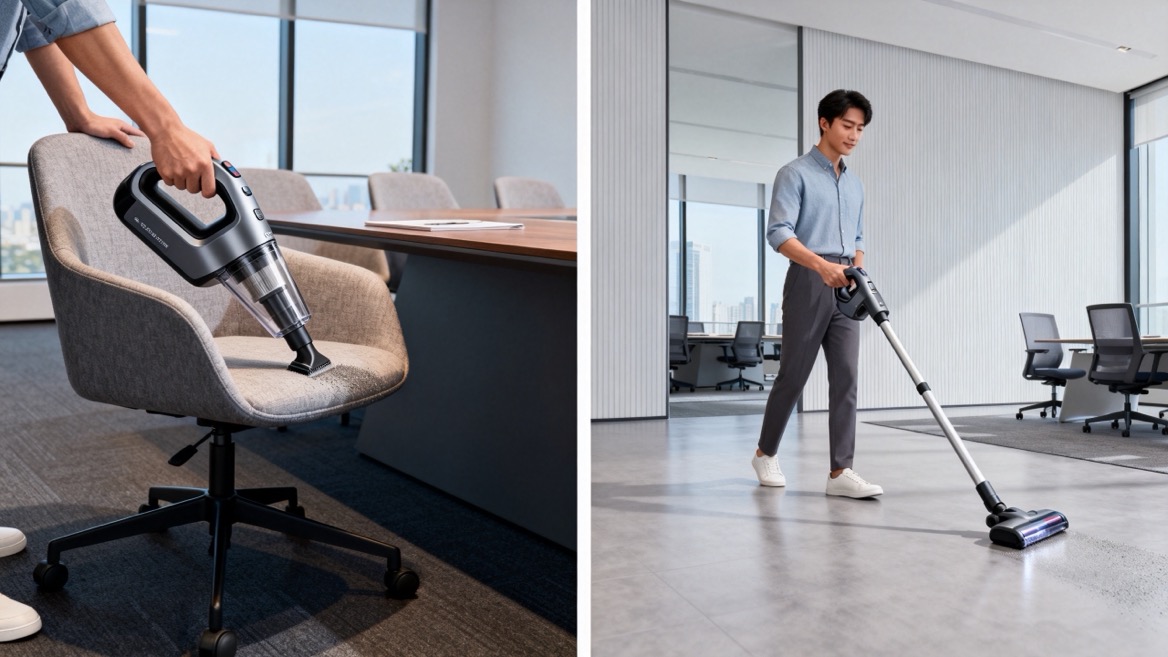
Choose a portable vacuum when most tasks involve crumbs, window tracks, chair seams, shelves, or other small areas above the floor. Choose a stick vacuum when staff regularly clean walkways, meeting rooms, and hard floors. If the office has extensive carpet or long cleaning shifts, test both options against a suitable commercial floor vacuum before purchasing.
| Office maintenance factor | Portable handheld vacuum | Stick vacuum |
|---|---|---|
| Best cleaning pattern | Short, targeted cleanups | Repeated floor passes |
| Strongest locations | Desks, upholstery, stairs, edges | Corridors, meeting rooms, open work areas |
| Main limitation | Slow and tiring for large floors | Less convenient for tight, elevated spaces |
| Storage | Fits a cabinet or cleaning cart | Usually needs upright storage or a dock |
| Corded option | Continuous power, limited reach | Continuous power, cord management required |
| Cordless option | Fast access, limited by charge and bin size | Free movement, limited by usable runtime |
| Best purchasing test | Reach, emptying, and pickup on small debris | Floor pickup, maneuverability, and shift coverage |
These are equipment categories, not performance guarantees. A well-designed handheld model can outperform a poorly matched stick model on its intended task. The reverse is equally true.
In this comparison, "portable vacuum" means a compact handheld unit that the operator carries while cleaning. Its advantage is access. A narrow nozzle can reach chair joints and baseboards; a brush attachment can lift loose dust from appropriate hard surfaces; and an upholstery tool can handle fabric seating.
That makes it useful for reception desks, conference chairs, drawers, and dry crumbs around break-room furniture. It also reduces the effort of bringing a full-size machine out for a two-minute job.
Its weakness is floor coverage. Cleaning an entire corridor with a handheld unit means bending repeatedly and covering a narrow path. Small bins also interrupt work more often. Do not use a standard dry vacuum for liquid spills, hazardous dust, or toner unless the specific machine is rated and approved for that material.
A stick vacuum positions the motor and handle above a floor head, allowing the operator to clean while standing. It suits daily passes through entrances, meeting rooms, and open-plan areas. Many models convert to handheld use, but the converted unit may still feel bulky for extended desk-level work.
Check the floor head before assuming a stick vacuum will handle every surface. A head that moves easily over hard flooring may perform differently on commercial carpet tiles. Brush design, head clearance, sealing, and how the unit handles edges all matter.
For a carpet-heavy office, ask for evidence of soil removal and dust containment, not just a suction figure. The Carpet and Rug Institute's vacuum testing considers soil removal, soil containment, and wear to carpet. That is a more relevant purchasing framework than treating motor wattage as a cleaning score.
A compact office with scattered desks may generate many small cleaning tasks but little uninterrupted floor space. A handheld vacuum can serve those tasks well, while a stick vacuum handles the main aisle.
A larger floor plate changes the calculation. Every return trip to empty a bin, change a battery, or move furniture adds time. In a long corridor, floor-head width and comfortable steering may matter more than the speed of a single pickup test.
Before buying, sketch a simple route. Mark the areas that need daily floor cleaning, the spots that need occasional detail work, and the distance from storage to each zone. The best machine is the one that fits that route with fewer interruptions.
Hard floors often call for a floor head that picks up fine debris without scattering larger pieces. Carpet tiles require effective agitation and soil removal, while delicate surfaces may need a non-marring brush or a lower-power setting.
Do not assume "more power" solves a poor attachment match. The European Commission notes that higher input power does not necessarily mean better cleaning performance. Compare results on the office's actual flooring, including edges and transitions.
A quiet-looking machine is not necessarily quiet in use. Motor setting, floor head, surface, and room acoustics affect what employees hear. If cleaning takes place during working hours, test the candidate while people are taking calls.
Ask suppliers for the test method and operating mode behind any noise figure. Also check whether the reported measurement is sound pressure or sound power; the numbers should not be treated as interchangeable. If daytime operation is disruptive, schedule louder floor cleaning outside core hours and keep a portable unit available for quick, localized work.
The shape of a vacuum and its power source are separate choices. Both portable and stick vacuums can be corded or cordless, although available configurations vary by product.
A cordless vacuum helps when cleaners move between rooms, work around furniture, or respond to a sudden mess. Its planning challenge is usable runtime. Request runtime under the cleaning mode and floor-head configuration you intend to use—not only the longest advertised setting. Account for charging time, battery availability, and performance as the bin fills.
A corded vacuum avoids battery-related interruptions and may suit longer, predictable shifts. It also needs accessible outlets and careful cord handling. In the United States, OSHA requires applicable cord-and-plug equipment and extension cords to be visually inspected before use on a shift; equipment with potentially dangerous defects must be removed from service.
For a facility manager, the practical question is: Which interruption costs more? If charging stops a daily cleaning route, a corded model or a battery plan may be preferable. If moving a cord through occupied walkways slows every task, cordless operation may be worth the added battery management.
A vacuum picks up dust at one end and releases air at the other. For office purchasing, ask how the complete machine contains collected material, how the bin or bag is emptied, and how replacement filters are supplied.
A HEPA filter alone does not prove that a vacuum is a sealed HEPA system. In its guidance on renovation cleanup, the U.S. Environmental Protection Agency distinguishes a vacuum designed to direct its exhaust through a HEPA final filter from a machine merely fitted with a HEPA filter. That renovation-specific requirement should not be presented as a universal rule for everyday office dust, but the design distinction is useful when evaluating filtration claims.
Emptying also affects the cleaning routine. A compact, bagless handheld vacuum may be easy to deploy yet require frequent bin emptying. A larger stick model may reduce those stops but be harder to empty neatly. Ask to see the process demonstrated with a used test machine, not an empty display sample.
Vacuuming is only one part of indoor air management. Building maintenance, ventilation, pollutant control, and filtration all play roles. Neither vacuum type should be marketed as a substitute for an office's ventilation plan.
Product listings cannot tell you how a vacuum feels after repeated use or whether its attachments reach a particular chair. A short, repeatable trial gives buyers stronger evidence.
1. Map the tasks. Record the approximate floor area, surface types, desk-level cleaning points, stairs, and cleaning frequency.
2. Select representative zones. Include a hard-floor walkway, a carpeted area if present, a furnished meeting room, and an edge or corner.
3. Use comparable conditions. Give each candidate the same debris type, operator instructions, and allotted time. Follow the manufacturer's operating guidance.
4. Record interruptions. Note cleaning time, bin emptying, outlet changes, battery changes, attachment swaps, and missed spots.
5. Review the full shift. Ask cleaners about grip comfort, carrying, storage, noise, and how easy the unit is to maintain.
A useful scorecard separates pickup quality from workflow efficiency. A vacuum might remove debris well but take too long to set up. Another might move quickly yet leave material along the edges. If several people share equipment, have more than one operator complete the trial.
This approach also makes procurement discussions more precise. Instead of asking whether a supplier has a "powerful office vacuum," ask whether a proposed unit completes your defined route to an acceptable standard within the available time.
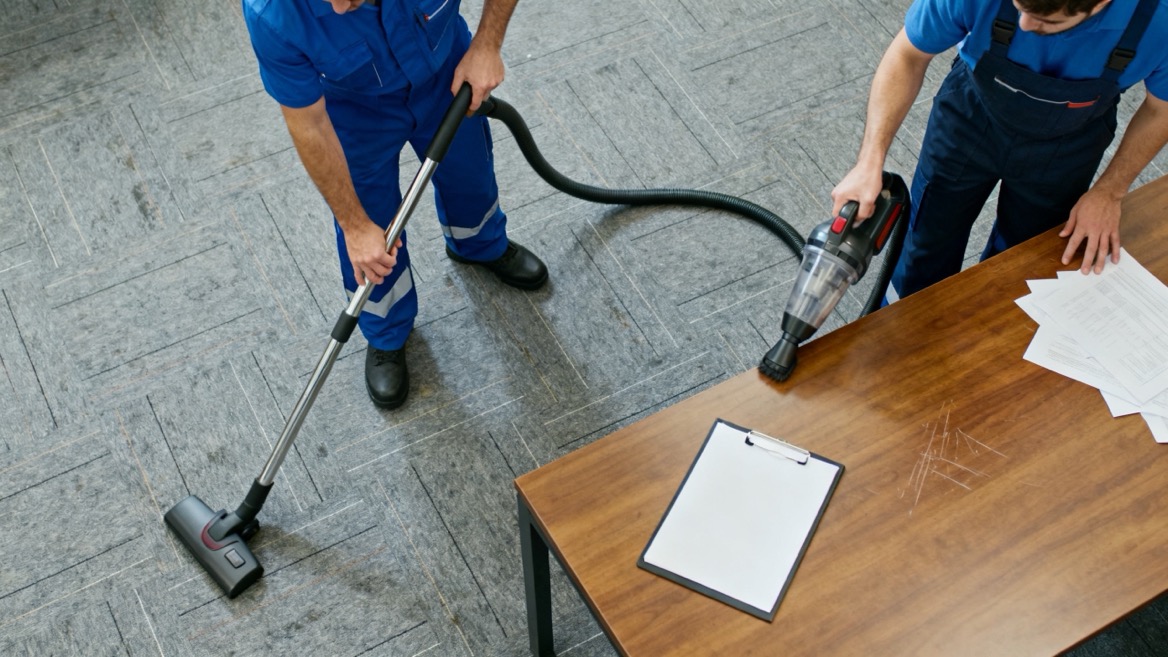
The lowest unit price is not always the lowest operating cost. Estimate ownership cost over the period your team normally keeps equipment, using quotations and your own trial results.
| Cost item | What to request or measure |
|---|---|
| Initial purchase | Unit, attachments, chargers, and any spare batteries |
| Consumables | Filters, bags if used, brush rolls, and replacement tools |
| Labor | Minutes per cleaning route and time spent on interruptions |
| Repairs | Warranty terms, parts prices, and expected service process |
| Downtime | Backup equipment needed while a unit is charging or repaired |
For example, a cordless stick vacuum may eliminate outlet changes but require a second battery for a long route. A handheld unit may have a low purchase price yet take too much labor to clean open flooring. The right comparison is cost per completed cleaning task, provided both candidates meet the required result.
Treat manufacturer specifications as inputs, not proof of outcomes. Request test conditions for runtime, noise, filtration, and pickup claims. Then check whether the specifications match the office's real use.
A mixed setup is often more practical than forcing one device to do every job. Consider a stick vacuum for scheduled floor passes and a portable handheld vacuum for reception-area touch-ups, meeting-room chairs, and break-room crumbs.
The pairing is especially useful when the people doing daily spot cleaning differ from the team handling scheduled maintenance. Staff can reach for a compact unit without moving the floor-cleaning machine, while cleaners retain an appropriate tool for wider routes.
Keep the system simple. Standardize where practical: label chargers and attachments, specify who empties each unit, and keep replacement filters easy to identify. A shared checklist can prevent a charged machine from being returned to storage with a full bin or blocked head.
There are limits. For extensive carpet, lengthy continuous operation, or a specialized cleaning requirement, neither a light handheld nor a typical stick vacuum should be chosen without a field test. A purpose-built commercial machine may be the better primary floor tool.
For distributors and facilities buyers, the best specification starts with the cleaning application, not a list of optional features. Give the manufacturer the surfaces, route length, expected use frequency, target market, and service expectations. Then ask for a configuration and supporting test information.
- Performance: How is pickup tested on the intended hard floor or carpet? Which head and power mode are used?
- Battery and power: What is the usable runtime in the proposed configuration? Are spare batteries or corded alternatives available?
- Filtration: What is the complete air path? What evidence supports any filtration claim?
- Usability: Can operators access the bin, brush roll, and filters without difficult steps?
- Supply: Which consumables and replacement parts will remain available, and under what terms?
- Documentation: What product instructions, test reports, labeling, and market-specific documents can be provided for review?
For buyers supplying the European Union, check the exact product category before applying a regulatory claim. The European Commission identifies mains-operated vacuums as within the scope of its vacuum ecodesign rules while listing handheld and cordless stick vacuum cleaners among exclusions. A product's intended market and configuration therefore deserve a separate compliance review.
Ningbo Eyunhome Electric Technology Co., Ltd. offers upright, handheld, corded, and cordless vacuum solutions, along with OEM/ODM services, production support, and after-sales support. Those capabilities can help buyers develop a matched product range, but specifications, availability, and service terms should be confirmed for the proposed order.
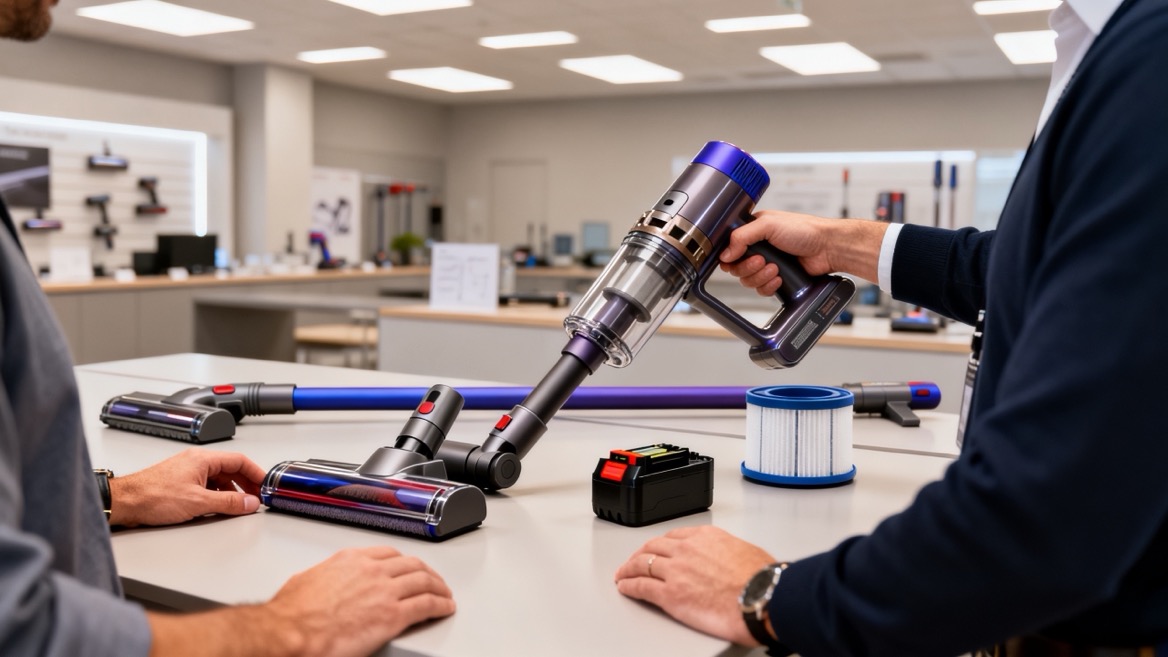
For small, scattered messes, choose a portable vacuum. For regular floor routes, start with a stick vacuum and test it on your actual surfaces. For offices with both needs, a coordinated pair is often the clearest solution. If carpet coverage or shift length is substantial, compare that pair with a dedicated commercial floor machine.
The final decision should rest on a documented trial: clean the right areas, measure the time, check operator comfort, and confirm the cost of keeping the equipment in service. Contact Ningbo Eyunhome Electric Technology Co., Ltd. with your office floor plan, surface mix, cleaning schedule, and target market to discuss a suitable OEM/ODM vacuum configuration.
Usually not if the office needs regular cleaning across open floors. A handheld portable vacuum works best for localized debris and hard-to-reach places. Test a stick or other floor vacuum for the main cleaning route.
Sometimes. A convertible stick model can handle both jobs, but its handheld configuration may be less comfortable in narrow or elevated spaces. Try the conversion and attachments on actual office furniture before deciding.
Start with the machine and floor head that achieve acceptable pickup on the specific carpet tiles. A stick vacuum is generally more practical than a handheld for floor coverage, but buyers should verify soil removal, edge cleaning, and carpet compatibility through testing.
It depends on the route. Cordless models simplify movement between rooms, while corded models avoid charging interruptions. Compare usable runtime, outlet access, cord handling, and the length of each cleaning shift.
No. Check the complete machine design and the material being collected. A standard office vacuum should not be assumed suitable for hazardous dust or specialized cleanup merely because its filter carries a HEPA claim.
Ask for written warranty terms, consumable and spare-part availability, troubleshooting procedures, and the process for handling a failed unit. If the equipment is business-critical, establish a backup plan before rollout.
- [U.S. Environmental Protection Agency — *An Office Building Occupant's Guide to Indoor Air Quality*]. Guidance on office pollutant sources, ventilation, filtration, and shared maintenance responsibilities. [epa]
- [Carpet and Rug Institute — *A Guide to CRI's Seal of Approval Program*]. Explains independent vacuum testing for soil removal, soil containment, and carpet wear. [carpet-rug]
- [U.S. Environmental Protection Agency — *What to Look for in a HEPA Vacuum for Renovation Cleanup*]. Explains the distinction between a sealed HEPA vacuum and a machine fitted only with a HEPA filter; its regulatory context is renovation cleanup. [epa]
- [Occupational Safety and Health Administration — *29 CFR 1910.334: Use of Equipment*]. Requirements concerning the handling and inspection of applicable cord-and-plug equipment and extension cords. [osha]
- [European Commission — *Vacuum Cleaners: Energy Efficient Products*]. Explains why input power alone is not a cleaning-performance measure and describes the scope of European vacuum ecodesign requirements. [energy-efficient-products.ec.europa]
- [ISSA — *Cleaning Industry Management Standard*]. Industry framework covering work plans, equipment performance evaluation, purchasing, and planned maintenance. [go.issa]


