
Views: 224 Author: Eyunhome Vacuum Publish Time: 2026-09-26 Origin: Site


Content Menu
● What Do "Portable" and "Upright" Mean?
● Portable Vacuum vs Upright Vacuum: Key Differences
● Which Cleans Compact Floors Better?
>> Hard Floors and Everyday Debris
>> Rugs, Carpet, and Embedded Dirt
>> Furniture, Edges, and Pet Hair
● How Much Space Does Each Vacuum Need?
>> Measure Storage Before Comparing Specifications
● Corded or Cordless for Small Apartments?
● Three Checks Buyers Often Miss
>> 1. Compare Cleaning Results, Not Motor Watts Alone
>> 2. Evaluate Dust Containment During Use and Emptying
>> 3. Estimate the Cost of Living With It
● A Practical Five-Minute Home Audit
● What Should Retail and OEM Buyers Test?
● Which Vacuum Is Right for You?
>> Can a Portable Vacuum Replace an Upright in a Studio?
>> Is an Upright Vacuum Too Large for a Small Apartment?
>> Which Is Better for Pet Hair on Carpet?
>> Is a Cordless Vacuum Powerful Enough for Carpet?
>> Does a HEPA Filter Mean No Dust Escapes?
>> What Should an OEM Buyer Request Before Placing an Order?
In a small apartment, the best vacuum is not necessarily the smallest one. The choice between a portable vacuum vs upright vacuum in compact living spaces depends on what needs cleaning, where the machine can be stored, and whether quick access matters more than full-floor performance. A handheld portable vacuum excels at crumbs, furniture, and corners. An upright is usually the more practical single machine when carpet covers much of the floor.
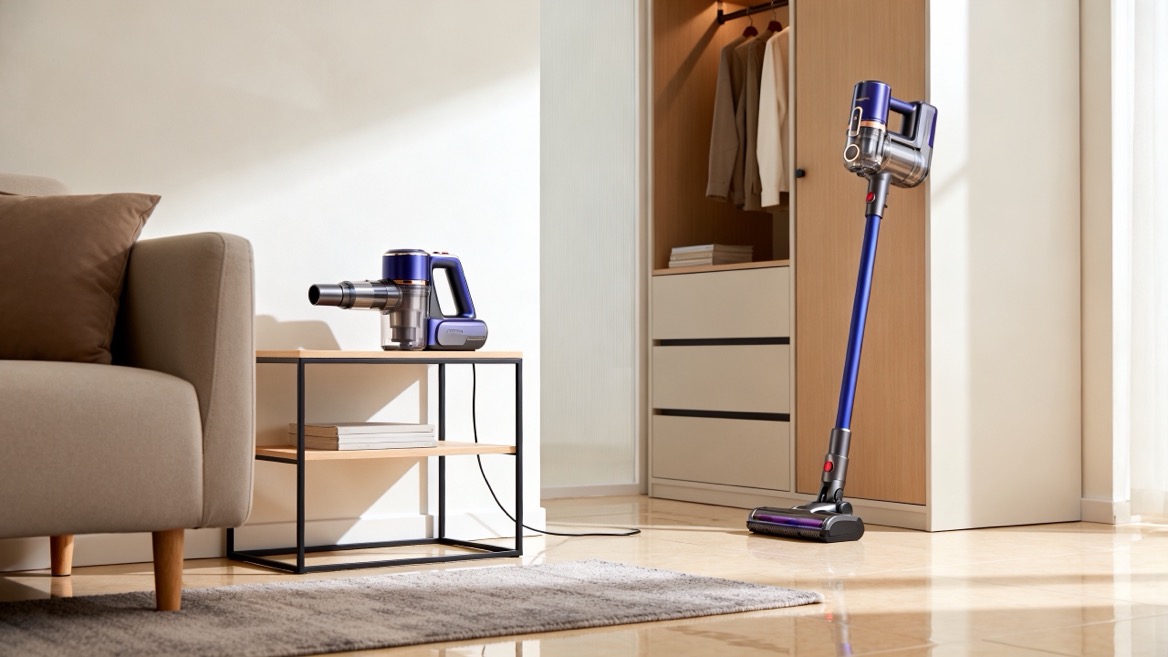
Portable vacuum is a broad label. In this guide, it means a compact handheld cleaner that you carry to the mess. Some portable models include a short hose or a small floor attachment, but many are designed primarily for surfaces above the floor. Portable does not automatically mean cordless; check the power source of the model you are considering.
An upright vacuum has a floor-cleaning head and a vertical body that you push across the room. It may be corded or cordless. Its floor head, brush design, and larger cleaning path generally make it better suited to cleaning an entire carpeted room than a handheld vacuum.
There is an important third option: the stick vacuum. A slim stick cleaner can be easy to store while still providing a full-size floor head. Some convert into handheld units. It is neither interchangeable with every portable vacuum nor identical to a traditional upright. If you are buying one machine for a compact home, it deserves consideration alongside the two categories in this article.
| Decision factor | Portable handheld vacuum | Upright vacuum |
|---|---|---|
| Best use | Small, frequent messes; furniture; stairs; tight spaces | Routine cleaning across whole floors, especially carpet |
| Floor coverage | Limited unless it has an effective floor attachment | Wider cleaning path and less bending for floor work |
| Carpet cleaning | Best for edges, small rugs, or localized debris | Generally better suited to larger carpeted areas |
| Storage | Usually fits in a drawer, cabinet, or small charging spot | Needs floor or closet space; measure its stored shape |
| Reach | Easy to carry to shelves, upholstery, and awkward corners | Depends on whether a hose and tools are included |
| Dust capacity | Usually smaller; may need frequent emptying | Typically accommodates longer cleaning sessions |
| Power choice | Often cordless, but corded versions exist | Available in corded and cordless designs |
| Main limitation | May be frustrating as the only floor-cleaning tool | Can feel cumbersome in a crowded room |
These are category-level tendencies, not guarantees. A well-designed compact upright can be easier to handle than a poorly balanced handheld. Likewise, a portable cleaner with a capable floor attachment may do more than its size suggests. Compare actual samples or model-level test results before making a purchasing claim.
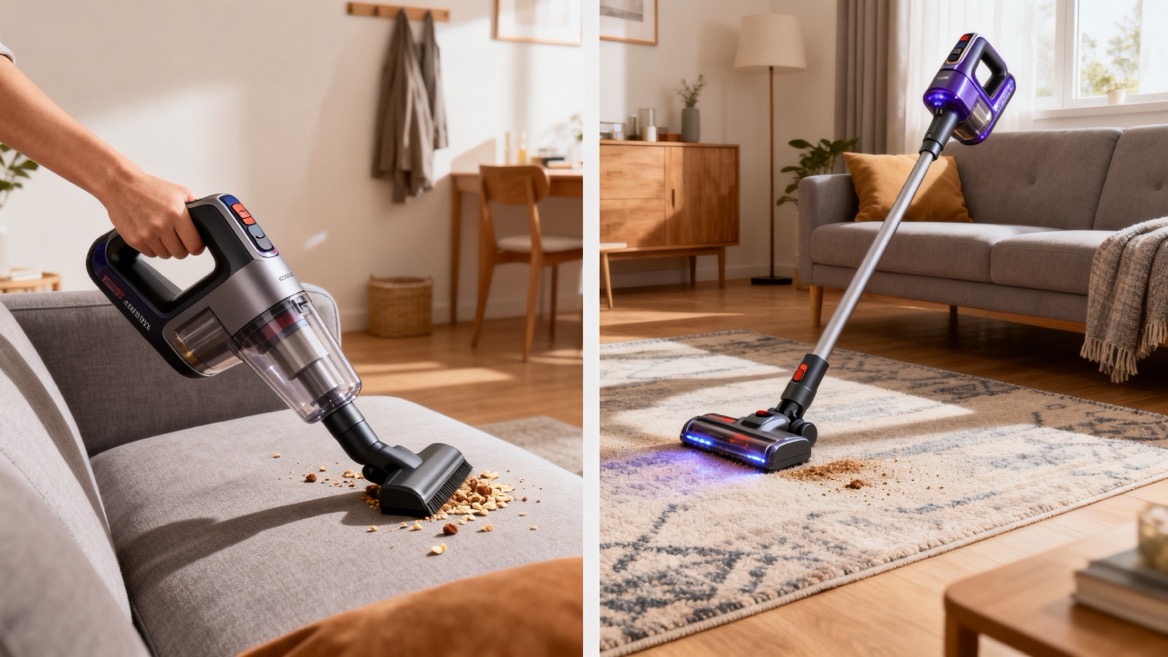
On hard floors, the difficulty is not simply generating suction. A head must also collect debris without pushing it forward or scattering it along edges. For a few crumbs beside a dining table, a portable vacuum is fast to retrieve and easy to direct.
For the entire kitchen and living area, an upright's floor head is less tiring. You can clean in continuous passes rather than working near the floor with a handheld nozzle. Check how the head behaves along skirting boards, under low furniture, and around chair legs.
If most of the home has hard flooring, convenience may determine whether cleaning happens often enough. A slim stick vacuum with a suitable floor head can be a useful middle ground. Do not assume that its small footprint alone proves effective pickup; try it on the debris and surfaces that matter to you.
Carpet presents a different challenge. Dirt can settle among the fibers, so floor-head design and agitation matter alongside airflow. A traditional upright with an appropriate brush roll is generally a stronger candidate for routine carpet cleaning than a handheld vacuum.
That does not mean every upright will suit every rug. Delicate or lightweight rugs may bunch up under a powerful head. Look for suitable brush settings or a floor head recommended for the material. For a small entry rug, a capable portable model may be enough for surface debris; for wall-to-wall carpet, it is unlikely to be a satisfying sole cleaner.
A useful buyer's question is: What percentage of the floor is carpeted? A studio with hard flooring and one small rug has different needs from an equally sized apartment with carpet in every room. Square footage alone will not settle the decision.
A portable vacuum comes into its own on sofa cushions, shelves, stairs, and narrow gaps. It is easy to pick up, carry, and put away. An upright can handle many of these jobs if it has a practical hose and attachments, but converting between floor and detail cleaning takes effort.
Pet owners should look beyond a "pet" label. Test hair pickup on the actual fabric or rug, then inspect whether hair wraps around the brush and whether the dust cup empties cleanly. A handheld tool may be excellent for a sofa yet inadequate for a carpet where hair is embedded.
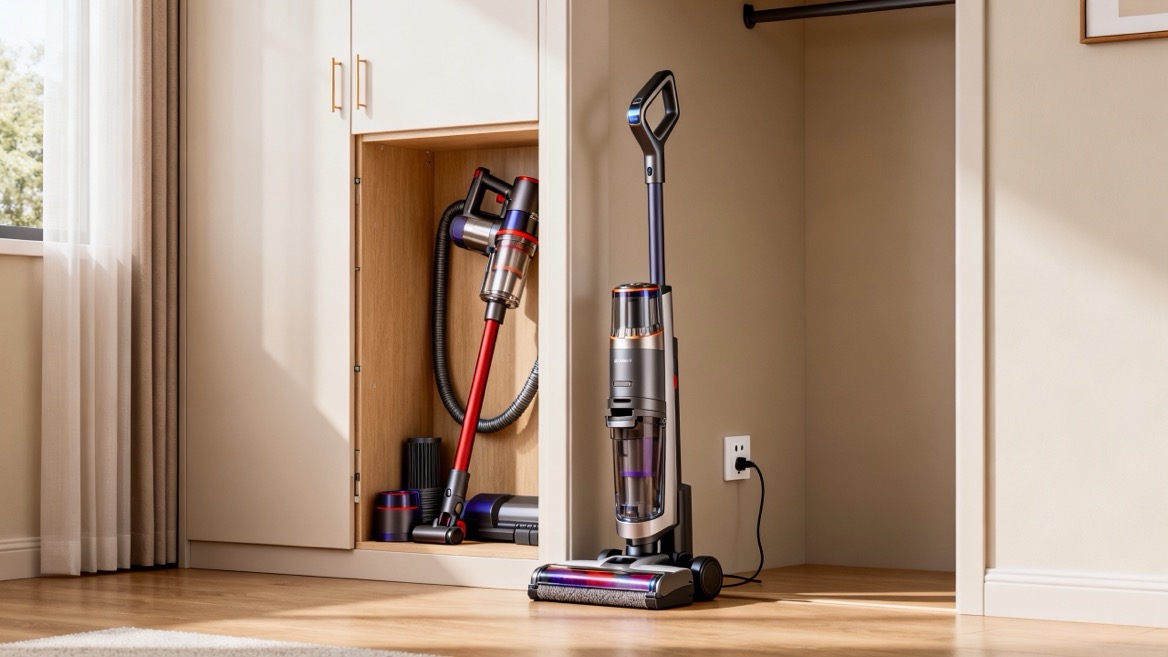
In a compact home, a vacuum must have a place to live. Measure the usable height, width, and depth of the intended cabinet or corner, including space to remove the cleaner without moving other items. Check the stored position with its attachments, not just the bare body.
A portable vacuum may fit inside a cupboard, but its charger and tools still need a home. An upright may stand on the floor, yet a wide head can block a narrow hallway. Some slim models need a wall mount or a docking base. If drilling is not allowed in a rented apartment, confirm that another stable storage arrangement is available.
Consider access as well as fit. A cleaner buried behind luggage is less convenient than one you can reach in seconds. This is why a slightly larger, easy-to-grab machine can be a better everyday choice than a tiny model stored awkwardly.
Storage is only half the spatial problem. For a corded vacuum, note outlet locations and the route around furniture. For a cordless model, check where it can charge safely without leaving a cable across a walkway.
Test whether the floor head turns around table legs and passes under the sofa. If it cannot reach beneath the main furniture, the apparent advantage of a wide cleaning path may disappear. A portable nozzle can reach some gaps easily, but cleaning the whole floor with it remains slow.
Corded power avoids battery-runtime limits, making it attractive for longer carpet-cleaning sessions. Its trade-offs are cable management, outlet changes, and finding storage for the cord. A compact home is not automatically easy to clean with one plug; furniture placement can make the cable route awkward.
Cordless power removes that obstacle and makes short cleanups appealing. Its trade-offs include charging time, battery wear, and runtime that changes with the selected mode and floor head. Published "up to" figures should not be treated as the time available for demanding carpet work.
One independent laboratory report covering more than 100 cordless vacuums found that only a handful reached manufacturers' commonly advertised claims of 60 minutes or more. Most models in that test set, excluding two outliers, ran for 35–50 minutes under the laboratory's stated approach. Those results describe the tested products, not every portable or upright vacuum. They show why buyers should ask for runtime under clearly defined, relevant conditions.
For a small studio, a shorter practical runtime might be entirely adequate. The question is whether the cleaner can finish your usual job at the setting that actually picks up your debris, with some margin left over.
Motor input describes electricity use, not the amount of dirt removed from a floor. Head geometry, brush action, airflow, seals, and the surface being cleaned all affect the result. A high wattage figure cannot substitute for a debris-pickup test.
For an apples-to-apples comparison, request results on both hard floor and carpet, with the test mode and head identified. International Standard IEC 62885-2:2026 covers methods for measuring the performance of mains-operated and cordless household dry vacuums. Handheld cleaners are largely outside its scope, so ask how a supplier tested portable units rather than assuming every reported number uses the same method.
A filter label tells only part of the story. Dust can escape through gaps or be released when a bin is emptied. If someone in the household is sensitive to dust, ask about the complete machine's dust containment, filter maintenance, and emptying process.
The Carpet and Rug Institute's vacuum evaluation considers soil removal, dust containment, and carpet appearance. These are more useful dimensions than a single suction figure. For households managing allergies or asthma, the U.S. Environmental Protection Agency advises regular cleaning, suggests considering a vacuum with a HEPA filter, and notes that sensitive people should avoid dust stirred up during vacuuming. A vacuum is a cleaning tool, not a medical treatment.
The purchase price is only the beginning. Before selecting a model, check the cost and availability of filters, batteries, brush rolls, bags if applicable, and replacement tools. A cordless unit with a replaceable battery may be easier to keep in service than one whose battery cannot be economically replaced.
Also check the chores it creates. Does the bin release dust when opened? Can you remove hair from the brush without a complicated procedure? Will the filter dry fully between uses if washing is permitted? Easy maintenance protects real-world performance because owners are more likely to keep the cleaner clear and ready.
Before shopping, use this short exercise to turn "small apartment" into a more useful specification. It works for individual buyers and for retailers deciding which product format to stock.
1. List the surfaces. Note hard floor, low-pile carpet, larger rugs, upholstery, and any delicate materials.
2. Identify the recurring mess. Is it kitchen crumbs, tracked-in grit, pet hair, or fine dust on carpet?
3. Measure the storage spot. Include the charging base, attachments, and space needed to lift the machine out.
4. Time a normal cleaning session. A whole-home clean and a daily spot clean place different demands on runtime and dust capacity.
5. Choose the primary job. If one vacuum must clean all floors, prioritize floor performance. If another machine already handles floors, prioritize quick-access detail cleaning.
For example, a hard-floor studio with a sofa and frequent crumbs may benefit most from a compact cordless cleaner—provided it has a useful floor-cleaning option. A carpeted one-bedroom apartment may be better served by an upright with suitable attachments. In either home, buying a handheld-only unit as the sole vacuum could leave a floor-cleaning gap.
This audit also helps avoid overspending on features that solve the wrong problem. A large dust cup offers little benefit if the machine cannot turn around the furniture. Conversely, excellent maneuverability will not compensate for poor pickup on the home's main floor covering.
For importers, distributors, and private-label brands, the decision extends beyond an attractive product page. A compact-living product must work in the customer's room and survive normal ownership. Build a sample evaluation around observable tasks rather than a long list of unverified claims.
- Specify the intended home: floor mix, typical debris, storage constraints, and whether this is a sole or secondary vacuum.
- Test the supplied configuration: use the production-intent battery, floor head, filters, and attachments—not a specially prepared demonstration unit.
- Record repeatable results: pickup on relevant surfaces, usable runtime by mode, charging time, handling, bin emptying, and access beneath furniture.
- Check after-sales readiness: confirm spare-part identification, replacement-filter supply, warranty procedures, and how product changes will be communicated.
- Verify claims for the destination market: request current, model-specific documents and applicable test reports; do not treat a factory's general profile as proof for every SKU.
Ningbo Eyunhome Electric Technology Co., Ltd. presents portable, handheld, corded, cordless stick, and other household vacuum categories on its company website. For a compact-living range, that breadth can support a discussion about different use cases and OEM/ODM configurations. Model-level specifications, certifications, production capacity, and service terms should still be confirmed directly before they appear in a buyer's listing or purchase agreement.
A useful range may contain two clearly differentiated products rather than one machine marketed for every task: a portable model for quick detail cleaning and a floor-focused model for routine whole-home use. The right combination depends on the target customer's surfaces, storage, and price expectations.
Choose a portable vacuum if fast spot cleaning, upholstery, stairs, and minimal storage are the priorities—and another solution can handle full-floor cleaning when needed. Choose an upright vacuum if this will be the household's main cleaner, especially where carpet covers substantial floor space.
If you need one machine for both jobs, compare a convertible stick vacuum with suitable floor and handheld attachments. Test its stored size and cleaning performance rather than assuming "two-in-one" means no compromises.
For retailers and sourcing teams planning a compact-living collection, contact Ningbo Eyunhome Electric Technology Co., Ltd. with your target floor types, preferred power format, storage dimensions, market requirements, and expected order scope. Request appropriate samples and model-specific documentation before finalizing an OEM/ODM specification.
Sometimes, but only if the portable model has an effective way to clean the entire floor and the studio's surfaces are relatively easy to maintain. A handheld-only vacuum is better treated as a secondary tool. Test how long whole-floor cleaning takes before relying on it as the sole machine.
Not necessarily. Its stored footprint matters more than its category name. Measure the chosen storage location and check whether the head and handle fit without obstructing a walkway. A manageable upright can be more useful than a tiny cleaner that makes every floor-cleaning session difficult.
An upright with an appropriate floor head is generally the stronger starting point for hair across a carpeted room. A portable vacuum is useful for furniture and localized messes. Test hair pickup and brush-roll cleaning on the surfaces you actually own; results vary by model.
Some are, but cordless describes the power source, not the cleaning result. Look for carpet-pickup evidence with the supplied floor head, then check runtime at the mode used in that test. A long runtime in a low-power setting may not answer your carpet-cleaning question.
No. The filter is only one component. The machine's sealing, exhaust path, and bin-emptying design also matter. Ask for evidence about whole-machine dust containment and follow the manufacturer's maintenance instructions. People sensitive to dust should take care around cleaning and emptying.
Request production-intent samples, model-specific specifications, relevant destination-market documentation, and a written account of replacement parts and after-sales procedures. Agree on the test conditions for pickup and runtime so that supplier claims can be checked against the intended customer's use.
1. [U.S. Environmental Protection Agency, *ENERGY STAR Market & Industry Scoping Report: Vacuum Cleaners* (November 2011)]. Defines upright and stick configurations and discusses floor heads, airflow, filtration, and the limits of motor-input figures. Its market figures are historical and are not used as current market estimates here.
2. [International Electrotechnical Commission, *IEC 62885-2:2026—Methods for Measuring the Performance of Dry Vacuum Cleaners*]. Describes the standard's scope for mains-operated and cordless household vacuums and its limited applicability to handheld cleaners.
3. [The Carpet and Rug Institute, *Seal of Approval Program*]. Explains its laboratory-based evaluation of carpet-cleaning products and equipment.
4. [The Carpet and Rug Institute, *The Importance of Vacuuming*]. Identifies soil removal, dust containment, and surface appearance as vacuum-evaluation criteria.
5. [U.S. Environmental Protection Agency, *Sources of Indoor Particulate Matter*]. Provides guidance on indoor dust, vacuuming, HEPA filters, and reducing exposure for sensitive occupants.
6. [CNET, *Exclusive Lab Testing on 100 Cordless Vacuums Shows a Surprising Link Between Battery Life and Price* (March 30, 2026)]. Reports the cited tested-product runtime findings and explains the laboratory's runtime method.
7. [Ningbo Eyunhome Electric Technology Co., Ltd., *Company Introduction*]. Source for the company identity and product categories; individual product and service claims require direct verification.


