
Views: 258 Author: Eyunhome Vacuum Publish Time: 2026-09-24 Origin: Site


Content Menu
● Quick Answer: Stick Vacuum or Handheld Vacuum?
● What Studio-Apartment Residents Actually Need
● Stick Vacuum: The Better Primary Cleaner for Most Studios
>> Why Stick Vacuums Work Well in Small Homes
>> Key Stick Vacuum Features to Prioritize
● Handheld Vacuum: The Best Tool for Immediate Small Messes
>> Where Handheld Vacuums Perform Best
● The Real Difference: Coverage Versus Convenience
>> A Practical Cleaning Scenario
● Cordless vs Corded for Studio Apartments
● Filtration, Dust Control, and User Confidence
● Expert Product-Development Insight: Design for the "30-Second Clean"
● How Buyers Can Choose the Right Vacuum
>> Choose a Stick Vacuum If You Need:
>> Choose a Handheld Vacuum If You Need:
>> Choose a 2-in-1 Stick Vacuum If You Need:
● OEM and ODM Considerations for Vacuum Brands
● FAQ
>> 1. Is a stick vacuum enough for a studio apartment?
>> 2. Can a handheld vacuum replace a stick vacuum?
>> 3. Are cordless stick vacuums powerful enough for pet hair?
>> 4. How long should a cordless vacuum run for a studio apartment?
>> 5. Is a HEPA filter necessary in a vacuum cleaner?
>> 6. Is a corded or cordless vacuum better for a small apartment?
>> 7. What is the best vacuum cleaner configuration for private-label brands?
For studio-apartment living, the choice between a stick vacuum vs handheld vacuum is not simply about size. It affects how quickly residents can clean floors, remove crumbs from furniture, reach tight gaps, manage pet hair, and store the appliance in limited space.
For most studio apartments, a cordless stick vacuum is the more complete primary cleaning solution because it covers floors efficiently while often converting into a handheld unit for furniture and detail cleaning. A dedicated handheld vacuum is usually better as a compact secondary tool for fast spot cleaning, cars, desks, sofas, and small messes.
At Ningbo Eyunhome Electric Technology Co., Ltd., we work with global buyers and product teams that need practical upright, handheld, corded, and cordless vacuum cleaner solutions. From an OEM/ODM perspective, the best product is not defined by a single specification such as motor power or advertised runtime. It is defined by how well the vacuum fits the user's actual cleaning route, storage conditions, flooring mix, and daily habits.

Choose a stick vacuum if the studio has hard floors, low-pile rugs, pet hair, or an open floor plan that requires frequent floor cleaning.
Choose a handheld vacuum if the buyer needs a lightweight device for crumbs, upholstery, shelves, keyboard areas, car interiors, or other quick cleaning tasks.
For brands developing a studio-apartment vacuum range, a 2-in-1 cordless stick vacuum with a removable handheld unit often offers the strongest value proposition. It reduces the need for customers to buy and store two separate appliances.
| Comparison factor | Stick vacuum | Handheld vacuum |
|---|---|---|
| Main purpose | Whole-floor and daily home cleaning | Fast spot cleaning and detail work |
| Best for | Floors, rugs, pet hair, under-furniture areas | Sofa gaps, desks, cars, stairs, crumbs |
| Cleaning coverage | High | Low to medium |
| Reach | Long wand improves floor reach | Excellent close-range control |
| Storage footprint | Compact, often wall-mounted | Very compact, drawer or cabinet friendly |
| Typical runtime need | 25–60 minutes depending on power mode | 10–25 minutes is often sufficient |
| Dust-bin capacity | Usually larger | Usually smaller |
| Primary studio role | Main vacuum cleaner | Supplemental cleaning tool |
| Buyer value | Convenience and broad cleaning capability | Portability and immediate access |
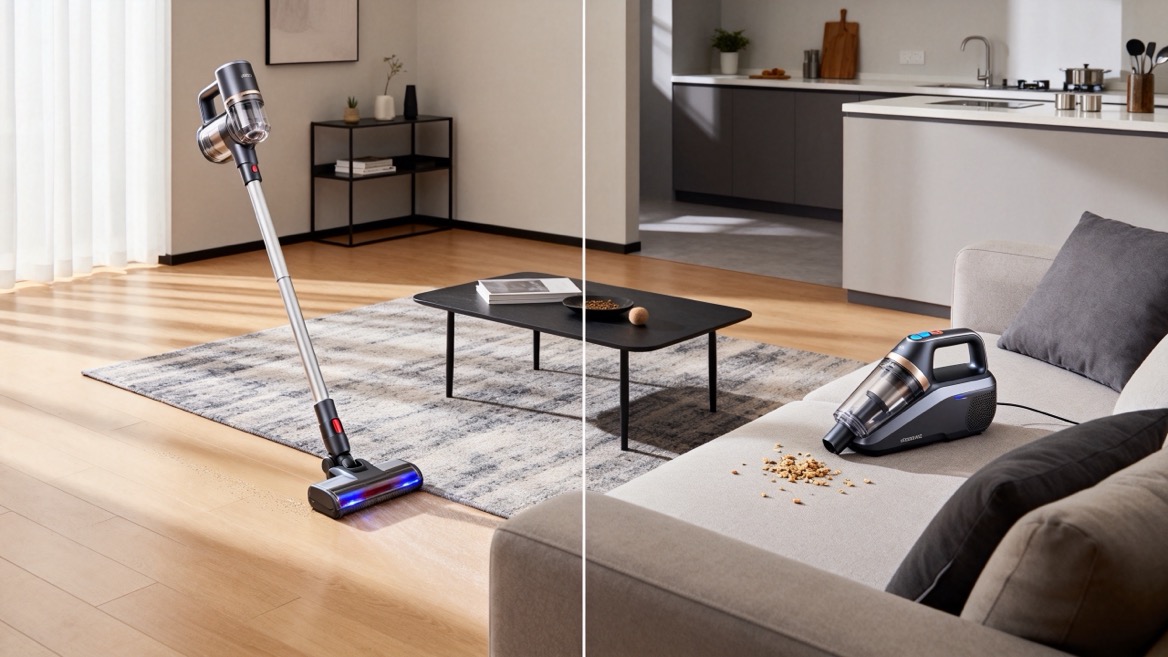
A studio apartment can look simple on a floor plan, but it creates a concentrated cleaning environment. Cooking, sleeping, working, eating, and relaxing often happen in one connected space. Dust, hair, crumbs, and fabric fibers become visible quickly, especially on hard flooring and in brightly lit interiors.
In real use, residents commonly need to clean:
- Hard floors near the bed, kitchen, entryway, and desk
- Small rugs that trap hair, dust, and food debris
- Sofa cushions and upholstery where crumbs accumulate
- Narrow gaps behind a bed, beside a refrigerator, and under furniture
- High-touch work areas such as keyboards, shelves, drawers, and chairs
- Entry zones where outdoor dust and small particles enter the home
This is why the stick vacuum vs handheld vacuum decision should begin with cleaning behavior rather than marketing labels.
A customer who cooks daily and has a rug may need a motorized floor head and a longer runtime. A customer living in a minimalist furnished studio with mostly hard flooring may prioritize a lightweight stick vacuum that can be removed from a wall dock in seconds. Someone who only wants to clean crumbs after meals may be satisfied with a compact handheld vacuum.
A stick vacuum is designed to make regular floor cleaning faster and less physically demanding. Its long tube and floor head allow users to clean while standing upright, which is especially useful in a studio where the main floor area may need attention every few days.
A modern cordless stick vacuum can usually handle several cleaning tasks in one session:
- Hard-floor pickup for dust, hair, crumbs, and dry debris
- Rug cleaning with a motorized brush roll
- Edge cleaning around baseboards and furniture legs
- Under-furniture cleaning with a low-profile floor head
- Above-floor cleaning when used with a crevice or brush tool
- Quick maintenance cleaning before visitors arrive or after cooking
The greatest advantage is continuity. Instead of bending down repeatedly with a handheld vacuum, users can move through the whole studio with a predictable cleaning route: entryway, kitchenette, main floor, rug, bed area, then furniture.
For studio residents, this matters more than maximum cleaning power on paper. A vacuum stored visibly on a charging dock and ready to use is more likely to be used regularly.
For an OEM or private-label stick vacuum designed for apartments, the following features usually create meaningful user value:
| Feature | Why it matters in a studio apartment |
|---|---|
| Cordless operation | Makes fast cleaning easier without finding power outlets |
| Lightweight body | Reduces fatigue during frequent short cleaning sessions |
| Motorized floor brush | Improves pickup from rugs and helps collect hair |
| LED floor-head lights | Makes dust visible under beds, sofas, and cabinets |
| Removable battery | Supports longer cleaning cycles and easier servicing |
| Wall-mount charging | Saves floor space and keeps the vacuum accessible |
| Multi-stage filtration | Helps contain collected dust before air exits the machine |
| Easy-empty dust cup | Reduces contact with debris and improves daily usability |
| Anti-tangle brush roll | Helpful for long hair and pet hair management |
| Convertible handheld mode | Adds upholstery and crevice-cleaning capability |
Battery claims should be explained carefully. Independent testing and buying guidance consistently show that cordless runtime changes substantially with the power setting, floor type, brush-roll use, and debris load. A vacuum promoted for 40 to 60 minutes of low-power runtime may provide materially less time when the user selects high-power cleaning or operates a motorized brush.
For this reason, product teams should communicate both maximum runtime and practical cleaning runtime. Clear specifications improve buyer trust and reduce avoidable product returns.
A handheld vacuum is small, direct, and convenient. It is usually the fastest option when the cleaning task is limited to a particular spot rather than the entire floor.
Examples include spilled cereal near a desk, dust on a windowsill, hair on a sofa, crumbs between car seats, or dry debris inside drawers. In these situations, pulling out a full-size cleaner can feel unnecessary. A compact handheld vacuum encourages immediate action.
A handheld vacuum is especially useful for:
- Sofa seams and cushions
- Mattress surfaces
- Dining chairs
- Desk drawers and workstations
- Kitchen counters
- Window tracks
- Car interiors
- Pet beds
- Small dry spills
- Tight crevices around furniture
The ergonomic advantage is important. A handheld design gives the user close control over the nozzle. This makes it easier to target a narrow area without moving a large floor head or extension tube.
However, a handheld vacuum becomes less efficient when used for an entire studio floor. The user must bend more often, work in shorter passes, and empty the dust container more frequently. A small bin is practical for crumbs but can become inconvenient when dealing with a week's worth of dust and hair.
The most useful way to compare a stick vacuum and a handheld vacuum is to separate coverage from convenience.
A stick vacuum delivers broader coverage. It is built to clean a room, a floor, or an apartment. A handheld vacuum delivers immediate convenience. It is built to clean a small problem before it becomes a larger one.
Imagine a 35-square-meter studio apartment with laminate flooring, one low-pile rug, a two-seat sofa, a bed, and a compact kitchenette.
A stick vacuum can complete the core cleaning sequence:
1. Clean dust near the entryway
2. Vacuum the open floor area
3. Pass over the rug
4. Reach beneath the bed
5. Remove hair around the sofa
6. Use a crevice tool around the kitchenette
A handheld vacuum can efficiently handle only selected tasks:
1. Collect crumbs from the sofa
2. Clean a desktop or keyboard area
3. Vacuum the car after a weekend trip
4. Remove dry debris from drawers
5. Clean tight gaps near the bed frame
The stick vacuum is the better single purchase. The handheld vacuum is the better instant-access companion.
The stick vacuum vs handheld vacuum comparison often overlaps with another buying decision: cordless vs corded vacuum cleaner.
Cordless models are particularly attractive for small living spaces because they remove setup friction. Residents can start cleaning immediately without unplugging, rerouting a cable, or finding another outlet.
Their strongest benefits include:
- Fast daily cleaning
- Simple storage on a charging dock
- No cable management in tight rooms
- Easy cleaning around furniture
- More convenient conversion to handheld mode
The trade-off is battery management. Runtime varies significantly by cleaning mode. Third-party testing commonly finds that high-power or maximum modes reduce operating time sharply compared with low-power modes. A realistic product design should balance motor performance, airflow, battery capacity, brush design, and charging convenience rather than relying on a single headline runtime figure.
A corded stick vacuum may be a strong option for value-oriented buyers, rental-property programs, or markets where users prefer continuous power. It eliminates charging downtime and can support consistent cleaning performance during longer sessions.
However, the cord can reduce convenience in compact rooms. In a studio, cables may catch on chairs, bed frames, table legs, and kitchen equipment. For many urban consumers, cordless usability outweighs the benefit of unlimited operating time.
Filtration is often underexplained in vacuum marketing. It should be treated as part of the total airflow system, not merely as a label on the box.
A high-efficiency particulate air, or HEPA, filter is generally defined as capturing at least 99.97% of particles measuring 0.3 microns when used as the final filtration stage in a properly designed system. The system also needs to limit air leakage around the filter; simply including a filter does not guarantee that all exhaust air receives the same level of filtration.
For apartment vacuum development, this creates several important product considerations:
- Filter fit and sealing quality matter as much as filter media
- Cyclonic separation can reduce loading on the final filter
- Washable filters can lower ongoing ownership costs when properly maintained
- Clear maintenance instructions help users preserve pickup performance
- Transparent dust bins make emptying behavior more intuitive
For people sensitive to dust or allergens, vacuum cleaning is only part of a broader indoor-air approach. Public-health guidance identifies high-efficiency filtration as useful for air cleaning, while emphasizing that devices and filters must be selected and maintained correctly.
In product planning, it is easy to focus on laboratory numbers: wattage, kilopascals, airflow, battery capacity, and dust-bin volume. These values matter, but studio-apartment customers often make their purchase decision based on a simpler question:
Can I clean this mess in 30 seconds without turning cleaning into a project?
That question should influence product design.
A successful studio-focused cordless stick vacuum should make it easy to:
- Remove the vacuum from its dock with one hand
- Start the machine quickly
- Reach the kitchen floor without moving furniture
- Switch to a crevice tool without searching for accessories
- Empty the bin without touching debris
- Return the product to a compact charging position
For handheld vacuums, the priority is even more immediate. The appliance should be light, comfortable, easy to charge, and powerful enough for ordinary crumbs, hair, and dry debris. If it is buried in a cabinet or difficult to empty, it will not become part of the customer's routine.
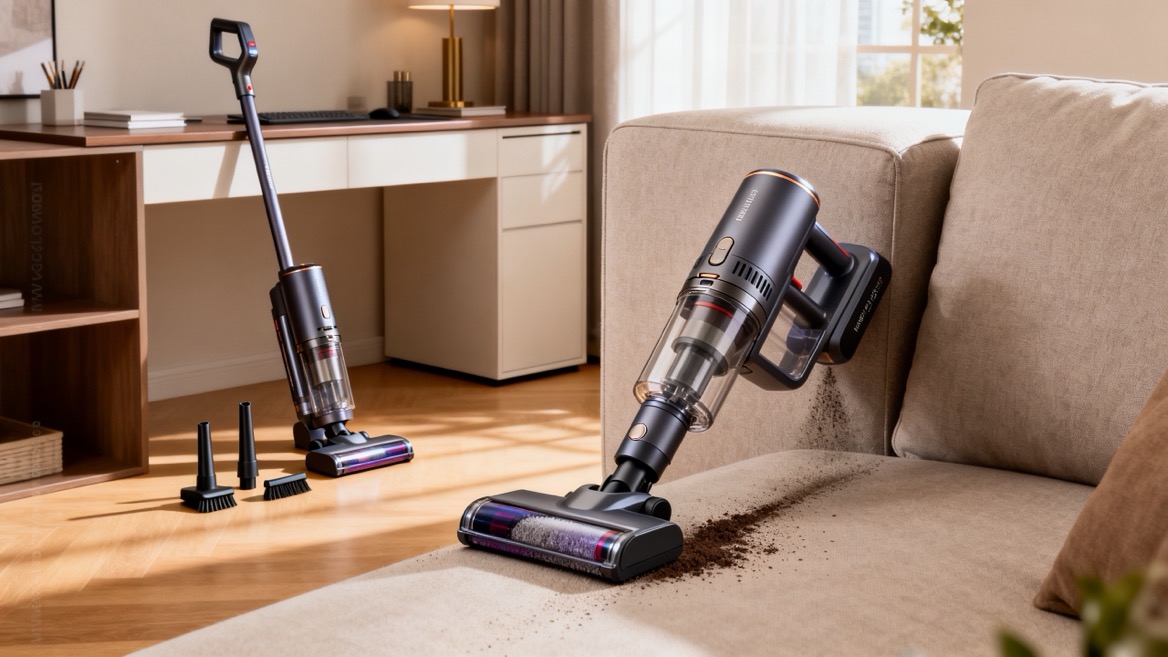
Before selecting a stick vacuum or handheld vacuum, buyers should evaluate the product against the real environment.
- A primary vacuum for a studio apartment
- Regular cleaning of hard floors and rugs
- Better reach under beds and sofas
- A larger dust capacity
- A motorized brush for hair pickup
- A device that can replace a traditional upright vacuum
- Convertible handheld functionality for furniture and crevices
- Fast cleanup after meals
- A compact appliance for cars and furniture
- A lightweight tool for occasional dry debris
- A small storage footprint
- Detail cleaning in narrow areas
- A secondary vacuum to complement a larger floor cleaner
- One appliance for floors and furniture
- A cleaner product lineup with fewer separate SKUs
- Flexible merchandising for apartment, dormitory, and small-home users
- Strong perceived value for e-commerce and retail buyers
- A practical combination of long reach and handheld control
For importers, retailers, distributors, and emerging appliance brands, the best model depends on more than consumer features. It also depends on target price, compliance requirements, packaging expectations, spare-part availability, and after-sales strategy.
At Ningbo Eyunhome Electric Technology Co., Ltd., an OEM/ODM vacuum cleaner project can be developed around market-specific needs, including:
- Cordless stick vacuum platforms for apartment and urban-home use
- Handheld vacuum cleaners for compact cleaning and automotive applications
- Corded vacuum solutions for continuous operation and value-oriented segments
- Upright vacuum designs for broader floor-cleaning coverage
- Customized colors, branding, packaging, manuals, and accessories
- Battery, filtration, brush-roll, and dust-bin configurations aligned with buyer requirements
- Stable production planning and dependable after-sales support for global market programs
A well-positioned product should never overpromise. It should state its intended cleaning use clearly. For example, a lightweight handheld vacuum can be marketed as a daily spot-cleaning tool, while a 2-in-1 stick vacuum can be positioned as a compact floor-care system for modern apartments.
That level of clarity helps brands match the right vacuum to the right customer and build longer-term trust.
For the majority of studio apartments, a cordless stick vacuum is the better overall choice. It offers faster floor coverage, better reach, improved comfort for regular cleaning, and more versatility when paired with practical attachments.
A handheld vacuum remains highly valuable for quick cleanup, upholstery, tight spaces, and car interiors. But it is best viewed as a supporting tool rather than a full replacement for floor cleaning.
The strongest all-around option is often a 2-in-1 stick vacuum with detachable handheld functionality. It gives studio residents the convenience of a handheld vacuum and the coverage of a stick vacuum without demanding extra storage space.
If your brand, retail program, or sourcing business is looking for reliable vacuum cleaner solutions, Ningbo Eyunhome Electric Technology Co., Ltd. can support customized upright, stick, handheld, corded, and cordless vacuum programs with professional OEM/ODM capabilities, stable production, and responsive after-sales support. Contact our team to discuss your target market, product requirements, and custom vacuum cleaner project.
Yes. A stick vacuum is usually enough for a studio apartment, especially when it has a motorized floor head, a crevice tool, and sufficient battery capacity. It can clean hard floors, rugs, corners, and furniture areas in one routine.
Usually, no. A handheld vacuum can manage small messes and detailed cleaning, but it is less efficient for cleaning an entire floor. It may require more bending, more frequent emptying, and longer cleaning time.
Many cordless stick vacuums can manage pet hair effectively when they include a motorized brush roll, adequate airflow, and an anti-tangle design. Performance also depends on the floor surface, hair length, cleaning mode, and regular brush maintenance.
For a typical studio, practical cleaning time of around 20 to 40 minutes can be sufficient for routine cleaning. Buyers should check runtime at different power modes because maximum runtime is often measured under lower-power operating conditions.
A HEPA filtration system can be beneficial for users who prioritize fine-particle capture, but performance depends on the full sealed airflow path and proper maintenance. A genuine HEPA filter is generally defined by 99.97% particle capture at 0.3 microns under the stated test conditions.
Cordless models are generally more convenient for quick, frequent cleaning in a small apartment. Corded models provide continuous operation and can suit buyers who prioritize longer sessions, consistent power availability, or lower product cost.
A 2-in-1 cordless stick vacuum is often a strong private-label configuration because it addresses floor cleaning, upholstery, crevices, and small-space storage in one product. The final specification should be matched to the target market, price segment, compliance needs, and buyer expectations.
1. [U.S. Environmental Protection Agency — Residential Air Cleaners: HEPA Filter Definition] [19january2017snapshot.epa]
2. [U.S. Environmental Protection Agency — HEPA Vacuum Requirements and Filtration Guidance] [19january2021snapshot.epa]
3. [CDC/NIOSH — Improving Air Cleanliness and HEPA Filtration] [cdc]
4. [American Lung Association — Vacuum Cleaners and Indoor Air Quality] [lung]
5. [RTINGS — Cordless Vacuum Runtime Guidance] [rtings]
6. [TechGearLab — Cordless Stick Vacuum Testing and Runtime Comparisons] [techgearlab]
7. [Vacuum Wars — Cordless Vacuum Buyer's Guide] [vacuumwars]


