
Views: 263 Author: Eyunhome Vacuum Publish Time: 2026-09-20 Origin: Site


Content Menu
● Tesla's Robotaxi Vacuum Robot at a Glance
● Why Autonomous Vehicle Cleaning Matters
>> Cleaning directly affects fleet utilization
>> Cabin debris is more complex than floor dust
>> The cleaning robot demonstrates modularity
● What the Demonstration Does Well—and What It Still Leaves Unanswered
● Core Vacuum Requirements for Vehicle and Fleet Cleaning
>> Suction performance and airflow balance
>> Filtration and maintenance design
>> Corded versus cordless for fleet work
● Practical Product Development Lessons for OEM/ODM Buyers
>> Start with the cleaning scenario
>> Design attachments as part of the product
>> Build for durability and serviceability
● How to Select a Vacuum Manufacturer for Fleet-Cleaning Projects
>> 1. Define the product brief
>> 2. Compare product platforms, not only catalogs
>> 3. Request samples and test realistically
>> 4. Confirm quality and compliance planning
>> 5. Plan after-sales support before launch
● The Future of Commercial Vacuum Solutions
● Partner With Ningbo Eyunhome for Vacuum Development
>> What is Tesla's robotaxi vacuum robot?
>> Why would a robotaxi fleet need automated vacuum cleaning?
>> Can a handheld vacuum clean a vehicle interior effectively?
>> Which is better for car cleaning: corded or cordless vacuum cleaners?
>> What should buyers look for in an OEM/ODM vacuum manufacturer?
>> Can vacuum cleaners be customized for fleet or automotive use?
>> Is Tesla's cleaning robot already a fully proven commercial product?
Tesla's robotaxi vacuum robot has turned a familiar cleaning task into a powerful demonstration of automated fleet readiness. The concept shows how vacuum systems, specialized attachments, and intelligent cleaning workflows could help autonomous vehicles return to service faster between rides.
For commercial vacuum brands, fleet operators, and product-development teams, the significance is broader than one high-profile demonstration. It points to a growing opportunity for vehicle interior cleaning solutions that are compact, durable, adaptable, and designed for repeatable operation. Ningbo Eyunhome Electric Technology Co., Ltd. supports this evolving market with OEM/ODM upright, handheld, corded, and cordless vacuum cleaner solutions built around global B2B requirements.
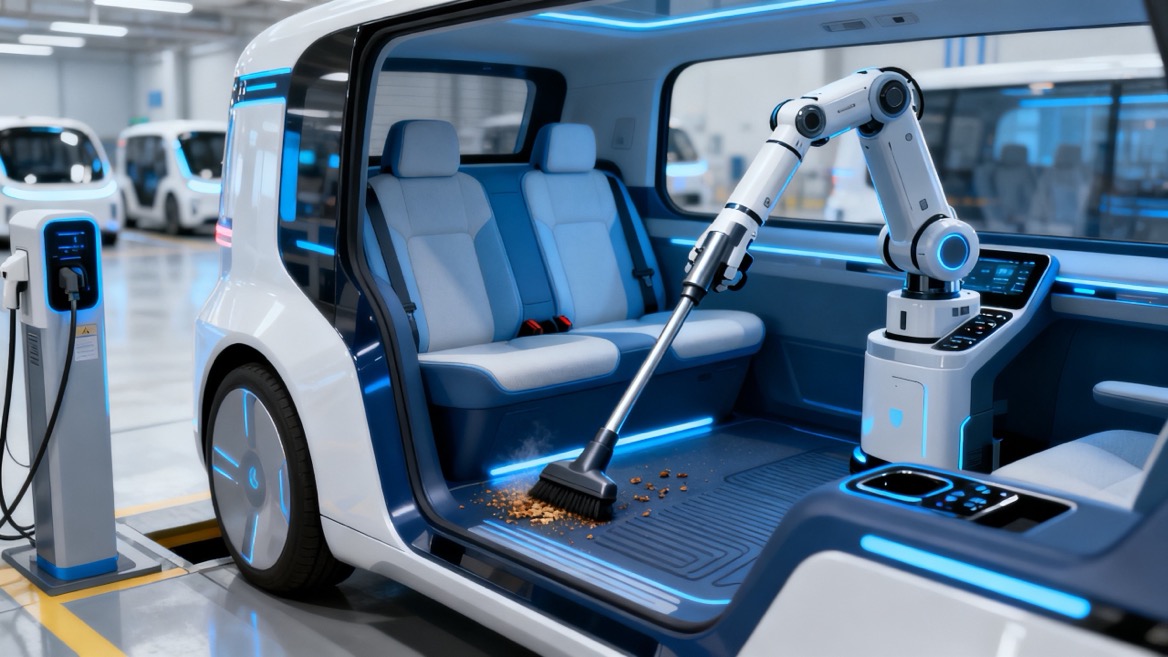
Tesla attracted attention after showing an automated cleaning device working inside a vehicle cabin. The system demonstrated several practical tasks: vacuuming crumbs and loose debris, handling larger items left in the vehicle, and changing tools to clean surfaces such as the central display.
The original demonstration was compelling because it addressed a problem that every shared-mobility operator understands: a vehicle cannot earn revenue while it is waiting for manual cleaning.
A robotaxi fleet depends on more than autonomous driving. It also requires dependable systems for:
- Vehicle charging
- Condition checks
- Cabin cleaning
- Waste removal
- Lost-property handling
- Surface wiping
- Maintenance scheduling
- Fast redeployment
Tesla's video showed a cleaning concept that could use a robotic arm and multiple end-effectors to perform interior maintenance tasks with limited human involvement. The system appeared capable of vacuuming seats and footwells, removing visible rubbish, and switching to a softer attachment for display cleaning.
This matters because passenger expectations do not disappear when a driver disappears. In fact, cleanliness may become even more important in an autonomous ride-hailing environment. Riders may judge a driverless service by the condition of the cabin, the freshness of the interior, and whether the vehicle feels ready for immediate use.
Tesla's cleaning robot was initially demonstrated in connection with its broader robotaxi ambitions. The company has since described robotaxi activity involving Model Y vehicles in several U.S. markets, while positioning Cybercab as a future addition to its fleet.
A vacuum cleaner is often treated as a simple appliance. In a commercial fleet, however, it becomes part of an operational system.
The goal is not only to remove dust. The goal is to maintain vehicle availability while creating a consistently acceptable passenger experience.
Every minute a ride-hailing vehicle spends parked for cleaning may reduce its ability to complete trips. For a conventional taxi or car-sharing operator, staff may inspect and clean a vehicle manually between shifts or after customer complaints. A large autonomous fleet needs a more standardized approach.
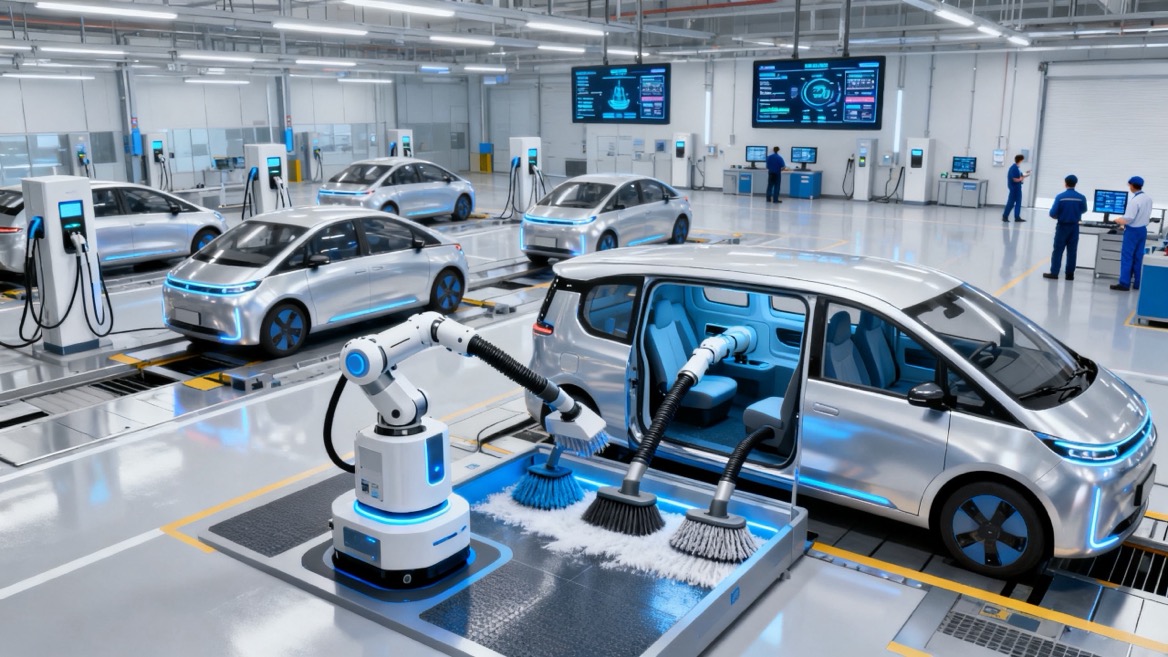
An automated interior-cleaning station could potentially support a repeatable process:
1. A vehicle arrives at a service hub.
2. A system checks whether cleaning is required.
3. The cabin is scanned for waste or forgotten belongings.
4. A vacuum tool removes dust, crumbs, hair, and loose debris.
5. A separate tool wipes touchpoints or displays.
6. The vehicle is cleared for charging, inspection, or redeployment.
This workflow is especially relevant for fleets operating for long hours with frequent passenger turnover. The value is not simply in high suction. It is in achieving consistent cleaning results with predictable cycle times.
Vehicle interiors present a different cleaning challenge from a typical home. Dirt is often concentrated in narrow spaces, fabric seams, seat gaps, floor mats, door pockets, and under-seat areas.
Common contaminants may include:
- Food crumbs and snack packaging
- Hair and pet fur
- Sand, fine dust, and soil
- Paper receipts and tissues
- Leaves and outdoor debris
- Drink spills and dried residue
- Small personal items
- Dust on screens and control surfaces
A vacuum solution for these applications should therefore be designed around more than raw motor power. It needs usable airflow, targeted attachments, maneuverability, filtration, and ergonomic handling.
One of the most interesting features of Tesla's concept is the apparent use of multiple tools. A vacuum head alone cannot complete every cabin-care task. A commercial cleaning workflow may require a suction nozzle, crevice tool, soft brush, microfiber wiping attachment, pickup gripper, or surface-treatment system.
This modular approach offers an important product lesson for vacuum manufacturers and OEM buyers: the most valuable cleaning platform is often not a single all-purpose machine. It is a system that can be configured for a specific operating environment.
Tesla's concept reportedly includes vacuuming, waste removal, and a soft cleaning tool for sensitive interior surfaces. Reports on a cleaning robot installation at an Austin robotaxi hub have described a robotic arm with interchangeable attachments, including a microfiber tool intended for display and interior-surface care.
Tesla's robotaxi cleaning concept is visually persuasive. It makes autonomous maintenance feel tangible. However, a short demonstration does not provide all the information commercial buyers need before assessing the technology.
For fleet operators and vacuum-product developers, the real questions are operational.
| Evaluation Area | What the Demonstration Suggests | What Buyers Still Need to Know |
|---|---|---|
| Debris pickup | The system can collect crumbs and larger visible objects | Performance with hair, sand, embedded dirt, and wet debris |
| Tool changing | Different attachments can perform different tasks | Tool-change reliability over thousands of cycles |
| Cabin access | A robotic arm can reach seats and visible surfaces | Coverage in tight footwells, under seats, and door compartments |
| Surface care | Soft attachments may clean displays and touchpoints | Material compatibility, scratch prevention, and cleaning-agent control |
| Lost property | Larger objects can be detected or moved | Identification, sorting, storage, privacy, and handover procedures |
| Fleet efficiency | Automation could shorten cleaning turnaround | Actual cleaning time, uptime, labor savings, and total ownership cost |
| Hygiene | Frequent cleaning may improve cabin presentation | Validation of disinfection performance and odor control |
The biggest information gap is repeatability at scale. A concept may work well in a controlled video, but a fleet solution must operate safely and consistently through thousands of real-world cleaning cycles.
For example, a robot may encounter a drink cup under a seat, sticky food residue on upholstery, pet hair woven into fabric, a child's toy in a seat gap, or a wet floor mat after rain. Each condition requires different sensing, cleaning tools, and escalation rules.
This is why manufacturers should avoid presenting automated cleaning as a simple replacement for every human task. Instead, it should be positioned as a scalable solution for routine, high-frequency cabin maintenance, supported by manual intervention for exceptions.
For product teams developing an automotive, car-care, robotaxi, or commercial portable vacuum, the right specification depends on the cleaning environment. A lightweight handheld unit may be ideal for spot cleaning, while a corded machine may suit fixed cleaning stations where uninterrupted power matters most.
A strong vacuum motor is important, but it is not the only performance measure. Effective pickup depends on the relationship between suction, airflow, nozzle design, brush action, and sealing against the surface.
For vehicle cleaning, a well-designed nozzle can make a major difference. A narrow crevice tool can access gaps around seats. A motorized mini brush can help lift hair from fabric. A flexible hose can improve reach without requiring the operator—or robotic arm—to reposition the full machine repeatedly.
When evaluating an OEM/ODM vacuum platform, ask suppliers to clarify:
- Rated input power and motor type
- Airflow and vacuum-pressure test methods
- Dust pickup performance on hard surfaces and fabric
- Runtime under different power modes for cordless models
- Noise level under real working conditions
- Filter type and maintenance requirements
- Attachment compatibility
- Hose length, flexibility, and durability
- Dustbin capacity and emptying method
Fleet-cleaning applications may involve frequent cycles. That makes maintenance convenience essential.
A vacuum with poor dust separation or a quickly clogged filter can lose performance over time. A dustbin that is difficult to empty can slow the cleaning process and make the system less hygienic. For high-use commercial settings, easy-access filters, washable components where appropriate, and straightforward bin removal can improve day-to-day usability.
Depending on the target market and application, buyers may consider designs that support:
- Multi-stage filtration
- Washable or replaceable filters
- Cyclonic dust separation
- Sealed dust paths
- Clear bin visibility
- Quick-release dust containers
- Filter-status reminders
- Reduced-contact emptying options
The correct solution should match the operating environment. A compact car-detailing vacuum may prioritize portability, while a centralized robotaxi station may prioritize continuous-duty capability and easy integration with external dust collection.
There is no single best power format. The choice should follow the workflow.
| Vacuum Type | Best-Fit Use Case | Key Advantages | Main Considerations |
|---|---|---|---|
| Corded handheld vacuum | Fixed cleaning bays and detailing stations | Continuous power and consistent performance | Cable management and access to outlets |
| Cordless handheld vacuum | Mobile spot cleaning and quick vehicle turnaround | Portable, flexible, convenient | Runtime, charging time, battery replacement planning |
| Corded upright vacuum | Larger commercial interiors and facility areas | Extended cleaning sessions and larger capacity | Usually less suitable for tight vehicle cabins |
| Cordless stick vacuum | Mixed-use fleet facilities and flexible teams | Easy movement and rapid deployment | Must balance weight, runtime, and bin capacity |
| Dedicated vehicle vacuum system | Car washes, garages, and fleet hubs | Can be customized for hoses and high-frequency use | Requires application-specific engineering |
For robot-assisted cleaning, vacuum architecture becomes even more important. The system may need a remote-mounted power unit, flexible suction hose, lightweight end effector, automatic tool docking, and a dust-management process that minimizes interruptions.
Tesla's robotaxi vacuum robot is a useful reminder that product development should start with the job to be done, not only with the product category.
A buyer may initially request a "high-power handheld vacuum." But the deeper requirement may be: "We need a cleaning solution that helps a car-rental or fleet operator reset vehicle interiors quickly, safely, and consistently."
That distinction changes the development brief.
Before selecting a motor, battery, or housing design, define the intended use:
- Is the product for personal car owners, detailing shops, rental fleets, or autonomous vehicle hubs?
- Will it be used several times a week or hundreds of times a day?
- Is the main debris fine dust, pet hair, sand, food crumbs, or larger rubbish?
- Does the user need cordless mobility or continuous corded operation?
- Are narrow seat gaps and footwells the primary cleaning zones?
- Will the vacuum be operated by people, integrated into a workstation, or adapted for robotic handling?
A clear use case helps determine the appropriate product architecture.
In vehicle cleaning, accessories are not secondary items. They often determine whether the vacuum is genuinely useful.
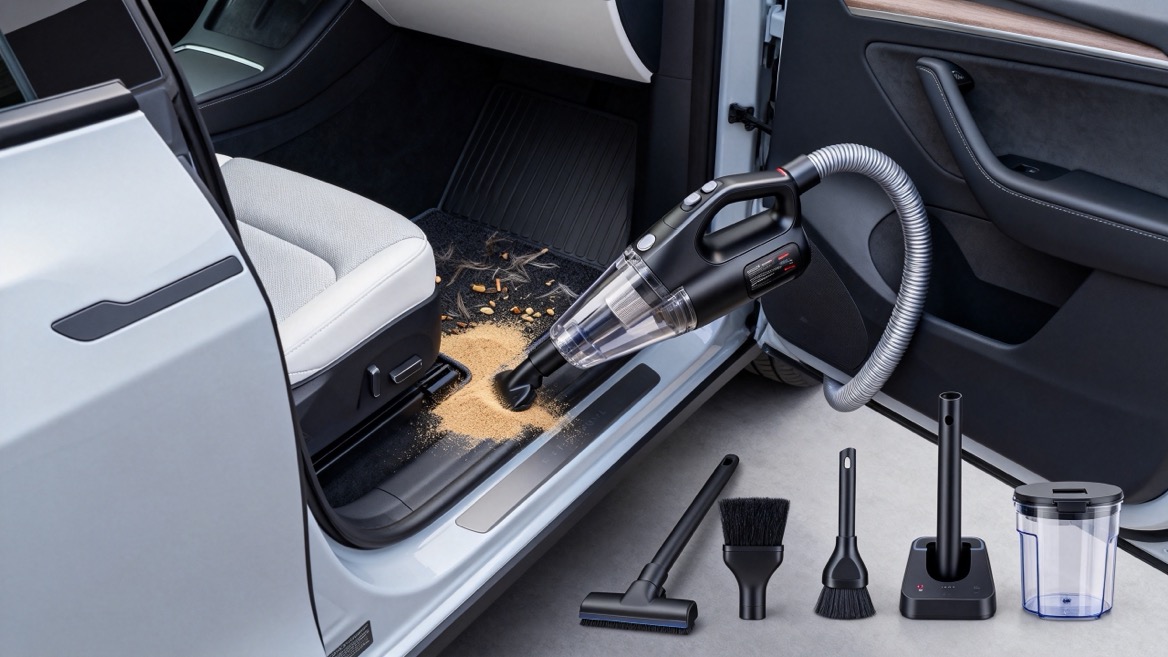
A practical vehicle-cleaning kit may include:
- A crevice nozzle for seat gaps and tight edges
- A soft dusting brush for vents and delicate trim
- A flexible hose for improved reach
- A mini motorized brush for upholstery and hair
- A wide nozzle for floor mats and larger surfaces
- A storage base or wall-mount system
- A charging dock for cordless models
For commercial brands, custom-colored accessories, branded storage solutions, retail packaging, and market-specific plug configurations can also strengthen product differentiation.
Frequent-use equipment must withstand repeated handling, dustbin emptying, filter cleaning, charging, and accessory changes.
A reliable OEM/ODM program should consider:
- Housing strength and impact resistance
- Battery-cycle performance for cordless products
- Switch durability
- Connector wear resistance
- Filter availability and replacement planning
- Spare-parts support
- Packaging protection for international shipping
- Quality-control procedures before shipment
Ningbo Eyunhome Electric Technology Co., Ltd. is listed as a manufacturer based in Zhejiang, China, on HKTDC Sourcing. For global B2B buyers, manufacturer verification is only the starting point; the more important next step is to confirm product specifications, compliance needs, sample quality, lead times, testing standards, and after-sales arrangements for the intended market.
Choosing an OEM/ODM vacuum supplier is a strategic decision. A low unit price may appear attractive, but the real cost includes product reliability, claims handling, replacement parts, delivery consistency, and the supplier's ability to adapt the product as market requirements change.
Use this five-step selection process.
Prepare a written brief that covers intended users, cleaning environment, target retail price, preferred product type, annual volume forecast, power requirements, accessories, packaging, and compliance expectations.
The clearer the brief, the faster a manufacturer can recommend a suitable platform or development path.
Ask whether the supplier already has a proven base model that can be adapted. This may reduce development time and risk compared with creating a fully new product.
Evaluate the platform's:
- Motor and battery configuration
- Dustbin and filter design
- Available attachments
- Tooling options
- Color and logo customization
- Packaging flexibility
- Certification readiness
- Quality history
A sample should be tested in the conditions where the product will actually be used. For vehicle applications, test it on crumbs, sand, hair, carpeted mats, fabric seats, plastic trim, and narrow gaps.
Do not judge performance only by a short no-load demonstration.
Discuss target-market requirements early. Requirements vary by destination and product configuration, particularly for electrical safety, batteries, labeling, documentation, and restricted substances.
Also clarify inspection procedures, acceptable quality limits, pre-shipment testing, and defect-resolution processes.
A vacuum brand's reputation is built after the sale. Ask about replacement filters, battery availability, accessory supply, spare parts, troubleshooting support, warranty coordination, and recurring order capability.
A dependable manufacturer should support the complete commercial lifecycle, not only the first shipment.
Tesla's robotaxi vacuum robot is not simply a futuristic novelty. It illustrates how cleaning equipment can become part of a larger automated service ecosystem.
In the coming years, commercial vacuum products may increasingly be designed for:
- Shared-mobility fleets
- Autonomous vehicle depots
- Car-rental operations
- Smart parking and charging hubs
- Robotic cleaning stations
- Airport and rail transport fleets
- Hospitality shuttle services
- Delivery-vehicle maintenance centers
The opportunity is especially strong for manufacturers that can combine established vacuum-engineering knowledge with adaptable OEM/ODM development. The winning products will not necessarily be the largest or most powerful. They will be the products that solve a clearly defined maintenance problem with dependable performance and straightforward service.
For fleet managers, the priority is uptime. For consumers, it is convenience. For brand owners, it is differentiation. For manufacturers, the opportunity lies in translating these needs into durable, market-ready vacuum solutions.
If your business is developing a commercial vehicle-cleaning product, a handheld car vacuum, a cordless stick vacuum, a corded cleaning solution, or a customized fleet-maintenance platform, Ningbo Eyunhome Electric Technology Co., Ltd. can support your sourcing and product-development goals.
Our OEM/ODM services are built for businesses that need more than a standard product. We help customers explore suitable vacuum categories, configurations, accessories, branding options, packaging solutions, and production plans for international markets.
A successful vacuum program starts with a practical conversation about your target user, sales channel, product positioning, and performance requirements. Contact our team to discuss your next upright, handheld, corded, or cordless vacuum cleaner project and request a tailored OEM/ODM proposal.
Tesla's robotaxi vacuum robot is an automated cabin-cleaning concept designed to help maintain the interiors of robotaxi vehicles. Demonstrations have shown a robotic system vacuuming debris, handling larger objects, and using separate attachments for interior surface cleaning.
Robotaxi vehicles may serve many passengers each day. Automated cleaning can help reduce downtime between rides, improve cabin consistency, and support fleet readiness without relying exclusively on manual cleaning teams.
Yes. A well-designed handheld vacuum can be highly effective for vehicle interiors when paired with suitable accessories, especially a crevice tool, flexible hose, and upholstery brush. Performance depends on airflow, suction, nozzle design, filtration, and how easily the tool reaches confined areas.
Cordless models are usually best for mobility and quick spot cleaning. Corded models are often better for fixed detailing bays or high-frequency cleaning because they can provide continuous power without battery charging interruptions. The best choice depends on the workflow.
Buyers should assess product quality, engineering capability, available platforms, customization options, sample performance, production capacity, quality control, compliance support, packaging capability, delivery reliability, spare-parts availability, and after-sales responsiveness.
Yes. OEM/ODM vacuum projects can be customized through motor configuration, battery capacity, cord length, accessories, hose design, colors, logos, packaging, storage systems, and application-specific features. The final configuration should be based on the actual cleaning scenario.
Public demonstrations and reporting show that Tesla has explored and installed cleaning-robot infrastructure connected to robotaxi operations. However, detailed public information on full-scale performance, cleaning-cycle duration, maintenance needs, reliability, and commercial deployment metrics remains limited.
1. [Vacuum Wars: "Check Out Tesla's Vacuum Robot for its Robotaxi Fleet"]
2. [Tesla Support: Cybercab Frequently Asked Questions]
3. [Interesting Engineering: Tesla wants to build self-cleaning robots for its Cybercab]
4. [Not a Tesla App: Tesla Robotaxi Hubs Start Installing Car Cleaning Robots]
5. [HKTDC Sourcing: Ningbo Eyunhome Electric Technology Co., Ltd.]
6. [MarketScale: Tesla's Cybercab Launch Tests Fleet Platform]


